Quick links


Quick links
Quick links
Quick links
Quick links
Quick links
Otago Girls High School Main Block
41 Tennyson Street, DUNEDIN
Private
Historic Place Category 1
List No. 2202
Quick links:
List GalleryLocationDetails
41 Tennyson Street, DUNEDIN
Private
Historic Place Category 1
List No. 2202
List Entry Information
Status
Listed
List Entry Status
Historic Place Category 1
Access
Private/No Public Access
List Number
2202
Date Entered
2nd July 1987
Date of Effect
2nd July 1987
City/District Council
Dunedin City
Region
Otago Region
Legal description
Secs 47-48, 53 and pt 54, Blk XIII, Town of Dunedin (RT OT310/162), Otago Land District
Status
Listed
List Entry Status
Historic Place Category 1
Access
Private/No Public Access
List Number
2202
Date Entered
2nd July 1987
Date of Effect
2nd July 1987
City/District Council
Dunedin City
Region
Otago Region
Legal description
Secs 47-48, 53 and pt 54, Blk XIII, Town of Dunedin (RT OT310/162), Otago Land District
Why is this place significant?
Historic Significance
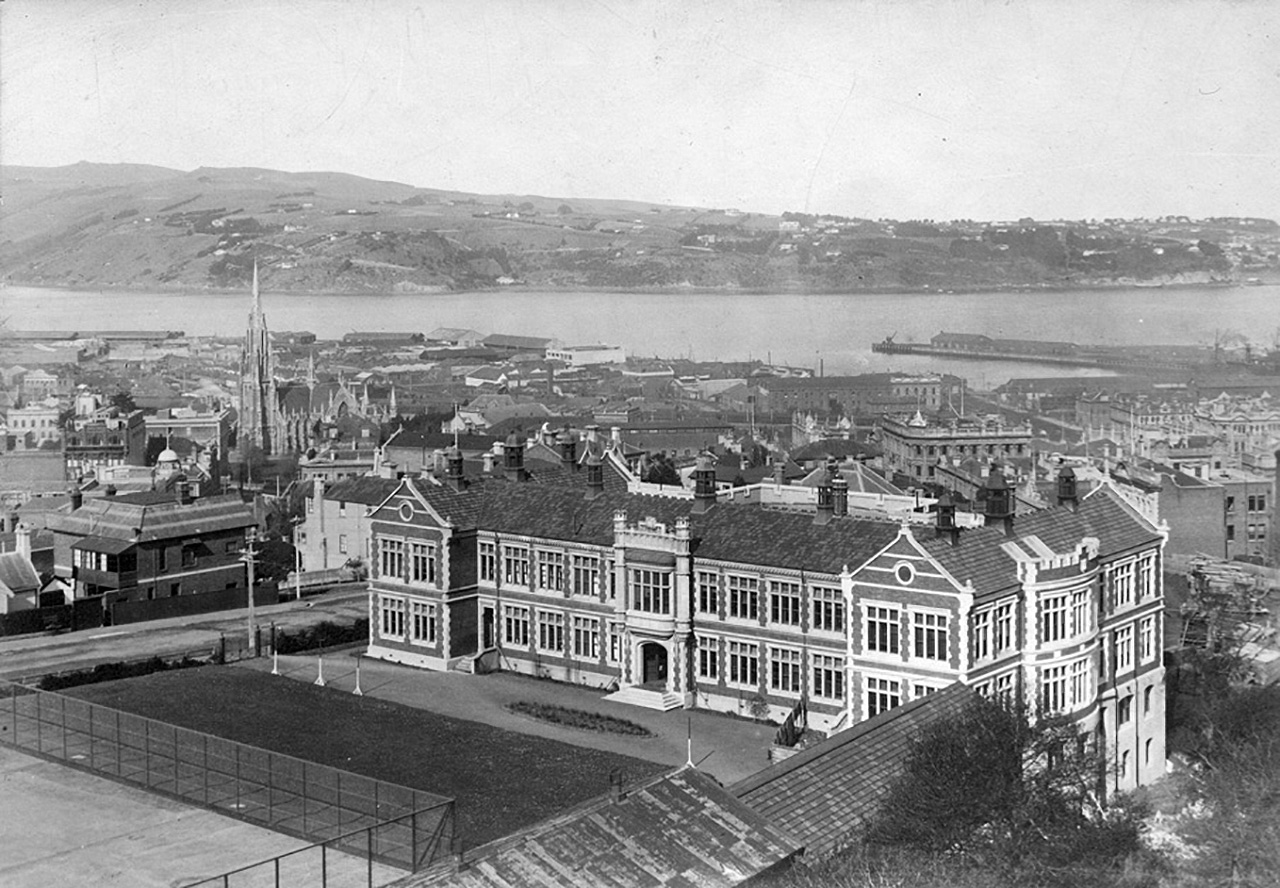
Historical Significance or Value Otago Girls' High School was the first girls secondary school in New Zealand, and it is believed to be the first in the southern hemisphere. Established with the assistance of the Presbyterian Synod, it was opened on 16 February 1871. The girls were originally housed in the south wing of the original Boys' High School in Tennyson Street until, in 1885, the boys moved into their new building designed by R A Lawson and situated in Arthur Street. In 1910 the girls moved into the present building of the Otago Girls' High School main block situated in Tennyson Street. From the outset the school sought to establish high standards for New Zealand women based on the principles of Christian temperance, equality and academic endeavour. As part of these standards, domestic science was encouraged by the school authorities and was eventually introduced as an optional course at the turn of the century. Outdoor recreation areas, however, were not seen as necessary for girls in 1910 and were not provided. Among those who received their education at Otago Girls' High School are Margaret Cruickshank, New Zealand's first practising woman doctor, and Ethel Benjamin, New Zealand's first woman barrister. Since the 1910 building was constructed, other more modern buildings have been added to the school complex although these in no way impinge upon or affect the appearance of the historic main building which embodies a rich heritage of women's achievements in New Zealand.
Physical Significance
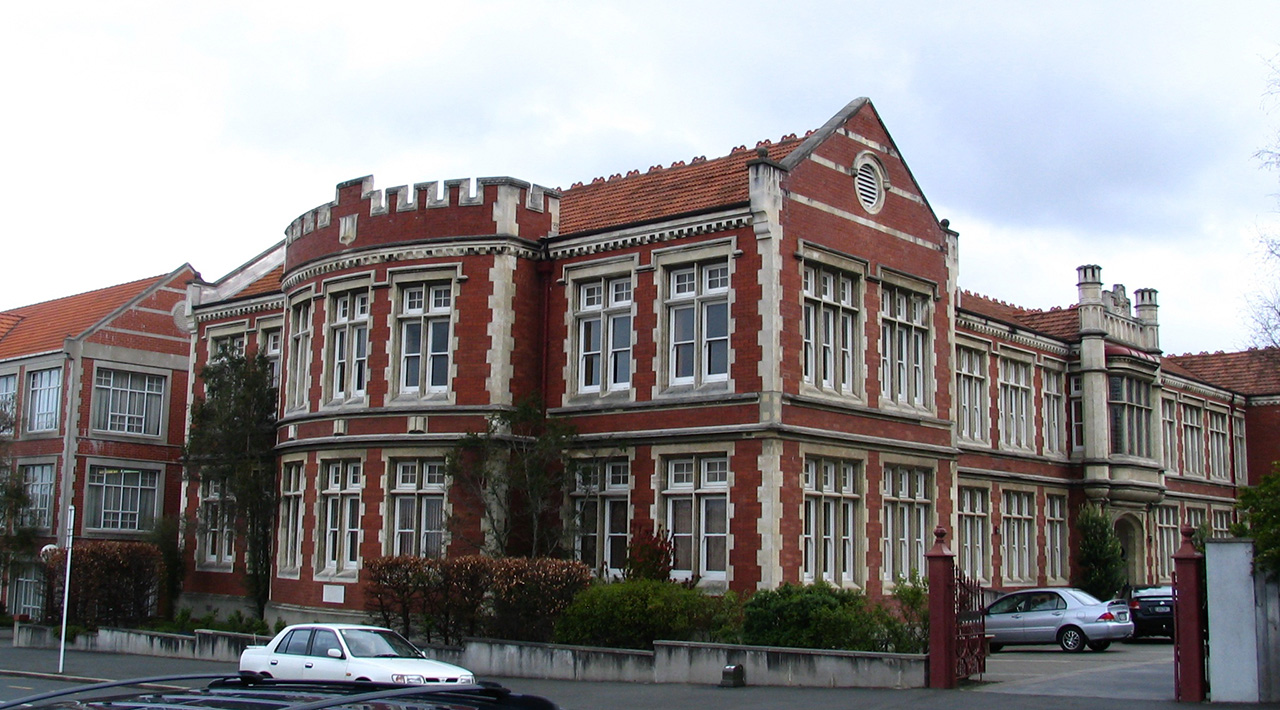
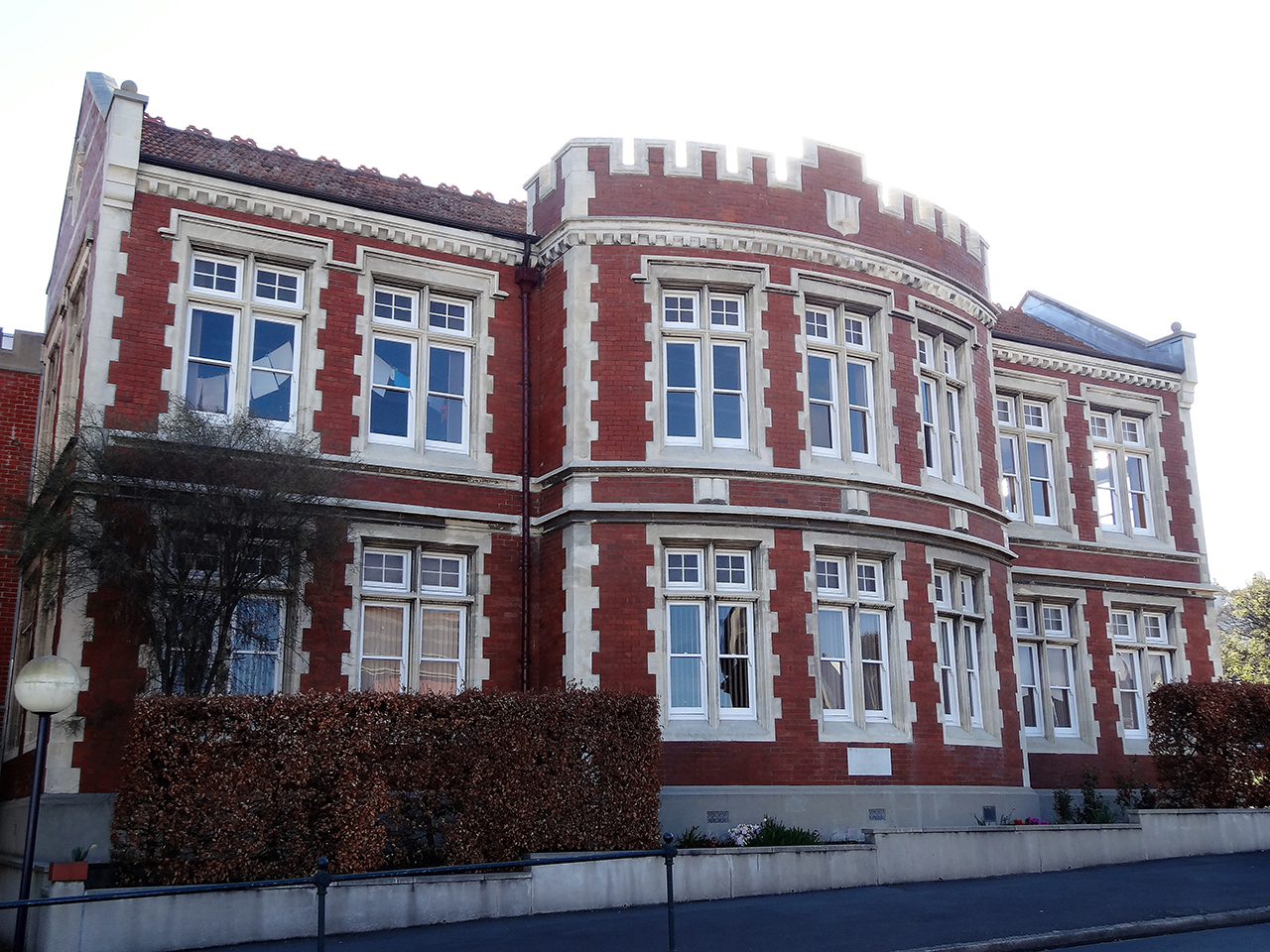
ARCHITECTURAL SIGNIFCANCE The old main block buildings have significant architectural merit in their own right as examples of Edward Anscombe's early work. Anscombe, who is perhaps better known for his later work in the Art Deco style, showed in the Otago Girls' High School building a sensitive handling of the Gothic collegiate architecture theme. This is evident in the balanced façade, with twin matching gable ends and central Tudor period tower, and in the rich but tasteful interior decoration. In this sense the building looks forward to the simpler, more rationalised style of Gothic architecture which evolved in the 1920s, but at the same time incorporates the highly decorative tradition of the preceding Edwardian era. TOWNSCAPE/LANDMARK SIGNIFICANCE The old main block building has considerable streetscape appeal when approached from View Street. From this angle one sees an impressive two storied bay windowed projection topped with battlements. This view extends around to the right to the imposing main entrance which faces two other notable buildings classified by the Trust, the Dominican Priory and St Joseph's Cathedral opposite. The building therefore forms part of an historic precinct and also crowns the top of the inner-city's steepest street, which is View Street.
Why is this place significant?
Historic Significance
Historical Significance or Value Otago Girls' High School was the first girls secondary school in New Zealand, and it is believed to be the first in the southern hemisphere. Established with the assistance of the Presbyterian Synod, it was opened on 16 February 1871. The girls were originally housed in the south wing of the original Boys' High School in Tennyson Street until, in 1885, the boys moved into their new building designed by R A Lawson and situated in Arthur Street. In 1910 the girls moved into the present building of the Otago Girls' High School main block situated in Tennyson Street. From the outset the school sought to establish high standards for New Zealand women based on the principles of Christian temperance, equality and academic endeavour. As part of these standards, domestic science was encouraged by the school authorities and was eventually introduced as an optional course at the turn of the century. Outdoor recreation areas, however, were not seen as necessary for girls in 1910 and were not provided. Among those who received their education at Otago Girls' High School are Margaret Cruickshank, New Zealand's first practising woman doctor, and Ethel Benjamin, New Zealand's first woman barrister. Since the 1910 building was constructed, other more modern buildings have been added to the school complex although these in no way impinge upon or affect the appearance of the historic main building which embodies a rich heritage of women's achievements in New Zealand.
Physical Significance
ARCHITECTURAL SIGNIFCANCE The old main block buildings have significant architectural merit in their own right as examples of Edward Anscombe's early work. Anscombe, who is perhaps better known for his later work in the Art Deco style, showed in the Otago Girls' High School building a sensitive handling of the Gothic collegiate architecture theme. This is evident in the balanced façade, with twin matching gable ends and central Tudor period tower, and in the rich but tasteful interior decoration. In this sense the building looks forward to the simpler, more rationalised style of Gothic architecture which evolved in the 1920s, but at the same time incorporates the highly decorative tradition of the preceding Edwardian era. TOWNSCAPE/LANDMARK SIGNIFICANCE The old main block building has considerable streetscape appeal when approached from View Street. From this angle one sees an impressive two storied bay windowed projection topped with battlements. This view extends around to the right to the imposing main entrance which faces two other notable buildings classified by the Trust, the Dominican Priory and St Joseph's Cathedral opposite. The building therefore forms part of an historic precinct and also crowns the top of the inner-city's steepest street, which is View Street.
Construction Professional
Name
Anscombe, Edmund
Type
Architect
Biography
Anscombe (1874-1948) was born in Sussex and came to New Zealand as a child. He began work as a builder's apprentice in Dunedin and in 1901 went to America to study architecture. He returned to Dunedin in 1907 and designed the School of Mines building for the University of Otago. The success of this design gained him the position of architect to the University. Five of the main University buildings were designed by Anscombe, as well as Otago Girls' High School and several of Dunedin's finest commercial buildings including the Lindo Ferguson Building (1927) and the Haynes building. Anscombe moved to Wellington about 1928 and was known for his work as the designer of the Centennial Exhibition (1939-1940). Anscombe had travelled extensively and had visited major exhibitions in Australia, Germany and America. The practice of Edmund Anscombe and Associates, Architects, had offices in the Dunedin, Wellington and Hawkes Bay districts, and Anscombe's buildings include the Vocational Centre for Disabled Servicemen, Wellington (1943), Sargent Art Gallery, Wanganui, and several blocks of flats including Anscombe Flats, 212 Oriental Parade (1937) and Franconia, 136 The Terrace (1938), both in Wellington. As well as being interested in the housing problem, Anscombe held strong views concerning the industrial advancement of New Zealand. (See also http://www.dnzb.govt.nz/dnzb/ )
Construction Details
Start Year
1910
Type
Original Construction
Description
Central Classrooms and East Wing
Start Year
1913
Type
Addition
Description
Assembly Hall
Start Year
1921
Type
Addition
Description
West Wing, including basement and sub-basement
Start Year
1970
Type
Modification
Description
Assembly Hall extension, in association with building strengthening.
Construction Materials
Foundations are of unreinforced concrete. Exterior walls are of brick cavity construction with internal walls and solid brick construction. All floors are of timber with the ground floor supported on concrete piles. The pitched roof is of Marseilles clay tiles supported on timber trusses. The roof over the auditorium is flat and supported by roof joists notched on to steel beams. Gable ends are of solid brickwork capped with Oamaru stone capping stones. Parapets are of similar construction. Walls and ceilings are plastered except for the walls in the corridors and stair wells of the two main floors.
Notable Features
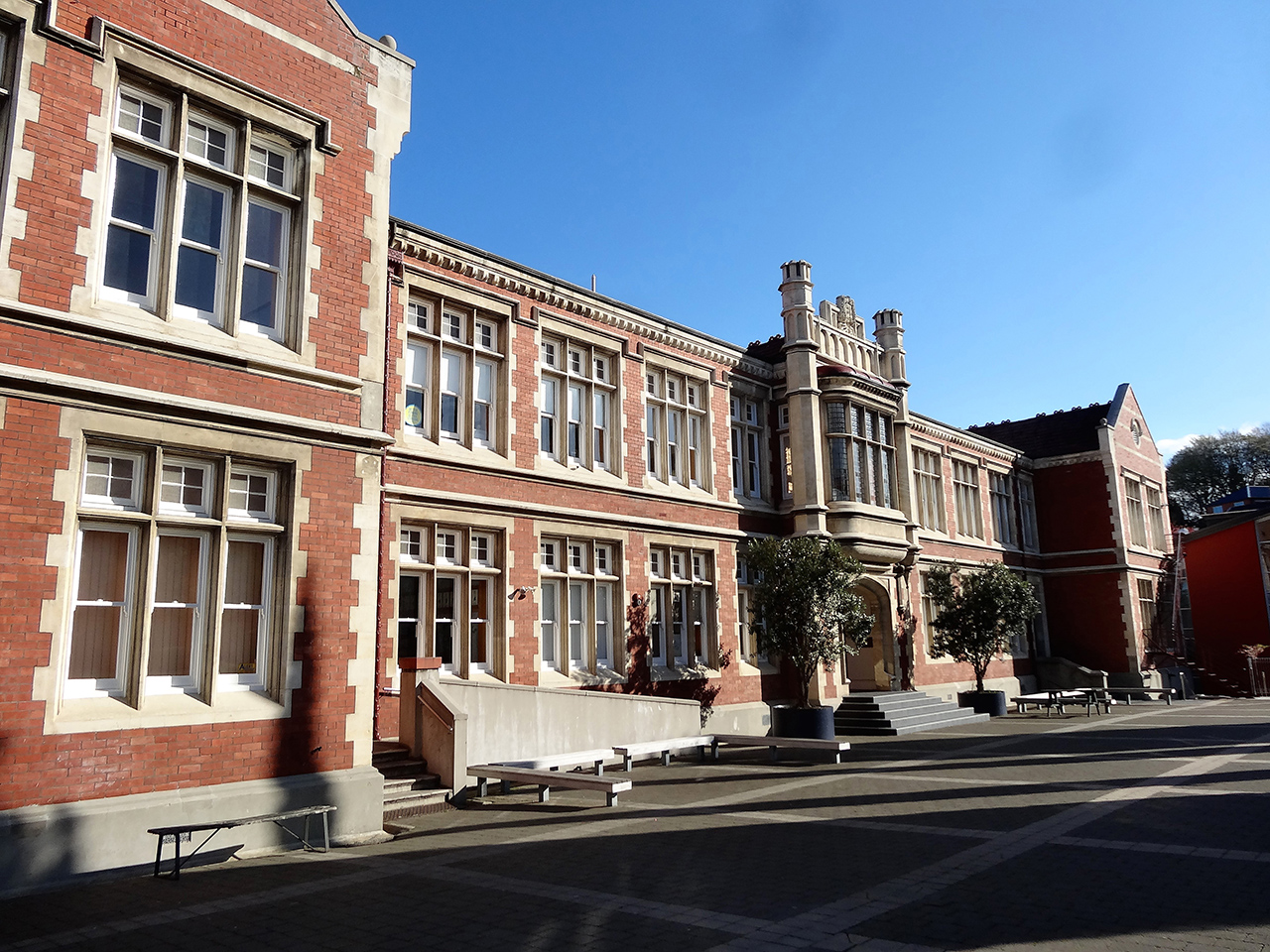
The front façade of the main building is dominated by a central architectural feature over the main entrance doorway. It consists of a projecting bay window and a pair of heavy stone minarets topped with battlements in the style of the collegiate architecture of the Tudor period. The whole is supported on the heavy abutments of the entrance archway.
Construction Professional
Name
Anscombe, Edmund
Type
Architect
Biography
Anscombe (1874-1948) was born in Sussex and came to New Zealand as a child. He began work as a builder's apprentice in Dunedin and in 1901 went to America to study architecture. He returned to Dunedin in 1907 and designed the School of Mines building for the University of Otago. The success of this design gained him the position of architect to the University. Five of the main University buildings were designed by Anscombe, as well as Otago Girls' High School and several of Dunedin's finest commercial buildings including the Lindo Ferguson Building (1927) and the Haynes building. Anscombe moved to Wellington about 1928 and was known for his work as the designer of the Centennial Exhibition (1939-1940). Anscombe had travelled extensively and had visited major exhibitions in Australia, Germany and America. The practice of Edmund Anscombe and Associates, Architects, had offices in the Dunedin, Wellington and Hawkes Bay districts, and Anscombe's buildings include the Vocational Centre for Disabled Servicemen, Wellington (1943), Sargent Art Gallery, Wanganui, and several blocks of flats including Anscombe Flats, 212 Oriental Parade (1937) and Franconia, 136 The Terrace (1938), both in Wellington. As well as being interested in the housing problem, Anscombe held strong views concerning the industrial advancement of New Zealand. (See also http://www.dnzb.govt.nz/dnzb/ )
Construction Details
Start Year
1910
Type
Original Construction
Description
Central Classrooms and East Wing
Start Year
1913
Type
Addition
Description
Assembly Hall
Start Year
1921
Type
Addition
Description
West Wing, including basement and sub-basement
Start Year
1970
Type
Modification
Description
Assembly Hall extension, in association with building strengthening.
Construction Materials
Foundations are of unreinforced concrete. Exterior walls are of brick cavity construction with internal walls and solid brick construction. All floors are of timber with the ground floor supported on concrete piles. The pitched roof is of Marseilles clay tiles supported on timber trusses. The roof over the auditorium is flat and supported by roof joists notched on to steel beams. Gable ends are of solid brickwork capped with Oamaru stone capping stones. Parapets are of similar construction. Walls and ceilings are plastered except for the walls in the corridors and stair wells of the two main floors.
Notable Features
The front façade of the main building is dominated by a central architectural feature over the main entrance doorway. It consists of a projecting bay window and a pair of heavy stone minarets topped with battlements in the style of the collegiate architecture of the Tudor period. The whole is supported on the heavy abutments of the entrance archway.
ARCHITECTURAL DESCRIPTION (Style) Designed in the Gothic Revival tradition of collegiate architecture, Otago Girls' High School displays characteristic Gothic decorative elements in the façade, which is dominated by a central tower consisting of bay windows with window reveals in Oamaru stone, and a pair of stone minarets topped with battlements. Inside, wood panelling consists of richly varnished dados, heavy panelled doors, architraves, reveals and skirtings. This high decorative Edwardian element is also evident in the patterned ceiling and in the elaborate cast iron balustrade on the main stairs. MODIFICATIONS The building, a replacement to an earlier building, was constructed in stages. There have been only minor changes to the original internal subdivision of rooms, but it appears that some of these modifications have resulted in a few features such as doors which are out of character with the original. Elements of the 1970 strengthening scheme have involved conventional pre-stressing techniques using steel ties, straps and struts.
ARCHITECTURAL DESCRIPTION (Style) Designed in the Gothic Revival tradition of collegiate architecture, Otago Girls' High School displays characteristic Gothic decorative elements in the façade, which is dominated by a central tower consisting of bay windows with window reveals in Oamaru stone, and a pair of stone minarets topped with battlements. Inside, wood panelling consists of richly varnished dados, heavy panelled doors, architraves, reveals and skirtings. This high decorative Edwardian element is also evident in the patterned ceiling and in the elaborate cast iron balustrade on the main stairs. MODIFICATIONS The building, a replacement to an earlier building, was constructed in stages. There have been only minor changes to the original internal subdivision of rooms, but it appears that some of these modifications have resulted in a few features such as doors which are out of character with the original. Elements of the 1970 strengthening scheme have involved conventional pre-stressing techniques using steel ties, straps and struts.
Historical and Associated Iwi / Hapū / Whānau
Information Sources
Gardyne, 1981
Gardyne, Stuart, ‘The Transition in Architectural Style from Beaux-Arts to Bauhaus, Wellington between the Wars, 1918-1939’, Research reports, Architecture, B.Arch., Victoria University of Wellington, 1981
Griffiths, 1983
Otago Boys' High and its Historic Neighbourhood. Otago Heritage books, 1983.
New Zealand Historic Places Trust (NZHPT)
New Zealand Historic Places Trust
Olssen, 1984
Erik Olssen, A History of Otago, John McIndoe, Dunedin, 1984
Otago Daily Times
Otago Daily Times, 1 Jun 1915, p.10.
Robinson, 1986
Otago Girls' High School Main Block. Structural Report Prepared for the New Zealand Historic Places Trust. February 1986. Hadley and Robinson Ltd, Consulting Civil and Structural Engineers.
Porter, 1983
Frances Porter (ed), Historic Buildings of Dunedin, South Island, Methuen, Auckland, 1983.
Other Information
This historic place was registered under the Historic Places Act 1980. The following text is complied from the original classification report considered by the NZHPT Board at the time of registration. Please note that entry on the New Zealand Heritage List/Rarangi Korero identifies only the heritage values of the property concerned, and should not be construed as advice on the state of the property, or as a comment of its soundness or safety, including in regard to earthquake risk, safety in the event of fire, or insanitary conditions.
Historical and Associated Iwi / Hapū / Whānau
Information Sources
Gardyne, 1981
Gardyne, Stuart, ‘The Transition in Architectural Style from Beaux-Arts to Bauhaus, Wellington between the Wars, 1918-1939’, Research reports, Architecture, B.Arch., Victoria University of Wellington, 1981
Griffiths, 1983
Otago Boys' High and its Historic Neighbourhood. Otago Heritage books, 1983.
New Zealand Historic Places Trust (NZHPT)
New Zealand Historic Places Trust
Olssen, 1984
Erik Olssen, A History of Otago, John McIndoe, Dunedin, 1984
Otago Daily Times
Otago Daily Times, 1 Jun 1915, p.10.
Robinson, 1986
Otago Girls' High School Main Block. Structural Report Prepared for the New Zealand Historic Places Trust. February 1986. Hadley and Robinson Ltd, Consulting Civil and Structural Engineers.
Porter, 1983
Frances Porter (ed), Historic Buildings of Dunedin, South Island, Methuen, Auckland, 1983.
Other Information
This historic place was registered under the Historic Places Act 1980. The following text is complied from the original classification report considered by the NZHPT Board at the time of registration. Please note that entry on the New Zealand Heritage List/Rarangi Korero identifies only the heritage values of the property concerned, and should not be construed as advice on the state of the property, or as a comment of its soundness or safety, including in regard to earthquake risk, safety in the event of fire, or insanitary conditions.
Current Usages
Uses: Education
Specific Usage: School
Former Usages
General Usage: Education
Specific Usage: School
Web Links
description:
Current Usages
Uses: Education
Specific Usage: School
Former Usages
General Usage: Education
Specific Usage: School
Web Links
description:
Location
Get the latest heritage news, features and events delivered
straight to your inbox.
