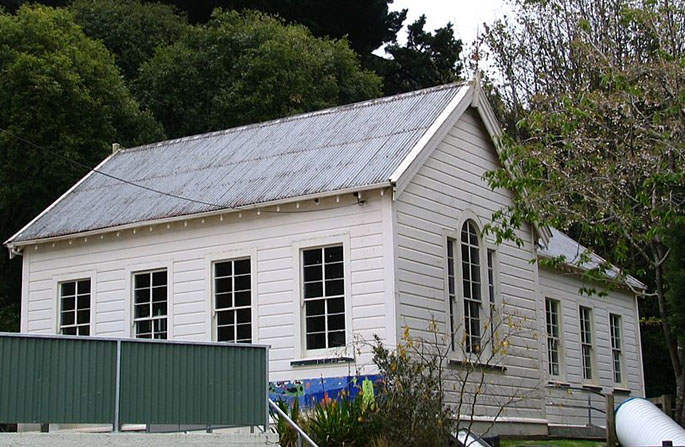
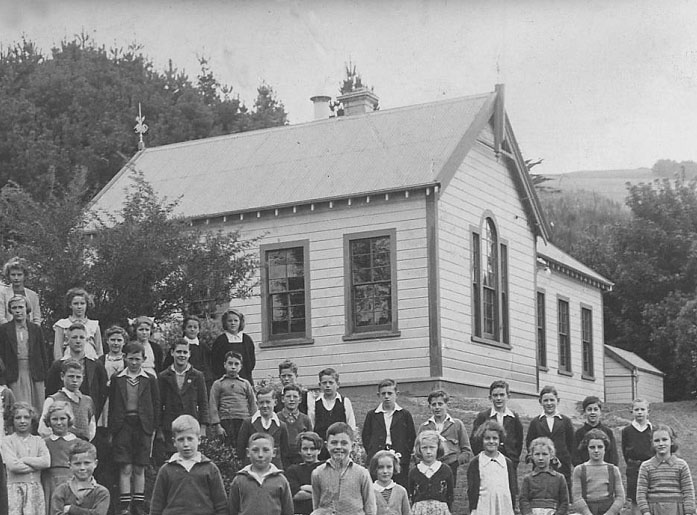
St Leonards School, 29 St Leonards Drive, has been on this site since 1868. The first school building was replaced in 1885 with this two classroom building. Since these early beginnings, the school roll has grown exponentially and prefabricated classrooms now surround the 1885 school. The building escaped demolition in the 1970s due to the stalwart efforts of the school community. It has been used as a play centre, library and now is a resource room. Over 128 years later the 1885 school building remains standing as a testament to the enduring commitment of St Leonards School and community.
Upper Harbour School was established in 1868 by the Otago Provincial Government and subsidised by the local community. The one classroom school was built by John Drake at a cost of £175. In 1869 the community was still collecting money to pay off the debt. By 1874 the roll stood at 25 children and a two-roomed teacher’s residence was added to the rear. In 1877 the name was changed to St Leonards School. Although sanitary conditions were very poor, and the school was closed for several weeks because of an outbreak of scarletina, a toilet block proposed in 1877 was not built. In May 1878 an application was made to the Otago Education Board (OEB) that notice be taken of ‘the very miserable quarters of the school masters and likewise of the school’. Some seven years later in 1882, improvements were made to the master’s residence, shrubs and trees were planted, a fence and picket gate were erected and, finally, a school toilet was erected behind the school.
With an increasing roll the school community desired a new building. Their application to the OEB was declined in 25 August 1883. The campaign continued, however, and in April 1885, the OEB Finance Committee recommended that a building of two classrooms be erected at St Leonards. In May the Board also approved the purchase of part section 51 as an extension to the school site. The new T-shaped school was built on this land. In October 1885 the new school building, with two classrooms, was completed. With a second classroom came a second teacher; their first school mistress, Miss Nimmo. In December that year the OEB agreed to give the old school building to the school committee ‘on condition that the proceeds be devoted to improving the school grounds’. It is unclear what happened to the original school. For a time it was used as a play shed and drill shed on wet days. It was still on site in 1889. Newer school buildings were later placed on its site.
In 1886 the remaining parts of section 51 as well as sections 51A and 52 were purchased as an extension to the school. The pupils now had a large play area. The roll continued to grow and by May 1901 it stood at 70.
In 1911-1912 the school gained a Coronation Hall. The Government was offering £250 for coronation halls if local communities raised the remaining £250. The West Harbour Council exchanged plat of land with the Otago Education Board so that the Hall was built on school grounds. The school was allowed to use the hall free of charge. The hall was built and designed by Mr Shaw Crosland of St Leonard and opened in February 1912. Today, it is still used for school assemblies and events.
The twentieth century saw little change to the 1885 school building. Electric light was introduced in the winter of 1916. A toilet block was added at the rear of the building. Open fireplaces were replaced by pot belly stoves. The split level floors were levelled. In the 1930s, in an attempt to brighten the classrooms, the pupils painted their desks in various colours. After World War Two new houses were built in and around the St Leonards-Burkes area. As the roll increased a pre-fabricated classroom was added. In 1959 two additional classrooms with staff room and toilets were added. Water was piped to the school from the reservoir and septic tanks were installed which ‘vastly improved’ drinking and toilet facilities. A tennis court shelter shed and a ‘putting course’ were also added. In the 1970s the school and local community object to an Education Department decision to demolish the 1885 building rather than maintain it. The Department agreed not to demolish the building and the School Committee took responsibility for its upkeep.
By 1992 the 1885 school building was serving a dual purpose. One classroom was employed as the school library. The other classroom had become the St Leonards Playcentre. Voluntary labour maintained the building and in the early 1990s the Playcentre upgraded their half. In 1992/1993 the School Board of Trustees sought funding to replacing rotten weatherboards and repaint their half, which was being used as library.
Upper Harbour School was established in 1868 by the Otago Provincial Government and subsidised by the local community. The one classroom school was built by John Drake at a cost of £175. In 1869 the community was still collecting money to pay off the debt. By 1874 the roll stood at 25 children and a two-roomed teacher’s residence was added to the rear. In 1877 the name was changed to St Leonards School. Although sanitary conditions were very poor, and the school was closed for several weeks because of an outbreak of scarletina, a toilet block proposed in 1877 was not built. In May 1878 an application was made to the Otago Education Board (OEB) that notice be taken of ‘the very miserable quarters of the school masters and likewise of the school’. Some seven years later in 1882, improvements were made to the master’s residence, shrubs and trees were planted, a fence and picket gate were erected and, finally, a school toilet was erected behind the school.
With an increasing roll the school community desired a new building. Their application to the OEB was declined in 25 August 1883. The campaign continued, however, and in April 1885, the OEB Finance Committee recommended that a building of two classrooms be erected at St Leonards. In May the Board also approved the purchase of part section 51 as an extension to the school site. The new T-shaped school was built on this land. In October 1885 the new school building, with two classrooms, was completed. With a second classroom came a second teacher; their first school mistress, Miss Nimmo. In December that year the OEB agreed to give the old school building to the school committee ‘on condition that the proceeds be devoted to improving the school grounds’. It is unclear what happened to the original school. For a time it was used as a play shed and drill shed on wet days. It was still on site in 1889. Newer school buildings were later placed on its site.
In 1886 the remaining parts of section 51 as well as sections 51A and 52 were purchased as an extension to the school. The pupils now had a large play area. The roll continued to grow and by May 1901 it stood at 70.
In 1911-1912 the school gained a Coronation Hall. The Government was offering £250 for coronation halls if local communities raised the remaining £250. The West Harbour Council exchanged plat of land with the Otago Education Board so that the Hall was built on school grounds. The school was allowed to use the hall free of charge. The hall was built and designed by Mr Shaw Crosland of St Leonard and opened in February 1912. Today, it is still used for school assemblies and events.
The twentieth century saw little change to the 1885 school building. Electric light was introduced in the winter of 1916. A toilet block was added at the rear of the building. Open fireplaces were replaced by pot belly stoves. The split level floors were levelled. In the 1930s, in an attempt to brighten the classrooms, the pupils painted their desks in various colours. After World War Two new houses were built in and around the St Leonards-Burkes area. As the roll increased a pre-fabricated classroom was added. In 1959 two additional classrooms with staff room and toilets were added. Water was piped to the school from the reservoir and septic tanks were installed which ‘vastly improved’ drinking and toilet facilities. A tennis court shelter shed and a ‘putting course’ were also added. In the 1970s the school and local community object to an Education Department decision to demolish the 1885 building rather than maintain it. The Department agreed not to demolish the building and the School Committee took responsibility for its upkeep.
By 1992 the 1885 school building was serving a dual purpose. One classroom was employed as the school library. The other classroom had become the St Leonards Playcentre. Voluntary labour maintained the building and in the early 1990s the Playcentre upgraded their half. In 1992/1993 the School Board of Trustees sought funding to replacing rotten weatherboards and repaint their half, which was being used as library.