Quick links


Quick links
Quick links
Quick links
Quick links
Quick links
Lawrence Presbyterian Church (Former)
7 Colonsay Street, LAWRENCE
Private
Historic Place Category 2
List No. 2243
Quick links:
List GalleryLocationDetails
7 Colonsay Street, LAWRENCE
Private
Historic Place Category 2
List No. 2243
List Entry Information
Status
Listed
List Entry Status
Historic Place Category 2
Access
Private/No Public Access
List Number
2243
Date Entered
2nd April 2004
Date of Effect
2nd April 2004
City/District Council
Clutha District
Region
Otago Region
Extent of List Entry
Registration includes the building and land on RT OT222/95
Legal description
Secs 7-8 Pt Sec 6 Blk II Town of Lawrence (RT OT222/95)
Status
Listed
List Entry Status
Historic Place Category 2
Access
Private/No Public Access
List Number
2243
Date Entered
2nd April 2004
Date of Effect
2nd April 2004
City/District Council
Clutha District
Region
Otago Region
Extent of List Entry
Registration includes the building and land on RT OT222/95
Legal description
Secs 7-8 Pt Sec 6 Blk II Town of Lawrence (RT OT222/95)
Why is this place significant?
Cultural Significance
Spiritually it remained the focus for the Presbyterian congregation in Lawrence for over 100 years, as an important site for the worship of that congregation.
Historic Significance
Historical Significance or Value It is historically important representing the role of the Presbyterian Church in the goldfields era, as well as the contribution of that Church to the history and development of the Lawrence community.
Physical Significance
The Lawrence Presbyterian Church has architectural significance, both as a Lawson Church, representing his work in the provincial areas in Otago as well as recognising its architectural contribution to the townscape of Lawrence - particularly its proximity to the former Post Office (Lawson 1866), and the Wardens Court (David Ross, 1875).
Why is this place Category 1 / Category 2?
Detail Of Assessed Criteria
The Lawrence Presbyterian Church reflects the importance of the Presbyterian Church particularly in the history of Otago and the important role that it played in the spiritual welfare and support of small communities such as Lawrence. The Church is associated with prominent architect Robert Arthur Lawson, a pre-eminent church architect, who has made a strong contribution to the architecture of Dunedin and wider Otago. The Church's gothic styling is representative of Lawson's churches and is a significant element in his design history which included other Presbyterian churches in the locality including the Tokomairiro Presbyterian Church in nearby Milton (1889) and the East Taieri Presbyterian Church (1870). In addition the proximity to Lawson's Warden's Court (1866) later used as the Post Office adds to its significance as a representation of his designs. The Church has a strong association with the Lawrence community, providing a place of worship for 108 years. It also is a significant part of the wider Lawrence historical landscape, forming a significant element in the buildings dating from the early period of Lawrence's development and prosperity associated with the goldrushes.
Why is this place significant?
Cultural Significance
Spiritually it remained the focus for the Presbyterian congregation in Lawrence for over 100 years, as an important site for the worship of that congregation.
Historic Significance
Historical Significance or Value It is historically important representing the role of the Presbyterian Church in the goldfields era, as well as the contribution of that Church to the history and development of the Lawrence community.
Physical Significance
The Lawrence Presbyterian Church has architectural significance, both as a Lawson Church, representing his work in the provincial areas in Otago as well as recognising its architectural contribution to the townscape of Lawrence - particularly its proximity to the former Post Office (Lawson 1866), and the Wardens Court (David Ross, 1875).
Why is this place Category 1 / Category 2?
Detail Of Assessed Criteria
The Lawrence Presbyterian Church reflects the importance of the Presbyterian Church particularly in the history of Otago and the important role that it played in the spiritual welfare and support of small communities such as Lawrence. The Church is associated with prominent architect Robert Arthur Lawson, a pre-eminent church architect, who has made a strong contribution to the architecture of Dunedin and wider Otago. The Church's gothic styling is representative of Lawson's churches and is a significant element in his design history which included other Presbyterian churches in the locality including the Tokomairiro Presbyterian Church in nearby Milton (1889) and the East Taieri Presbyterian Church (1870). In addition the proximity to Lawson's Warden's Court (1866) later used as the Post Office adds to its significance as a representation of his designs. The Church has a strong association with the Lawrence community, providing a place of worship for 108 years. It also is a significant part of the wider Lawrence historical landscape, forming a significant element in the buildings dating from the early period of Lawrence's development and prosperity associated with the goldrushes.
Construction Professional
Name
Lawson, Robert Arthur
Type
Architect
Biography
Born in Scotland, Lawson (1833-1902) began his professional career in Perth. At the age of 25 he moved to Melbourne and was engaged in goldmining and journalism before resuming architectural practice. In 1862 Lawson sailed for Dunedin, where his sketch plans had won the competition for the design of First Church. This was built 1867-73. Lawson went on to become one of the most important architects in New Zealand. First Church is regarded as his masterpiece and one of the finest nineteenth century churches in New Zealand. He was also responsible for the design of the Trinity Church (now Fortune Theatre), Dunedin (1869-70), the East Taieri Presbyterian Church (1870), and Knox Church, Dunedin (1874). He designed Park's School (1864) and the ANZ Bank (originally Union Bank, 1874). In Oamaru he designed the Bank of Otago (later National Bank building, 1870) and the adjoining Bank of New South Wales (now Forrester Gallery, 1881). See also: Ledgerwood, Norman, 2013. 'R.A. Lawson: Victorian Architect of Dunedin'. Historic Cemeteries Conservation NZ.
Construction Details
Start Year
2002
Finish Year
2008
Type
Other
Description
Restoration and conversion to a home.
Start Year
1886
Type
Original Construction
Start Year
1998
Type
Other
Description
Damaged by fire.
Construction Materials
The Church was constructed of locally made red brick on stone foundations. It had contrasting cement horizontal bandings and trim, and a slate roof. It measured 38 ft (11.5m) on the Colonsay Street frontage, and was 64 ft (19.5m) deep. It was 65 ft (19.8m) high to the top of its spire. The interior joinery was of wood, using kauri, as well as red and white pine. There also decorative plasterwork. The Church was built for around £1,200 and seated 300. The interior was remodelled and electric heating installed in the mid 1950s. The exterior was replastered in 1960. For the centennial celebrations of the founding of the Presbyterian Church in Lawrence in 1961 the interior was renovated, with the seating and positioning of communion furniture rearranged. In 1998 the church was severely damaged by fire as a result of an arson attack. The roof, interior, windows and floors were damaged. The building languished for a period, with much local concern expressed about its condition. In 2003 the new owner began to repair and restore the Church, replacing the roof with corrugated iron.
Construction Professional
Name
Lawson, Robert Arthur
Type
Architect
Biography
Born in Scotland, Lawson (1833-1902) began his professional career in Perth. At the age of 25 he moved to Melbourne and was engaged in goldmining and journalism before resuming architectural practice. In 1862 Lawson sailed for Dunedin, where his sketch plans had won the competition for the design of First Church. This was built 1867-73. Lawson went on to become one of the most important architects in New Zealand. First Church is regarded as his masterpiece and one of the finest nineteenth century churches in New Zealand. He was also responsible for the design of the Trinity Church (now Fortune Theatre), Dunedin (1869-70), the East Taieri Presbyterian Church (1870), and Knox Church, Dunedin (1874). He designed Park's School (1864) and the ANZ Bank (originally Union Bank, 1874). In Oamaru he designed the Bank of Otago (later National Bank building, 1870) and the adjoining Bank of New South Wales (now Forrester Gallery, 1881). See also: Ledgerwood, Norman, 2013. 'R.A. Lawson: Victorian Architect of Dunedin'. Historic Cemeteries Conservation NZ.
Construction Details
Start Year
2002
Finish Year
2008
Type
Other
Description
Restoration and conversion to a home.
Start Year
1886
Type
Original Construction
Start Year
1998
Type
Other
Description
Damaged by fire.
Construction Materials
The Church was constructed of locally made red brick on stone foundations. It had contrasting cement horizontal bandings and trim, and a slate roof. It measured 38 ft (11.5m) on the Colonsay Street frontage, and was 64 ft (19.5m) deep. It was 65 ft (19.8m) high to the top of its spire. The interior joinery was of wood, using kauri, as well as red and white pine. There also decorative plasterwork. The Church was built for around £1,200 and seated 300. The interior was remodelled and electric heating installed in the mid 1950s. The exterior was replastered in 1960. For the centennial celebrations of the founding of the Presbyterian Church in Lawrence in 1961 the interior was renovated, with the seating and positioning of communion furniture rearranged. In 1998 the church was severely damaged by fire as a result of an arson attack. The roof, interior, windows and floors were damaged. The building languished for a period, with much local concern expressed about its condition. In 2003 the new owner began to repair and restore the Church, replacing the roof with corrugated iron.
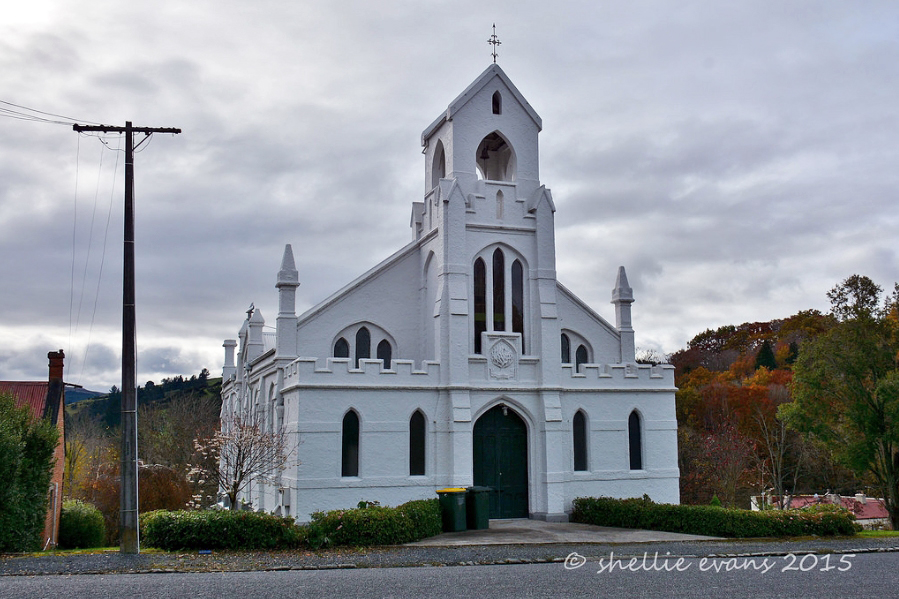
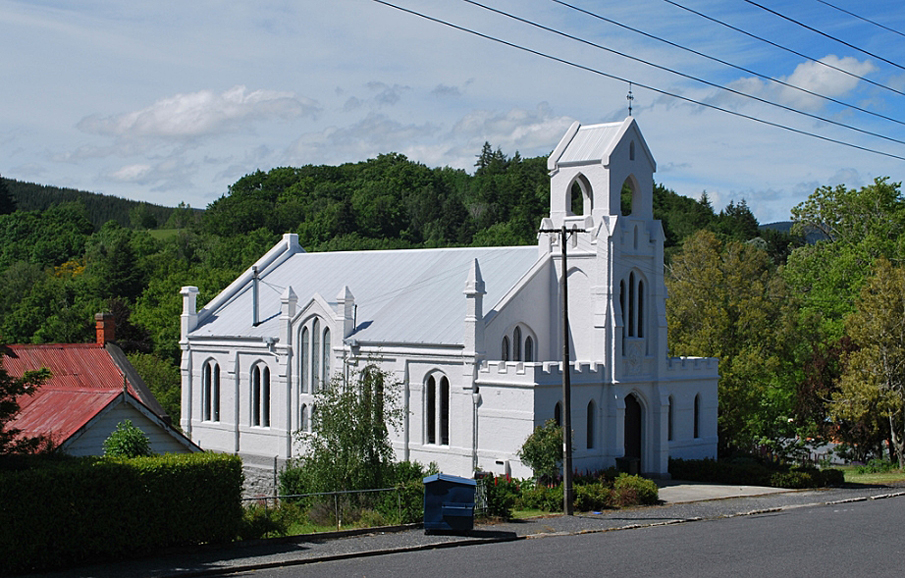
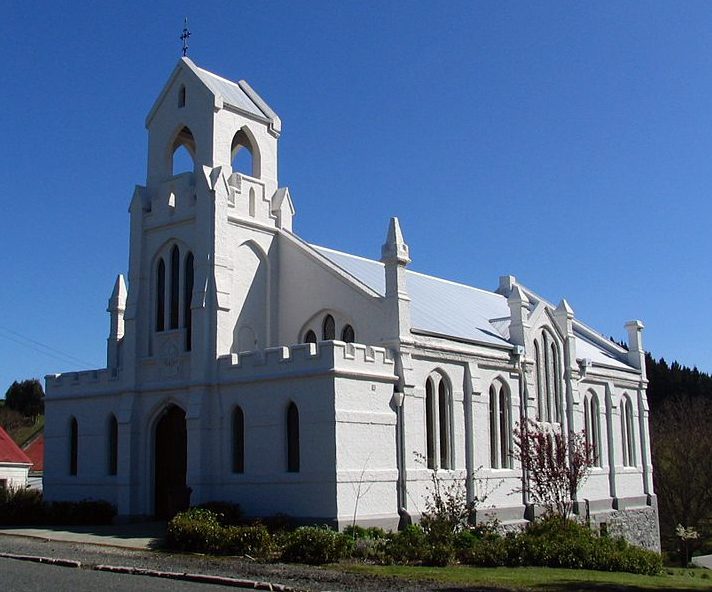
The Church was designed by prominent Dunedin architect Robert A. Lawson. Scottish born Lawson designed and superintended over the construction of over forty churches. He also designed the former Post Office (Lawson, 1866) on the opposite side of Colonsay Street. This church as with other Lawson churches was designed in gothic style on a notional cruciform plan , with a steeple at the southern end facing Colonsay Street. The tower has gothic arches to either side, with battlemented work extending to the end of the gable and terminating in small turrets on each corner. The Church forms an important component in the group of heritage buildings sited on a prominent hillside overlooking the main street of Lawrence. These include the former Post Office (1866), the Warden's Court (David Ross, 1875) and the Lodge St George (Miller, 1878), as well as the nearby government buildings such as the postmaster's house, and the constable's residence.
The Church was designed by prominent Dunedin architect Robert A. Lawson. Scottish born Lawson designed and superintended over the construction of over forty churches. He also designed the former Post Office (Lawson, 1866) on the opposite side of Colonsay Street. This church as with other Lawson churches was designed in gothic style on a notional cruciform plan , with a steeple at the southern end facing Colonsay Street. The tower has gothic arches to either side, with battlemented work extending to the end of the gable and terminating in small turrets on each corner. The Church forms an important component in the group of heritage buildings sited on a prominent hillside overlooking the main street of Lawrence. These include the former Post Office (1866), the Warden's Court (David Ross, 1875) and the Lodge St George (Miller, 1878), as well as the nearby government buildings such as the postmaster's house, and the constable's residence.
Historical and Associated Iwi / Hapū / Whānau
Completion Date
7th September 2004
Report Written By
Heather Bauchop
Information Sources
Barton, n.d.
Henry H Barton, Lawrence Presbyterian Church, including Waitahuna and Beaumont - A History from the date of the first service in Gabriels Gully in 1861, Centennial Souvenir 1861-1948, nd
Cyclopedia of New Zealand, 1905
Cyclopedia Company, Industrial, descriptive, historical, biographical facts, figures, illustrations, Wellington, N.Z, 1897-1908, Vol. 4 Otago and Southland, Cyclopedia Company, Christchurch, 1905
Dictionary of New Zealand Biography
Dictionary of New Zealand Biography
Mayhew, 1949
W.R. Mayhew, Tuapeka: The Land and Its People: A Social History of the Borough of Lawrence and its Surrounding Districts, Otago Centennial Historical Publications, Dunedin, 1949
New Zealand Presbyterian
New Zealand Presbyterian
Other Information
A fully referenced version of this report is available from the NZHPT Otago/Southland Area Office Please note that entry on the New Zealand Heritage List/Rarangi Korero identifies only the heritage values of the property concerned, and should not be construed as advice on the state of the property, or as a comment of its soundness or safety, including in regard to earthquake risk, safety in the event of fire, or insanitary conditions.
Historical and Associated Iwi / Hapū / Whānau
Completion Date
7th September 2004
Report Written By
Heather Bauchop
Information Sources
Barton, n.d.
Henry H Barton, Lawrence Presbyterian Church, including Waitahuna and Beaumont - A History from the date of the first service in Gabriels Gully in 1861, Centennial Souvenir 1861-1948, nd
Cyclopedia of New Zealand, 1905
Cyclopedia Company, Industrial, descriptive, historical, biographical facts, figures, illustrations, Wellington, N.Z, 1897-1908, Vol. 4 Otago and Southland, Cyclopedia Company, Christchurch, 1905
Dictionary of New Zealand Biography
Dictionary of New Zealand Biography
Mayhew, 1949
W.R. Mayhew, Tuapeka: The Land and Its People: A Social History of the Borough of Lawrence and its Surrounding Districts, Otago Centennial Historical Publications, Dunedin, 1949
New Zealand Presbyterian
New Zealand Presbyterian
Other Information
A fully referenced version of this report is available from the NZHPT Otago/Southland Area Office Please note that entry on the New Zealand Heritage List/Rarangi Korero identifies only the heritage values of the property concerned, and should not be construed as advice on the state of the property, or as a comment of its soundness or safety, including in regard to earthquake risk, safety in the event of fire, or insanitary conditions.
Current Usages
Uses: Accommodation
Specific Usage: Boarding/ Guest House
Former Usages
General Usage: Religion
Specific Usage: Church
General Usage: Vacant
Specific Usage: Vacant
Themes
Cultures (other than Maori and Pakeha)
Current Usages
Uses: Accommodation
Specific Usage: Boarding/ Guest House
Former Usages
General Usage: Religion
Specific Usage: Church
General Usage: Vacant
Specific Usage: Vacant
Themes
Cultures (other than Maori and Pakeha)
Location
Get the latest heritage news, features and events delivered
straight to your inbox.
