Maori
Traditionally, the Waitaha people had authority over Murihiku, the southern part of the South Island. Around 1750 the Ngati Mamoe, originally from the North Island’s East Coast, established themselves in Murihiku. They in turn fell under the sway of another tribe from the North Island’s East Coast, Ngai Tahu. Archaeology suggests moa became extinct around 1500. The climate was too cold to grow kumara, so no horticulture was established. Settlement focused on the coast, where ocean fish, seabirds and seals were plentiful. People journeyed inland to harvest eels, forest birds such as weka and kereru, and cabbage trees. They also travelled to sources of highly-valued pounamu in the headwaters of rivers draining into Lakes Wakatipu and Wanaka, While Maori travelled considerable distances seasonally to gather food sources, permanent villages were usually on the coast. Confusion exists over the Maori meaning of ‘Tuapeka’, although one authority says it should be ‘Tuakipeta’ meaning cut down a branch of a tree for firewood.
In 1848 with the arrival of 344 emigrants at Dunedin, the European and Maori population were almost equal. With increasing European settlement, the next few decades saw the loss of major inland mahika kai resources. Inland areas were still visited but the gold rushes in the 1860s lead to closer land settlement by Europeans which often shut out Maori.
Tuapeka, however, saw an increase in Maori population when gold was discovered at Gabriel’s Gully in May 1861. Traditionally, Maori placed no importance on gold but had long been aware of the yellow metal in Central Otago rivers. There are examples of exchanges with Europeans in 1849 and 1851 where they speak of the gold. When Maori realised the worth Europeans placed on the metal, a number of Maori joined the rush.
There are no recorded Maori archaeological sites on the land on which St Patrick’s Church is built.
Lawrence
Lawrence was one of the most important towns in Otago. The discovery of gold at Gabriel's Gully by Gabriel Read in May 1861 led to the Otago gold rush. While gold had been found in the province before, this rush was beyond expectation, with the population of the gold field rising from almost nothing to around 11,500 within a year, twice that of Dunedin at the time. Gabriel’s Gully was the first site of Lawrence; albeit a canvas township.
The gully quickly became dotted with tents and workings, stores and government ‘buildings’. This site, however, was also gold rich (and is now buried beneath thousands of tonnes of rubble from subsequent mining operations.) Gradually, the commercial and administrative services for the Tuapeka fields were concentrated on non-auriferous ground three kilometres away at the entrance of the Gully. The new town, promised by Superintendent J.L.C. Richardson, was surveyed in 1862 by Robert Grigor and named Tuapeka. Town sections were auctioned on 5 November 1862. By 1864 most people had shifted from the canvas town across the stream to Lawrence, where there was already several business including hotels, ironmongers, drapers, a bank, bookmaker, storekeeper, newsagent, and watchmaker. The town became a municipality in 1866 and was renamed Lawrence in honour of Sir Henry Lawrence, defender of Lucknow during the Indian mutiny in 1857. The development of large scale sluicing in the 1870s, however, caused flooding on the flat, forcing government buildings, churches and schools on to the hill on to Colonsay Street. Peel Street became the business street.
Irish Immigrants
The discovery of gold at Gabriel’s Gully saw miners flood into the area. By December 1861, some 14,000 people were on the Tuapeka goldfield; by February 1864 the population was around 24,000. Around a third of these miners were English, some were European, others were of Chinese origin, and a significant proportion of Irish also made their way to the goldfields.
The character of Irish immigration into Otago in the 1860s had remained largely unchartered. Yet analysis of a random sample from passenger lists show 17.7% were Irish. Of those, 90% were male, 83% were aged between 25 and 39, and only 17.9% were married. As the gold rush peak waned, many wives and families immigrated to join their menfolk. New Zealand’s Irish came mainly through Victoria, Australia, as a number of Irish had taken the opportunity of the assisted migration scheme to Australia. Many moved south across the Tasman as news of the gold rush spread. Significant to the Presbyterian-founded Otago Province, was that two thirds of these Irish were Roman Catholic.
The Catholic Church
Otago was established in 1848 as a Presbyterian settlement. The discovery of gold, however, saw miners of all nationalities and creeds flood in, among their number Irish Catholics.
Perceiving the spiritual need, Father Delphin Moreau (1813-1883) began visiting the miners, from Dunedin, in the first weeks of the gold rush. Moreau, born in the South of France, arrived in New Zealand in 1843. For 18 years he worked with the Catholic mission to North Island Maori. The discovery of gold saw his mission diverted.
Cobb & Co’s first coach to the diggings was not until 11 October 1861 so Moreau’s first visits to Tuapeka were on foot. At first travelling to Lawrence once a month to hold Mass, by 1862 he was travelling every alternate Sunday and services were being held in a calico tent in Gabriel’s Gully. Even during winter he was seen walking from claim to claim over the snow carrying a long stick with which to test the ground. The gold rush led to such a population increase that Moreau was formally appointed to the South Island and his duties extended over the whole of Otago.
Moreau saw the need for land to house a church and school and set about raising awareness. In October 1863 a section on the corner of Colonsay and Lancaster Streets was donated by John Donovan, a prominent local businessman. The land was vested in the hands of trustees John Donovan, Bryan Sweeney and Father Joseph Eccuyer, who in 1864 had become the first priest resident permanently in Lawrence.
A corrugated iron church was erected on the site. In November 1864 Bishop Viard blessed the church named St Gabriel’s; the first Catholic church in Otago. The nave of the present church now stands on this site.
The influx of Catholic miners and an increasingly settled population in Otago prompted the formation of a Catholic Diocese of Dunedin in 1869. It was not until January 1871, however, that Bishop Patrick Moran arrived to take charge of the new Diocese. The first parish he established was Tuapeka. Bishop Moran travelled often to Lawrence as it contained the largest community of Irish in the new Diocese.
On 30 May 1871 Moran appointed Father William Larkin as Parish priest to Tuapeka. Larking brought vitality to the Parish. As the Tuapeka Times remarked he ‘possesses in a marked degree the ‘organising talent’, if we may so term it, and in fertility of resource it would be difficult to find his equal’. His impetus saw a large wooden Gothic church-school opened on 17 March 1872, across the road from the now superseded St Gabriel’s. In 1875 St Patrick’s was the biggest Catholic school in the Diocese with 140 pupils, compared with 113 in Dunedin and 85 in Invercargill.
Fr Larkin was succeeded by Fr Crowley in 1875. Resident until 1880, Crowley was succeeded by Fr Patrick O’Leary in 1882. O'Leary was a staunch Irishman, fervently nationalist in politics, and an expert in Irish history and language. His leadership helped shape Lawrence's Irish and Catholic community, which he served until his death in 1916. It was during his tenure that calls intensified for a separate Catholic Church, distinct from the combined St Patrick’s Church and School. The existing building was large and commodious but it was essentially a school rather than a church.
Bishop Moran had established a building fund for a new church in 1880, by selling a Diocese-owned farmlet. As the 1880s drew to a close, major fundraising was taking place for a new church. One bazaar, for example, raised over £250. The community proved supportive and half the amount was raised before construction even began.
The Architect
The noted architect, Francis Petre, was selected to draw a design for the church. Petre was born at Petone in 1847, into one of England’s oldest and most influential Catholic families. This religious faith was to play an important role in Petre’s career. Educated in England, he worked for architects and engineers. This experience afforded a thorough understanding of the latest engineering techniques including the use of concrete. In 1872 Petre returned to New Zealand to work as an engineer for a contracting company, building railway lines. By 1875 he was based in Dunedin, and had returned to architecture. His career went from strength to strength; the first New Zealand-born architect to rise to national importance. Pioneering the use of concrete in New Zealand architecture, he employed this material more extensively and more imaginatively than any of his contemporaries.
It was Gothic Revival architecture, however, which was his first enthusiasm. One of New Zealand’s most able practitioners in the style, he praised it for ‘the great richness and delicacy of detail, and the closer application of geometrical rules to architecture….’ This ‘delicacy of detail’ is the common denominator in his buildings. It was said that his drawings of stones, window traceries, arches and ornamentation were so precise that stonemasons could execute his intentions from one single drawing.
His passion for sculpture also showed itself in his best work, which had a strong sculptural quality. Despite Petre’s emphasis on detailed, sculptural Gothic Revival architecture, he also believed that an architectural style should be ‘treated liberally’. His designs, therefore, remained individual creations, lighter and more delicate than many who designed in the Gothic style. It has been said that ‘he can now be seen as one of our great creative artists: the man, perhaps shy and modest, but the architect, one of daring and intelligence’.
Petre’s other strong passion, Roman Catholicism, equally directed his career. As a Catholic, he was often the architect of choice for Catholic dioceses. He designed St Joseph’s Cathedral and the Dominican Convent in Dunedin, Sacred Heart Basilica in Wellington (NZHPT Category I, Record no. 214) and, perhaps his most imposing design, the Cathedral of the Blessed Sacrament in Christchurch (NZHPT Category I, Record no. 47). His expertise was not only sought out for imposing cathedrals, but also for smaller local churches.
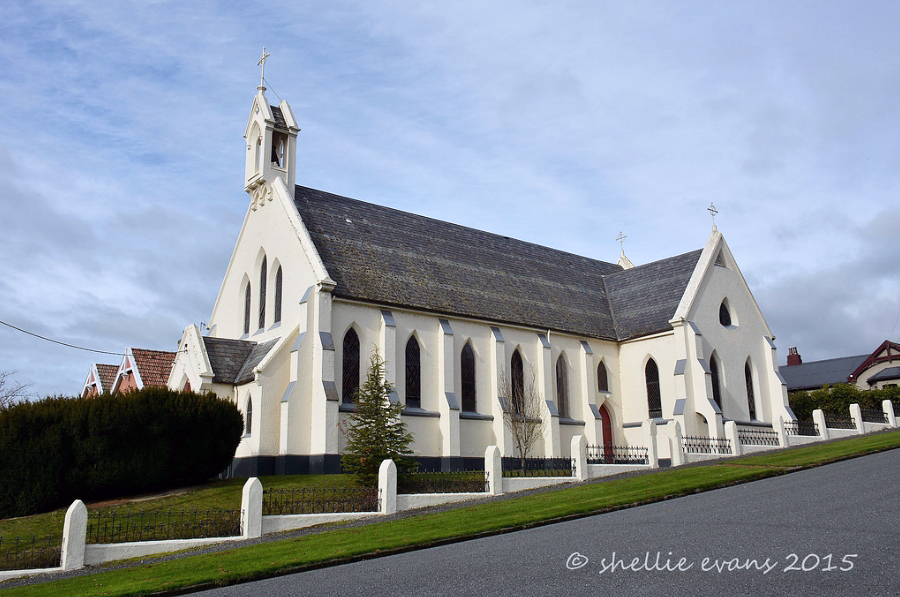
In March 1891 The New Zealand Tablet reported that Petre’s design indicated the new Church would be ‘a fine, roomy building possessed of architectural beauty, and fit for the ceremonies of religion’. The periodical also approved of the site which was central and elevated at the intersection of Colonsay and Lancaster Streets, conspicuously situated beside fine government buildings and above the main street.
St Patrick’s Catholic Church
On 21 November 1890, Petre called for tenders for the erection of a brick church at Lawrence. Specifications were available at the office of the County Clerk, Lawrence, or the office of Petre. On 7 December 1890 the successful tenderer was announced as Mr Daniel W. Woods of Dunedin, with the price of £3000. Woods was the brother of John Woods of Lawrence, who composed the melody for the national anthem God Defend New Zealand.
On 17 March 1891, St Patrick’s Day, the foundation stone was laid by Bishop Moran, even though the walls were almost at their full height. A special train to Lawrence was laid on for the occasion. Numerous Dunedin visitors arrived, including the altar boy choir of St Joseph’s Cathedral. After the conclusion of the Mass, a procession was formed and proceeded up the hill. The Tablet described the scene: ‘A gay line of bunting hung across the road, and conspicuous on the newly-erected walls was a green flag with a harp, a round tower, a Celtic cross, and, most appropriate to the day, a sprig of shamrock.’
On 6 January 1892, Bishop Moran officially opened the completed Church. Every seat in the Church was filled, and a large crowd filled the main entrance and any other vacant spaces. The ceremony was described as ‘picturesque and imposing’. An offering towards costs was also taken up. At the beginning of the day, the debt on the Church was £600; by the end of the day it was £400.
The Tuapeka Times waxed lyrical over the new church:
‘Of the building itself, of the symmetry and solidity of its proportions, its appropriateness of outline and correctness of design, and the general air of finish and completeness that pervades the entire structure - in these respects it is impossible to speak too highly, just as it is impossible to over-estimate the warmth of feeling and the generous giving, inspired, of course, by an enduring faith, that could produce so splendid an edifice for so sublime a purpose. In no country parish in Otago, and not improbably in the colony, is it possible to see so handsome a church.’
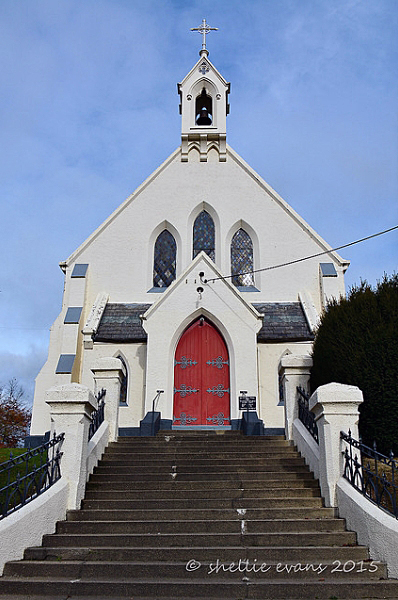
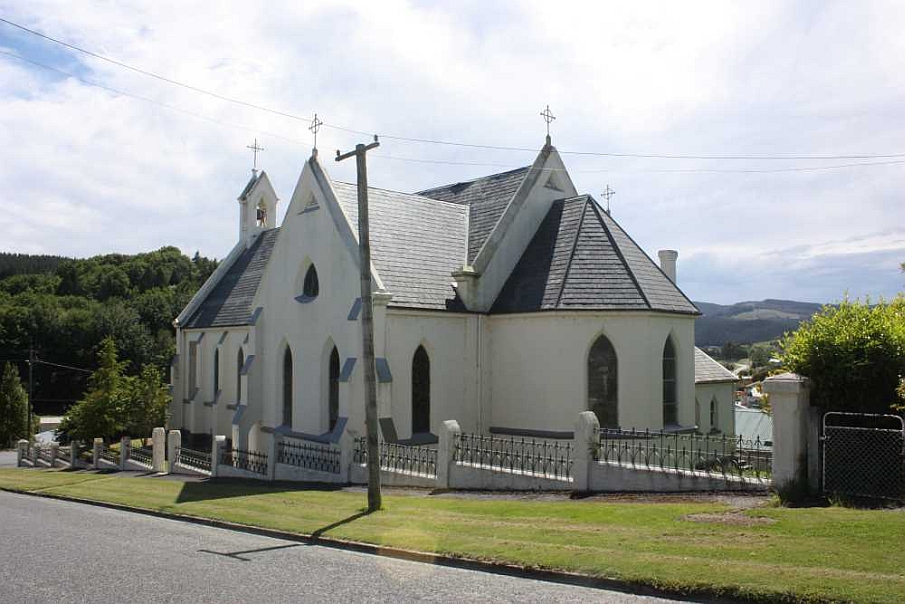
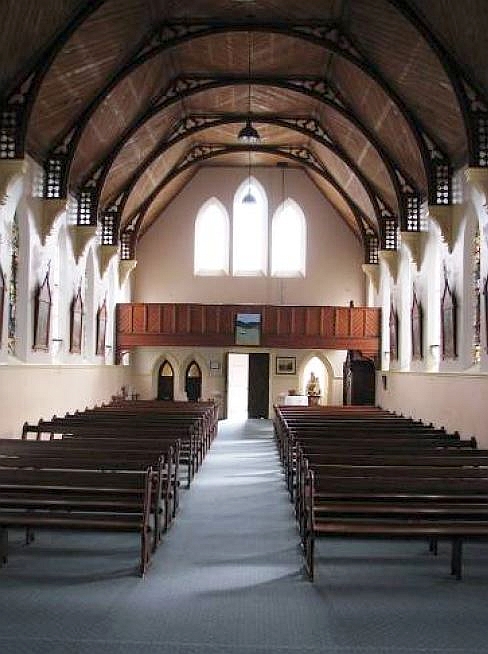
Tablet described the church’s design in detail. Built in brick, and laid in mortar made with hydraulic lime, the Church was supported on concrete foundations. The roof was slate on timber trusses. An Oamaru stone belfry, 60 feet (18.3 metres) in height, surmounted the building and was given more decorative treatment than elsewhere. A central flight of concrete steps led to a spacious porch entranceway with two sets of double wooden doors. Entering the church nave, to the right and behind were two doors to the confessional, and to the left and behind was the baptistery. Also to the left was a small spiral wooden staircase leading to a gallery for the organ, 27 feet (8.2 metres) by 12 feet (3.7 metres). The design of the nave was 70 feet by 27 feet (21.3 by 8.2 metres); the transept was 50 feet by 27 feet (15.2 by 8.2 metres); and the apse was 16 feet by 20 feet (4.9 by 6.1 metres) with the height of the walls being 20 feet (6.1 metres), and that of the middle ceiling 32 feet (9.8 metres). The windows were stained glass and there was seating for about 600 worshippers. Lighting was provided by lamps in brass cups on twisted brass rods standing in the middle aisle against the pews. The ironwork was produced by J. Mann, Stuart Street, Dunedin. The altar and baptismal font were carved from Oamaru stone by parishioner Andrew Moody.
The overall effect was impressive and in 1895 the newly appointed Bishop, Michael Verdon, noted that St Patrick’s impressed him as a cathedral church. A convent for the Dominican nuns, built directly behind the Church section, was formally opened by Bishop Moran on Sunday 3 February 1893. In 1902, the Church was further complemented by the construction of the adjacent Presbytery.
Modifications
In September 1897 a pulpit was presented to the church by the congregation. Designed by Petre and constructed by Daniel Woods, the pulpit was octagonal and entered from the altar rails. The panels were of kauri and the mouldings of red pine. The platform was 3 feet 6 inches (1.1 metres) from the floor, although its full height was 6 feet 6 inches (1.9 metres) and its diameter 4 feet (1.2 metres). The pulpit cost £20 and was a significant addition to the interior of the church.
The interior was further enhanced by gifts generous benefactors over the next years, including stained glass windows, two statues (Our Lady and St Joseph), and the Stations of the Cross. The Pietà and the thirteenth Station of the Cross, for example, were given by a member of the Hart family in memory of the family. Various plaques testify to similar gifts from members of the congregation.
Between 1918 and 1939 stained glass windows, known as the ‘McInerney Windows’, were installed. Made in the famous Zettler factory in Munich, ‘The Annunciation’ window was placed in the west wall of the nave, and the ‘St Patrick’ window was placed in the east nave wall. The ‘Kelleher Window’, titled ‘the Holy Family’, was made in Dunedin by Smith & Smith Ltd and also installed in the west wing of the nave. In the early 1940s, Fr Michael Scanlan, the Parish priest, obtained three windows. One depicted Raphael’s ‘Madonna of the Grand Duke’, which was placed on the left of the apse. Another, titled ‘St John the Evangelist’, was placed on the right. The other has since been lost. A window of St Munchin, previously on the left of the apse, was moved to the right transept; the other window removed from the right of the apex has since been lost. The stained glass picture-light in the niche above the Blessed Sacrament Shrine, titled ‘This is My Beloved Son’, commemorates His Eminence Cardinal Reginald Delargey who, as a child, was a parishioner. The window was designed by Beverley Shore Bennett of Wellington, from an original drawing by Michael McConnell of Dunedin. It was made and installed by Paul Hutchens of Miller Studios, Dunedin, in 1982. The Shrine itself was designed by Sr M. Anthony, O.P., for the alterations in 1971.
Several modifications to the interior took place in the early 1970s when the sanctuary was restyled in accordance with the liturgical changes of Vatican II. The original Oamaru stone altar, for example, was reduced to three-fifths of its original size by Robert Young. The old altar rails were removed and a wooden cross, hung above the altar, was carved from the old kneeler. The Cross figure was carved in Manila in 1974. The Tabernacle was created for the Parish centennial in 1971 and was designed and constructed by Bert Wansink, Dunedin. Around this time also, a Blessed Sacrament Canopy was placed over the tabernacle. It was created from part of the old altar. The Sanctuary’s lamp holder was also added, created from a remnant from the town’s early lighting system.
Concerning the exterior, by 1926 bricks and mortar were decaying. The church was roughcast to protect the exterior. The plastered parapets cracked, however, and allowed water in. The water expanded during frosts and large sections of roughcast came away from the bricks. When the interior walls were painted about 1960, the water in the walls was sealed in. It eventually reacted with the plaster bursting through the paint and causing large areas of efflorescence. By the 1990s the church needed significant repairs. Funds were raised through grants from the Otago Community Trust and the Alexander McMillan Trust, as well as community fund raising. In March 1995 work started. Loose plaster and roughcast were removed and repaired. Rotten barge boards were repaired. Seventy slate roof tiles were replaced. The stain glass windows were protected with polycarbonate shield. Walls, fence posts and the wrought iron fence work were also restored.