DonateSupporterVisit Heritage
  • Tūrangawaewae
    Places
  • Tira Māori
    Māori Heritage
  • Poutairangahia
    Archaeology
  • Rauemi
    Resources
  • Mō Tātou
    About Us
  • New Zealand Heritage List
  • Nominate and submit
  • Explore the List
  • National Historic Landmarks
  • Plaques
  • Rainbow List Project
  • Lost heritage
  • Visit Heritage
  • Our properties
  • Turnbull House Project
  • Collections
  • Shop
  • Tohu Whenua
  • Tira Māori
  • Conserving Māori heritage
  • Marae built heritage
  • Māori heritage on the List
  • Hinemihi—Te Hokinga Mai
  • What is archaeology?
  • Is there a site on my property?
  • What are my legal requirements?
  • Affecting an archaeological site
  • Declaring an archaeological site
  • Archaeology FAQs
  • Archaeology Digital Library
  • Archaeology guidelines and templates
  • Resources
  • Funding
  • Publications
  • Sustainable management guides
  • Disaster recovery
  • Podcasts & digital resources
  • Education Hub
  • Conservation plans
  • About
  • Board
  • Māori Heritage Council
  • Senior Staff
  • Offices
  • Contact us
  • Careers
  • Covenants
  • Fast-track
  • Corporate documents
  • Currently consulting on
  • Our submissions
  • News
  • Covid-19 response
Quick links
Rārangi Kōrero | The List
Explore the List
National Historic Landmarks
Ngā Manawhenua o Aotearoa me ōna Kōrero Tūturu
Quick links
Tapuwae
A Vision for Places of Māori Heritage
Funding for Māori Heritage
Resources
Quick links
Archaeological Authority Portal
Applying for an archaeological authority
Archaeology FAQs
Browse the most frequently asked questions about archaeological authorities and the archaeological process.
Quick links
Quick links
Contact us
Offices
DonateSupporterVisit Heritage
  • Tūrangawaewae
    Places
  • Tira Māori
    Māori Heritage
  • Poutairangahia
    Archaeology
  • Rauemi
    Resources
  • Mō Tātou
    About Us
  • New Zealand Heritage List
  • Nominate and submit
  • Explore the List
  • National Historic Landmarks
  • Plaques
  • Rainbow List Project
  • Lost heritage
  • Visit Heritage
  • Our properties
  • Turnbull House Project
  • Collections
  • Shop
  • Tohu Whenua
  • Tira Māori
  • Conserving Māori heritage
  • Marae built heritage
  • Māori heritage on the List
  • Hinemihi—Te Hokinga Mai
  • What is archaeology?
  • Is there a site on my property?
  • What are my legal requirements?
  • Affecting an archaeological site
  • Declaring an archaeological site
  • Archaeology FAQs
  • Archaeology Digital Library
  • Archaeology guidelines and templates
  • Resources
  • Funding
  • Publications
  • Sustainable management guides
  • Disaster recovery
  • Podcasts & digital resources
  • Education Hub
  • Conservation plans
  • About
  • Board
  • Māori Heritage Council
  • Senior Staff
  • Offices
  • Contact us
  • Careers
  • Covenants
  • Fast-track
  • Corporate documents
  • Currently consulting on
  • Our submissions
  • News
  • Covid-19 response
Quick links
Rārangi Kōrero | The List
Explore the List
National Historic Landmarks
Ngā Manawhenua o Aotearoa me ōna Kōrero Tūturu
Quick links
Tapuwae
A Vision for Places of Māori Heritage
Funding for Māori Heritage
Resources
Quick links
Archaeological Authority Portal
Applying for an archaeological authority
Archaeology FAQs
Browse the most frequently asked questions about archaeological authorities and the archaeological process.
Quick links
Quick links
Contact us
Offices
  • Places
  • Nominate and submit
  • National Historic Landmarks
  • Places
  • Nominate and submit
  • National Historic Landmarks
  • Tira Māori
  • Conserving Māori heritage
  • Marae built heritage
  • Tira Māori
  • Conserving Māori heritage
  • Marae built heritage
  • Archaeological authorities
  • Archaeology Digital Library
  • Archaeological authorities
  • Archaeology Digital Library
  • All resources
  • Publications
  • Funding
  • All resources
  • Publications
  • Funding
  • FAQs
  • FAQs
Follow us on:
Places
  • Places
  • Nominate and submit
  • National Historic Landmarks
Tira Māori
  • Tira Māori
  • Conserving Māori heritage
  • Marae built heritage
Archaeology
  • Archaeological authorities
  • Archaeology Digital Library
Resources
  • All resources
  • Publications
  • Funding
FAQs
  • FAQs
Follow us on
HomePrivacyTerms and conditionsAbout this site
© Heritage New Zealand Pouhere Taonga 2026.
 
Hyde School

9125 Eton Street (State Highway 87), HYDE

Private

Historic Place Category 2

List No. 2258

Quick links:
List GalleryLocationDetails
The former Hyde School was built in 1879 and continued to serve the educational needs of its community for 120 years. The now tiny settlement of Hyde was founded during the gold rushes of the early 1860s. Miners poured into the district, and a thriving town developed to cater for their needs. Once the rush was over some of the miners remained in the district to take up farming and other businesses. Hyde's first schools were short-lived private institutions, but none lasted long. Finally, in 1869, an official public school opened in the Union Church building. Seymour Saunders, the first teacher, had a class of 22 children.

Eventually the school committee decided that the school needed better accommodation than the small iron church - "cold as an icicle in the winter, sweltering hot in the summer" - and in 1879 contracted Palmerston builder Robert Highet to erect a schoolroom. The simple wooden school was built on a site which had been granted to the Provincial Government by the Crown in 1876 for educational purposes. With the abolition of provincial government and the passing of the Education Act of 1877, the land became the property of the Education Board of the district of Otago.

The school continued to grow, and by 1893 eighty children crowded into its one room. This prompted the addition of a second classroom, forming a north wing to the original building. Local carpenters John Mackie and William Wright built the new wing in 1894 at a price of ₤191. Both the original building and the 1893 addition are likely to have been designed by John Somerville, the then Otago Education Board's architect. Both sections are of very simple but functional design.

Although the school never grew beyond these two classrooms, various amenities were added in the twentieth century. In 1956 an ablution block was added, a welcome replacement to the old long-drops behind the school. Sports grounds were improved over the years and in 1969 the centennial celebrations included the opening of a swimming pool. A new teacher's residence and garage were built in 1960, a new staff room relocated from Patearoa in 1976 and for some years a re-locatable staff flat added to the school complex.

Through all these changes, the two nineteenth-century classrooms remained the core of the school. In addition to minor renovations, these underwent some larger changes in the 1970s and 1980s, with replacement of the windows and relining of the interiors. The old potbelly stoves were also replaced with multi-fuel burners and electric heating. The last major change to the building came in 1996, when the timber exterior was re-clad with roughcast plaster.

In addition to schooling, the building has been used for various community activities over the years. In 1994, for example, it was a venue for a playgroup, Plunket meetings, and clinics for the Doctor and Public Health Nurse. As the school-age population of Hyde declined in the late twentieth century and government education policies changed, keeping the school going became increasingly difficult, despite much community support. Hyde School finally closed at the end of 1999, with just four pupils in its final year.

The former Hyde School stands as a representative example of an institution of great importance in New Zealand history - the country primary school. Many New Zealand children were educated in such classrooms, which also served as centres of small and remote communities throughout the land.
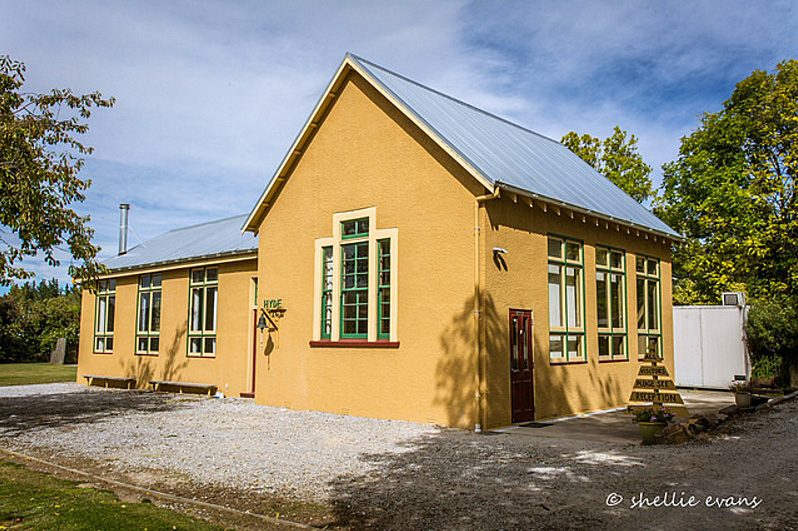
Hyde School. State Highway 87, Hyde. Image courtesy of www.flickr.com | Shellie Evans – flyingkiwigirl | 20/03/2017 | Shellie Evans
Hyde School. State Highway 87, Hyde. CC Licence 2.0 Image courtesy of commons.wikimedia.org | Ben Hill | 05/09/2009 | Ben Hill - Wikimedia Commons
Hyde School. State Highway 87, Hyde. Image courtesy of www.flickr.com | Shellie Evans – flyingkiwigirl | 20/03/2017 | Shellie Evans
Hyde School. State Highway 87, Hyde. CC Licence 2.0 Image courtesy of commons.wikimedia.org | Ben Hill | 05/09/2009 | Ben Hill - Wikimedia Commons

List Entry Information

Overview

Status
Listed

List Entry Status
Historic Place Category 2

Access
Private/No Public Access

List Number
2258

Date Entered
10th September 2004

Date of Effect
10th September 2004

City/District Council
Dunedin City

Region
Otago Region

Extent of List Entry

Registration Includes: Part of the land in RT OT28/69 and the school building, its fixtures and fittings, thereon. The registration applies only to the original 1879 building and the 1894 addition (See Plan A in Appendix 4 of the registration report).

Legal description

Secs 5 to 7 Blk II Town of Hyde, being part of RT OT28/69, Otago Land District

Detailed List Entry
Significance

Historic Significance

Historical Significance or Value The former Hyde School is a building of architectural and historical significance. It is an example of a type of building becoming increasingly rare in New Zealand - the small rural school. The history of the development of rural communities, from the hey-day of the gold mining period, through subsequent booms and slow decline, with parallel expansion and contraction of services tells an important story. Schools are a vital component of these communities, and the centre for the lives of the residents.

Detail Of Assessed Criteria

The former Hyde School is representative of the significance of education in the history of New Zealand's rural communities, and a building/institution held in esteem by the local community. The school of this fairly remote area created an important focus for the community for a period of 120 years. Declining population and changing government policy finally forced its closure. It stands as a good example of a small nineteenth-century primary school.

Construction Details

Start Year

1879

Type

Original Construction

Start Year

1894

Type

Addition

Description

Addition of north wing.

Start Year

1955

Finish Year

1956

Type

Addition

Description

Addition of ablution block.

Start Year

1960

Type

Addition

Description

New teacher's residence and garage.

Start Year

1969

Type

Addition

Description

Addition of swimming pool.

Start Year

1976

Type

Addition

Description

Addition of staff room.

Start Year

1996

Type

Modification

Description

Exterior plastered.

Construction Materials

The School is built of weatherboard. The exterior has been plastered. The roof is iron.

Physical Description

The original portion of the school is a large single rectangular-plan classroom. The room has been partitioned to create a small corridor at the northern end. The north wing, added in 1894, contains a second classroom. Its floor area is smaller than the original room. It has a higher and more steeply pitched roof. The two wings meet to form a T-shape. The gable end of the north wing, facing the road, has a large multi-paned window. The window at the southern end of the south wing is also multi-paned. Older photographs show that the majority of the windows were originally 12-light double-hung sash windows, but some have been replaced with aluminium frames. Each of the classrooms has a door leading to the exterior, and another leading into the corridor. The school bell has been removed, but its bracket remains in a prominent position next to the main door, which opens into the corridor between the classrooms. At the back of the building an ablution block forms a small separate wing. To the rear of the north wing sits a small prefabricated building which was used as a staff room. The interiors are in part wood-panelled. There is a multi-fuel burner in the southern classroom, but the burner and flue have been removed from the northern classroom (the concrete hearth remains in place).

Reference

Completion Date

7th October 2004

Report Written By

Heather Bauchop

Information Sources

Anon.

Anon.

Cowan, 1948

Janet. C. Cowan, Down the Years in the Maniototo: A Survey of the Early History of Maniototo County and Naseby Borough, Otago Centennial Historical Publications, Whitcombe and Tombs, Dunedin, 1948

Hocken Library

Hocken Library, University of Otago, Dunedin

Knight, H. & N. Wales, 1988

Hardwicke Knight and Niel Wales, Buildings of Dunedin: An Illustrated Architectural Guide to New Zealand's Victorian City, John McIndoe, Dunedin, 1988

Report Written By

A fully referenced registration report is available from the NZHPT Otago/Southland Area office Please note that entry on the New Zealand Heritage List/Rarangi Korero identifies only the heritage values of the property concerned, and should not be construed as advice on the state of the property, or as a comment of its soundness or safety, including in regard to earthquake risk, safety in the event of fire, or insanitary conditions.

Further Information

Current Usages

Uses: Vacant

Specific Usage: Vacant

Former Usages

General Usage:: Education

Specific Usage: School

Themes

Web Links

Overview

Status

Listed

List Entry Status

Historic Place Category 2

Access

Private/No Public Access

List Number

2258

Date Entered

10th September 2004

Date of Effect

10th September 2004

City/District Council

Dunedin City

Region

Otago Region

Extent of List Entry

Registration Includes: Part of the land in RT OT28/69 and the school building, its fixtures and fittings, thereon. The registration applies only to the original 1879 building and the 1894 addition (See Plan A in Appendix 4 of the registration report).

Legal description

Secs 5 to 7 Blk II Town of Hyde, being part of RT OT28/69, Otago Land District

Status

Listed

List Entry Status

Historic Place Category 2

Access

Private/No Public Access

List Number

2258

Date Entered

10th September 2004

Date of Effect

10th September 2004

City/District Council

Dunedin City

Region

Otago Region

Extent of List Entry

Registration Includes: Part of the land in RT OT28/69 and the school building, its fixtures and fittings, thereon. The registration applies only to the original 1879 building and the 1894 addition (See Plan A in Appendix 4 of the registration report).

Legal description

Secs 5 to 7 Blk II Town of Hyde, being part of RT OT28/69, Otago Land District

Significance

Why is this place significant?

Historic Significance

Historical Significance or Value The former Hyde School is a building of architectural and historical significance. It is an example of a type of building becoming increasingly rare in New Zealand - the small rural school. The history of the development of rural communities, from the hey-day of the gold mining period, through subsequent booms and slow decline, with parallel expansion and contraction of services tells an important story. Schools are a vital component of these communities, and the centre for the lives of the residents.

Why is this place Category 1 / Category 2?

Detail Of Assessed Criteria

The former Hyde School is representative of the significance of education in the history of New Zealand's rural communities, and a building/institution held in esteem by the local community. The school of this fairly remote area created an important focus for the community for a period of 120 years. Declining population and changing government policy finally forced its closure. It stands as a good example of a small nineteenth-century primary school.

Why is this place significant?

Historic Significance

Historical Significance or Value The former Hyde School is a building of architectural and historical significance. It is an example of a type of building becoming increasingly rare in New Zealand - the small rural school. The history of the development of rural communities, from the hey-day of the gold mining period, through subsequent booms and slow decline, with parallel expansion and contraction of services tells an important story. Schools are a vital component of these communities, and the centre for the lives of the residents.

Why is this place Category 1 / Category 2?

Detail Of Assessed Criteria

The former Hyde School is representative of the significance of education in the history of New Zealand's rural communities, and a building/institution held in esteem by the local community. The school of this fairly remote area created an important focus for the community for a period of 120 years. Declining population and changing government policy finally forced its closure. It stands as a good example of a small nineteenth-century primary school.

Construction Information

Construction Details

Start Year

1879

Type

Original Construction

Start Year

1894

Type

Addition

Description

Addition of north wing.

Start Year

1955

Finish Year

1956

Type

Addition

Description

Addition of ablution block.

Start Year

1960

Type

Addition

Description

New teacher's residence and garage.

Start Year

1969

Type

Addition

Description

Addition of swimming pool.

Start Year

1976

Type

Addition

Description

Addition of staff room.

Start Year

1996

Type

Modification

Description

Exterior plastered.

Construction Materials

The School is built of weatherboard. The exterior has been plastered. The roof is iron.

Construction Details

Start Year

1879

Type

Original Construction

Start Year

1894

Type

Addition

Description

Addition of north wing.

Start Year

1955

Finish Year

1956

Type

Addition

Description

Addition of ablution block.

Start Year

1960

Type

Addition

Description

New teacher's residence and garage.

Start Year

1969

Type

Addition

Description

Addition of swimming pool.

Start Year

1976

Type

Addition

Description

Addition of staff room.

Start Year

1996

Type

Modification

Description

Exterior plastered.

Construction Materials

The School is built of weatherboard. The exterior has been plastered. The roof is iron.

Physical Description

The original portion of the school is a large single rectangular-plan classroom. The room has been partitioned to create a small corridor at the northern end. The north wing, added in 1894, contains a second classroom. Its floor area is smaller than the original room. It has a higher and more steeply pitched roof. The two wings meet to form a T-shape. The gable end of the north wing, facing the road, has a large multi-paned window. The window at the southern end of the south wing is also multi-paned. Older photographs show that the majority of the windows were originally 12-light double-hung sash windows, but some have been replaced with aluminium frames. Each of the classrooms has a door leading to the exterior, and another leading into the corridor. The school bell has been removed, but its bracket remains in a prominent position next to the main door, which opens into the corridor between the classrooms. At the back of the building an ablution block forms a small separate wing. To the rear of the north wing sits a small prefabricated building which was used as a staff room. The interiors are in part wood-panelled. There is a multi-fuel burner in the southern classroom, but the burner and flue have been removed from the northern classroom (the concrete hearth remains in place).

The original portion of the school is a large single rectangular-plan classroom. The room has been partitioned to create a small corridor at the northern end. The north wing, added in 1894, contains a second classroom. Its floor area is smaller than the original room. It has a higher and more steeply pitched roof. The two wings meet to form a T-shape. The gable end of the north wing, facing the road, has a large multi-paned window. The window at the southern end of the south wing is also multi-paned. Older photographs show that the majority of the windows were originally 12-light double-hung sash windows, but some have been replaced with aluminium frames. Each of the classrooms has a door leading to the exterior, and another leading into the corridor. The school bell has been removed, but its bracket remains in a prominent position next to the main door, which opens into the corridor between the classrooms. At the back of the building an ablution block forms a small separate wing. To the rear of the north wing sits a small prefabricated building which was used as a staff room. The interiors are in part wood-panelled. There is a multi-fuel burner in the southern classroom, but the burner and flue have been removed from the northern classroom (the concrete hearth remains in place).

Reference

Historical and Associated Iwi / Hapū / Whānau

Completion Date

7th October 2004

Report Written By

Heather Bauchop

Information Sources

Anon.

Anon.

Cowan, 1948

Janet. C. Cowan, Down the Years in the Maniototo: A Survey of the Early History of Maniototo County and Naseby Borough, Otago Centennial Historical Publications, Whitcombe and Tombs, Dunedin, 1948

Hocken Library

Hocken Library, University of Otago, Dunedin

Knight, H. & N. Wales, 1988

Hardwicke Knight and Niel Wales, Buildings of Dunedin: An Illustrated Architectural Guide to New Zealand's Victorian City, John McIndoe, Dunedin, 1988

Other Information

A fully referenced registration report is available from the NZHPT Otago/Southland Area office Please note that entry on the New Zealand Heritage List/Rarangi Korero identifies only the heritage values of the property concerned, and should not be construed as advice on the state of the property, or as a comment of its soundness or safety, including in regard to earthquake risk, safety in the event of fire, or insanitary conditions.

Historical and Associated Iwi / Hapū / Whānau

Completion Date

7th October 2004

Report Written By

Heather Bauchop

Information Sources

Anon.

Anon.

Cowan, 1948

Janet. C. Cowan, Down the Years in the Maniototo: A Survey of the Early History of Maniototo County and Naseby Borough, Otago Centennial Historical Publications, Whitcombe and Tombs, Dunedin, 1948

Hocken Library

Hocken Library, University of Otago, Dunedin

Knight, H. & N. Wales, 1988

Hardwicke Knight and Niel Wales, Buildings of Dunedin: An Illustrated Architectural Guide to New Zealand's Victorian City, John McIndoe, Dunedin, 1988

Other Information

A fully referenced registration report is available from the NZHPT Otago/Southland Area office Please note that entry on the New Zealand Heritage List/Rarangi Korero identifies only the heritage values of the property concerned, and should not be construed as advice on the state of the property, or as a comment of its soundness or safety, including in regard to earthquake risk, safety in the event of fire, or insanitary conditions.

Further Information

Current Usages

Uses: Vacant

Specific Usage: Vacant

Former Usages

General Usage: Education

Specific Usage: School

Current Usages

Uses: Vacant

Specific Usage: Vacant

Former Usages

General Usage: Education

Specific Usage: School

Location

Loading
Sign up to hear more

Get the latest heritage news, features and events delivered
straight to your inbox.

Subscribe