

In 1853 the first combined school/church was built, Rev. William Will, the parish's first minister, arriving the following year. The building soon became inadequate for the needs of the growing community and was extended in the early 1860s. In 1869 the congregation decided to build a new church, large enough to seat 500. They selected as the site a high point behind the existing building, on the close to seven acres of land set aside by the authorities of the Otago colony for the church, manse and glebe.
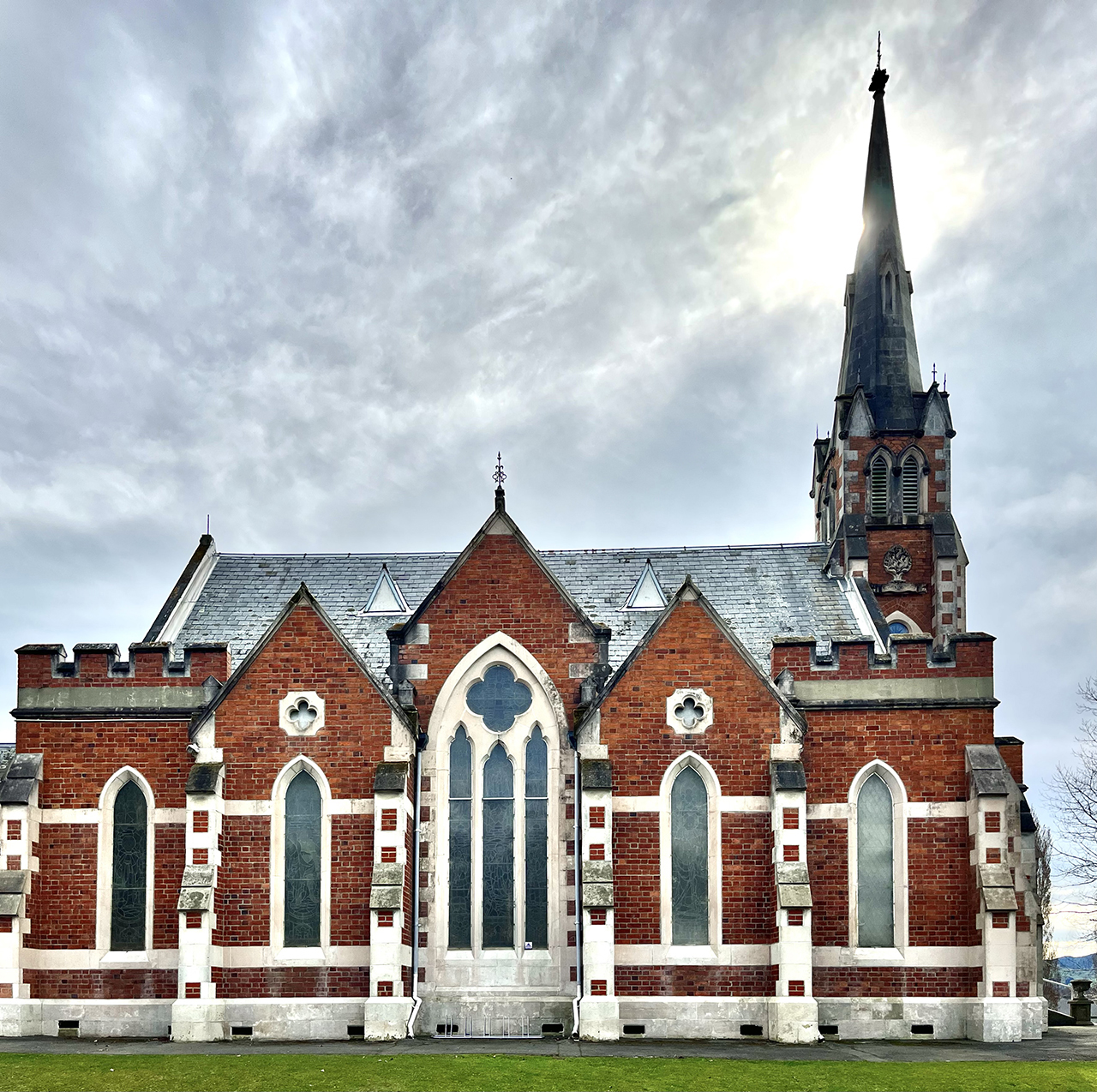
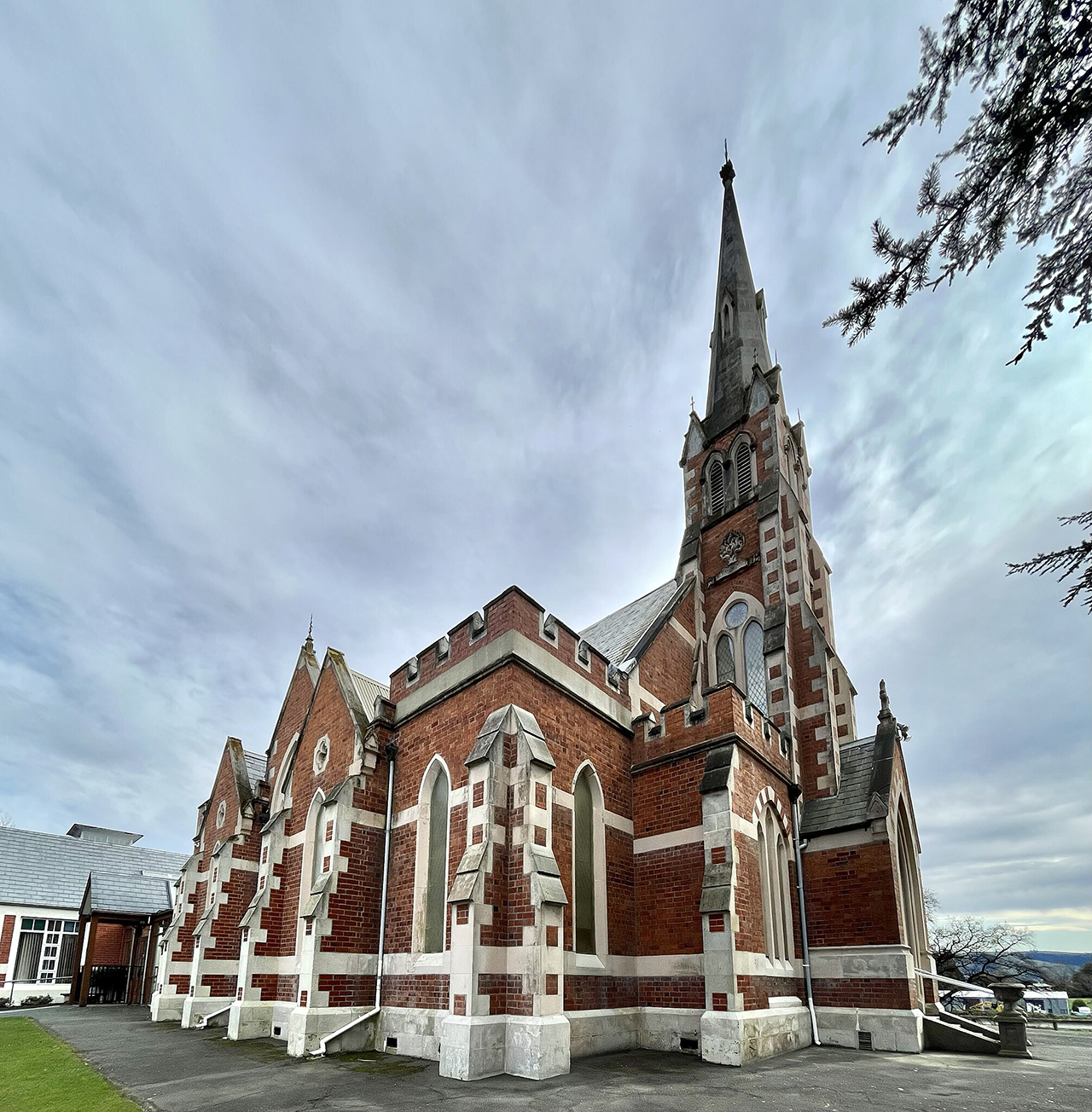
Of the eleven plans presented to them, the Deacons' Court selected a design by Dunedin architect R.A. Lawson for a substantial building in Gothic style, to be made of brick with cement facings and stone spire. They employed the firm Hunter & Goodfellow to construct the building. The cost, including builders' and architect's fees and furnishings, was ₤1854. Over 1871 and 1872 the Church had a prolonged dispute with the building contractors. They withheld payment for 'extras' due to their dissatisfaction with the standard of workmanship. The builders took the congregation to court and were awarded ₤188, with a further hefty charge for legal advice. The Deacons' Court later refused to pay Lawson's entire fee: as they had lost the court case, they now attributed the building's problems to "the many defects errors and discrepancies in the plans and specifications" prepared by the architect. The building's faults ranged from weak foundations to loose slates to concerns that the spire might collapse, and repairs and maintenance involved considerable expense for the congregation. The most visible element of these repairs is the new buttresses added to the building in the 1920s to provide further support for the walls.
Despite these difficulties, many consider the church design to be a great success. In 1905 the Cyclopedia of New Zealand commented that it was "often spoken of as the prettiest country church in New Zealand," and the centennial history described it as "one of the most beautiful Presbyterian churches in New Zealand."
In addition to repairs and renovations, the church has undergone several alterations to fit the changing needs of the congregation over the years. In 1897, prompted by a suggestion from the Christian Endeavour Society, the vestry was extended by 10 feet to give a larger room for meetings. In 1911 the parish built a separate hall to cater for the social and educational needs of the congregation.
The greatest change to the original church came in the 1990s, with the addition of a substantial administrative and fellowship centre at the rear of the building. Designed by architect E.J. McCoy in brick and Oamaru stone to complement the original building, the centre was built in two stages, opening in 1991 and 1999. It houses offices for the church and various community groups, in addition to a kitchen and meeting rooms of various sizes.
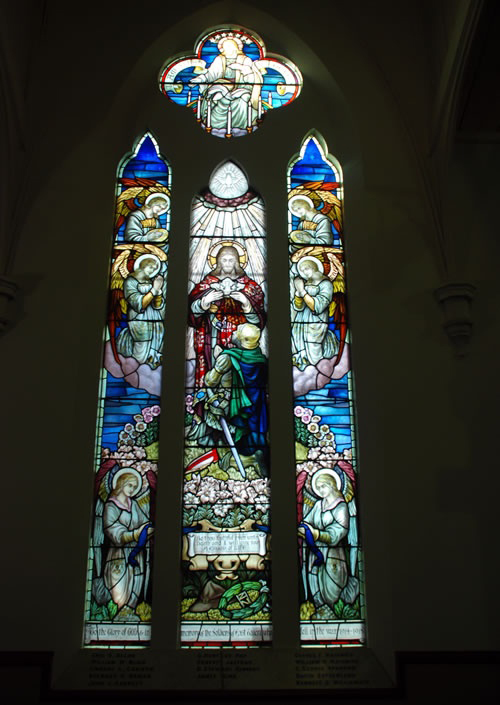
An outstanding feature of the church is the twelve stained glass windows added over the course of the twentieth century. The most recent, designed by Beverley Shore Bennet and crafted by Paul Hutchins, was installed in 1983 in memory of Rev. J.C. Mathews, minister from 1953 to 1976. The other eleven windows are the work of John Brock, an English craftsman who arrived in Dunedin in 1914. Two are memorials to the East Taieri servicemen who died in World Wars I and II, eight remember various ministers and members of the congregation, and the final window - "Look to the rock from which you were hewn, to the quarry from which you were dug" - is in memory of the pioneers.
In recent years the church interior has undergone various modifications to suit the changing style of worship of the congregation. The pulpit has been completely removed to give a flexible unfurnished platform at the front of the church, and the pews which once stood on both sides of the pulpit area have gone to make room for a band. Beside the church lies another item of interest, the belfry, dating from 1901. Dunedin firm A. & T. Burt made the bell. Originally located between the church and manse, the belfry was moved to the west side of the church in 1904. During restoration in 1992 it was moved to its current site to make it more visible. Other notable features outside the church itself are the magnificent old trees in the grounds. The Dunedin City Council has listed six of these as significant trees - a totara, three oaks, a deodar and an ash.
The East Taieri Presbyterian Church is a building of aesthetic, architectural, historical and spiritual significance. Designed by one of Victorian New Zealand's most notable architects, it is a particularly attractive building which forms a notable landmark on the Taieri plain. It has been an important spiritual centre for the district since 1870, hosting a large congregation to this day. It stands as a memorial to its past members and clergy, who have played a notable role in the history of the district.
List Entry Information
Status
Listed
List Entry Status
Historic Place Category 2
Access
Private/No Public Access
List Number
2260
Date Entered
10th September 2004
Date of Effect
10th September 2004
City/District Council
Dunedin City
Region
Otago Region
Extent of List Entry
Registration includes: the land in RT OT267/253 and the Church, its fixtures and fittings, thereon. The registration applies to the 1869-1870 East Taieri Presbyterian Church (and not the later addition known as the 1990s Fellowship Centre).
Legal description
Pt Sec 22 Irregular Block East Taieri SD (RT OT267/253), Otago Land District
Status
Listed
List Entry Status
Historic Place Category 2
Access
Private/No Public Access
List Number
2260
Date Entered
10th September 2004
Date of Effect
10th September 2004
City/District Council
Dunedin City
Region
Otago Region
Extent of List Entry
Registration includes: the land in RT OT267/253 and the Church, its fixtures and fittings, thereon. The registration applies to the 1869-1870 East Taieri Presbyterian Church (and not the later addition known as the 1990s Fellowship Centre).
Legal description
Pt Sec 22 Irregular Block East Taieri SD (RT OT267/253), Otago Land District
Why is this place significant?
Historic Significance
Historical Significance or Value The East Taieri Presbyterian Church is a building of architectural, historical and spiritual significance. Historically it represents the significance of religion in Otago's history, and particularly the importance of Presbyterianism in the development of the Province. East Taieri was an early parish, and has an important association with two long term ministers who had influence on the national church - particularly Rev. William Will (1854-1899) and more recently Rev. Peter Willsman (1977-2001). Spiritually it has provided a place of worship for its East Taieri congregation for over one hundred and thirty years.
Physical Significance
The church is one of prominent Presbyterian Church architect Robert Lawson's (1833-1902) more noted middle period designs, characteristically Gothic in style. It has a notional cruciform plan, with significant interior detailing and layout. It is noted for its beautiful setting on the Taieri and its design applauded.
Why is this place Category 1 / Category 2?
Detail Of Assessed Criteria
(a) The East Taieri Presbyterian Church is representative of the significance of religion in New Zealand's colonial history. More specifically, it stands as a monument to the importance of Presbyterianism in the settlement of Otago. The parish was established early and employed the region's second Presbyterian minister, and has served as a spiritual centre for the Taieri plain from the earliest days of the colony. (b)The church also has significance due to its association with people of importance in New Zealand history. Its ministers have been leaders to the local community and, in some cases, to the New Zealand church. Two long-term ministers with particular influence on the national church were Rev. William Will and Rev. Peter Willsman. Will was one of the pioneers of Presbyterianism in New Zealand. (e) The "kirk on the hill", as it is sometimes known, is a building held in high regard by the local community and looked upon as a landmark. Plans to extend the church in the 1990s created concern that the character of the valued old building must not be lost. (g) The design of the church adds to its significance. It has been described as one of the most attractive churches in New Zealand, and is a fine example of the work of noted Victorian architect R.A. Lawson, who had a particular association with the Presbyterian Church. (h) The church has commemorative value. The building itself stands as a memorial to the early Taieri colonists, and in particular the stained glass windows give it commemorative significance. Two of the windows are war memorials, while the others commemorate the pioneers of the congregation and various ministers and church members.
Why is this place significant?
Historic Significance
Historical Significance or Value The East Taieri Presbyterian Church is a building of architectural, historical and spiritual significance. Historically it represents the significance of religion in Otago's history, and particularly the importance of Presbyterianism in the development of the Province. East Taieri was an early parish, and has an important association with two long term ministers who had influence on the national church - particularly Rev. William Will (1854-1899) and more recently Rev. Peter Willsman (1977-2001). Spiritually it has provided a place of worship for its East Taieri congregation for over one hundred and thirty years.
Physical Significance
The church is one of prominent Presbyterian Church architect Robert Lawson's (1833-1902) more noted middle period designs, characteristically Gothic in style. It has a notional cruciform plan, with significant interior detailing and layout. It is noted for its beautiful setting on the Taieri and its design applauded.
Why is this place Category 1 / Category 2?
Detail Of Assessed Criteria
(a) The East Taieri Presbyterian Church is representative of the significance of religion in New Zealand's colonial history. More specifically, it stands as a monument to the importance of Presbyterianism in the settlement of Otago. The parish was established early and employed the region's second Presbyterian minister, and has served as a spiritual centre for the Taieri plain from the earliest days of the colony. (b)The church also has significance due to its association with people of importance in New Zealand history. Its ministers have been leaders to the local community and, in some cases, to the New Zealand church. Two long-term ministers with particular influence on the national church were Rev. William Will and Rev. Peter Willsman. Will was one of the pioneers of Presbyterianism in New Zealand. (e) The "kirk on the hill", as it is sometimes known, is a building held in high regard by the local community and looked upon as a landmark. Plans to extend the church in the 1990s created concern that the character of the valued old building must not be lost. (g) The design of the church adds to its significance. It has been described as one of the most attractive churches in New Zealand, and is a fine example of the work of noted Victorian architect R.A. Lawson, who had a particular association with the Presbyterian Church. (h) The church has commemorative value. The building itself stands as a memorial to the early Taieri colonists, and in particular the stained glass windows give it commemorative significance. Two of the windows are war memorials, while the others commemorate the pioneers of the congregation and various ministers and church members.
Construction Professional
Name
Lawson, Robert Arthur
Type
Architect
Biography
Born in Scotland, Lawson (1833-1902) began his professional career in Perth. At the age of 25 he moved to Melbourne and was engaged in goldmining and journalism before resuming architectural practice. In 1862 Lawson sailed for Dunedin, where his sketch plans had won the competition for the design of First Church. This was built 1867-73. Lawson went on to become one of the most important architects in New Zealand. First Church is regarded as his masterpiece and one of the finest nineteenth century churches in New Zealand. He was also responsible for the design of the Trinity Church (now Fortune Theatre), Dunedin (1869-70), the East Taieri Presbyterian Church (1870), and Knox Church, Dunedin (1874). He designed Park's School (1864) and the ANZ Bank (originally Union Bank, 1874). In Oamaru he designed the Bank of Otago (later National Bank building, 1870) and the adjoining Bank of New South Wales (now Forrester Gallery, 1881). See also: Ledgerwood, Norman, 2013. 'R.A. Lawson: Victorian Architect of Dunedin'. Historic Cemeteries Conservation NZ.
Name
McCoy, E.J.
Type
Architect
Biography
E McCoy is a major modern Dunedin architect and has designed the University Hocken Building and many other notable modern buildings in Dunedin
Name
Hunter & Goodfellow
Type
Builder
Biography
Joshua Goodfellow Scottish-born Joshua Goodfellow came to New Zealand ‘in the very early days’, residing in the country for around fifty years. He worked on the post office in Dunedin and laid part of the Lawrence railway before moving north, where he completed large contracts, including several in Wellington. He died in Scotland in 1907, while visiting family. John Grey Hunter John Grey Hunter was a well-known builder and contractor. He came to New Zealand 1860s, going to the Otago goldfields. He returned to Scotland, married and then returned to Dunedin. He later moving to Christchurch where he entered into partnership with W. Greig, building the first Girls’ and Boys’ High Schools and the Canterbury College of Art (List No. 7301). He later lived in Hokitika where he died in 1924. Hunter and Goodfellow Hunter and Goodfellow were responsible for the construction of the First Church of Otago (Presbyterian) (List No. 60), East Taieri Presbyterian Church (List No. 2260), and the Bank of Otago at Oamaru (List No. 363). Their residential work includes Telford’s 1869 homestead and station buildings at Otanomomo (List No.’s 2127 and 5199). In 1870 they advertised regularly in the Bruce Herald, indicating their range of work. The advertisement indicated that the worked on tombstones, railings, monuments, stone carving, and supplied lime, cement, hearthstones, firebricks, slates, marble and stone mantelpieces. Source: List Entry Review Report for St Andrew's Presbyterian Church and Warden's Cottage (Former), 23 March 2016.
Construction Details
Start Year
1999
Type
Modification
Description
Completion of Stage II of fellowship centre.
Start Year
1869
Finish Year
1870
Type
Original Construction
Start Year
1897
Type
Addition
Description
Addition to vestry.
Start Year
1925
startYearCirca
Type
Addition
Description
New buttresses added.
Start Year
1991
Type
Modification
Description
Completion of Stage I of fellowship centre.
Construction Materials
The exterior is predominantly brick, with cement and stone facings. The roof is slate. The interior of the church is plaster with wooden panelling, and the ceilings and trusses are of wood.
Construction Professional
Name
Lawson, Robert Arthur
Type
Architect
Biography
Born in Scotland, Lawson (1833-1902) began his professional career in Perth. At the age of 25 he moved to Melbourne and was engaged in goldmining and journalism before resuming architectural practice. In 1862 Lawson sailed for Dunedin, where his sketch plans had won the competition for the design of First Church. This was built 1867-73. Lawson went on to become one of the most important architects in New Zealand. First Church is regarded as his masterpiece and one of the finest nineteenth century churches in New Zealand. He was also responsible for the design of the Trinity Church (now Fortune Theatre), Dunedin (1869-70), the East Taieri Presbyterian Church (1870), and Knox Church, Dunedin (1874). He designed Park's School (1864) and the ANZ Bank (originally Union Bank, 1874). In Oamaru he designed the Bank of Otago (later National Bank building, 1870) and the adjoining Bank of New South Wales (now Forrester Gallery, 1881). See also: Ledgerwood, Norman, 2013. 'R.A. Lawson: Victorian Architect of Dunedin'. Historic Cemeteries Conservation NZ.
Name
McCoy, E.J.
Type
Architect
Biography
E McCoy is a major modern Dunedin architect and has designed the University Hocken Building and many other notable modern buildings in Dunedin
Name
Hunter & Goodfellow
Type
Builder
Biography
Joshua Goodfellow Scottish-born Joshua Goodfellow came to New Zealand ‘in the very early days’, residing in the country for around fifty years. He worked on the post office in Dunedin and laid part of the Lawrence railway before moving north, where he completed large contracts, including several in Wellington. He died in Scotland in 1907, while visiting family. John Grey Hunter John Grey Hunter was a well-known builder and contractor. He came to New Zealand 1860s, going to the Otago goldfields. He returned to Scotland, married and then returned to Dunedin. He later moving to Christchurch where he entered into partnership with W. Greig, building the first Girls’ and Boys’ High Schools and the Canterbury College of Art (List No. 7301). He later lived in Hokitika where he died in 1924. Hunter and Goodfellow Hunter and Goodfellow were responsible for the construction of the First Church of Otago (Presbyterian) (List No. 60), East Taieri Presbyterian Church (List No. 2260), and the Bank of Otago at Oamaru (List No. 363). Their residential work includes Telford’s 1869 homestead and station buildings at Otanomomo (List No.’s 2127 and 5199). In 1870 they advertised regularly in the Bruce Herald, indicating their range of work. The advertisement indicated that the worked on tombstones, railings, monuments, stone carving, and supplied lime, cement, hearthstones, firebricks, slates, marble and stone mantelpieces. Source: List Entry Review Report for St Andrew's Presbyterian Church and Warden's Cottage (Former), 23 March 2016.
Construction Details
Start Year
1999
Type
Modification
Description
Completion of Stage II of fellowship centre.
Start Year
1869
Finish Year
1870
Type
Original Construction
Start Year
1897
Type
Addition
Description
Addition to vestry.
Start Year
1925
startYearCirca
Type
Addition
Description
New buttresses added.
Start Year
1991
Type
Modification
Description
Completion of Stage I of fellowship centre.
Construction Materials
The exterior is predominantly brick, with cement and stone facings. The roof is slate. The interior of the church is plaster with wooden panelling, and the ceilings and trusses are of wood.
The Church is a typical Lawson design being in the Gothic Revival style. In the original plans the interior has two side aisles and a large central nave. These are separated visually by narrow Corinthian style columns that define the arched arcades, the design of which is carried onto the exterior. These columns also carry the supporting ribs that spring from these capitals across the ceiling, evoking the effect of a simplified arched timber vault. The symmetrical east end terminates with a shallow apse, with a raised platform. This section is separated from the nave by a low decorative railing. On either side, in the shallow transepts are located the seating for the choir. The low decorative railing and the choir seats have been removed. Doorways surmounted by arched fanlights with trefoil and quatrefoil decorations, lead to side porches and the vestry. The floor is sloped down to the front of the church, an unusual feature. The entrance to the church is through an elaborate vestibule and covered porch that acts as a narlex. The front of the building features a spire rising from the centre, with crenellations at either side, matching those on the corner of the building but at a slightly lower level. A porch at the front has a steeply pitched roof to match that of the main building. Originally the church had buttresses at the four main corners of the church and on the spire. Further buttresses were added later to provide additional structural support. The church interior has plastered walls with wooden panelling. The windows are an outstanding feature of this church. All are lancets. Most are single windows, but the large windows in the centre of each side wall and the three smaller windows in the steeple feature stone tracery. Over the twentieth century most of the windows have had stained glass installed. Some of the earlier windows, notably the World War I memorial window, are pre-Raphaelite in style. The porch features a stone memorial to Rev. William Will, first minister of the parish. At the rear of the original church is the substantial 1990s addition. This has been designed to complement the original building. It is made of brick and stone, with a greater proportion of stone than the original. It features gables and crenellations to match those which are such are a characteristic of the older section. It has large windows of modern style. The addition encloses the original vestry. Its interior, in modern style, includes several offices, a kitchen and meeting rooms of various sizes, two of them on an upper level. It has an entry area enclosing the old brick walls of the original back corner of the building, and a large central atrium with a skylight. Near the front of the original church building is a separate bell tower, an ornate wooden structure located to side of the main church.
The Church is a typical Lawson design being in the Gothic Revival style. In the original plans the interior has two side aisles and a large central nave. These are separated visually by narrow Corinthian style columns that define the arched arcades, the design of which is carried onto the exterior. These columns also carry the supporting ribs that spring from these capitals across the ceiling, evoking the effect of a simplified arched timber vault. The symmetrical east end terminates with a shallow apse, with a raised platform. This section is separated from the nave by a low decorative railing. On either side, in the shallow transepts are located the seating for the choir. The low decorative railing and the choir seats have been removed. Doorways surmounted by arched fanlights with trefoil and quatrefoil decorations, lead to side porches and the vestry. The floor is sloped down to the front of the church, an unusual feature. The entrance to the church is through an elaborate vestibule and covered porch that acts as a narlex. The front of the building features a spire rising from the centre, with crenellations at either side, matching those on the corner of the building but at a slightly lower level. A porch at the front has a steeply pitched roof to match that of the main building. Originally the church had buttresses at the four main corners of the church and on the spire. Further buttresses were added later to provide additional structural support. The church interior has plastered walls with wooden panelling. The windows are an outstanding feature of this church. All are lancets. Most are single windows, but the large windows in the centre of each side wall and the three smaller windows in the steeple feature stone tracery. Over the twentieth century most of the windows have had stained glass installed. Some of the earlier windows, notably the World War I memorial window, are pre-Raphaelite in style. The porch features a stone memorial to Rev. William Will, first minister of the parish. At the rear of the original church is the substantial 1990s addition. This has been designed to complement the original building. It is made of brick and stone, with a greater proportion of stone than the original. It features gables and crenellations to match those which are such are a characteristic of the older section. It has large windows of modern style. The addition encloses the original vestry. Its interior, in modern style, includes several offices, a kitchen and meeting rooms of various sizes, two of them on an upper level. It has an entry area enclosing the old brick walls of the original back corner of the building, and a large central atrium with a skylight. Near the front of the original church building is a separate bell tower, an ornate wooden structure located to side of the main church.
Historical and Associated Iwi / Hapū / Whānau
Public NZAA Number
I44/1001
Completion Date
7th October 2004
Report Written By
Heather Bauchop
Information Sources
Collie, 1934
John Collie, After Eighty Years: East Taieri Presbyterian Church 1854-1934, Dunedin & Wellington: A.H. Reed, [1934].
Dictionary of New Zealand Biography
Dictionary of New Zealand Biography
Kirk, 1954
W.R. Kirk, After 100 Years: A Souvenir History of the East Taieri Presbyterian Church 1854-1954, Dunedin: Coulls Somerville Wilke, [1954].
New Zealand Historic Places Trust (NZHPT)
New Zealand Historic Places Trust
Otago Daily Times
Otago Daily Times, 1 Jun 1915, p.10.
Otago Witness
Otago Witness
Presbyterian Church Archives
Presbyterian Church Archives
Taieri Herald
Taieri Herald
Other Information
A fully referenced registration report is available from the NZHPT Otago/Southland Area office Please note that entry on the New Zealand Heritage List/Rarangi Korero identifies only the heritage values of the property concerned, and should not be construed as advice on the state of the property, or as a comment of its soundness or safety, including in regard to earthquake risk, safety in the event of fire, or insanitary conditions.
Historical and Associated Iwi / Hapū / Whānau
Public NZAA Number
I44/1001
Completion Date
7th October 2004
Report Written By
Heather Bauchop
Information Sources
Collie, 1934
John Collie, After Eighty Years: East Taieri Presbyterian Church 1854-1934, Dunedin & Wellington: A.H. Reed, [1934].
Dictionary of New Zealand Biography
Dictionary of New Zealand Biography
Kirk, 1954
W.R. Kirk, After 100 Years: A Souvenir History of the East Taieri Presbyterian Church 1854-1954, Dunedin: Coulls Somerville Wilke, [1954].
New Zealand Historic Places Trust (NZHPT)
New Zealand Historic Places Trust
Otago Daily Times
Otago Daily Times, 1 Jun 1915, p.10.
Otago Witness
Otago Witness
Presbyterian Church Archives
Presbyterian Church Archives
Taieri Herald
Taieri Herald
Other Information
A fully referenced registration report is available from the NZHPT Otago/Southland Area office Please note that entry on the New Zealand Heritage List/Rarangi Korero identifies only the heritage values of the property concerned, and should not be construed as advice on the state of the property, or as a comment of its soundness or safety, including in regard to earthquake risk, safety in the event of fire, or insanitary conditions.
Current Usages
Uses: Commemoration
Specific Usage: Memorial - World War One
Uses: Religion
Specific Usage: Church
Former Usages
General Usage: Commemoration
Specific Usage: Memorial - World War One
General Usage: Religion
Specific Usage: Church
Themes
War Memorial
Web Links
description: The Memorials Register, New Zealand History Online, Ministry for Culture and Heritage.
Current Usages
Uses: Commemoration
Specific Usage: Memorial - World War One
Uses: Religion
Specific Usage: Church
Former Usages
General Usage: Commemoration
Specific Usage: Memorial - World War One
General Usage: Religion
Specific Usage: Church
Themes
War Memorial
Web Links
description: The Memorials Register, New Zealand History Online, Ministry for Culture and Heritage.
Sign up to hear more
Get the latest heritage news, features and events delivered
straight to your inbox.
