

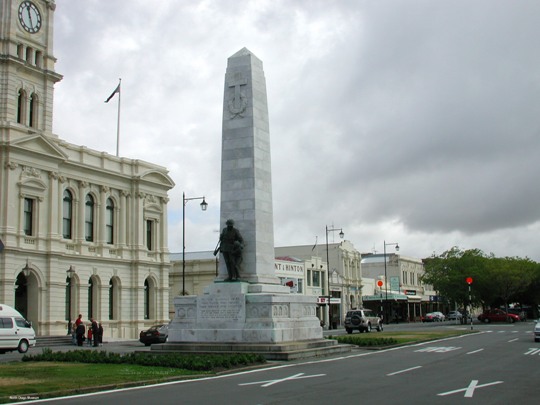
North Otago people fought their own battles over this memorial. For months they argued whether it should be utilitarian or inspirational. Then they argued about where it should be placed. Even more vigorously, they argued about whether it should carry the names of the fallen. The people first chose to plant oak trees on certain streets in Oamaru, and at mile intervals along country roads, each with a plate with the name of a fallen soldier. After further debate, this more conventional memorial was chosen for the centre of Thames Street, in a prime site outside the Chief Post Office.
Dunedin architect Eric Miller won the competition to design the memorial. Governor-General Jellicoe laid the foundation stone on 14 October 1924. On Anzac Day 1926, Lieutenant-Colonel J. Hargest unveiled the memorial and placed in a locked receptacle a bronze casket containing the names of the district's soldiers who had served overseas.
In 2003, the beautifully illustrated face plate and hand-written roll-of-honour was removed for safe-keeping to the North Otago Museum Archive after damp and mould were discovered to be causing severe damage in the 1990s. The Roll of Honour has since been conserved. In 2015, the World War One Memorial remains a landmark on Thames Street.
List Entry Information
Status
Listed
List Entry Status
Historic Place Category 2
Access
Able to Visit
List Number
2316
Date Entered
2nd July 1982
Date of Effect
2nd July 1982
City/District Council
Waitaki District
Region
Otago Region
Extent of List Entry
Extent includes part of the land described as Legal Road, Otago Land District, and the structure known as the World War One Memorial, thereon. (Refer to the extent map tabled at the Heritage List/Rārangi Kōrero Committee meeting on 8 October 2015.)
Legal description
Legal Road, Otago Land District
Status
Listed
List Entry Status
Historic Place Category 2
Access
Able to Visit
List Number
2316
Date Entered
2nd July 1982
Date of Effect
2nd July 1982
City/District Council
Waitaki District
Region
Otago Region
Extent of List Entry
Extent includes part of the land described as Legal Road, Otago Land District, and the structure known as the World War One Memorial, thereon. (Refer to the extent map tabled at the Heritage List/Rārangi Kōrero Committee meeting on 8 October 2015.)
Legal description
Legal Road, Otago Land District
Construction Professional
Name
E. Miller
Type
Designer
Biography
Eric Miller was a Dunedin architect. With James White, he established the architectural firm of Miller & White in 1927. Both architects had practiced in the city for some years previously, White in partnership with Leslie Coombs from 1922 to 1927. Miller & White almost immediately took over the Dunedin practice of Edmund Anscombe, who left the city for Wellington in 1928. The most significant client inherited from Anscombe was the University of Otago and Miller & White remained architects to the university for many years. Eric Miller died in 1948.
Name
T. Clapperton
Type
Sculptor
Biography
Thomas Clapperton (1879-1962) was a Scottish sculptor trained at the Galashiels Mechanics Institute, the Glasgow School of Art and the Kennington School of Art. After receiving a travelling scholarship he returned to London where he set up studios. Among his commission were war memorials, including in Canobie, Minto, Galashiels and Selkirk. His work abroad included Oamaru’s war memorial, sculpture in Canada, and a fountain in California. His most well known work in Scotland is the statue of Robert the Bruce at the entrance to Edinburgh Castle (1929). He completed other public monuments and friezes in Scotland and England.
Construction Details
Start Year
1924
Type
Original Construction
Description
Foundation stone laid, 14 October
Start Year
1926
Type
Original Construction
Description
Memorial unveiled, 25 April
Construction Professional
Name
E. Miller
Type
Designer
Biography
Eric Miller was a Dunedin architect. With James White, he established the architectural firm of Miller & White in 1927. Both architects had practiced in the city for some years previously, White in partnership with Leslie Coombs from 1922 to 1927. Miller & White almost immediately took over the Dunedin practice of Edmund Anscombe, who left the city for Wellington in 1928. The most significant client inherited from Anscombe was the University of Otago and Miller & White remained architects to the university for many years. Eric Miller died in 1948.
Name
T. Clapperton
Type
Sculptor
Biography
Thomas Clapperton (1879-1962) was a Scottish sculptor trained at the Galashiels Mechanics Institute, the Glasgow School of Art and the Kennington School of Art. After receiving a travelling scholarship he returned to London where he set up studios. Among his commission were war memorials, including in Canobie, Minto, Galashiels and Selkirk. His work abroad included Oamaru’s war memorial, sculpture in Canada, and a fountain in California. His most well known work in Scotland is the statue of Robert the Bruce at the entrance to Edinburgh Castle (1929). He completed other public monuments and friezes in Scotland and England.
Construction Details
Start Year
1924
Type
Original Construction
Description
Foundation stone laid, 14 October
Start Year
1926
Type
Original Construction
Description
Memorial unveiled, 25 April
Historical and Associated Iwi / Hapū / Whānau
Completion Date
24th September 2015
Report Written By
Gavin McLean and Heather Bauchop
Information Sources
McDonald, 1962
K C McDonald, 'White Stone Country', Oamaru, 1962
Ministry for Culture and Heritage
www.nzhistory.net.nz
Nisbet, N. D.
Glasgow - City of Sculpture website
Maclean and Phillips, 1990
Chris Maclean and Jock Phillips, The Sorrow and the Pride: New Zealand War Memorials, Historical Branch, Department of Internal Affairs, 1990
Other Information
This place was identified as significant under previous legislation with different information requirements. It remains significant under the current legislation. There is opportunity under our legislation and policies to add to this information. Further information about this place may be available from the Otago/Southland Office of Heritage New Zealand Pouhere Taonga. Please note that entry on the New Zealand Heritage List/Rarangi Korero identifies only the heritage values of the property concerned, and should not be construed as advice on the state of the property, or as a comment of its soundness or safety, including in regard to earthquake risk, safety in the event of fire, or insanitary conditions. A fully referenced upgrade report is available on request from the Otago/Southland Office of Heritage New Zealand
Historical and Associated Iwi / Hapū / Whānau
Completion Date
24th September 2015
Report Written By
Gavin McLean and Heather Bauchop
Information Sources
McDonald, 1962
K C McDonald, 'White Stone Country', Oamaru, 1962
Ministry for Culture and Heritage
www.nzhistory.net.nz
Nisbet, N. D.
Glasgow - City of Sculpture website
Maclean and Phillips, 1990
Chris Maclean and Jock Phillips, The Sorrow and the Pride: New Zealand War Memorials, Historical Branch, Department of Internal Affairs, 1990
Other Information
This place was identified as significant under previous legislation with different information requirements. It remains significant under the current legislation. There is opportunity under our legislation and policies to add to this information. Further information about this place may be available from the Otago/Southland Office of Heritage New Zealand Pouhere Taonga. Please note that entry on the New Zealand Heritage List/Rarangi Korero identifies only the heritage values of the property concerned, and should not be construed as advice on the state of the property, or as a comment of its soundness or safety, including in regard to earthquake risk, safety in the event of fire, or insanitary conditions. A fully referenced upgrade report is available on request from the Otago/Southland Office of Heritage New Zealand
Current Usages
Uses: Commemoration
Specific Usage: Memorial - World War One
Former Usages
General Usage: Commemoration
Specific Usage: Memorial - World War One
Themes
War Memorial
Web Links
description: The Memorials Register, New Zealand History Online, Ministry for Culture and Heritage.
Current Usages
Uses: Commemoration
Specific Usage: Memorial - World War One
Former Usages
General Usage: Commemoration
Specific Usage: Memorial - World War One
Themes
War Memorial
Web Links
description: The Memorials Register, New Zealand History Online, Ministry for Culture and Heritage.
