Completed in 1848, the building known as The Gables in New Plymouth was a Colonial Hospital planned, on the orders of Governor Sir George Grey [1812-1898], to provide medical care for Maori and Pakeha. Four hospitals were erected in the North Island to advance Grey's policy of encouraging the assimilation of Maori into Pakeha culture. The hospital at New Plymouth was the third of the four hospitals commissioned in the North Island and it is the only one still standing.
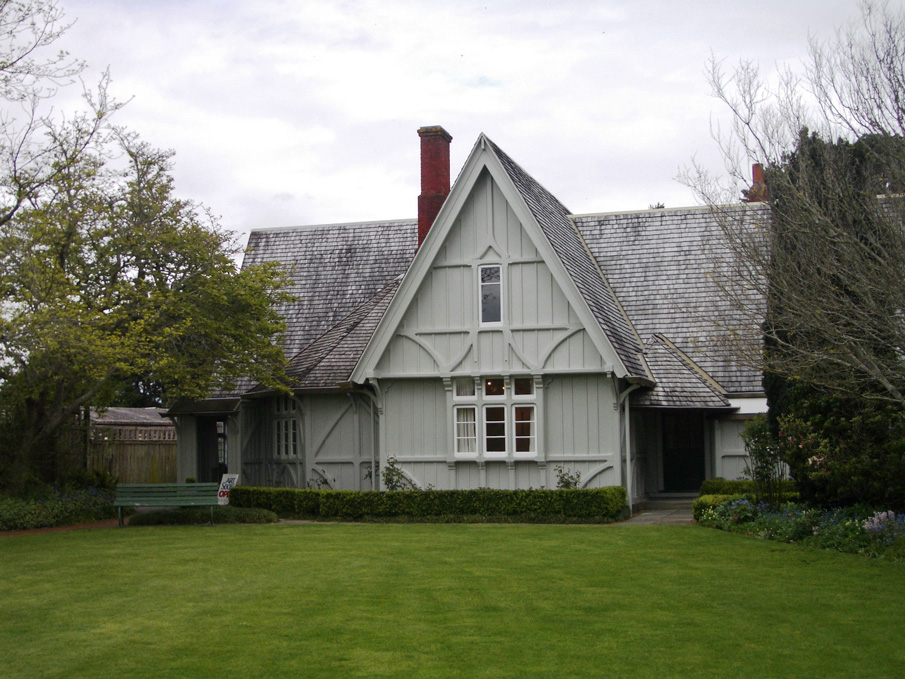
Indicating the importance of the venture, Grey commissioned architect Frederick Thatcher [1814-1890] to design the hospital building. Thatcher was an associate of the Institute of British Architects and, since his arrival in New Plymouth in 1843, had designed a number of churches for Anglican Bishop George Selwyn [1809-1878]. Thatcher based his design for the hospital on a plan he conceived in 1841 for a vicarage in Sussex, England. Built of durable heart rimu and brick by carpenter George Robinson and stone masons Thomas Rusden and Samuel Curtis, the building features the steeply pitched roofs and decorative cross-bracing typical of the Anglo-Gothic style. Picturesquely situated on the northern bank of the Henui Stream, the hospital included three wards, a surgery, and a dispensary. An attic room served as servants' quarters, while the 'deadhouse' or mortuary was accommodated in a small building a short distance away. The completed hospital was handed over to the resident magistrate, Captain Henry King, in September 1848.
Located too far from the New Plymouth township to attract Pakeha patients, the building soon became known as 'the native hospital', thwarting Grey's vision of the hospital as a tool of assimilation. It assisted in protecting Maori from new Pakeha diseases to which they had no immunity. In the first year, Dr. Alexander MacShane treated 55 inpatients and 570 outpatients, and administered 380 smallpox vaccinations. Only four of his patients were Pakeha.
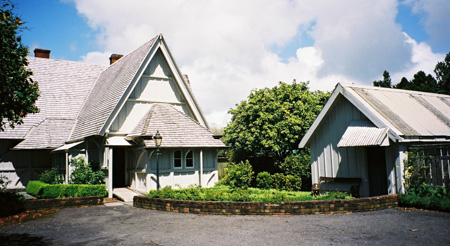
Following MacShane's death in 1848, Dr. Peter Wilson [1791-1863] took up his post and discovered that, while aesthetically pleasing, the building was completely impractical. The hospital lacked a washhouse and the wards were too small and were very cold in winter. Wilson converted the deadhouse into a washhouse and, in 1850, erected a circular porch for outpatients onto the front door of the hospital. The hospital gained an excellent reputation among Maori, and patients travelled from as far as Wanganui to receive treatment.
When the chief Rawiri Waiaua was shot during a confrontation between two factions of the Puketapu hapu of Te Ati Awa in 1854, he was brought to the hospital for treatment. He died shortly afterwards and a tapu was placed over the building. Patient attendance dropped dramatically as a result, although numbers treated as outpatients remained high.
War between Maori and Pakeha over sovereignty and land ownership erupted in the Taranaki district in 1860, and the little-used hospital was eventually converted into a military outpost. When the new Provincial Hospital was opened in New Plymouth in 1867, the building at Henui was handed to the Taranaki Provincial Council. Apart from a brief period in 1872, the building was unused and neglected until its conversion into 'The Refuge', a home for old men, in 1880. At that time there were just twelve officially recognised 'benevolent asylums' in the country. The Refuge was closed for economic reasons in 1903, and the building was auctioned the following year.
Purchased for £10 by Mary King, wife of business man Newton King, the hospital was removed from its Henui site to Brooklands and renamed 'The Gables'. In an interesting twist of fate, Brooklands was the former estate of Captain Henry King, to whom charge of the hospital had been placed 56 years earlier. The family lived in the house until 1934 when, on the death of Mrs King, it was gifted to the city of New Plymouth. Private tenants leased The Gables until 1983, when a two year restoration of the building commenced. It was re-opened as an arts centre in 1985.
The Gables is of immense national significance. It is historically important as a physical reminder of Governor Sir George Grey's policy of assimilation, and of the first attempt to provide quality medical care to all New Zealanders. As the last remaining of the four original hospitals, the building also has rarity value. It is architecturally important as one of the earliest surviving buildings designed by an architect in New Zealand. It is the work of one the country's first architects, Frederick Thatcher, and was used by Thatcher to develop a distinctive form of timber frame construction used in a number of his later buildings. Built in the Anglo-Gothic tradition, the building is a product of the contemporary popularity for this style in England. The Gables is significant for the valuable insight its subsequent history provides into Maori health, and Maori reactions to Pakeha medical care. Made tapu by local iwi in 1854, the building is a sacred place. It has cultural importance through its links with a number of people who played a key part in the development of both New Zealand and the Taranaki region, and as an early example of a refuge for New Zealand's destitute.
Indicating the importance of the venture, Grey commissioned architect Frederick Thatcher [1814-1890] to design the hospital building. Thatcher was an associate of the Institute of British Architects and, since his arrival in New Plymouth in 1843, had designed a number of churches for Anglican Bishop George Selwyn [1809-1878]. Thatcher based his design for the hospital on a plan he conceived in 1841 for a vicarage in Sussex, England. Built of durable heart rimu and brick by carpenter George Robinson and stone masons Thomas Rusden and Samuel Curtis, the building features the steeply pitched roofs and decorative cross-bracing typical of the Anglo-Gothic style. Picturesquely situated on the northern bank of the Henui Stream, the hospital included three wards, a surgery, and a dispensary. An attic room served as servants' quarters, while the 'deadhouse' or mortuary was accommodated in a small building a short distance away. The completed hospital was handed over to the resident magistrate, Captain Henry King, in September 1848.
Located too far from the New Plymouth township to attract Pakeha patients, the building soon became known as 'the native hospital', thwarting Grey's vision of the hospital as a tool of assimilation. It assisted in protecting Maori from new Pakeha diseases to which they had no immunity. In the first year, Dr. Alexander MacShane treated 55 inpatients and 570 outpatients, and administered 380 smallpox vaccinations. Only four of his patients were Pakeha.
Following MacShane's death in 1848, Dr. Peter Wilson [1791-1863] took up his post and discovered that, while aesthetically pleasing, the building was completely impractical. The hospital lacked a washhouse and the wards were too small and were very cold in winter. Wilson converted the deadhouse into a washhouse and, in 1850, erected a circular porch for outpatients onto the front door of the hospital. The hospital gained an excellent reputation among Maori, and patients travelled from as far as Wanganui to receive treatment.
When the chief Rawiri Waiaua was shot during a confrontation between two factions of the Puketapu hapu of Te Ati Awa in 1854, he was brought to the hospital for treatment. He died shortly afterwards and a tapu was placed over the building. Patient attendance dropped dramatically as a result, although numbers treated as outpatients remained high.
War between Maori and Pakeha over sovereignty and land ownership erupted in the Taranaki district in 1860, and the little-used hospital was eventually converted into a military outpost. When the new Provincial Hospital was opened in New Plymouth in 1867, the building at Henui was handed to the Taranaki Provincial Council. Apart from a brief period in 1872, the building was unused and neglected until its conversion into 'The Refuge', a home for old men, in 1880. At that time there were just twelve officially recognised 'benevolent asylums' in the country. The Refuge was closed for economic reasons in 1903, and the building was auctioned the following year.
Purchased for £10 by Mary King, wife of business man Newton King, the hospital was removed from its Henui site to Brooklands and renamed 'The Gables'. In an interesting twist of fate, Brooklands was the former estate of Captain Henry King, to whom charge of the hospital had been placed 56 years earlier. The family lived in the house until 1934 when, on the death of Mrs King, it was gifted to the city of New Plymouth. Private tenants leased The Gables until 1983, when a two year restoration of the building commenced. It was re-opened as an arts centre in 1985.
The Gables is of immense national significance. It is historically important as a physical reminder of Governor Sir George Grey's policy of assimilation, and of the first attempt to provide quality medical care to all New Zealanders. As the last remaining of the four original hospitals, the building also has rarity value. It is architecturally important as one of the earliest surviving buildings designed by an architect in New Zealand. It is the work of one the country's first architects, Frederick Thatcher, and was used by Thatcher to develop a distinctive form of timber frame construction used in a number of his later buildings. Built in the Anglo-Gothic tradition, the building is a product of the contemporary popularity for this style in England. The Gables is significant for the valuable insight its subsequent history provides into Maori health, and Maori reactions to Pakeha medical care. Made tapu by local iwi in 1854, the building is a sacred place. It has cultural importance through its links with a number of people who played a key part in the development of both New Zealand and the Taranaki region, and as an early example of a refuge for New Zealand's destitute.