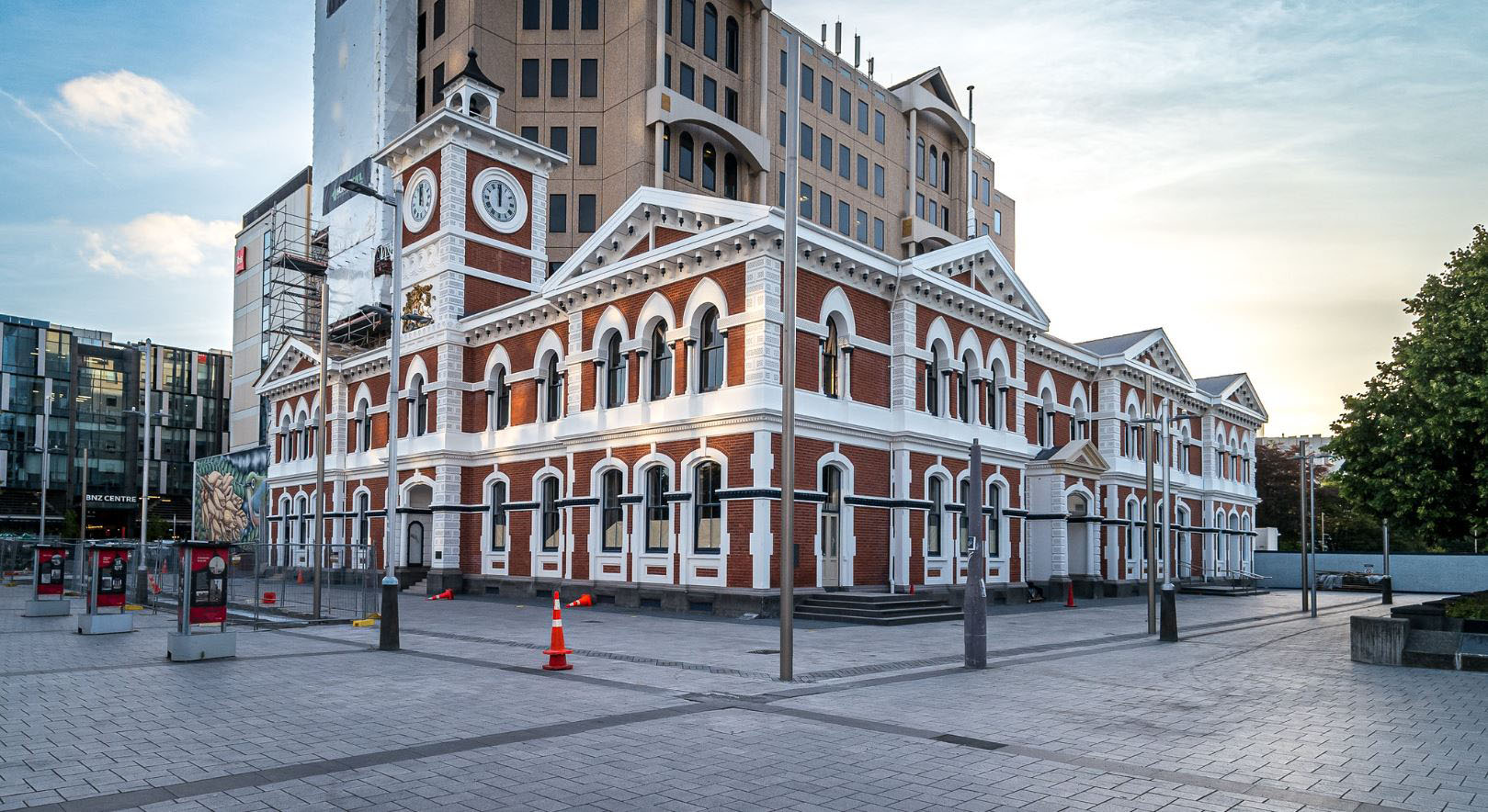
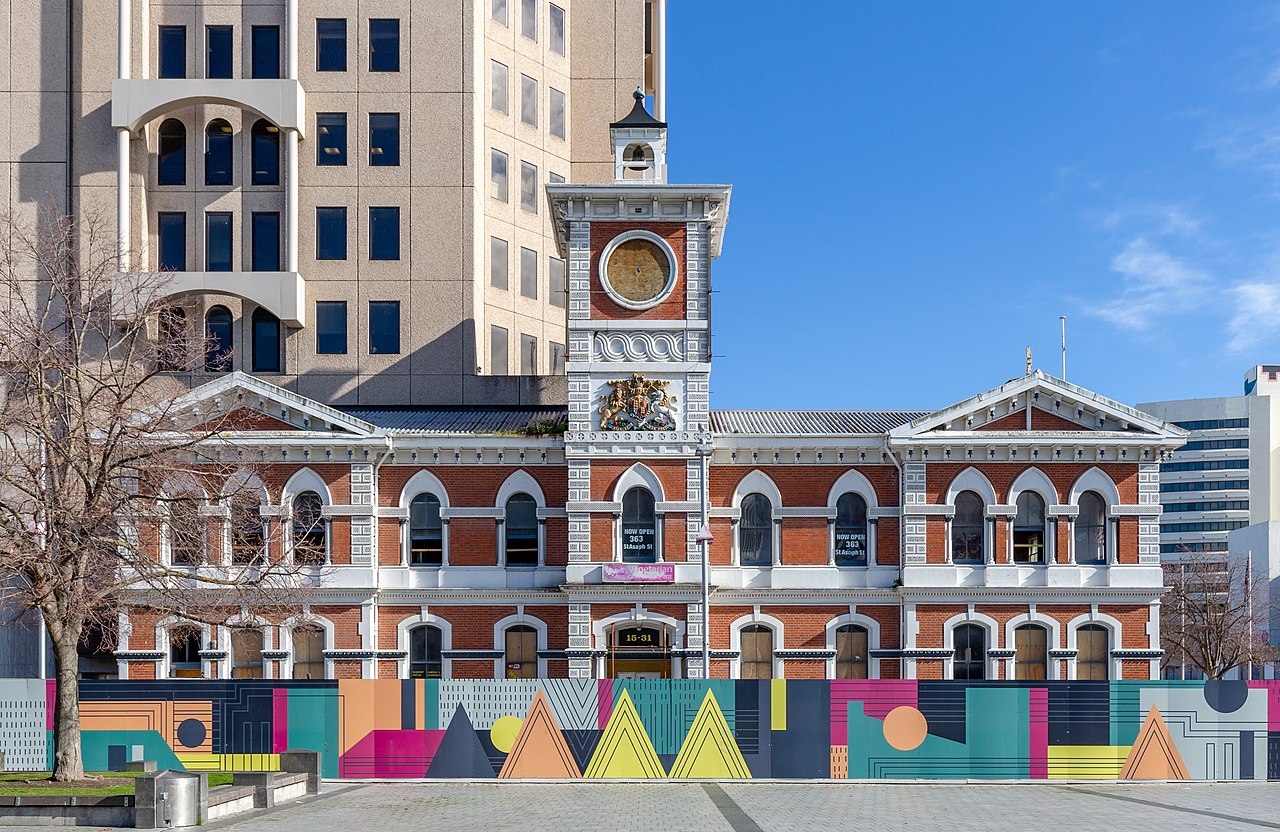
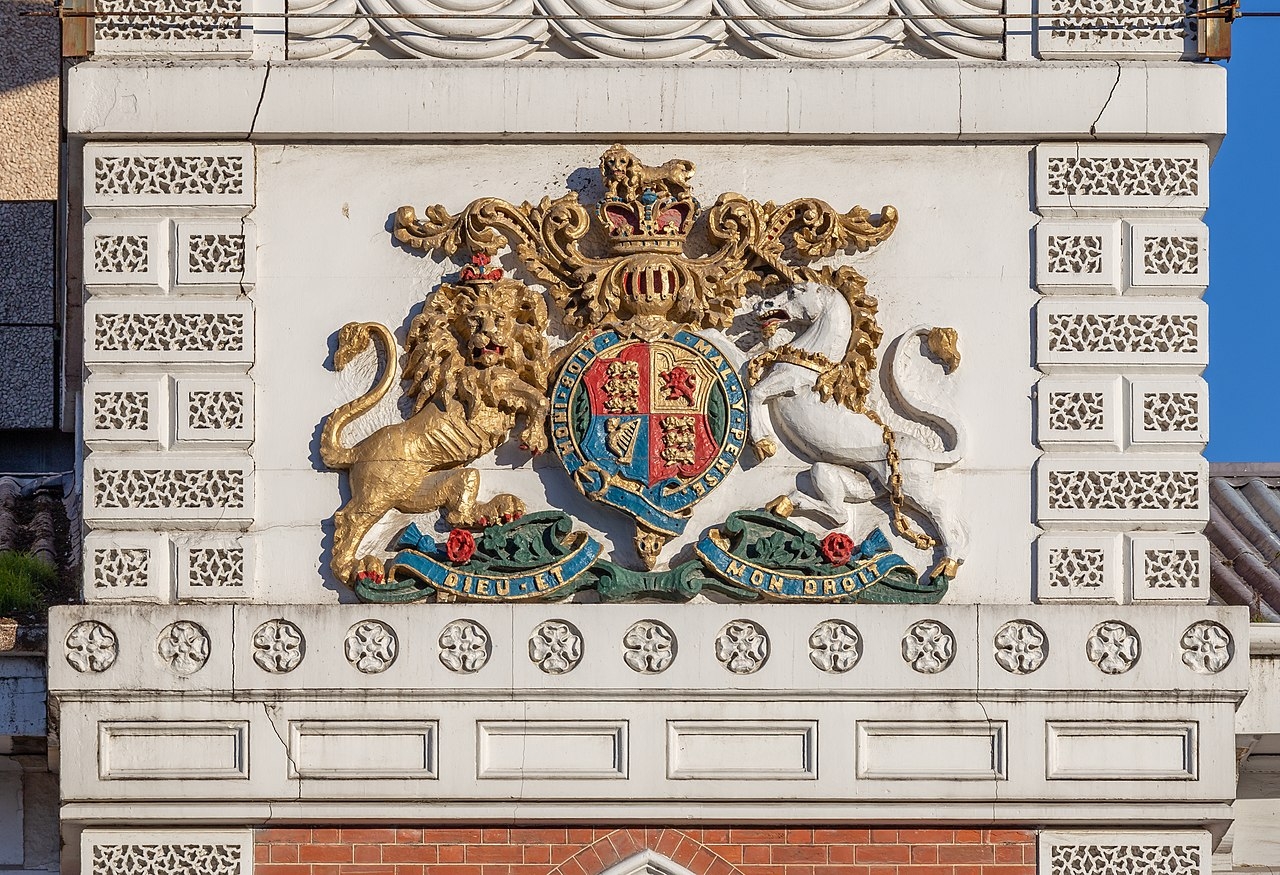
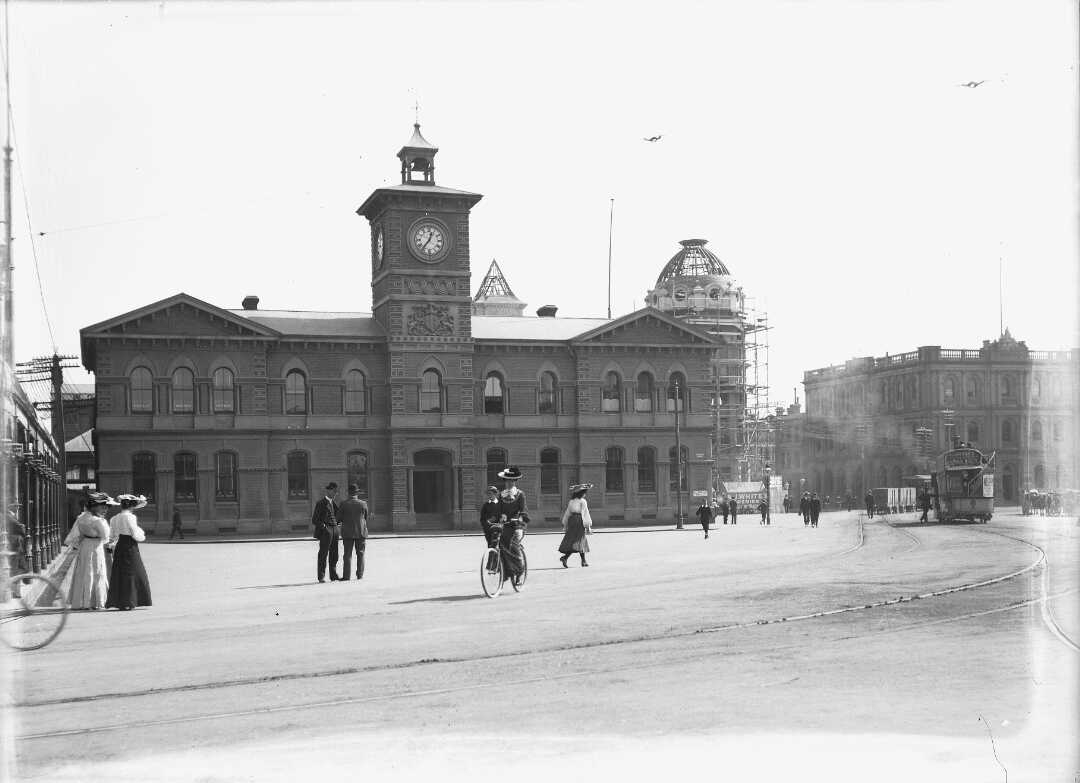
The Christchurch Chief Post Office was built in an Italianate style combining classical and Venetian Gothic elements, such as the pointed arches over the upper windows. Peter Richardson has argued, in his thesis on government architecture in New Zealand, that both the Lyttelton Government Buildings, and the Christchurch Chief Post Office recall Clayton's earlier Italianate design for the Government Buildings in Wellington. These two later buildings differ in the materials used (brick instead of timber), and in the use of Venetian Gothic elements on the facades, a stylistic preference which Clayton saw as particularly appropriate to Canterbury. On the east façade is a clock tower with the British coat of arms above the main entrance.
Initially the building housed Immigration, Customs, and Public Works as well as the Post Office. In 1881 the first telephone exchange in New Zealand was installed in the building, where it remained until 1929. (After that date the telephone exchange was housed in Hereford Street.) In 1907 the building was extended by the addition of a third gabled bay to the western end of the north frontage. From 1913, when the Government Buildings on the other side of Cathedral Square opened, the Post Office was the main occupant of the Chief Post Office, although the Tourist Department retained a bureau there until the 1950s.
The Chief Post Office had been threatened with demolition since the 1930s when the need for a new Post Office was first mooted. However it was not until 1989 that construction started on a new seven storey building, which was erected behind the original north and east wings to provide Telecom with a new telecommunications centre. Some of the original building was demolished during this process.
The Chief Post Office has been a notable feature of Cathedral Square since its completion and provides an important nineteenth century element among the varied buildings around the Square. It is historically significant as one of the early major post offices in New Zealand and as the home of the first telephone exchange in New Zealand.

List Entry Information
Status
Listed
List Entry Status
Historic Place Category 1
Access
Private/No Public Access
List Number
291
Date Entered
2nd April 1985
Date of Effect
2nd April 1985
City/District Council
Christchurch City
Region
Canterbury Region
Extent of List Entry
Extent includes the land described as Lot 3 DP 82408 (RT CB47C/1021), Canterbury Land District and the building known as the Chief Post Office (Former) thereon, and its fittings and fixtures.
Legal description
Lot 3 DP 82408 (RT CB47C/1021), Canterbury Land District
Location Description
Note: the land parcel is not numbered on the LINZ map but is located between nos 13 and 31 Cathedral Square.
Status
Listed
List Entry Status
Historic Place Category 1
Access
Private/No Public Access
List Number
291
Date Entered
2nd April 1985
Date of Effect
2nd April 1985
City/District Council
Christchurch City
Region
Canterbury Region
Extent of List Entry
Extent includes the land described as Lot 3 DP 82408 (RT CB47C/1021), Canterbury Land District and the building known as the Chief Post Office (Former) thereon, and its fittings and fixtures.
Legal description
Lot 3 DP 82408 (RT CB47C/1021), Canterbury Land District
Location Description
Note: the land parcel is not numbered on the LINZ map but is located between nos 13 and 31 Cathedral Square.
Construction Professional
Name
Burrows, Pierre Finch Martineau
Type
Architect
Biography
Burrows was born in Norwich, England, and arrived in New Zealand about 1863. He began working under W H Clayton in the Colonial Architect's Office in 1874 and became Chief Draughtsman in 1875. When Clayton died, Burrows took over his duties, but he did not receive a designation of Colonial Architect. Burrow's most important buildings include the Post Office at Christchurch (1877), the Supreme Court House, Wellington (1879), and the Mount Eden Prison (begun 1883). He was also responsible for a number of smaller post offices and courthouses. His brother Arthur Washington Burrows was also an architect, practising in Auckland and Tauranga.
Name
Clayton, William Henry
Type
Architect
Biography
Born in Tasmania, Clayton (1823-1877) travelled to Europe with his family in 1842. He studied architecture in Brussells and was then articled to Sir John Rennie, engineer to the Admiralty, in London. He returned to Tasmania in 1848 and worked in private practice until he was appointed Government Surveyor in 1852. He resumed private practice in 1855 and was involved with surveying in the Launceston area. In 1857 he was elected an alderman on the Launceston Municipal Council. By the time Clayton immigrated to Dunedin in 1863 he had been responsible for the design of many buildings including churches, banks, a mechanics' institute, a theatre, steam and water mills, breweries, bridges, mansions and villas, in addition to being a land surveyor and road engineer. In 1864 he entered partnership with William Mason. Mason and Clayton were responsible for some important buildings in Dunedin including All Saints Church (1865) and The Exchange (former Post Office) (1865) as well as the Colonial Museum, Wellington (1865). These were two of the most prominent architects of their day in New Zealand. In 1869 Clayton became the first and only Colonial Architect and was responsible for the design of Post and Telegraph offices, courthouses, customhouses, Government department offices and ministerial residences. His acknowledged masterpiece is Government Buildings, Wellington (1876) a stone-simulated wooden building and the largest timber framed building in the Southern Hemisphere. Clayton was a prolific and highly accomplished architect both within the Public Service and in private practice, in New Zealand and Australia. See https://teara.govt.nz/en/biographies/2c20/clayton-william-henry
Construction Details
Start Year
1877
Finish Year
1879
Type
Original Construction
Start Year
1907
Type
Addition
Start Year
1989
Finish Year
1991
Type
Addition
Description
Telecom. Addition of seven storey block behind the original building. Demolition of part of south and west portions of building
Construction Professional
Name
Burrows, Pierre Finch Martineau
Type
Architect
Biography
Burrows was born in Norwich, England, and arrived in New Zealand about 1863. He began working under W H Clayton in the Colonial Architect's Office in 1874 and became Chief Draughtsman in 1875. When Clayton died, Burrows took over his duties, but he did not receive a designation of Colonial Architect. Burrow's most important buildings include the Post Office at Christchurch (1877), the Supreme Court House, Wellington (1879), and the Mount Eden Prison (begun 1883). He was also responsible for a number of smaller post offices and courthouses. His brother Arthur Washington Burrows was also an architect, practising in Auckland and Tauranga.
Name
Clayton, William Henry
Type
Architect
Biography
Born in Tasmania, Clayton (1823-1877) travelled to Europe with his family in 1842. He studied architecture in Brussells and was then articled to Sir John Rennie, engineer to the Admiralty, in London. He returned to Tasmania in 1848 and worked in private practice until he was appointed Government Surveyor in 1852. He resumed private practice in 1855 and was involved with surveying in the Launceston area. In 1857 he was elected an alderman on the Launceston Municipal Council. By the time Clayton immigrated to Dunedin in 1863 he had been responsible for the design of many buildings including churches, banks, a mechanics' institute, a theatre, steam and water mills, breweries, bridges, mansions and villas, in addition to being a land surveyor and road engineer. In 1864 he entered partnership with William Mason. Mason and Clayton were responsible for some important buildings in Dunedin including All Saints Church (1865) and The Exchange (former Post Office) (1865) as well as the Colonial Museum, Wellington (1865). These were two of the most prominent architects of their day in New Zealand. In 1869 Clayton became the first and only Colonial Architect and was responsible for the design of Post and Telegraph offices, courthouses, customhouses, Government department offices and ministerial residences. His acknowledged masterpiece is Government Buildings, Wellington (1876) a stone-simulated wooden building and the largest timber framed building in the Southern Hemisphere. Clayton was a prolific and highly accomplished architect both within the Public Service and in private practice, in New Zealand and Australia. See https://teara.govt.nz/en/biographies/2c20/clayton-william-henry
Construction Details
Start Year
1877
Finish Year
1879
Type
Original Construction
Start Year
1907
Type
Addition
Start Year
1989
Finish Year
1991
Type
Addition
Description
Telecom. Addition of seven storey block behind the original building. Demolition of part of south and west portions of building
Historical and Associated Iwi / Hapū / Whānau
Completion Date
11th December 2001
Report Written By
Melanie Lovell-Smith
Information Sources
New Zealand Federation of University Women, 1995
New Zealand Federation of University Women, Canterbury Branch, Round the Square. A History of Christchurch's Cathedral Square, Christchurch, 1995
Richardson, 1997
Peter Richardson, 'Building the Dominion: Government Architecture in New Zealand 1840-1922', PhD thesis, University of Canterbury, 1997
Other Information
This place was identified as significant under previous legislation with different information requirements. It remains significant under the current legislation. There is opportunity under our legislation and policies to add to this information. Further information about this place may be available from the Southern Regional Office of Heritage New Zealand Pouhere Taonga. Please note that entry on the New Zealand Heritage List/Rarangi Korero identifies only the heritage values of the property concerned, and should not be construed as advice on the state of the property, or as a comment of its soundness or safety, including in regard to earthquake risk, safety in the event of fire, or insanitary conditions.
Historical and Associated Iwi / Hapū / Whānau
Completion Date
11th December 2001
Report Written By
Melanie Lovell-Smith
Information Sources
New Zealand Federation of University Women, 1995
New Zealand Federation of University Women, Canterbury Branch, Round the Square. A History of Christchurch's Cathedral Square, Christchurch, 1995
Richardson, 1997
Peter Richardson, 'Building the Dominion: Government Architecture in New Zealand 1840-1922', PhD thesis, University of Canterbury, 1997
Other Information
This place was identified as significant under previous legislation with different information requirements. It remains significant under the current legislation. There is opportunity under our legislation and policies to add to this information. Further information about this place may be available from the Southern Regional Office of Heritage New Zealand Pouhere Taonga. Please note that entry on the New Zealand Heritage List/Rarangi Korero identifies only the heritage values of the property concerned, and should not be construed as advice on the state of the property, or as a comment of its soundness or safety, including in regard to earthquake risk, safety in the event of fire, or insanitary conditions.
Current Usages
Uses: Civic Facilities
Specific Usage: Information/Visitors Centre
Uses: Trade
Specific Usage: Restaurant/cafe/tearoom
Former Usages
General Usage: Communication
Specific Usage: Post Office
General Usage: Communication
Specific Usage: Telephone Exchange
General Usage: Government
Specific Usage: Government office building
Current Usages
Uses: Civic Facilities
Specific Usage: Information/Visitors Centre
Uses: Trade
Specific Usage: Restaurant/cafe/tearoom
Former Usages
General Usage: Communication
Specific Usage: Post Office
General Usage: Communication
Specific Usage: Telephone Exchange
General Usage: Government
Specific Usage: Government office building
Location
Sign up to hear more
Get the latest heritage news, features and events delivered
straight to your inbox.

