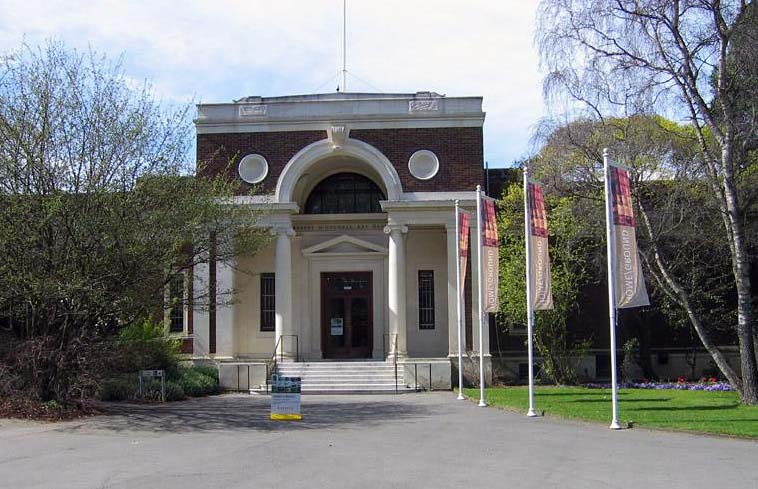
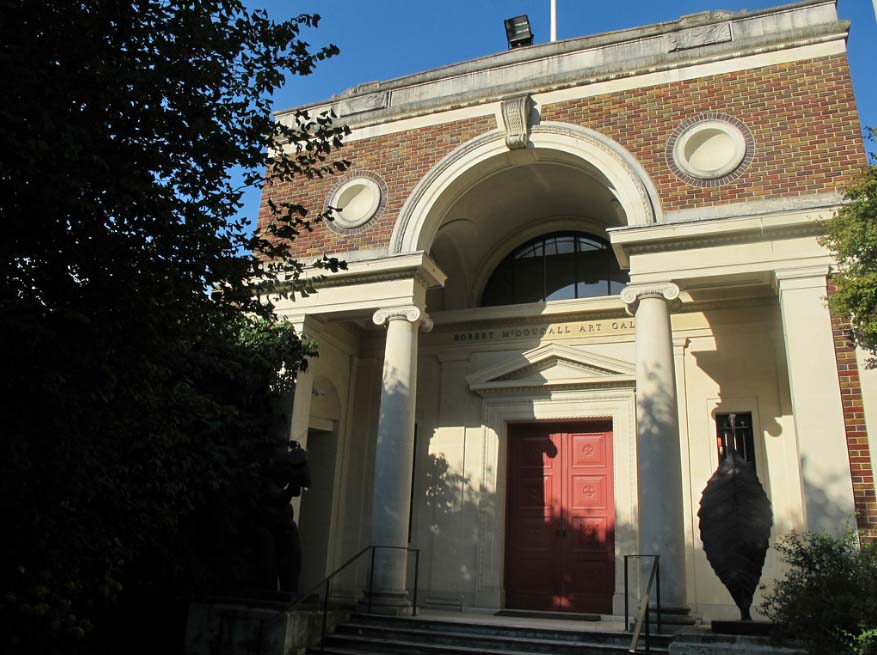
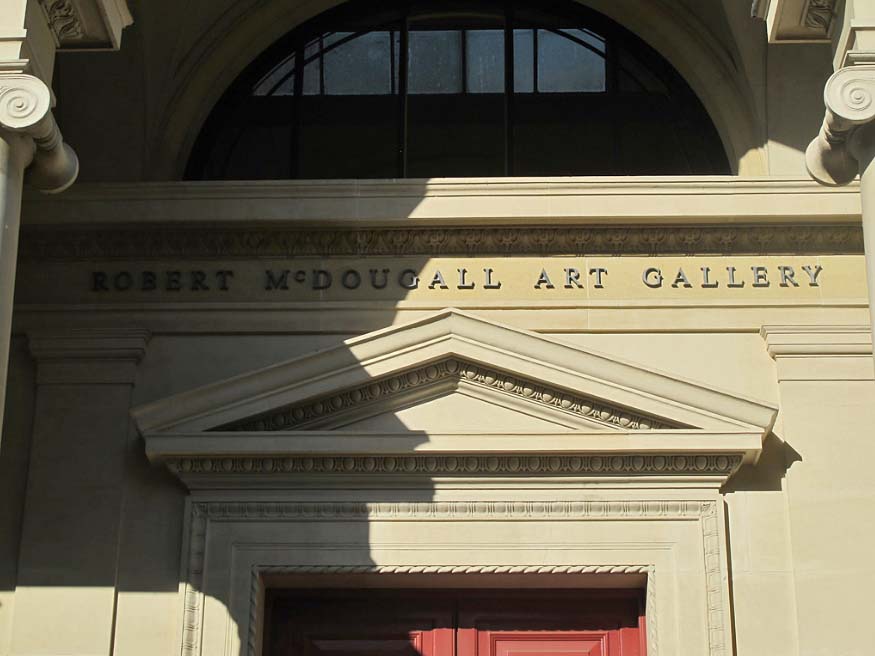
A donation of £25,000 from Robert Ewing McDougall enabled this gallery to be built for the city of Christchurch, and consequently it was named after him. McDougall was the managing director of Aulsebrook's, then the largest biscuit factory in Australasia. The impetus behind his donation appears to be the decision by James Jamieson, in 1925, to leave his substantial art collection to the city on the condition that new premises were built to house it. Legislation was passed in the same year that vested a portion of Hagley Park in the City Council for the purposes of an art gallery. The site selected was tucked behind Canterbury Museum, facing the Botanic Gardens. Despite the passing of this legislation, a referendum asking the citizens of Christchurch whether the council should borrow the money needed to construct an art gallery was defeated and there was little response to the appeal for donations. Dissatisfaction with the site chosen for the art gallery did not help. Jamieson's death in 1927 made the matter more urgent but nothing happened until 1928 when McDougall donated the sum required.
A competition was held to select a design for the new gallery and this was won by the architect Edward Armstrong. Armstrong, born in Gisborne, spent much of his life overseas, living and working in Burma and Britain, among other countries. In the 1950s he returned to Gisborne and practised with the firm Glengarry and Corson until his retirement. He stated that one of the aims of the design of the McDougall Art Gallery was to allow natural light to fall onto the displayed pictures by the use of skylights, without the light falling onto the visitors or the floors. Here he refers to Samuel Hurst Seager's notion of 'top side lighting'. Seager, a noted architect and town planner, as well as an internationally acknowledged expert on the lighting of art galleries had written about 'top side lighting' in 1912 and the incorporation of this form of lighting had been part of the design brief for the Sarjeant Gallery in Wanganui, built in 1917-1919.
Armstrong saw his design for the Christchurch gallery as being similar to that of the Sarjeant Gallery in Wanganui in other ways, through, for example, the inclusion of a large central hall, with scagliola columns, marble floor and lofty roof. (Scagliola is a material used since Roman times to imitate marble and other coloured stones.) The McDougall Gallery was constructed in brick and concrete and faced with Oamaru stone. Stylistically the Gallery is classical, not an unusual choice for such a civic building, but it is a classical architecture influenced, and therefore pared back, by the modernist movement of the 1920s and 1930s.
Keith Thomson states that when the McDougall Gallery was opened in 1932 it was one of the most up-to-date in the southern hemisphere. At the time of its opening the Canterbury Society of Arts, who had been agitating for a city gallery for a number of years, formally presented their collection of artworks to the McDougall. In total the new gallery housed 160 works, the majority of which came from two collections, the CSA and James Jamieson. By 1961 the McDougall's collection had grown to 325 works, and by 2001 it totalled over 5,000 items.
At the time of writing a new gallery is being constructed on a new site and is due for completion in 2003. The Gallery states that a new building is needed as less than ten percent of the permanent collection can be displayed at any one time and many international exhibitions cannot be shown because of its limited size and facilities. While the fate of the 1932 building is not yet known, it is possible that it might become part of the Canterbury Museum.
This building is significant as Christchurch's public art gallery since 1932 and it stands as a memorial to Robert McDougall, whose 1928 donation funded the building of the gallery. It was one of a number of significant civic landmarks built in Christchurch during the 1930s despite the Depression, and it forms a significant part of the townscape around the Botanic Gardens, in conjunction with the Canterbury Museum.
A competition was held to select a design for the new gallery and this was won by the architect Edward Armstrong. Armstrong, born in Gisborne, spent much of his life overseas, living and working in Burma and Britain, among other countries. In the 1950s he returned to Gisborne and practised with the firm Glengarry and Corson until his retirement. He stated that one of the aims of the design of the McDougall Art Gallery was to allow natural light to fall onto the displayed pictures by the use of skylights, without the light falling onto the visitors or the floors. Here he refers to Samuel Hurst Seager's notion of 'top side lighting'. Seager, a noted architect and town planner, as well as an internationally acknowledged expert on the lighting of art galleries had written about 'top side lighting' in 1912 and the incorporation of this form of lighting had been part of the design brief for the Sarjeant Gallery in Wanganui, built in 1917-1919.
Armstrong saw his design for the Christchurch gallery as being similar to that of the Sarjeant Gallery in Wanganui in other ways, through, for example, the inclusion of a large central hall, with scagliola columns, marble floor and lofty roof. (Scagliola is a material used since Roman times to imitate marble and other coloured stones.) The McDougall Gallery was constructed in brick and concrete and faced with Oamaru stone. Stylistically the Gallery is classical, not an unusual choice for such a civic building, but it is a classical architecture influenced, and therefore pared back, by the modernist movement of the 1920s and 1930s.
Keith Thomson states that when the McDougall Gallery was opened in 1932 it was one of the most up-to-date in the southern hemisphere. At the time of its opening the Canterbury Society of Arts, who had been agitating for a city gallery for a number of years, formally presented their collection of artworks to the McDougall. In total the new gallery housed 160 works, the majority of which came from two collections, the CSA and James Jamieson. By 1961 the McDougall's collection had grown to 325 works, and by 2001 it totalled over 5,000 items.
At the time of writing a new gallery is being constructed on a new site and is due for completion in 2003. The Gallery states that a new building is needed as less than ten percent of the permanent collection can be displayed at any one time and many international exhibitions cannot be shown because of its limited size and facilities. While the fate of the 1932 building is not yet known, it is possible that it might become part of the Canterbury Museum.
This building is significant as Christchurch's public art gallery since 1932 and it stands as a memorial to Robert McDougall, whose 1928 donation funded the building of the gallery. It was one of a number of significant civic landmarks built in Christchurch during the 1930s despite the Depression, and it forms a significant part of the townscape around the Botanic Gardens, in conjunction with the Canterbury Museum.