At Greymouth the station buildings were to consist of a second-class passenger-station, platform and a goods-shed 100ft. x 40ft (30.5m x 12m). The term 'second-class passenger-station' refers to one of the standard designs that formed the basis of most of the railway stations erected during the late nineteenth century expansion of New Zealand's railways. This expansion of the railway network began as part of Sir Julius Vogel's (1835-1899) immigration and public works scheme. Standard designs were an easy way of coping with the numbers of buildings that needed to be erected in a relatively short space of time. These early standard designs ranged from large stations with gabled roofs to very simple single room lean-tos.Greymouth Railway Station is one of the few second-class stations ever erected.
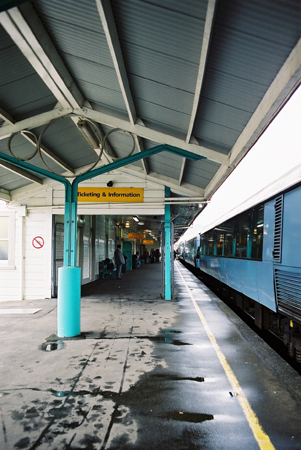
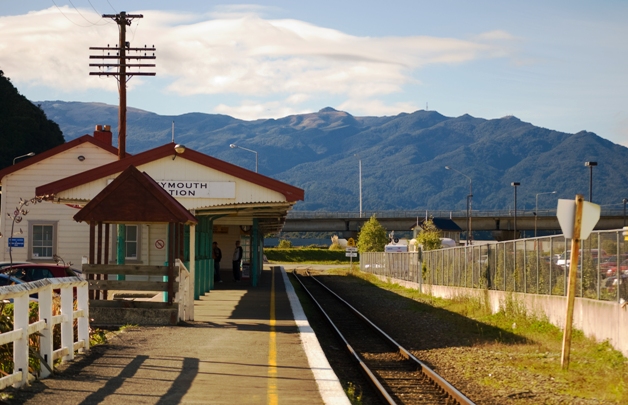
The main station building is a long, rectangular wooden structure and backs onto Mackay Street. A verandah runs the length of the building on the platform side, and a free-standing shelter extends on either side of the building. The station building is one room deep and housed, from west to east, foreman's office, storeroom, porters' room, parcel and freight inspector's offices, a parcel store, booking office, ticket lobby, waiting room, bookstall and women's toilets. All of the rooms were entered from the platform side with the exception of the ticket office, which could also be accessed from Mackay Street. Now the station building houses a rental car agency and an information centre.
A collection of outbuildings once stood at the east end of the railway station, which housed the men's toilets, lamp room, coal shed and footwarmer store. These were demolished as part of a refurbishment during the late 1990s. The station is also associated with the adjacent footbridge, which was constructed as part of the re-arrangement of the railway yard in the late 1920s. The footbridge is also registered by the New Zealand Historic Places Trust/Pouhere Taonga, but has, unfortunately, recently been dismantled.
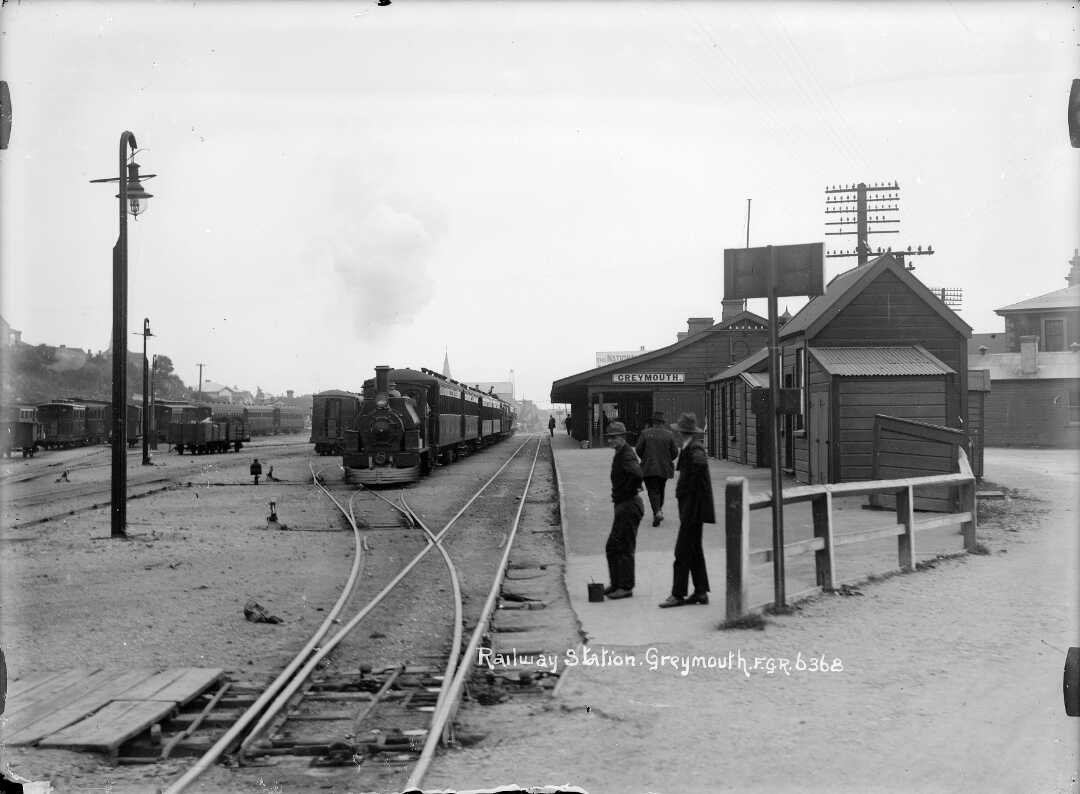
The Greymouth Railway Station was a pivotal part of the West Coast railway system; a railway system that was essential for the exploitation of the West Coast resources such as coal and timber. The station has been the district headquarters of the railways on the West Coast and a busy passenger station for nearly 100 years. Although both passenger and freight business declined during the 1970s the success of the TranzAlpine train journey between Christchurch and Greymouth has revived the station to some extent in recent years. The station building itself is one of the few examples of second-class passenger stations built in New Zealand and is an important feature of the Greymouth townscape.


List Entry Information
Status
Listed
List Entry Status
Historic Place Category 1
Access
Private/No Public Access
List Number
3039
Date Entered
28th June 1990
Date of Effect
28th June 1990
City/District Council
Grey District
Region
West Coast Region
Extent of List Entry
Extent includes the land described as Lot 1 DP 3735 (RT WS8C/418), Westland Land District and the building known as Greymouth Railway Station thereon.
Legal description
Lot 1 DP 3735 (RT WS8C/418), Westland Land District
Status
Listed
List Entry Status
Historic Place Category 1
Access
Private/No Public Access
List Number
3039
Date Entered
28th June 1990
Date of Effect
28th June 1990
City/District Council
Grey District
Region
West Coast Region
Extent of List Entry
Extent includes the land described as Lot 1 DP 3735 (RT WS8C/418), Westland Land District and the building known as Greymouth Railway Station thereon.
Legal description
Lot 1 DP 3735 (RT WS8C/418), Westland Land District
Why is this place significant?
Historic Significance
Historical Significance or Value Before the Otira Tunnel opened in 1923 Greymouth was the hub of a self-contained railway complex of some magnitude, both in the number of lines and their volume of traffic. All the West Coast railway operations were formerly supervised from the district headquarters at Greymouth and in recent times the station has regained some of its importance with the introduction of the Trans-Alpine Scenic railway.
Physical Significance
ARCHITECTURAL QUALITY: The Greymouth Railway Station is a good example of the standard Class 2 station erected in New Zealand's larger provincial centres in the late nineteenth century. Standardisation of design was first applied to railway stations in this country in the 1870s and was developed and continued by George Troup well into the twentieth century as it was the most economical way of designing the hundreds of stations needed throughout the country. Standardisation also created a uniform corporate image for the Railways Department and to this end the stations even had a standardised colour scheme. Six classes of stations were erected nationwide, of which the largest three had gabled roofs and the remainder were of lean-to construction. Only a handful of Class 2 stations were ever built in New Zealand, however, as it was difficult to meet the specialised needs of larger complexes with a standardised design. The Greymouth station is a building of few architectural pretensions but which is nevertheless architecturally important because of its relatively unaltered state and because its adjacent outbuildings, once a feature of most large stations, are still extant. TOWNSCAPE/LANDMARK VALUE: The railway station is a prominent feature of the Greymouth townscape, although the main station building presents a very unprepossessing facade to Mackay Street.
Why is this place significant?
Historic Significance
Historical Significance or Value Before the Otira Tunnel opened in 1923 Greymouth was the hub of a self-contained railway complex of some magnitude, both in the number of lines and their volume of traffic. All the West Coast railway operations were formerly supervised from the district headquarters at Greymouth and in recent times the station has regained some of its importance with the introduction of the Trans-Alpine Scenic railway.
Physical Significance
ARCHITECTURAL QUALITY: The Greymouth Railway Station is a good example of the standard Class 2 station erected in New Zealand's larger provincial centres in the late nineteenth century. Standardisation of design was first applied to railway stations in this country in the 1870s and was developed and continued by George Troup well into the twentieth century as it was the most economical way of designing the hundreds of stations needed throughout the country. Standardisation also created a uniform corporate image for the Railways Department and to this end the stations even had a standardised colour scheme. Six classes of stations were erected nationwide, of which the largest three had gabled roofs and the remainder were of lean-to construction. Only a handful of Class 2 stations were ever built in New Zealand, however, as it was difficult to meet the specialised needs of larger complexes with a standardised design. The Greymouth station is a building of few architectural pretensions but which is nevertheless architecturally important because of its relatively unaltered state and because its adjacent outbuildings, once a feature of most large stations, are still extant. TOWNSCAPE/LANDMARK VALUE: The railway station is a prominent feature of the Greymouth townscape, although the main station building presents a very unprepossessing facade to Mackay Street.
Construction Professional
Name
Troup, George Alexander
Type
Architect
Biography
G A Troup (1863-1941) was born in London in 1863 and educated in Scotland. He trained as an architect and engineer under C E Calvert of Edinburgh and came to New Zealand in 1884. After a short time with the Survey Department in Otago he became a draughtsman for New Zealand Railways in Dunedin and then, from 1888, in Wellington. Troup became Chief Draughtsman in 1894. He designed many station buildings throughout the county, some of which are still in use today; these buildings form an important part of New Zealand's landscape. His best known building is the Dunedin Railway Station (1904-07). He also designed the head office building in Wellington for Railways (1901, now demolished). Troup became a Fellow of the Royal Institute of British Architects in 1907. After World War I he was promoted to head the newly established Architectural Branch of New Zealand Railways. On retirement from Railways in 1925 he entered local body politics and was Mayor of Wellington from 1927 to 1931. Troup was prominent in the Presbyterian Church and founded the Presbyterian Young Men's Bible Class Union. He was an elder of the church for 47 years and also served on the governing bodies of several Wellington secondary schools. Education was a life-long interest and he was keenly involved in the training of engineering cadets in New Zealand Railways. Troup was knighted in 1937 and died in 1941. Last updated 1 October 2014 See also: James Veitch. 'Troup, George Alexander', Dictionary of New Zealand Biography, first published in 1993. Te Ara - the Encyclopedia of New Zealand, https://teara.govt.nz/en/biographies/2t49/troup-george-alexander
Construction Details
Start Year
1894
Finish Year
1895
Type
Original Construction
Start Year
1920
Type
Modification
Description
Parcel office extended
Start Year
1925
Finish Year
1926
Type
Addition
Description
Porters' room added
Start Year
1934
Type
Modification
Description
Platform extended
Start Year
1936
Type
Modification
Description
Verandah extended
Construction Materials
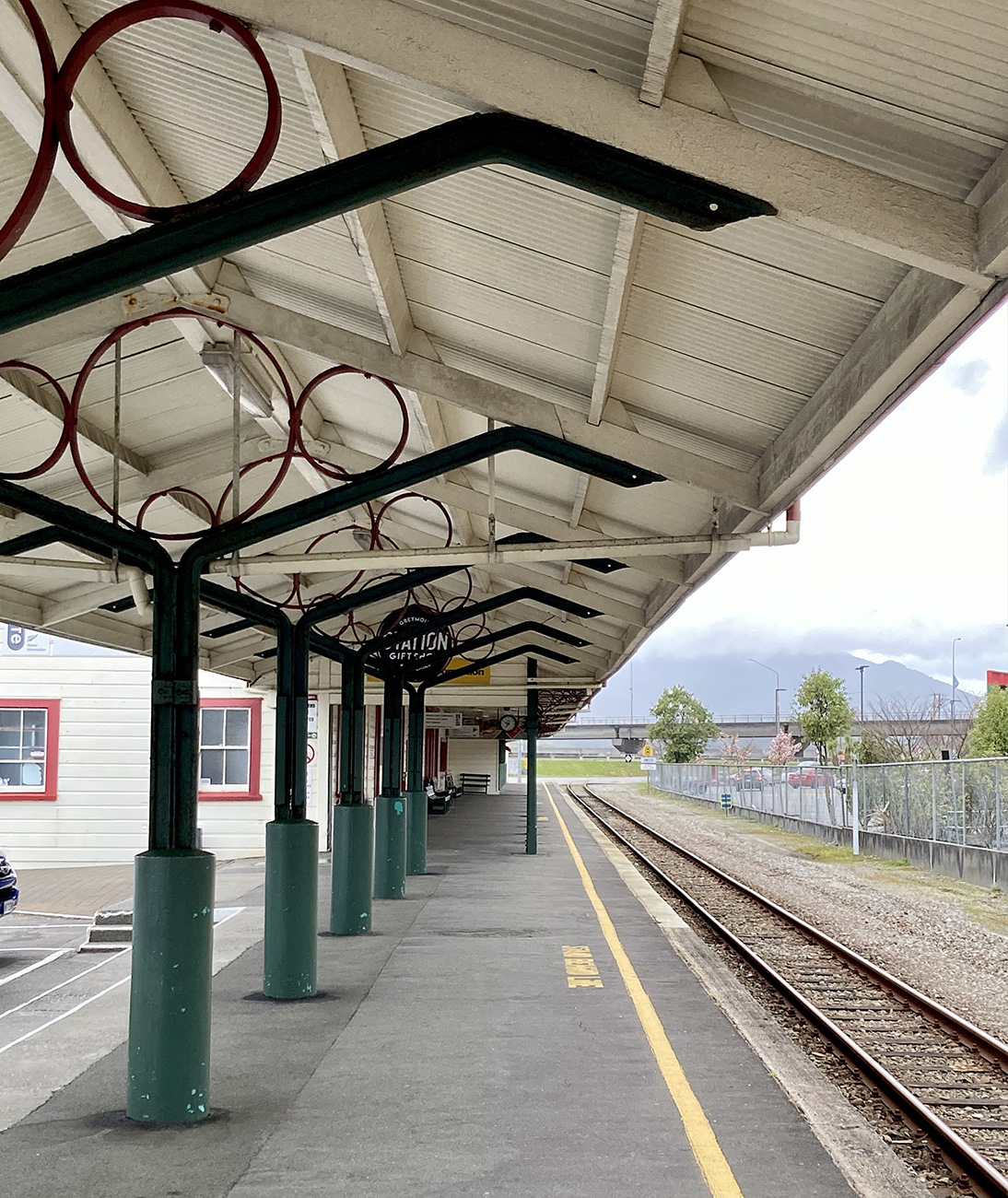
Timber frame structure clad in rusticated weatherboards with wooden internal linings and a corrugated iron roof. Aluminium cladding north side of main station building. Freestanding platform shelters flanking station are supported by railway iron and circular steel hoops.
Construction Professional
Name
Troup, George Alexander
Type
Architect
Biography
G A Troup (1863-1941) was born in London in 1863 and educated in Scotland. He trained as an architect and engineer under C E Calvert of Edinburgh and came to New Zealand in 1884. After a short time with the Survey Department in Otago he became a draughtsman for New Zealand Railways in Dunedin and then, from 1888, in Wellington. Troup became Chief Draughtsman in 1894. He designed many station buildings throughout the county, some of which are still in use today; these buildings form an important part of New Zealand's landscape. His best known building is the Dunedin Railway Station (1904-07). He also designed the head office building in Wellington for Railways (1901, now demolished). Troup became a Fellow of the Royal Institute of British Architects in 1907. After World War I he was promoted to head the newly established Architectural Branch of New Zealand Railways. On retirement from Railways in 1925 he entered local body politics and was Mayor of Wellington from 1927 to 1931. Troup was prominent in the Presbyterian Church and founded the Presbyterian Young Men's Bible Class Union. He was an elder of the church for 47 years and also served on the governing bodies of several Wellington secondary schools. Education was a life-long interest and he was keenly involved in the training of engineering cadets in New Zealand Railways. Troup was knighted in 1937 and died in 1941. Last updated 1 October 2014 See also: James Veitch. 'Troup, George Alexander', Dictionary of New Zealand Biography, first published in 1993. Te Ara - the Encyclopedia of New Zealand, https://teara.govt.nz/en/biographies/2t49/troup-george-alexander
Construction Details
Start Year
1894
Finish Year
1895
Type
Original Construction
Start Year
1920
Type
Modification
Description
Parcel office extended
Start Year
1925
Finish Year
1926
Type
Addition
Description
Porters' room added
Start Year
1934
Type
Modification
Description
Platform extended
Start Year
1936
Type
Modification
Description
Verandah extended
Construction Materials
Timber frame structure clad in rusticated weatherboards with wooden internal linings and a corrugated iron roof. Aluminium cladding north side of main station building. Freestanding platform shelters flanking station are supported by railway iron and circular steel hoops.
DESCRIPTION: The first railway station in Greymouth was erected in 1876 to serve the first railway line on the West Coast which ran from Greymouth to the Brunner coal mine. This building was a Class 4 standard railways design and it was subsequently replaced in 1897 by the present station. For many years staff from the railway station had offices in the nearby Government Building because there was insufficient room in the station itself. Despite this the station was never substantially altered or replaced.
ARCHITECTURAL DESCRIPTION: The Greymouth Railway Station is a through station which stands at the eastern end of the township. Built five years after George Troup became Chief Draughtsman of the New Zealand Railways Department, the station building which is a standard Class 2 design, borders on Mackay Street without an intervening footpath. Beneath the gabled roof, the building is one room wide for the most part and it houses, from west to east, a foremen's office, store room, porters', parcels and freight inspector's offices, a parcel store, booking office, ticket lobby, waiting room, bookstall, and women's toilets. Large sash windows, with fanlights above those on the south wall, light these rooms and the ticket lobby has double doors at both ends, thus providing passenger access from the platform to Mackay Street. Over the platform the building has a lean-to verandah which is supported by chamfered wooden columns with diagonal braces and wrought iron brackets between the columns and verandah eaves which feature circular insets. These are complemented by the steel hoops which lie between the gable apex and I-beam supports of the freestanding platform shelter which extends from each end of the main building. By contrast the northern wall of the station has very shallow eaves and so offers no protection from the weather for people using the Mackay Street parcel and passenger entrances. At the eastern end of the platform, adjacent to the main station building, are a group of outbuildings, also clad in rusticated weatherboards, which house the men's toilets, footwarmers' store, lamp room and coal sheds. MODIFICATIONS: 1907 Platform lengthened. 1915 Verandah and platform extended west end by 30.5 metres. 1916 Dog boxes built at east end of station building. 1922 Bicycle shelter erected beside dog boxes and parcels office extended. 1926 Porters' locker room erected in place of bicycle shelter, further bicycle stand built. 1934 Platform lengthened eighteen metres to the west. 1936 Lean-to sections of outbuildings removed, lamp room shifted and main to conform with footwarmers' store, dog boxes moved to other side of yard. Verandah extended by 30.5 metres to the east. 1947 Partition between waiting room and ticket lobby erected. 1952 Platform resurfaced and faced with concrete. 1961 Verandah over Mackay Street entrance pulled down. Post 1970 Aluminium cladding fitted north wall of station building. Internal partitions erected in parcels store to create a private office.
Historical and Associated Iwi / Hapū / Whānau
Completion Date
16th May 2002
Report Written By
Melanie Lovell-Smith
Information Sources
Appendices to the Journals of the House of Representatives (AJHR)
Appendices to the Journals of the House of Representatives
Archives New Zealand (Chch)
Archives New Zealand (Christchurch)
Cyclopedia of New Zealand, 1906
Cyclopedia Company, Industrial, descriptive, historical, biographical facts, figures, illustrations, Wellington, N.Z, 1897-1908, Vol. 5, Nelson, Marlborough, Westland, 1906
Department of Conservation
Garner, 1996
John Garner, Guide to New Zealand Rail Heritage, Wellington, 1996
Leitch, 1972
David B. Leitch, Railways of New Zealand, Auckland, 1972
Mahoney, 1987
J. D. Mahoney, Down at the Station: A Study of the New Zealand Railway Station, Palmerston North, 1987
New Zealand Historic Places Trust (NZHPT)
New Zealand Historic Places Trust
Noonan, 1975
Rosslyn J. Noonan, By Design: A Brief History of the Public Works Department Ministry of Works 1870-1970, Wellington, 1975
Rail Heritage Trust of New Zealand Register
Roberts, 1998
F.K. Roberts, A Compendium of Railway Construction: a summary of the Public Works statements from 1889-1941. Part Three, Nelson and West Coast Region, Wellington, 1998
Troup, 1982
G. Troup, George Troup: Architect and Engineer, Palmerston North, 1982
University of Canterbury
West Coast Scrapbook
Other Information
This historic place was registered under the Historic Places Act 1980. This report includes the text from the original Building Classification Committee report considered by the NZHPT Board at the time of registration. Please note that entry on the New Zealand Heritage List/Rarangi Korero identifies only the heritage values of the property concerned, and should not be construed as advice on the state of the property, or as a comment of its soundness or safety, including in regard to earthquake risk, safety in the event of fire, or insanitary conditions.
Historical and Associated Iwi / Hapū / Whānau
Completion Date
16th May 2002
Report Written By
Melanie Lovell-Smith
Information Sources
Appendices to the Journals of the House of Representatives (AJHR)
Appendices to the Journals of the House of Representatives
Archives New Zealand (Chch)
Archives New Zealand (Christchurch)
Cyclopedia of New Zealand, 1906
Cyclopedia Company, Industrial, descriptive, historical, biographical facts, figures, illustrations, Wellington, N.Z, 1897-1908, Vol. 5, Nelson, Marlborough, Westland, 1906
Department of Conservation
Garner, 1996
John Garner, Guide to New Zealand Rail Heritage, Wellington, 1996
Leitch, 1972
David B. Leitch, Railways of New Zealand, Auckland, 1972
Mahoney, 1987
J. D. Mahoney, Down at the Station: A Study of the New Zealand Railway Station, Palmerston North, 1987
New Zealand Historic Places Trust (NZHPT)
New Zealand Historic Places Trust
Noonan, 1975
Rosslyn J. Noonan, By Design: A Brief History of the Public Works Department Ministry of Works 1870-1970, Wellington, 1975
Rail Heritage Trust of New Zealand Register
Roberts, 1998
F.K. Roberts, A Compendium of Railway Construction: a summary of the Public Works statements from 1889-1941. Part Three, Nelson and West Coast Region, Wellington, 1998
Troup, 1982
G. Troup, George Troup: Architect and Engineer, Palmerston North, 1982
University of Canterbury
West Coast Scrapbook
Other Information
This historic place was registered under the Historic Places Act 1980. This report includes the text from the original Building Classification Committee report considered by the NZHPT Board at the time of registration. Please note that entry on the New Zealand Heritage List/Rarangi Korero identifies only the heritage values of the property concerned, and should not be construed as advice on the state of the property, or as a comment of its soundness or safety, including in regard to earthquake risk, safety in the event of fire, or insanitary conditions.
Current Usages
Uses: Civic Facilities
Specific Usage: Information/Visitors Centre
Uses: Trade
Specific Usage: Shop
Uses: Transport
Specific Usage: Railway station/ platform/ refreshment room
Former Usages
General Usage: Transport
Specific Usage: Railway station/ platform/ refreshment room
Current Usages
Uses: Civic Facilities
Specific Usage: Information/Visitors Centre
Uses: Trade
Specific Usage: Shop
Uses: Transport
Specific Usage: Railway station/ platform/ refreshment room
Former Usages
General Usage: Transport
Specific Usage: Railway station/ platform/ refreshment room
Stay up to date with Heritage this month


