DonateSupporterVisit Heritage
  • Tūrangawaewae
    Places
  • Tira Māori
    Māori Heritage
  • Poutairangahia
    Archaeology
  • Rauemi
    Resources
  • Mō Tātou
    About Us
  • New Zealand Heritage List
  • Nominate and submit
  • Explore the List
  • National Historic Landmarks
  • Plaques
  • Rainbow List Project
  • Lost heritage
  • Visit Heritage
  • Our properties
  • Turnbull House Project
  • Collections
  • Shop
  • Tohu Whenua
  • Tira Māori
  • Conserving Māori heritage
  • Marae built heritage
  • Māori heritage on the List
  • Hinemihi—Te Hokinga Mai
  • What is archaeology?
  • Is there a site on my property?
  • What are my legal requirements?
  • Affecting an archaeological site
  • Declaring an archaeological site
  • Archaeology FAQs
  • Archaeology Digital Library
  • Archaeology guidelines and templates
  • Resources
  • Funding
  • Publications
  • Sustainable management guides
  • Disaster recovery
  • Podcasts & digital resources
  • Education Hub
  • Conservation plans
  • About
  • Board
  • Māori Heritage Council
  • Senior Staff
  • Offices
  • Contact us
  • Careers
  • Covenants
  • Fast-track
  • Corporate documents
  • Currently consulting on
  • Our submissions
  • News
  • Covid-19 response
Quick links
Rārangi Kōrero | The List
Explore the List
National Historic Landmarks
Ngā Manawhenua o Aotearoa me ōna Kōrero Tūturu
Quick links
Tapuwae
A Vision for Places of Māori Heritage
Funding for Māori Heritage
Resources
Quick links
Archaeological Authority Portal
Applying for an archaeological authority
Archaeology FAQs
Browse the most frequently asked questions about archaeological authorities and the archaeological process.
Quick links
Quick links
Contact us
Offices
DonateSupporterVisit Heritage
  • Tūrangawaewae
    Places
  • Tira Māori
    Māori Heritage
  • Poutairangahia
    Archaeology
  • Rauemi
    Resources
  • Mō Tātou
    About Us
  • New Zealand Heritage List
  • Nominate and submit
  • Explore the List
  • National Historic Landmarks
  • Plaques
  • Rainbow List Project
  • Lost heritage
  • Visit Heritage
  • Our properties
  • Turnbull House Project
  • Collections
  • Shop
  • Tohu Whenua
  • Tira Māori
  • Conserving Māori heritage
  • Marae built heritage
  • Māori heritage on the List
  • Hinemihi—Te Hokinga Mai
  • What is archaeology?
  • Is there a site on my property?
  • What are my legal requirements?
  • Affecting an archaeological site
  • Declaring an archaeological site
  • Archaeology FAQs
  • Archaeology Digital Library
  • Archaeology guidelines and templates
  • Resources
  • Funding
  • Publications
  • Sustainable management guides
  • Disaster recovery
  • Podcasts & digital resources
  • Education Hub
  • Conservation plans
  • About
  • Board
  • Māori Heritage Council
  • Senior Staff
  • Offices
  • Contact us
  • Careers
  • Covenants
  • Fast-track
  • Corporate documents
  • Currently consulting on
  • Our submissions
  • News
  • Covid-19 response
Quick links
Rārangi Kōrero | The List
Explore the List
National Historic Landmarks
Ngā Manawhenua o Aotearoa me ōna Kōrero Tūturu
Quick links
Tapuwae
A Vision for Places of Māori Heritage
Funding for Māori Heritage
Resources
Quick links
Archaeological Authority Portal
Applying for an archaeological authority
Archaeology FAQs
Browse the most frequently asked questions about archaeological authorities and the archaeological process.
Quick links
Quick links
Contact us
Offices
  • Places
  • Nominate and submit
  • National Historic Landmarks
  • Places
  • Nominate and submit
  • National Historic Landmarks
  • Tira Māori
  • Conserving Māori heritage
  • Marae built heritage
  • Tira Māori
  • Conserving Māori heritage
  • Marae built heritage
  • Archaeological authorities
  • Archaeology Digital Library
  • Archaeological authorities
  • Archaeology Digital Library
  • All resources
  • Publications
  • Funding
  • All resources
  • Publications
  • Funding
  • FAQs
  • FAQs
Follow us on:
Places
  • Places
  • Nominate and submit
  • National Historic Landmarks
Tira Māori
  • Tira Māori
  • Conserving Māori heritage
  • Marae built heritage
Archaeology
  • Archaeological authorities
  • Archaeology Digital Library
Resources
  • All resources
  • Publications
  • Funding
FAQs
  • FAQs
Follow us on
HomePrivacyTerms and conditionsAbout this site
© Heritage New Zealand Pouhere Taonga 2026.
 
Bank Street Church

38-40 Bank Street, TIMARU

Private

Historic Place Category 2

List No. 3155

Quick links:
List GalleryLocationDetails
Until the late 1850's, Timaru was a tiny settlement serving 'The Levels' pastoral run (1851) of the Rhodes brothers. Organised settlement began with direct immigration in 1859, and thereafter the town grew rapidly. The first Wesleyan service in Timaru was held in 1863 in a private house in the area of Sandie Town. The Reverend James Buller, Chairman of the District, visited later the same year and the decision was made to establish a circuit. The first minister arrived in 1865. That same year, the Rhodes family donated a central Bank Street site and a wooden church was built. This was enlarged in 1868.

The enlarged church did not serve for long however, for the foundation stone for a new stone church seating 300 persons was laid by the Rev. Buller on October 28, 1874. Designed by F. Wilson and built by S. Harding, the building opened on March 21 the following year at a cost of £1120. The old wooden church was subsequently shifted to the rear of the site for use as a schoolroom. To allow for future growth, the new church was fitted with a timber rear wall. This expansion took place in 1890 when the stone nave was extended by 21 ft, and a wooden chancel with vestry and choir rooms added at a total cost of £500. This provided capacity for another 140 persons.

Renovations to modernise and enhance the building were carried out in 1930 by architects Turnbull and Rule and builders Harding and Co. The main entrance was removed from the east façade, and repositioned at the east end of the north façade under a new stone tower and 80 ft spire. New leadlights, including two figural stained glass memorial windows (one a WWI memorial), and a raked floor were installed. A brick choir vestry was added at the rear of the wooden chancel, with both probably stuccoed to match at this time.

Various internal reorganisations have also taken place during the church's life. Following the additions of 1890 the choir shifted into the new sanctuary, facing the congregation. In 1911, a new pipe organ was installed in the sanctuary behind the choir, effectively blocking the west window. This window was probably removed during the additions of 1930. At the time of the church's centenary in 1965, the choir stalls were shifted from the sanctuary to the north side of the nave facing the pulpit, providing an enlarged sanctuary space. The pews were also rearranged to reduce the double aisles to a single aisle. This appears to be the present arrangement.

After a period of internal dissent split the congregation, the church effectively closed in 1991. The last morning service was held in the church in that year. Since 1992, the building has been leased to South Canterbury Funeral Services. However occasional religious services are still conducted in the building by the parish.
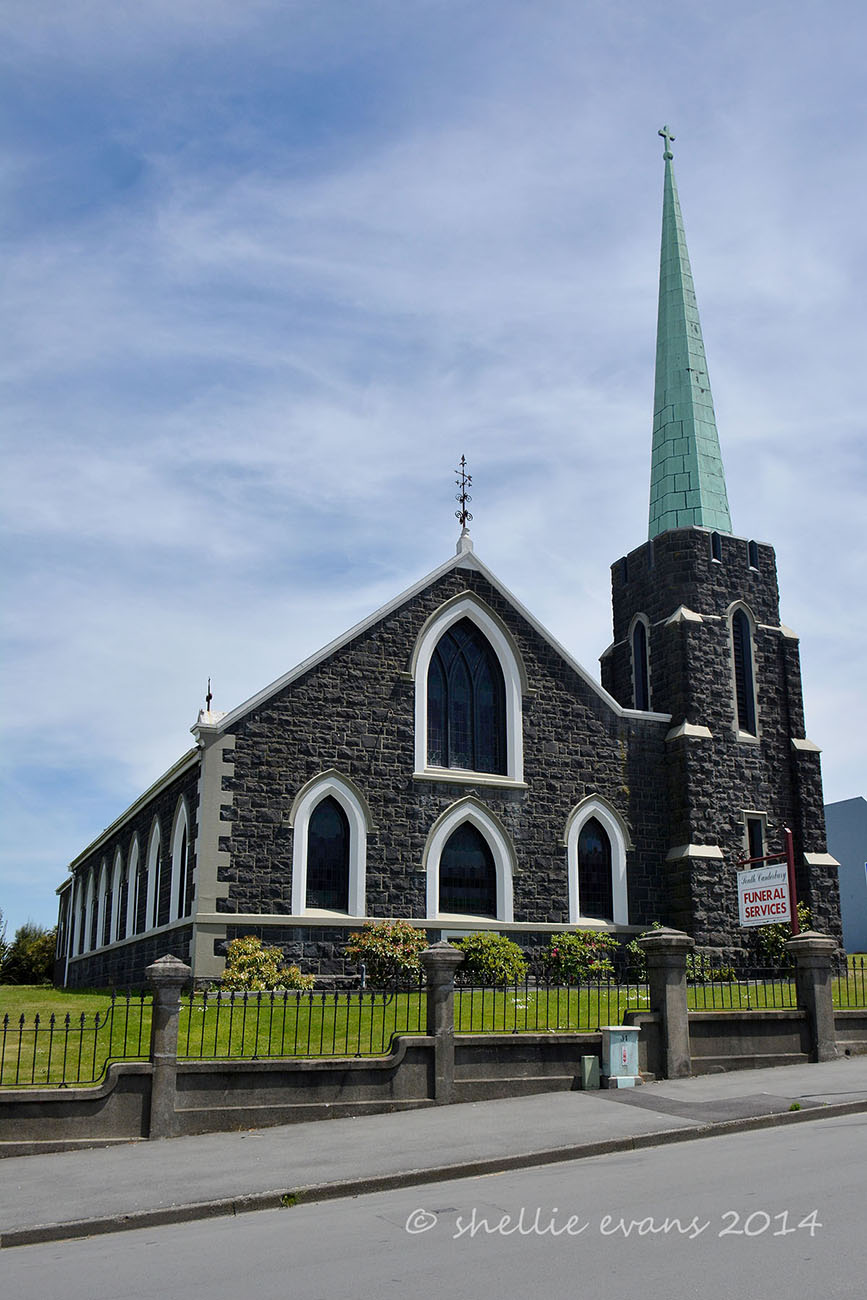
Bank Street Church, Timaru. CC BY-NC-ND 2.0 Image courtesy of www.flickr.com | Shellie Evans – flyingkiwigirl | 02/12/2013 | Shellie Evans
Bank Street Church, Timaru. CC BY-SA 2.0 Image courtesy of www.flickr.com | Marie Adamson | 27/05/2015 | Marie Adamson
Bank Street Church, Timaru. CC BY-NC-ND 2.0 Image courtesy of www.flickr.com | Shellie Evans – flyingkiwigirl | 02/12/2013 | Shellie Evans
Bank Street Church, Timaru. CC BY-SA 2.0 Image courtesy of www.flickr.com | Marie Adamson | 27/05/2015 | Marie Adamson

List Entry Information

Overview

Status
Listed

List Entry Status
Historic Place Category 2

Access
Private/No Public Access

List Number
3155

Date Entered
2nd April 2004

Date of Effect
2nd April 2004

City/District Council
Timaru District

Region
Canterbury Region

Extent of List Entry

Registration includes the building, its fixtures and fittings, and land on RT CB29A/152

Legal description

Lot 285 DP 1 (RT CB29A/152)

Detailed List Entry
Significance

Historic Significance

Historical Significance or Value The Bank Street Church has historical, spiritual and social value as the first Methodist church established in South Canterbury, and the centre for Methodist worship in Timaru for over a century. Despite its lack of a congregation today, it remains the oldest Methodist Church in South Canterbury.

Physical Significance

The church has aesthetic value for its streetscape presence, and architectural value for the quality of its design and the care taken to sensitively blend later additions.

Detail Of Assessed Criteria

(a) because of its representative value as a typically unostentatious Methodist place of worship, extended as needed and when funds were available. (h) The church also has symbolic and commemorative value as the first and oldest remaining Methodist church in South Canterbury; and as the only Wesleyan church in Timaru until 1913, when the Wesleyans and Primitive Methodists united.

Construction Professional

Name

Turnbull & Rule

Type

Architectural Partnership

Biography

James S. Turnbull worked in a Melbourne architect's office before returning to establish his own practice in Timaru in c.1895. In a career which spanned over forty years, Turnbull designed a wide range of building types in the South Canterbury town, including Chalmers Presbyterian Church (1903-04) and a considerable number of large town houses. Percy Watts Rule became James Turnbull's partner in c.1920 and subsequently became the firm's chief designer. From this time until his retirement in 1938, Turnbull was largely responsible for writing specifications and supervising the construction of buildings designed by Rule. In 1939 the latter was awarded the gold medal of the New Zealand Institute of Architects for his design of Timaru Hospital's Surgical Wing (1936-40), but little else is known about the junior partner of a firm which made a valuable contribution to Timaru architecture in the early years of this century.

Name

Wilson, F

Type

Architect

Biography

No biography is currently available for this construction professional

Name

Harding, S

Type

Builder

Biography

No biography is currently available for this construction professional

Name

Harding & Co.

Type

Builder

Biography

No biography is currently available for this construction professional

Construction Details

Start Year

1875

Type

Original Construction

Description

Stone church completed.

Start Year

1890

Type

Modification

Description

Stone nave extension and wooden chancel added.

Start Year

1930

Type

Modification

Description

Brick choir vestry, stone tower and steeple added, main entrance shifted.

Physical Description

The church is, in form, a traditional non-conformist chapel with gothic detailing. It is constructed of Timaru bluestone with cement dressings and concrete foundations. The hammer-beam totara roof is diagonally sarked, and clad with corrugated iron. There are iron finials on the apex and south corner of the east façade. At the west end are a timber chancel and brick choir vestry, both of which are stuccoed. On the north side is a bluestone tower with a spire. The church is lined with geometrically patterned leadlights, except for a pair of figural stained glass memorial windows which face each other across the nave. A nineteenth century concrete and wrought iron fence descends across the front of the property.

Reference

Completion Date

7th September 2004

Report Written By

Pam Wilson

Information Sources

Cyclopedia of New Zealand, 1903

Cyclopedia Company, Industrial, descriptive, historical, biographical facts, figures, illustrations, Wellington, N.Z, 1897-1908, Vol. 3, Canterbury Provincial District, Christchurch, 1903

Wilson, 1991 (2)

J. Wilson, South Canterbury historical guide : including the towns of Timaru, Temuka, Geraldine, Pleasant Point, Fairlie and Waimate, their surrounding country districts, and the Mackenzie Country, Timaru, 1991.

Morley, 1900

Rev. William Morley, The History of Methodism in New Zealand, Wellington, 1900

Olds, 1965

N. Olds, Timaru Methodist Centenary 1865-1965: Wesley Church, Bank Street 1965.

Timaru Herald

Timaru Herald, 30 Mar 1915, p.3.

Historic Places in New Zealand

Historic Places in New Zealand

Report Written By

A fully referenced version of this report is available from the NZHPT Southern Region Office. Please note that entry on the New Zealand Heritage List/Rarangi Korero identifies only the heritage values of the property concerned, and should not be construed as advice on the state of the property, or as a comment of its soundness or safety, including in regard to earthquake risk, safety in the event of fire, or insanitary conditions.

Further Information

Current Usages

Uses: Funerary Sites

Specific Usage: Cemetery chapel

Uses: Religion

Specific Usage: Church

Former Usages

General Usage:: Religion

Specific Usage: Church

Themes

Web Links

Overview

Status

Listed

List Entry Status

Historic Place Category 2

Access

Private/No Public Access

List Number

3155

Date Entered

2nd April 2004

Date of Effect

2nd April 2004

City/District Council

Timaru District

Region

Canterbury Region

Extent of List Entry

Registration includes the building, its fixtures and fittings, and land on RT CB29A/152

Legal description

Lot 285 DP 1 (RT CB29A/152)

Status

Listed

List Entry Status

Historic Place Category 2

Access

Private/No Public Access

List Number

3155

Date Entered

2nd April 2004

Date of Effect

2nd April 2004

City/District Council

Timaru District

Region

Canterbury Region

Extent of List Entry

Registration includes the building, its fixtures and fittings, and land on RT CB29A/152

Legal description

Lot 285 DP 1 (RT CB29A/152)

Significance

Why is this place significant?

Historic Significance

Historical Significance or Value The Bank Street Church has historical, spiritual and social value as the first Methodist church established in South Canterbury, and the centre for Methodist worship in Timaru for over a century. Despite its lack of a congregation today, it remains the oldest Methodist Church in South Canterbury.

Physical Significance

The church has aesthetic value for its streetscape presence, and architectural value for the quality of its design and the care taken to sensitively blend later additions.

Why is this place Category 1 / Category 2?

Detail Of Assessed Criteria

(a) because of its representative value as a typically unostentatious Methodist place of worship, extended as needed and when funds were available. (h) The church also has symbolic and commemorative value as the first and oldest remaining Methodist church in South Canterbury; and as the only Wesleyan church in Timaru until 1913, when the Wesleyans and Primitive Methodists united.

Why is this place significant?

Historic Significance

Historical Significance or Value The Bank Street Church has historical, spiritual and social value as the first Methodist church established in South Canterbury, and the centre for Methodist worship in Timaru for over a century. Despite its lack of a congregation today, it remains the oldest Methodist Church in South Canterbury.

Physical Significance

The church has aesthetic value for its streetscape presence, and architectural value for the quality of its design and the care taken to sensitively blend later additions.

Why is this place Category 1 / Category 2?

Detail Of Assessed Criteria

(a) because of its representative value as a typically unostentatious Methodist place of worship, extended as needed and when funds were available. (h) The church also has symbolic and commemorative value as the first and oldest remaining Methodist church in South Canterbury; and as the only Wesleyan church in Timaru until 1913, when the Wesleyans and Primitive Methodists united.

Construction Information

Construction Professional

Name

Turnbull & Rule

Type

Architectural Partnership

Biography

James S. Turnbull worked in a Melbourne architect's office before returning to establish his own practice in Timaru in c.1895. In a career which spanned over forty years, Turnbull designed a wide range of building types in the South Canterbury town, including Chalmers Presbyterian Church (1903-04) and a considerable number of large town houses. Percy Watts Rule became James Turnbull's partner in c.1920 and subsequently became the firm's chief designer. From this time until his retirement in 1938, Turnbull was largely responsible for writing specifications and supervising the construction of buildings designed by Rule. In 1939 the latter was awarded the gold medal of the New Zealand Institute of Architects for his design of Timaru Hospital's Surgical Wing (1936-40), but little else is known about the junior partner of a firm which made a valuable contribution to Timaru architecture in the early years of this century.

Name

Wilson, F

Type

Architect

Biography

No biography is currently available for this construction professional

Name

Harding, S

Type

Builder

Biography

No biography is currently available for this construction professional

Name

Harding & Co.

Type

Builder

Biography

No biography is currently available for this construction professional

Construction Details

Start Year

1875

Type

Original Construction

Description

Stone church completed.

Start Year

1890

Type

Modification

Description

Stone nave extension and wooden chancel added.

Start Year

1930

Type

Modification

Description

Brick choir vestry, stone tower and steeple added, main entrance shifted.

Construction Professional

Name

Turnbull & Rule

Type

Architectural Partnership

Biography

James S. Turnbull worked in a Melbourne architect's office before returning to establish his own practice in Timaru in c.1895. In a career which spanned over forty years, Turnbull designed a wide range of building types in the South Canterbury town, including Chalmers Presbyterian Church (1903-04) and a considerable number of large town houses. Percy Watts Rule became James Turnbull's partner in c.1920 and subsequently became the firm's chief designer. From this time until his retirement in 1938, Turnbull was largely responsible for writing specifications and supervising the construction of buildings designed by Rule. In 1939 the latter was awarded the gold medal of the New Zealand Institute of Architects for his design of Timaru Hospital's Surgical Wing (1936-40), but little else is known about the junior partner of a firm which made a valuable contribution to Timaru architecture in the early years of this century.

Name

Wilson, F

Type

Architect

Biography

No biography is currently available for this construction professional

Name

Harding, S

Type

Builder

Biography

No biography is currently available for this construction professional

Name

Harding & Co.

Type

Builder

Biography

No biography is currently available for this construction professional

Construction Details

Start Year

1875

Type

Original Construction

Description

Stone church completed.

Start Year

1890

Type

Modification

Description

Stone nave extension and wooden chancel added.

Start Year

1930

Type

Modification

Description

Brick choir vestry, stone tower and steeple added, main entrance shifted.

Physical Description

The church is, in form, a traditional non-conformist chapel with gothic detailing. It is constructed of Timaru bluestone with cement dressings and concrete foundations. The hammer-beam totara roof is diagonally sarked, and clad with corrugated iron. There are iron finials on the apex and south corner of the east façade. At the west end are a timber chancel and brick choir vestry, both of which are stuccoed. On the north side is a bluestone tower with a spire. The church is lined with geometrically patterned leadlights, except for a pair of figural stained glass memorial windows which face each other across the nave. A nineteenth century concrete and wrought iron fence descends across the front of the property.

The church is, in form, a traditional non-conformist chapel with gothic detailing. It is constructed of Timaru bluestone with cement dressings and concrete foundations. The hammer-beam totara roof is diagonally sarked, and clad with corrugated iron. There are iron finials on the apex and south corner of the east façade. At the west end are a timber chancel and brick choir vestry, both of which are stuccoed. On the north side is a bluestone tower with a spire. The church is lined with geometrically patterned leadlights, except for a pair of figural stained glass memorial windows which face each other across the nave. A nineteenth century concrete and wrought iron fence descends across the front of the property.

Reference

Historical and Associated Iwi / Hapū / Whānau

Completion Date

7th September 2004

Report Written By

Pam Wilson

Information Sources

Cyclopedia of New Zealand, 1903

Cyclopedia Company, Industrial, descriptive, historical, biographical facts, figures, illustrations, Wellington, N.Z, 1897-1908, Vol. 3, Canterbury Provincial District, Christchurch, 1903

Wilson, 1991 (2)

J. Wilson, South Canterbury historical guide : including the towns of Timaru, Temuka, Geraldine, Pleasant Point, Fairlie and Waimate, their surrounding country districts, and the Mackenzie Country, Timaru, 1991.

Morley, 1900

Rev. William Morley, The History of Methodism in New Zealand, Wellington, 1900

Olds, 1965

N. Olds, Timaru Methodist Centenary 1865-1965: Wesley Church, Bank Street 1965.

Timaru Herald

Timaru Herald, 30 Mar 1915, p.3.

Historic Places in New Zealand

Historic Places in New Zealand

Other Information

A fully referenced version of this report is available from the NZHPT Southern Region Office. Please note that entry on the New Zealand Heritage List/Rarangi Korero identifies only the heritage values of the property concerned, and should not be construed as advice on the state of the property, or as a comment of its soundness or safety, including in regard to earthquake risk, safety in the event of fire, or insanitary conditions.

Historical and Associated Iwi / Hapū / Whānau

Completion Date

7th September 2004

Report Written By

Pam Wilson

Information Sources

Cyclopedia of New Zealand, 1903

Cyclopedia Company, Industrial, descriptive, historical, biographical facts, figures, illustrations, Wellington, N.Z, 1897-1908, Vol. 3, Canterbury Provincial District, Christchurch, 1903

Wilson, 1991 (2)

J. Wilson, South Canterbury historical guide : including the towns of Timaru, Temuka, Geraldine, Pleasant Point, Fairlie and Waimate, their surrounding country districts, and the Mackenzie Country, Timaru, 1991.

Morley, 1900

Rev. William Morley, The History of Methodism in New Zealand, Wellington, 1900

Olds, 1965

N. Olds, Timaru Methodist Centenary 1865-1965: Wesley Church, Bank Street 1965.

Timaru Herald

Timaru Herald, 30 Mar 1915, p.3.

Historic Places in New Zealand

Historic Places in New Zealand

Other Information

A fully referenced version of this report is available from the NZHPT Southern Region Office. Please note that entry on the New Zealand Heritage List/Rarangi Korero identifies only the heritage values of the property concerned, and should not be construed as advice on the state of the property, or as a comment of its soundness or safety, including in regard to earthquake risk, safety in the event of fire, or insanitary conditions.

Further Information

Current Usages

Uses: Funerary Sites

Specific Usage: Cemetery chapel

Uses: Religion

Specific Usage: Church

Former Usages

General Usage: Religion

Specific Usage: Church

Current Usages

Uses: Funerary Sites

Specific Usage: Cemetery chapel

Uses: Religion

Specific Usage: Church

Former Usages

General Usage: Religion

Specific Usage: Church

Location

Loading
Sign up to hear more

Get the latest heritage news, features and events delivered
straight to your inbox.

Subscribe
