Early Dunedin
Historically, Kāi Tahu visited the head of the Ōtākou harbour as either the gateway to the route to Kaikarai (Green Island) or going on other mahinga kai expeditions. When Scottish colonists arrived in 1848, the upper Ōtākou harbour was surrounded by heavy bush and there were many birds, tuna and other resources. While not as densely populated as the North Island, numerous kaik in the Ōtākou region still hosted a good number of Waitaha, Kāti Mamoe and later Kāi Tahu peoples.
Scottish settlers also saw the attraction of the upper harbour, identifying it as a potential site for a Free Church colony by the New Zealand Company. Scots George Rennie, who proposed the ‘New Edinburgh Scheme’, and promoter and later New Zealand Company agent William Cargill, allied themselves with the Free Church of Scotland, a movement of ministers and their congregations who had left the established church in 1843 in a move towards lay control. In 1847 the New Zealand Company gained title to the Otago Block, and their planned settlement Dunedin – a Gaelic version of Edinburgh. The first emigrant ship, the John Wickliffe, arrived off the Otago Peninsula on 21 March 1848. Dunedin developed a distinctive Scots-Presbyterian character, led by the Reverent Thomas Burns and the layman Cargill. But like other colonial settlements, it soon developed its own social problems.
Addressing Social Problems: Establishing the Walker Street Church
In 1861, Dunedin was transformed when an ‘impetuous torrent’ burst over the ‘staid life’ of the Free Church of Scotland settlement: gold seekers flooded into Dunedin on their way to the glittering prospect of Gabriel’s Gully, setting up a tent town on the foothills near the harbour close to Stafford and Walker (now Carroll) Streets. The mayhem lifted Presbyterian eyes from their Bibles and turned them to the blocks bounded by Maitland, Maclaggan and Princes Streets, an ethnically diverse muddle of tents, slums and shanties that became known as the ‘Devil’s Half Acre’, the town’s red light district and home to Dunedin’s poorest souls, but bordered by the houses of Dunedin’s elite.
Knox Church’s Reverend Donald McNaughton Stuart was among the first to set up his candle box, preaching at the foot of Stafford Street on a Sunday afternoon. Dunedin’s weather is not well suited to standing on street corners, so a more sheltered solution was found on a site offered by merchant Henry Cook who had premises on Stafford Street and where a 250-seat canvas chapel was erected, opening on 21 November 1861. Dunedin’s climate is not well suited to tents either and so by March 1862 the presbytery had approved the erection of a timber church, with the Reverend Glasgow, the first minister. Churches were recognising the importance of a ‘citadel of faith’ – the church being the centre for mission activity and a strong visual presence in the poorer areas of town.
The Walker Street Church (on the corner of Walker (now Carroll) and Melville Streets) opened on 4 May 1862. In June 1863, the Walker Street Church was declared a ministerial charge and the Reverend Donald Meiklejohn was inducted to the pastoral charge of the now renamed St Andrew’s Presbyterian Church. The church was supported by many prominent individuals and families – with William Hunter Reynolds and wife Rachel, as well as E.B. Cargill, printer and bookseller Thomas Coull among the notable congregation members.
Rachel (nee Pinkerton, 1838-1928) and William Reynolds (1822-1899) were founders and life-long members of the congregation. Rachel, who had led an adventurous life in South Australia before moving as a 17 year old with her parents to Dunedin and marrying her 34 year old businessman and politician husband, was committed to charity work at St Andrews and had a pioneering role in establishing free early childhood education and was deeply involved in other causes.
Building a new church
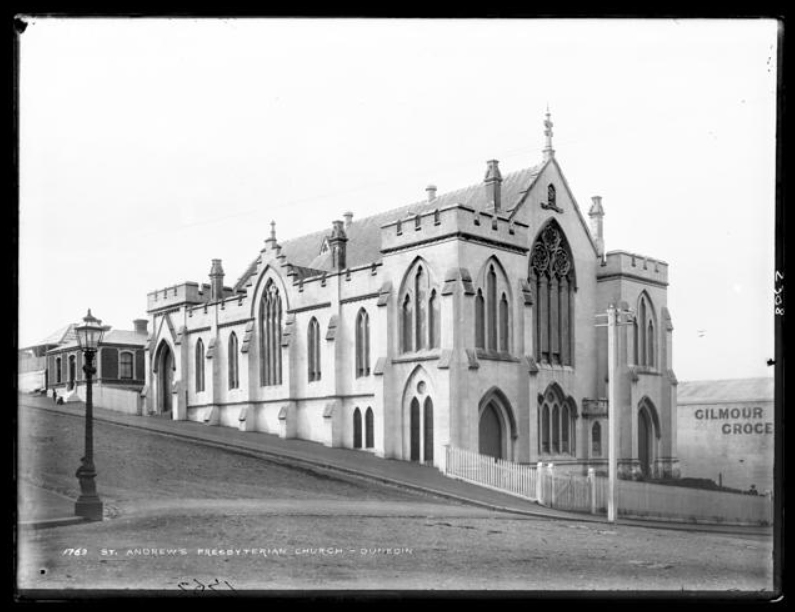
By 1865 the parish needed a bigger church. Plans were drawn up for a building capable of holding 500 worshippers, but lack of money delayed the building project. By 1868, the parish was able to obtain the freehold of the site, and in September of that year, the Deacon’s Court approved architect Robert Arthur Lawson’s plans. Lawson was one of the country’s pre-eminent church architects – designing and overseeing the construction of over 40 churches. He was a prominent Presbyterian, and the design of St Andrew’s along with the Trinity Wesleyan Church in Central Dunedin (List Entry No. 3378, Category 1) (both 1869) are significant early examples of Lawson’s work. Lawson’s choice of Gothic Revival style, a fashionable English style popular with Anglican congregations in the mid-nineteenth century, reflects the status and profile of the Presbyterian church in Dunedin – in the words of architectural historian James Stevens Curl, ‘architectural ambitions and rising social profile went together.’ By May 1869, contractors Hunter and Goodfellow had made a start clearing the section, and by 1870, the new church was ready, opening in a Sabbath service on 14 February 1870.
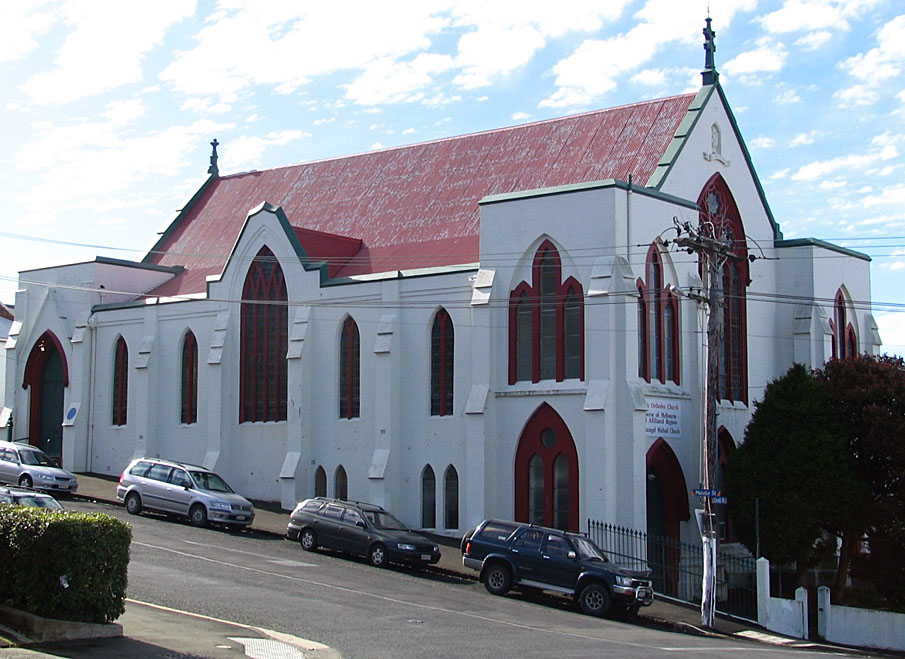
The Otago Daily Times provided a detailed description of the brick church with Oamaru facings, the design of which was dictated by the sloping site. The main entrance was on Melville Street, providing access to the ground floor, while the basement level (planned as classrooms for Sunday School) was accessed internally, or from Walker Street through a tower. The church measured 90 feet by 60 feet [27 by 18 metres], subdivided into a nave and two side aisles. The nave was 28 feet wide [8.5 metres], with the aisles 13 feet wide [4 metres]. At each corner of the church was a battlemented tower, finished with stone corbels and embrasured coping, providing an entrance porch, stairwell and vestry rooms. Octagonal columns with moulded capitals divided the aisles into four compartments and provided support for the roof bearers. A recess towards the Walker (Carroll) Street end of the nave provided a platform for the pulpit. Raised central bays gave the effect of a transept. The Times described the gables ‘each occupied by a four-light stone mullioned and richly traceried window, filled in with stained and ground glass, in floral and geometrical designs, the transept windows being similarly treated.’ The ceiling height was 35 feet [10.6 metres] from the line of the floor, the ceiling lined with diagonal tongued and grooved beaded panelling. The ceiling also has decorated octagonal ventilator openings. The Times described the church as ‘early British Gothic’ and ‘bold, massive and well proportioned.’ Over the main gable was the Presbyterian symbol of the burning bush. Stone detailing was carved by Louis Godfrey. Lawson’s competition design shows a spire on the south west corner of the building, but this was never built. Architect and historian Norman Ledgerwood writes that St Andrew’s was an unusual design for Lawson, being rectangular with four towers.
Despite the new church, the congregation lost some momentum in the 1870s when Reverend Scrimgeour resigned after conflict with the congregation, and while his replacement, The Reverend John Gow, did regain momentum, progress was slow. Gow (who retired in 1878) was, as poet and aspiring politician Thomas Bracken described him, a ‘zealous Calvinist’, whose ‘sincerity and earnestness compensate[d] for his lack of elocutionary display.’ The church established a mission to work in the slum community, and from February 1873, a ‘Collection for the Poor’ was made, with funds available for social services and distributed by the first Ladies Association (later the Friendly Aid Society, and later still the Sisterhood of St Andrews). A Sunday School was established in the now lined basement of St Andrew’s. The church was enthusiastic but perhaps not inspired. Gow’s successor was to focus all eyes on St Andrew’s and the social causes of the day.
The Sin of Cheapness
The 1880s saw New Zealand slide into a long depression, worsening the problems for Dunedin’s poor. St Andrew’s overlooked the worst examples of poverty, slum housing and unemployment in Dunedin. The Presbyterian Church as a rule focused on individual morality – poverty was considered a weakness in character rather than a result of social causes – but their focus was to change. Reverend Dr Stuart from Knox Church, for example, was concerned that his fellow church members would ‘weep over a heroine in a novel but would not cross the road to take a child out of the mud.’ The Reverend Rutherford Waddell, Gow’s successor, was to pull the metaphoric child out of the mud, wash her off, draw attention to her plight, and in so doing changed the political landscape.
Historian John Stenhouse describes Waddell as ‘perhaps the best-known and most influential Protestant minister in the country between the late 1870s and the 1930s.’ Rutherford Waddell was a young Irish Presbyterian minister who had come to Canterbury in 1877 and who had taken up a temporary position at St Andrew’s in 1879. The congregation was ‘electrified’ by Waddell’s first sermon and issued a call on the spot. Waddell, Stenhouse writes, ‘wielded words to move hearers and readers to new ways of feeling, thinking and acting.’ His ministry attracted crowds from all over the city, the congregations held in ‘breathless silence’, ‘spellbound’ by Waddell’s impassioned directness.’ His high profile and active writings meant that his influence, and respect for him reached far beyond the bounds of his congregation.
Waddell’s most important sermon, a sermon that was to change the political and social landscape of New Zealand, was preached to his St Andrew’s congregation in October 1888. In his sermon ‘The Sin of Cheapness’, Waddell described how some Dunedin women were working from 8 a.m. to 11 p.m. finishing moleskin trousers at two and a half pence a pair, earning two shillings per day. Waddell railed against the community’s ‘enormous rage to get cheap things’, which drove manufacturers to cut costs and wages, telling his congregation that everyone, and especially Christians, must take responsibility for the ‘sin of cheapness.’ Waddell was a Christian socialist, and believed in bringing the kingdom of God to New Zealand, making the kingdom real. He saw that it was crucial to prevent a rift from opening between the church and working people, giving faith ‘a potent public and this-worldly meaning.’ Newspapers around the country were flooded with articles and letters on Waddell’s views, describing the plight of the ‘colonial slaves of the needle.’
On 15 February 1889, Waddell held a public meeting at the Athenaeum Hall, attended by politicians, clergy, laypeople and a ‘large number of ladies.’ The meeting appointed a committee to negotiate with employers (particularly textile manufacturers, printers and shoe manufacturers who employed girls, women and boys) and identify minimum wages as the best solution to poverty. At this meeting employers individually agreed to only hire contractors who paid the minimum wage. After four warehousing firms banded together to argue that minimum wage should apply across the country, to allow Dunedin firms to remain competitive, Waddell called another meeting. Waddell identified the four firms – directors of at least two of which were prominent Presbyterians – and argued that they cared more for money than men, that they were importing an unjust system, and that they were sucking the souls out of the country’s women and girls. The crowd and subsequent speakers came in behind him with calls for a commission of inquiry and for female trade unions. Hundreds joined the country’s first female trade union, the Tailoresses, with Waddell serving as its first president, working alongside Harriet Morison, the country’s leading female unionist. In 1890 the Atkinson government appointed Waddell to its Sweating Commission. On this swell of activism and enthusiasm, John Ballance’s Liberals won the general election of 1890, passing a wave of labour and industrial laws.
Waddell was supported by other talented crusaders such as Rachel Reynolds, a founder of the Free Kindergarten movement in New Zealand. Waddell wanted to help the disadvantaged children he saw living in the neighbourhood around the church. Learmonth Dalrymple, who had helped to establish Otago Girl’s High School, suggested three year olds should be taught in schools based on the ideas of educationalist Friedrich Frobel. A public meeting on 4 March 1889 in the Dunedin Town Hall resulted in the formation of the Dunedin Kindergarten Association in May that year, with Rachel Reynolds elected president. The first kindergarten, attached to St Andrew’s, was opened on 10 June 1889 in the Walker Street Mission Hall. Reynolds was also a significant campaigner for girls’ and women’s education (involved in establishing Otago Girls’ High School, and in the campaign for women’s access to university on the same basis as men). Reynolds also promoted and supported women’s suffrage, and was vice president of the women’s franchise league formed in Dunedin in April 1892.
Stenhouse concludes that Waddell succeeded because he ‘did not set himself apart from and above ordinary folk. In battling for working people, unions, minimum wages, female suffrage and free kindergartens, and against sweated labour and alcohol abuse, Waddell practised as well as preached the kind of down-to-earth, this worldly, “practical Christianity” that won respect even from those who seldom went to church.’ ‘The Sin of Cheapness’ exposed the way women workers in the clothing industry were exploited and provided the catalyst for a ‘powerful and broad-based social reform movement on which the Liberal party rode to power in 1890.’ With their worker-friendly laws and the granting of votes to women in 1893, the Liberals gained for New Zealand the international reputation as the ‘social laboratory of the world.’
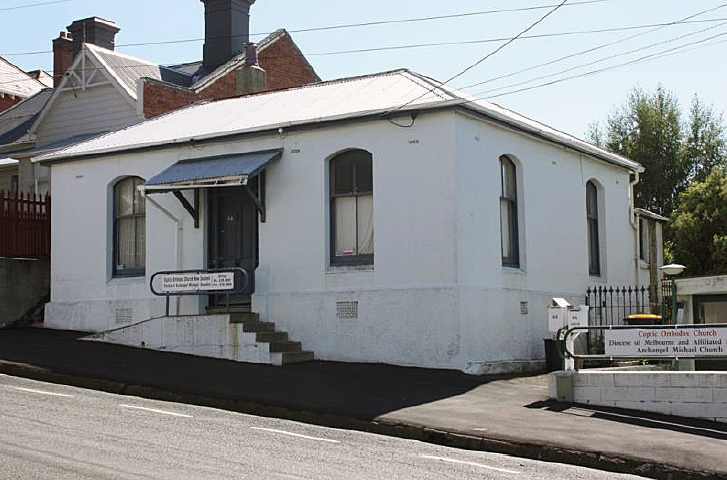
With all the activity, the church facilities grew in the 1880s – by 1883, the church itself had been plastered, possibly in an attempt to manage dampness issues, and the basement floor was lined to provide space for the Sunday School, and in 1885 the interior of the church was reconfigured to allow an organ to be installed, and there were further renovations in 1897. In 1885, the adjoining Warden’s Cottage (the caretaker’s house) was built. A mission hall was built in 1888 and a Bible School in 1912. Another building with a close connection to St Andrew’s is the J.L. Salmond designed Chinese Mission Hall further down Walker Street, built in 1897 (and later used as the Dunedin Chinese Presbyterian Church).
St Andrews in the Twentieth Century
St Andrew’s continued to emphasise social concerns, with Waddell initiating the deaconess order in the Presbyterian Church in New Zealand, appointing Sister Christabel Duncan deaconess in 1901. Sister Christabel acted as the equivalent of a full time social worker for the next 22 years, and was replaced by Sister Annie and her successors who continued to work among the poor.
Reverend Waddell retired in 1919 after forty years of service to the community and his St Andrew’s congregation. The Otago Daily Times lauded him as one of the finest organisers in the country who had proved himself to be one of the strongest personalities of the era.
In the 1920s and 1930s, St Andrew’s underwent substantial alterations. In the 1920s, a design for new windows was submitted by Robert Henry Fraser, and it is likely that the new windows were installed in 1922. In the 1930s there was a substantial repair programme, which saw the loss of many of the external architectural features at roof level – particularly the battlements and crow-stepped gables. The church was also re-rendered and painted. The interior of the church, however, retained many of its original features.
Over the latter part of the twentieth century St Andrew’s faced an ageing congregation, declining membership, and demographic changes to its inner city parish. In 1960, the church had a membership of 215; members were down to 65 by 1977.
An anniversary service, commemorating Waddell’s ‘Sin of Cheapness’ sermon was held on St Andrew’s Day, 27 November 1977, with lessons read by the managing director of Hallenstein Bros. Ltd and the Secretary of the Clothing Trades Union. A plaque was unveiled commemorating the sermon.
On 12 March 1978, the Presbyterians held their last service at St Andrew’s Church, before the congregation merged with that of First Church. The building was sold to the Word of Life Pentecostal Church.
In 2000, the building was bought by the Coptic Orthodox Church who have renamed it the Archangel Michael Coptic Orthodox Church. ‘ Te Ara, The Encyclopedia of New Zealand, describes the contemporary Coptic Orthodox Church as a Christian church based in Egypt, part of a group of Orthodox churches which also include the Ethiopian and Eritrean Orthodox Churches brought to this country by immigrants and refugees from the Middle East and North Africa. In 1999, Melbourne-based Bishop Suriel was appointed the first Coptic bishop for Australia and New Zealand. In 2010 there was a Coptic church in each of New Zealand’s four main centres, and close to 400 Coptic Orthodox Church members.
In 2006, the new congregation restored some of the windows, and installed new stained glass door panels depicting the guardian angel of the Coptic Orthodox Church and the Archangel Michael.
The church remains the place of worship for the Coptic Orthodox congregation in 2016.