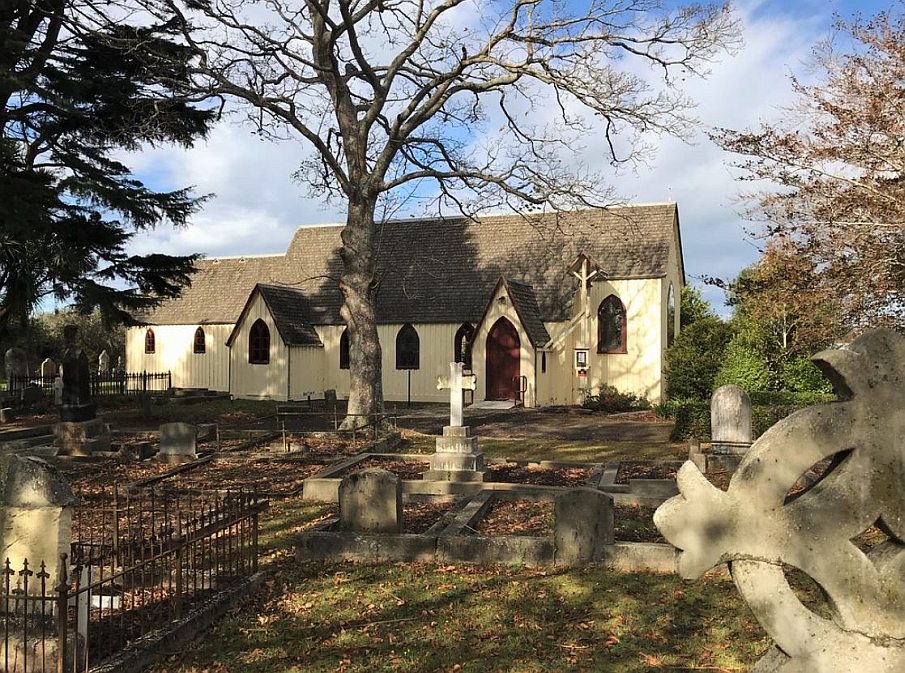
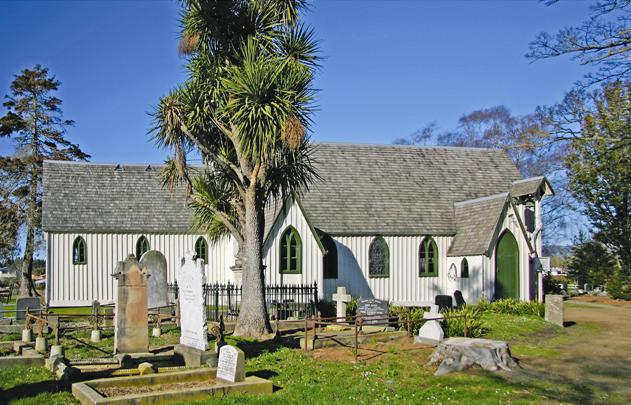
Opened in 1858, due to the generosity of Johnny Jones, St John the Evangelist Church (Anglican) at Waikouaiti is surrounded by its churchyard and burial ground creating a charming scene reminiscent of an English village church. It is reputed to be the first Anglican Church built in Otago and Southland.
In 1838 Johnny Jones (1808/1809?-1869) bought a whaling station and a quantity of land near Waikouaiti. Here he established a large community of workers. To help maintain a semblance of moral order, in 1840 he secured the services of Reverend James Watkin. Although of uncertain religious affiliation and determinedly non-sectarian, Jones made land grants and donations to the Presbyterian, Catholic and Methodist communities. To the Anglican Church at Waikouaiti he gave ten acres of land for a parsonage and glebe, three and a half acres of land for a church and burial ground and 62 quarter acre sections as an endowment. Benjamin Woolfield Mountfort (1825-1898), leading church architect of the time, was selected to design the new church.
Trained in Gothic Revival architecture, Mountfort immigrated to New Zealand in 1850. A Christchurch architect, he designed most of the public buildings which gave Christchurch its distinctive Gothic Revival character. Mountfort did not regard wood as an impediment to the Gothic style and his wooden churches are as ornately Gothic as those he designed in stone. Indeed his small timber churches have long been recognised as among his most significant contributions. St John the Evangelist is an excellent example of his design talents and his ability to produce fine detailing and exploitation of a confined space. Mountfort subscribed to the theory that true spirituality was influenced by physical surroundings. The influence of these ecclesiological beliefs can be seen here in the low walls of vertical boarding, steep pitched roof and lancet windows.
The church was built by Hardy & Winchester of Dunedin.Architect H.F. Hardy designed the window surrounds. The walls were clad in vertical board and batten from pit-sawn timber cut from the nearby Hawksbury Bush, as were the shingles for the steeply pitched roof. Other materials were bought by sea and bullock dray from Dunedin. The Church originally seated 120.
The Church was opened on 19 December 1858 and was consecrated in March 1860 by Bishop Harper of Christchurch. Contemporaries merely described the church as ‘a very neat erection’.
The shingles proved inadequate and were soon replaced with Tasmanian ones. In 1880 Rev. Sotham presented a bell dated 1787 and said to have come from Greenwich. The chancel was lengthened in 1881. The iron gates were erected in 1893. In 1906 a tower structure was added at the west end to house the new organ placed in it. It also provided increased accommodation for the congregation. The bell turret was removed and the bell bracketed on the outside of the tower. In the 1950s the ridge of the organ tower was lowered to be continuous with the nave ridge, and the area to the west end became a baptistery. The roof was then reshingled with Canadian redwood and the bell was hung in a stand near the porch. Four stained glass windows by Miller & Sons, Dunedin, were also added probably after 1947.
This charming gothic church has an appealing setting surrounded by its cemetery, church yard, parsonage and glebe. Not only architecturally appealing, the church has a significant history. Gifted by Johnny Jones, who was perhaps less concerned with a spiritual gains than moral order, the structure appears to be the earliest Anglican Church to be built in Otago and Southland. Designed by eminent architect, B.W. Mountfort, it is a testament to his fine skills and ecclesiological beliefs. Significantly for the community, St John the Evangelist Church (Anglican) has been also a gathering place and spiritual centre since 1858.
This historic place was registered under the Historic Places Act 1980. The following text is the original citation considered by the NZHPT Board at the time of registration.
St John's owes much to the generosity of John Jones who gave a substantial sum for its construction as well as 3 ½ acres (14 hectares) of land for the church and burial ground. The design is by B.W. Mountfort, the leading church architect of the time, and is an excellent example of his ability to produce fine detailing and exploitation of a confined space. The influence of the Ecclesiologists can be seen here in the low walls of vertical boarding, steep pitched roof and lancet windows. St John's is very attractively sited in an interesting well kept churchyard and dates from 1858.
In 1838 Johnny Jones (1808/1809?-1869) bought a whaling station and a quantity of land near Waikouaiti. Here he established a large community of workers. To help maintain a semblance of moral order, in 1840 he secured the services of Reverend James Watkin. Although of uncertain religious affiliation and determinedly non-sectarian, Jones made land grants and donations to the Presbyterian, Catholic and Methodist communities. To the Anglican Church at Waikouaiti he gave ten acres of land for a parsonage and glebe, three and a half acres of land for a church and burial ground and 62 quarter acre sections as an endowment. Benjamin Woolfield Mountfort (1825-1898), leading church architect of the time, was selected to design the new church.
Trained in Gothic Revival architecture, Mountfort immigrated to New Zealand in 1850. A Christchurch architect, he designed most of the public buildings which gave Christchurch its distinctive Gothic Revival character. Mountfort did not regard wood as an impediment to the Gothic style and his wooden churches are as ornately Gothic as those he designed in stone. Indeed his small timber churches have long been recognised as among his most significant contributions. St John the Evangelist is an excellent example of his design talents and his ability to produce fine detailing and exploitation of a confined space. Mountfort subscribed to the theory that true spirituality was influenced by physical surroundings. The influence of these ecclesiological beliefs can be seen here in the low walls of vertical boarding, steep pitched roof and lancet windows.
The church was built by Hardy & Winchester of Dunedin.Architect H.F. Hardy designed the window surrounds. The walls were clad in vertical board and batten from pit-sawn timber cut from the nearby Hawksbury Bush, as were the shingles for the steeply pitched roof. Other materials were bought by sea and bullock dray from Dunedin. The Church originally seated 120.
The Church was opened on 19 December 1858 and was consecrated in March 1860 by Bishop Harper of Christchurch. Contemporaries merely described the church as ‘a very neat erection’.
The shingles proved inadequate and were soon replaced with Tasmanian ones. In 1880 Rev. Sotham presented a bell dated 1787 and said to have come from Greenwich. The chancel was lengthened in 1881. The iron gates were erected in 1893. In 1906 a tower structure was added at the west end to house the new organ placed in it. It also provided increased accommodation for the congregation. The bell turret was removed and the bell bracketed on the outside of the tower. In the 1950s the ridge of the organ tower was lowered to be continuous with the nave ridge, and the area to the west end became a baptistery. The roof was then reshingled with Canadian redwood and the bell was hung in a stand near the porch. Four stained glass windows by Miller & Sons, Dunedin, were also added probably after 1947.
This charming gothic church has an appealing setting surrounded by its cemetery, church yard, parsonage and glebe. Not only architecturally appealing, the church has a significant history. Gifted by Johnny Jones, who was perhaps less concerned with a spiritual gains than moral order, the structure appears to be the earliest Anglican Church to be built in Otago and Southland. Designed by eminent architect, B.W. Mountfort, it is a testament to his fine skills and ecclesiological beliefs. Significantly for the community, St John the Evangelist Church (Anglican) has been also a gathering place and spiritual centre since 1858.
This historic place was registered under the Historic Places Act 1980. The following text is the original citation considered by the NZHPT Board at the time of registration.
St John's owes much to the generosity of John Jones who gave a substantial sum for its construction as well as 3 ½ acres (14 hectares) of land for the church and burial ground. The design is by B.W. Mountfort, the leading church architect of the time, and is an excellent example of his ability to produce fine detailing and exploitation of a confined space. The influence of the Ecclesiologists can be seen here in the low walls of vertical boarding, steep pitched roof and lancet windows. St John's is very attractively sited in an interesting well kept churchyard and dates from 1858.