DonateMembershipVisit Heritage
  • Tūrangawaewae
    Places
  • Tira Māori
    Māori Heritage
  • Poutairangahia
    Archaeology
  • Rauemi
    Resources
  • Mō Tātou
    About Us
  • New Zealand Heritage List
  • Nominate and submit
  • Explore the List
  • National Historic Landmarks
  • Plaques
  • Rainbow List Project
  • Lost heritage
  • Visit Heritage
  • Our properties
  • Turnbull House Project
  • Collections
  • Shop
  • Tohu Whenua
  • Tira Māori
  • Conserving Māori heritage
  • Marae built heritage
  • Māori heritage on the List
  • Hinemihi—Te Hokinga Mai
  • What is archaeology?
  • Is there a site on my property?
  • What are my legal requirements?
  • Affecting an archaeological site
  • Declaring an archaeological site
  • Archaeology FAQs
  • Archaeology Digital Library
  • Archaeology guidelines and templates
  • Resources
  • Funding
  • Publications
  • Sustainable management guides
  • Disaster recovery
  • Podcasts & digital resources
  • Education Hub
  • Conservation plans
  • About
  • Board
  • Māori Heritage Council
  • Senior Staff
  • Offices
  • Contact us
  • Careers
  • Covenants
  • Fast-track
  • Corporate documents
  • Currently consulting on
  • Our submissions
  • News
  • Covid-19 response
Quick links
Rārangi Kōrero | The List
Explore the List
National Historic Landmarks
Ngā Manawhenua o Aotearoa me ōna Kōrero Tūturu
Quick links
Tapuwae
A Vision for Places of Māori Heritage
Funding for Māori Heritage
Resources
Quick links
Archaeological Authority Portal
Applying for an archaeological authority
Archaeology FAQs
Browse the most frequently asked questions about archaeological authorities and the archaeological process.
Quick links
Quick links
News
News Keep up to date with Heritage New Zealand Pouhere Taonga
Membership
Membership Find out more and sign up today
DonateMembershipVisit Heritage
  • Tūrangawaewae
    Places
  • Tira Māori
    Māori Heritage
  • Poutairangahia
    Archaeology
  • Rauemi
    Resources
  • Mō Tātou
    About Us
  • New Zealand Heritage List
  • Nominate and submit
  • Explore the List
  • National Historic Landmarks
  • Plaques
  • Rainbow List Project
  • Lost heritage
  • Visit Heritage
  • Our properties
  • Turnbull House Project
  • Collections
  • Shop
  • Tohu Whenua
  • Tira Māori
  • Conserving Māori heritage
  • Marae built heritage
  • Māori heritage on the List
  • Hinemihi—Te Hokinga Mai
  • What is archaeology?
  • Is there a site on my property?
  • What are my legal requirements?
  • Affecting an archaeological site
  • Declaring an archaeological site
  • Archaeology FAQs
  • Archaeology Digital Library
  • Archaeology guidelines and templates
  • Resources
  • Funding
  • Publications
  • Sustainable management guides
  • Disaster recovery
  • Podcasts & digital resources
  • Education Hub
  • Conservation plans
  • About
  • Board
  • Māori Heritage Council
  • Senior Staff
  • Offices
  • Contact us
  • Careers
  • Covenants
  • Fast-track
  • Corporate documents
  • Currently consulting on
  • Our submissions
  • News
  • Covid-19 response
Quick links
Rārangi Kōrero | The List
Explore the List
National Historic Landmarks
Ngā Manawhenua o Aotearoa me ōna Kōrero Tūturu
Quick links
Tapuwae
A Vision for Places of Māori Heritage
Funding for Māori Heritage
Resources
Quick links
Archaeological Authority Portal
Applying for an archaeological authority
Archaeology FAQs
Browse the most frequently asked questions about archaeological authorities and the archaeological process.
Quick links
Quick links
News
News Keep up to date with Heritage New Zealand Pouhere Taonga
Membership
Membership Find out more and sign up today
  • Places
  • Nominate and submit
  • National Historic Landmarks
  • Places
  • Nominate and submit
  • National Historic Landmarks
  • Tira Māori
  • Conserving Māori heritage
  • Marae built heritage
  • Tira Māori
  • Conserving Māori heritage
  • Marae built heritage
  • Archaeological authorities
  • Archaeology Digital Library
  • Archaeological authorities
  • Archaeology Digital Library
  • All resources
  • Publications
  • Funding
  • All resources
  • Publications
  • Funding
  • FAQs
  • FAQs
Follow us on:
Places
  • Places
  • Nominate and submit
  • National Historic Landmarks
Tira Māori
  • Tira Māori
  • Conserving Māori heritage
  • Marae built heritage
Archaeology
  • Archaeological authorities
  • Archaeology Digital Library
Resources
  • All resources
  • Publications
  • Funding
FAQs
  • FAQs
Follow us on
HomePrivacyTerms and conditionsAbout this site
© Heritage New Zealand Pouhere Taonga 2026.
 
St James Theatre

77-81 Courtenay Place, WELLINGTON

Private

Historic Place Category 1

List No. 3639

Quick links:
List GalleryLocationDetails
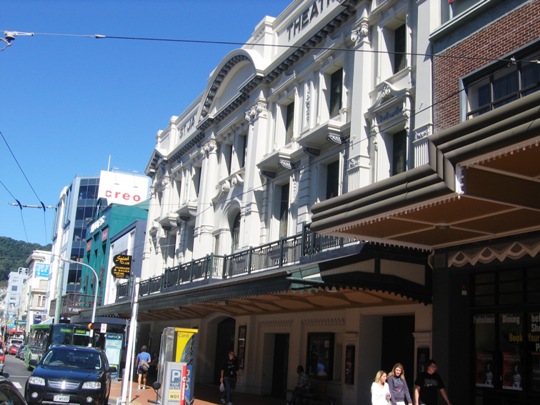
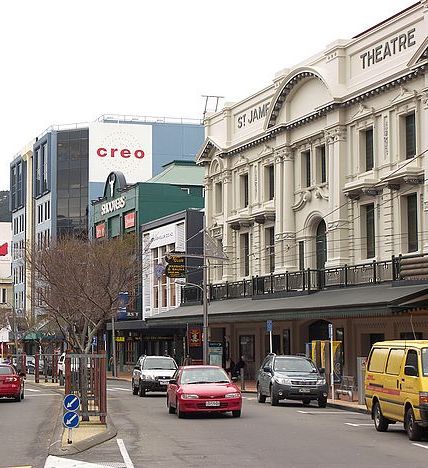
Built in 1912, this theatre was designed by Henry E White, a distinguished theatre designer whose buildings are well-known landmarks in Australia and America.

Seating up to [1560] people, this grand theatre is one of the few remaining examples in New Zealand of this type of public building. Constructed of plastered brick and concrete the building is both inside and out ornately designed. The interior has an elaborately plastered ceiling with a shallow dome as well as some of the most impressive theatre boxes in New Zealand.

St James Theatre is a splendid and rare example of early 20th century theatre architecture and is one of Wellington's most distinguished buildings.
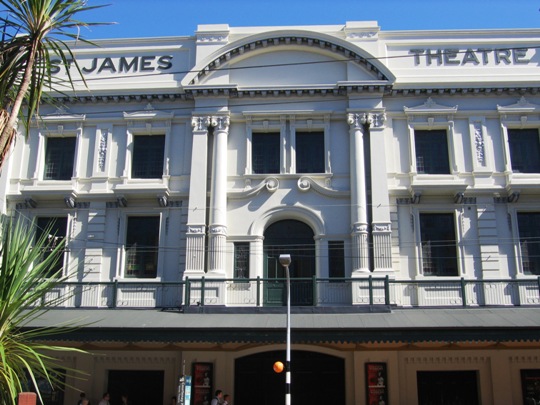
St James Theatre | Anika Klee | 04/03/2009 | NZ Historic Places Trust
null | Anika Klee | 04/03/2009 | NZ Historic Places Trust
null | www.cepolina.com
St James Theatre | Anika Klee | 04/03/2009 | NZ Historic Places Trust
null | Anika Klee | 04/03/2009 | NZ Historic Places Trust
null | www.cepolina.com

List Entry Information

Overview

Status
Listed

List Entry Status
Historic Place Category 1

Access
Private/No Public Access

List Number
3639

Date Entered
27th June 1985

Date of Effect
27th June 1985

City/District Council
Wellington City

Region
Wellington Region

Legal description

All Plans A 880 & 890

Detailed List Entry

Construction Professional

Name

White, Henry Eli (1876-1952)

Type

Architect

Biography

White was the son of a Dunedin building contractor and spent his early years learning a wide range of trades including bricklaying, plumbing, carpentry, joinery and painting. His first major project was in 1908, a tunnel on the Waipori River hydro-electric scheme. He developed a fascination with theatre design and educated himself in its principles while also attending Art School night classes. With the contract to build His Majesty's Theatre, Wellington, for (Sir) Benjamin Fuller in 1912, White moved his thriving practice to that city where he also built the Midland Hotel. White's reputation as a popular and innovative theatre designer grew to the extent that he became one of the most prominent in Australasia. He was to design over 130 theatres as well as a number of commercial buildings. Among his most notable designs were (builder of) The Press Building, Christchurch (1908), architect of His Majesty's Theatre, Wellington (1912), now the St James, and at the time the largest theatre in Australasia, the now demolished Midland Hotel, Wellington, (1916) The Strand, Christchurch (1917), the Tivoli, Brisbane, and his masterpiece, the State Theatre in Sydney. Much loved by audiences for its excessive Art Deco ornamentation, its interior made lavish use of marble, gold and ivory decoration, and featured paintings, sculpture and exotic objects (such as the 'Fujiyama cameo', removed during the Second World War). The Depression marked the end of White's architectural career. He won a competition to design a college at Auckland, but plans were shelved; he closed his office and lost money through farming in New Zealand. By 1937 he had returned to Sydney. Although a cement manufacturing project near Bathurst fell through, dolomite was discovered on the site and during the Second World War his company supplied it for windows and light bulbs made in Australia. White spent much time sailing and big-game fishing. Survived by his wife and two sons, he died on 3 March 1952 at Kings Cross, Sydney, and was cremated with Anglican rites. He had reputedly earned over £1 million in architectural fees, but was not an astute businessman; his estate was sworn for probate at £1147. Source: Registration Report for St Anthony's Convent (Former), Register No. 4345, February 2013. Sour

Construction Details

Start Year

1912

Type

Original Construction

Reference

Information Sources

Australian Dictionary of Biography

Australian Dictionary of Biography

Report Written By

This place was identified as significant under previous legislation with different information requirements. It remains significant under the current legislation. There is opportunity under our legislation and policies to add to this information. Further information about this place may be available from the Central Regional Office of Heritage New Zealand Pouhere Taonga. NZHPT Heritage Order (23 September 1986) Please note that entry on the New Zealand Heritage List/Rarangi Korero identifies only the heritage values of the property concerned, and should not be construed as advice on the state of the property, or as a comment of its soundness or safety, including in regard to earthquake risk, safety in the event of fire, or insanitary conditions. This historic place was registered under the Historic Places Act 1980. The following text is the original citation considered by the NZHPT Board at the time of registration (updates to the information are shown in square brackets).

Further Information

Current Usages

Uses: Civic Facilities

Specific Usage: Opera House

Uses: Civic Facilities

Specific Usage: Theatre

Former Usages

Themes

Web Links

Overview

Status

Listed

List Entry Status

Historic Place Category 1

Access

Private/No Public Access

List Number

3639

Date Entered

27th June 1985

Date of Effect

27th June 1985

City/District Council

Wellington City

Region

Wellington Region

Legal description

All Plans A 880 & 890

Status

Listed

List Entry Status

Historic Place Category 1

Access

Private/No Public Access

List Number

3639

Date Entered

27th June 1985

Date of Effect

27th June 1985

City/District Council

Wellington City

Region

Wellington Region

Legal description

All Plans A 880 & 890

Construction Information

Construction Professional

Name

White, Henry Eli (1876-1952)

Type

Architect

Biography

White was the son of a Dunedin building contractor and spent his early years learning a wide range of trades including bricklaying, plumbing, carpentry, joinery and painting. His first major project was in 1908, a tunnel on the Waipori River hydro-electric scheme. He developed a fascination with theatre design and educated himself in its principles while also attending Art School night classes. With the contract to build His Majesty's Theatre, Wellington, for (Sir) Benjamin Fuller in 1912, White moved his thriving practice to that city where he also built the Midland Hotel. White's reputation as a popular and innovative theatre designer grew to the extent that he became one of the most prominent in Australasia. He was to design over 130 theatres as well as a number of commercial buildings. Among his most notable designs were (builder of) The Press Building, Christchurch (1908), architect of His Majesty's Theatre, Wellington (1912), now the St James, and at the time the largest theatre in Australasia, the now demolished Midland Hotel, Wellington, (1916) The Strand, Christchurch (1917), the Tivoli, Brisbane, and his masterpiece, the State Theatre in Sydney. Much loved by audiences for its excessive Art Deco ornamentation, its interior made lavish use of marble, gold and ivory decoration, and featured paintings, sculpture and exotic objects (such as the 'Fujiyama cameo', removed during the Second World War). The Depression marked the end of White's architectural career. He won a competition to design a college at Auckland, but plans were shelved; he closed his office and lost money through farming in New Zealand. By 1937 he had returned to Sydney. Although a cement manufacturing project near Bathurst fell through, dolomite was discovered on the site and during the Second World War his company supplied it for windows and light bulbs made in Australia. White spent much time sailing and big-game fishing. Survived by his wife and two sons, he died on 3 March 1952 at Kings Cross, Sydney, and was cremated with Anglican rites. He had reputedly earned over £1 million in architectural fees, but was not an astute businessman; his estate was sworn for probate at £1147. Source: Registration Report for St Anthony's Convent (Former), Register No. 4345, February 2013. Sour

Construction Details

Start Year

1912

Type

Original Construction

Construction Professional

Name

White, Henry Eli (1876-1952)

Type

Architect

Biography

White was the son of a Dunedin building contractor and spent his early years learning a wide range of trades including bricklaying, plumbing, carpentry, joinery and painting. His first major project was in 1908, a tunnel on the Waipori River hydro-electric scheme. He developed a fascination with theatre design and educated himself in its principles while also attending Art School night classes. With the contract to build His Majesty's Theatre, Wellington, for (Sir) Benjamin Fuller in 1912, White moved his thriving practice to that city where he also built the Midland Hotel. White's reputation as a popular and innovative theatre designer grew to the extent that he became one of the most prominent in Australasia. He was to design over 130 theatres as well as a number of commercial buildings. Among his most notable designs were (builder of) The Press Building, Christchurch (1908), architect of His Majesty's Theatre, Wellington (1912), now the St James, and at the time the largest theatre in Australasia, the now demolished Midland Hotel, Wellington, (1916) The Strand, Christchurch (1917), the Tivoli, Brisbane, and his masterpiece, the State Theatre in Sydney. Much loved by audiences for its excessive Art Deco ornamentation, its interior made lavish use of marble, gold and ivory decoration, and featured paintings, sculpture and exotic objects (such as the 'Fujiyama cameo', removed during the Second World War). The Depression marked the end of White's architectural career. He won a competition to design a college at Auckland, but plans were shelved; he closed his office and lost money through farming in New Zealand. By 1937 he had returned to Sydney. Although a cement manufacturing project near Bathurst fell through, dolomite was discovered on the site and during the Second World War his company supplied it for windows and light bulbs made in Australia. White spent much time sailing and big-game fishing. Survived by his wife and two sons, he died on 3 March 1952 at Kings Cross, Sydney, and was cremated with Anglican rites. He had reputedly earned over £1 million in architectural fees, but was not an astute businessman; his estate was sworn for probate at £1147. Source: Registration Report for St Anthony's Convent (Former), Register No. 4345, February 2013. Sour

Construction Details

Start Year

1912

Type

Original Construction

Reference

Historical and Associated Iwi / Hapū / Whānau

Information Sources

Australian Dictionary of Biography

Australian Dictionary of Biography

Other Information

This place was identified as significant under previous legislation with different information requirements. It remains significant under the current legislation. There is opportunity under our legislation and policies to add to this information. Further information about this place may be available from the Central Regional Office of Heritage New Zealand Pouhere Taonga. NZHPT Heritage Order (23 September 1986) Please note that entry on the New Zealand Heritage List/Rarangi Korero identifies only the heritage values of the property concerned, and should not be construed as advice on the state of the property, or as a comment of its soundness or safety, including in regard to earthquake risk, safety in the event of fire, or insanitary conditions. This historic place was registered under the Historic Places Act 1980. The following text is the original citation considered by the NZHPT Board at the time of registration (updates to the information are shown in square brackets).

Historical and Associated Iwi / Hapū / Whānau

Information Sources

Australian Dictionary of Biography

Australian Dictionary of Biography

Other Information

This place was identified as significant under previous legislation with different information requirements. It remains significant under the current legislation. There is opportunity under our legislation and policies to add to this information. Further information about this place may be available from the Central Regional Office of Heritage New Zealand Pouhere Taonga. NZHPT Heritage Order (23 September 1986) Please note that entry on the New Zealand Heritage List/Rarangi Korero identifies only the heritage values of the property concerned, and should not be construed as advice on the state of the property, or as a comment of its soundness or safety, including in regard to earthquake risk, safety in the event of fire, or insanitary conditions. This historic place was registered under the Historic Places Act 1980. The following text is the original citation considered by the NZHPT Board at the time of registration (updates to the information are shown in square brackets).

Further Information

Current Usages

Uses: Civic Facilities

Specific Usage: Opera House

Uses: Civic Facilities

Specific Usage: Theatre

Current Usages

Uses: Civic Facilities

Specific Usage: Opera House

Uses: Civic Facilities

Specific Usage: Theatre

Location

Loading
Stay up to date with Heritage this month