DonateMembershipVisit Heritage
  • Tūrangawaewae
    Places
  • Tira Māori
    Māori Heritage
  • Poutairangahia
    Archaeology
  • Rauemi
    Resources
  • Mō Tātou
    About Us
  • New Zealand Heritage List
  • Nominate and submit
  • Explore the List
  • National Historic Landmarks
  • Plaques
  • Rainbow List Project
  • Lost heritage
  • Visit Heritage
  • Our properties
  • Turnbull House Project
  • Collections
  • Shop
  • Tohu Whenua
  • Tira Māori
  • Conserving Māori heritage
  • Marae built heritage
  • Māori heritage on the List
  • Hinemihi—Te Hokinga Mai
  • What is archaeology?
  • Is there a site on my property?
  • What are my legal requirements?
  • Affecting an archaeological site
  • Declaring an archaeological site
  • Archaeology FAQs
  • Archaeology Digital Library
  • Archaeology guidelines and templates
  • Resources
  • Funding
  • Publications
  • Sustainable management guides
  • Disaster recovery
  • Podcasts & digital resources
  • Education Hub
  • Conservation plans
  • About
  • Board
  • Māori Heritage Council
  • Senior Staff
  • Offices
  • Contact us
  • Careers
  • Covenants
  • Fast-track
  • Corporate documents
  • Currently consulting on
  • Our submissions
  • News
  • Covid-19 response
Quick links
Rārangi Kōrero | The List
Explore the List
National Historic Landmarks
Ngā Manawhenua o Aotearoa me ōna Kōrero Tūturu
Quick links
Tapuwae
A Vision for Places of Māori Heritage
Funding for Māori Heritage
Resources
Quick links
Archaeological Authority Portal
Applying for an archaeological authority
Archaeology FAQs
Browse the most frequently asked questions about archaeological authorities and the archaeological process.
Quick links
Quick links
News
News Keep up to date with Heritage New Zealand Pouhere Taonga
Membership
Membership Find out more and sign up today
DonateMembershipVisit Heritage
  • Tūrangawaewae
    Places
  • Tira Māori
    Māori Heritage
  • Poutairangahia
    Archaeology
  • Rauemi
    Resources
  • Mō Tātou
    About Us
  • New Zealand Heritage List
  • Nominate and submit
  • Explore the List
  • National Historic Landmarks
  • Plaques
  • Rainbow List Project
  • Lost heritage
  • Visit Heritage
  • Our properties
  • Turnbull House Project
  • Collections
  • Shop
  • Tohu Whenua
  • Tira Māori
  • Conserving Māori heritage
  • Marae built heritage
  • Māori heritage on the List
  • Hinemihi—Te Hokinga Mai
  • What is archaeology?
  • Is there a site on my property?
  • What are my legal requirements?
  • Affecting an archaeological site
  • Declaring an archaeological site
  • Archaeology FAQs
  • Archaeology Digital Library
  • Archaeology guidelines and templates
  • Resources
  • Funding
  • Publications
  • Sustainable management guides
  • Disaster recovery
  • Podcasts & digital resources
  • Education Hub
  • Conservation plans
  • About
  • Board
  • Māori Heritage Council
  • Senior Staff
  • Offices
  • Contact us
  • Careers
  • Covenants
  • Fast-track
  • Corporate documents
  • Currently consulting on
  • Our submissions
  • News
  • Covid-19 response
Quick links
Rārangi Kōrero | The List
Explore the List
National Historic Landmarks
Ngā Manawhenua o Aotearoa me ōna Kōrero Tūturu
Quick links
Tapuwae
A Vision for Places of Māori Heritage
Funding for Māori Heritage
Resources
Quick links
Archaeological Authority Portal
Applying for an archaeological authority
Archaeology FAQs
Browse the most frequently asked questions about archaeological authorities and the archaeological process.
Quick links
Quick links
News
News Keep up to date with Heritage New Zealand Pouhere Taonga
Membership
Membership Find out more and sign up today
  • Places
  • Nominate and submit
  • National Historic Landmarks
  • Places
  • Nominate and submit
  • National Historic Landmarks
  • Tira Māori
  • Conserving Māori heritage
  • Marae built heritage
  • Tira Māori
  • Conserving Māori heritage
  • Marae built heritage
  • Archaeological authorities
  • Archaeology Digital Library
  • Archaeological authorities
  • Archaeology Digital Library
  • All resources
  • Publications
  • Funding
  • All resources
  • Publications
  • Funding
  • FAQs
  • FAQs
Follow us on:
Places
  • Places
  • Nominate and submit
  • National Historic Landmarks
Tira Māori
  • Tira Māori
  • Conserving Māori heritage
  • Marae built heritage
Archaeology
  • Archaeological authorities
  • Archaeology Digital Library
Resources
  • All resources
  • Publications
  • Funding
FAQs
  • FAQs
Follow us on
HomePrivacyTerms and conditionsAbout this site
© Heritage New Zealand Pouhere Taonga 2026.
 
Los Angeles

110 Fendalton Road, CHRISTCHURCH

Private

Historic Place Category 1

List No. 3680
Quick links:
List GalleryLocationDetails
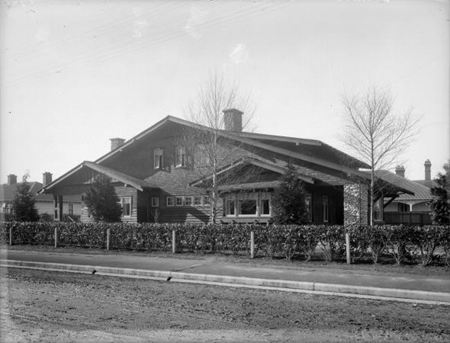
'Los Angeles' is one of the earliest examples of a California bungalow to be built in New Zealand, and was constructed sometime between 1909 and 1913. There are two traditions associated with the house. The first is that it was brought out from California in kitset form by the owner, Captain James McDonald, who was a trader between New Zealand and the United States. The second states that McDonald imported the weatherboards and cedar shingles he needed for the house from the States. Certainly shipments of exotic timbers were arriving in New Zealand by the beginning of the twentieth century, and American cedar in particular arrived in both baulks of timber and as sawn shingles. However, drawings by the architect J.S. Guthrie from 1909 indicate that the house was designed in New Zealand, but perhaps based on plans and drawings brought over from California.

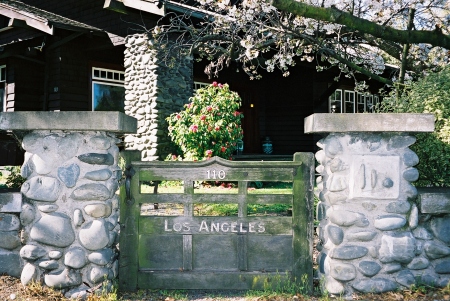
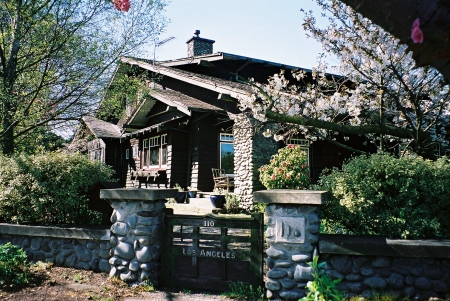
The typical features of the Californian bungalow seen here include the stone verandah post, the deep porch, the wide eaves, the horizontal lines of the building, the window hoods, the exposed rafters on the gables, and the dark exterior. Inside the house the halls, living room and breakfast room are panelled in rimu with a 'plate shelf' running around them. The ceilings feature exposed rafters.

Canterbury river stones were used for the verandah pillars, the chimneys, and the roadside fences, which are also included as part of the New Zealand Historic Places Trust/Pouhere Taonga registration. (The fence was moved and rebuilt due to road widening in 1992).

'Los Angeles' is highly significant as the earliest distinct example of a Californian bungalow in New Zealand. The advent of the bungalow is associated world wide with a more relaxed lifestyle, a growth in suburban living and ideas of 'town planning' and 'garden cities'. These changes are allied with a growth in private motor cars and public transport, making it easier for people to live away from the central city. In New Zealand the bungalow became the typical building of the suburbs and the construction of 'Los Angeles' is important as early evidence of the architectural expression of this developing trend.
Los Angeles | Melanie Lovell-Smith | 01/09/2001 | NZ Historic Places Trust
null | Melanie Lovell-Smith | 01/09/2001 | NZ Historic Places Trust
'American arts and crafts style bungalow in Fendalton, Christchurch'. Permission of the Alexander Turnbull Library, National Library of New Zealand Te Puna Matauranga o Aotearoa, must be obtained before any re-use of this image. Ref no. 1/1-021835 | Steffano Webb (1880?-1967). Photo taken c.1913. | Alexander Turnbull Library
Los Angeles | Melanie Lovell-Smith | 01/09/2001 | NZ Historic Places Trust
null | Melanie Lovell-Smith | 01/09/2001 | NZ Historic Places Trust
'American arts and crafts style bungalow in Fendalton, Christchurch'. Permission of the Alexander Turnbull Library, National Library of New Zealand Te Puna Matauranga o Aotearoa, must be obtained before any re-use of this image. Ref no. 1/1-021835 | Steffano Webb (1880?-1967). Photo taken c.1913. | Alexander Turnbull Library

List Entry Information

Overview

Status
Listed

List Entry Status
Historic Place Category 1

Access
Private/No Public Access

List Number
3680

Date Entered
2nd April 1985

Date of Effect
2nd April 1985

City/District Council
Christchurch City

Region
Canterbury Region

Legal description

Pt Lot 5, DP 2120

Detailed List Entry

Construction Professional

Name

Guthrie, John Steele and Maurice James

Type

Architect

Biography

'John Steele Guthrie (1883 - 1946) and Maurice James Guthrie (1891 - 1968) were one of Christchurch's most active architectural firms in the first half of [the twentieth] century. John, better known as 'Jack', trained in Christchurch with either J.C. Maddison or F.J. Barlow. By 1910 he was working in independent practice. In June 1919 his brother Maurice, who trained with Collins and Harman, joined the practice, although Jack remained the senior partner and designer. Their designs include 'Los Angeles' in Fendalton Road (1913), St Mary's Convent (1919), the now demolished Edmond's Factory (1920) and Christchurch Boys' High School (1926). The partnership was dissolved in 1929.' University of Canterbury, 'Arts and Crafts Churches of Canterbury', [Christchurch], 1996, p.14

Construction Details

Start Year

1909

Finish Year

1913

Type

Original Construction

Description

Exact year uncertain.

Start Year

1992

Type

Relocation

Description

Fence moved due to road widening

Reference

Completion Date

9th December 2001

Report Written By

Melanie Lovell-Smith

Information Sources

Ashford, 1994

Jeremy Ashford, The Bungalow in New Zealand, Auckland, 1994

Salmond, 1986

Jeremy Salmond, Old New Zealand Houses 1800-1940, Auckland, 1986, Reed Methuen

Shaw, 1997 (2003)

Peter Shaw, A History of New Zealand Architecture, Auckland, 1997

Report Written By

This place was identified as significant under previous legislation with different information requirements. It remains significant under the current legislation. There is opportunity under our legislation and policies to add to this information. Further information about this place may be available from the Southern Regional Office of Heritage New Zealand Pouhere Taonga. Please note that entry on the New Zealand Heritage List/Rarangi Korero identifies only the heritage values of the property concerned, and should not be construed as advice on the state of the property, or as a comment of its soundness or safety, including in regard to earthquake risk, safety in the event of fire, or insanitary conditions.

Further Information

Current Usages

Uses: Accommodation

Specific Usage: House

Uses: Civic Facilities

Specific Usage: Gate

Uses: Civic Facilities

Specific Usage: Wall/Fence

Former Usages

General Usage:: Accommodation

Specific Usage: House

General Usage:: Civic Facilities

Specific Usage: Gate

General Usage:: Civic Facilities

Specific Usage: Wall/Fence

Themes

Web Links

Overview

Status

Listed

List Entry Status

Historic Place Category 1

Access

Private/No Public Access

List Number

3680

Date Entered

2nd April 1985

Date of Effect

2nd April 1985

City/District Council

Christchurch City

Region

Canterbury Region

Legal description

Pt Lot 5, DP 2120

Status

Listed

List Entry Status

Historic Place Category 1

Access

Private/No Public Access

List Number

3680

Date Entered

2nd April 1985

Date of Effect

2nd April 1985

City/District Council

Christchurch City

Region

Canterbury Region

Legal description

Pt Lot 5, DP 2120

Construction Information

Construction Professional

Name

Guthrie, John Steele and Maurice James

Type

Architect

Biography

'John Steele Guthrie (1883 - 1946) and Maurice James Guthrie (1891 - 1968) were one of Christchurch's most active architectural firms in the first half of [the twentieth] century. John, better known as 'Jack', trained in Christchurch with either J.C. Maddison or F.J. Barlow. By 1910 he was working in independent practice. In June 1919 his brother Maurice, who trained with Collins and Harman, joined the practice, although Jack remained the senior partner and designer. Their designs include 'Los Angeles' in Fendalton Road (1913), St Mary's Convent (1919), the now demolished Edmond's Factory (1920) and Christchurch Boys' High School (1926). The partnership was dissolved in 1929.' University of Canterbury, 'Arts and Crafts Churches of Canterbury', [Christchurch], 1996, p.14

Construction Details

Start Year

1909

startYearCirca

Finish Year

1913

finishYearCirca

Type

Original Construction

Description

Exact year uncertain.

Start Year

1992

Type

Relocation

Description

Fence moved due to road widening

Construction Professional

Name

Guthrie, John Steele and Maurice James

Type

Architect

Biography

'John Steele Guthrie (1883 - 1946) and Maurice James Guthrie (1891 - 1968) were one of Christchurch's most active architectural firms in the first half of [the twentieth] century. John, better known as 'Jack', trained in Christchurch with either J.C. Maddison or F.J. Barlow. By 1910 he was working in independent practice. In June 1919 his brother Maurice, who trained with Collins and Harman, joined the practice, although Jack remained the senior partner and designer. Their designs include 'Los Angeles' in Fendalton Road (1913), St Mary's Convent (1919), the now demolished Edmond's Factory (1920) and Christchurch Boys' High School (1926). The partnership was dissolved in 1929.' University of Canterbury, 'Arts and Crafts Churches of Canterbury', [Christchurch], 1996, p.14

Construction Details

Start Year

1909

startYearCirca

Finish Year

1913

finishYearCirca

Type

Original Construction

Description

Exact year uncertain.

Start Year

1992

Type

Relocation

Description

Fence moved due to road widening

Reference

Historical and Associated Iwi / Hapū / Whānau

Completion Date

9th December 2001

Report Written By

Melanie Lovell-Smith

Information Sources

Ashford, 1994

Jeremy Ashford, The Bungalow in New Zealand, Auckland, 1994

Salmond, 1986

Jeremy Salmond, Old New Zealand Houses 1800-1940, Auckland, 1986, Reed Methuen

Shaw, 1997 (2003)

Peter Shaw, A History of New Zealand Architecture, Auckland, 1997

Other Information

This place was identified as significant under previous legislation with different information requirements. It remains significant under the current legislation. There is opportunity under our legislation and policies to add to this information. Further information about this place may be available from the Southern Regional Office of Heritage New Zealand Pouhere Taonga. Please note that entry on the New Zealand Heritage List/Rarangi Korero identifies only the heritage values of the property concerned, and should not be construed as advice on the state of the property, or as a comment of its soundness or safety, including in regard to earthquake risk, safety in the event of fire, or insanitary conditions.

Historical and Associated Iwi / Hapū / Whānau

Completion Date

9th December 2001

Report Written By

Melanie Lovell-Smith

Information Sources

Ashford, 1994

Jeremy Ashford, The Bungalow in New Zealand, Auckland, 1994

Salmond, 1986

Jeremy Salmond, Old New Zealand Houses 1800-1940, Auckland, 1986, Reed Methuen

Shaw, 1997 (2003)

Peter Shaw, A History of New Zealand Architecture, Auckland, 1997

Other Information

This place was identified as significant under previous legislation with different information requirements. It remains significant under the current legislation. There is opportunity under our legislation and policies to add to this information. Further information about this place may be available from the Southern Regional Office of Heritage New Zealand Pouhere Taonga. Please note that entry on the New Zealand Heritage List/Rarangi Korero identifies only the heritage values of the property concerned, and should not be construed as advice on the state of the property, or as a comment of its soundness or safety, including in regard to earthquake risk, safety in the event of fire, or insanitary conditions.

Further Information

Current Usages

Uses: Accommodation

Specific Usage: House

Uses: Civic Facilities

Specific Usage: Gate

Uses: Civic Facilities

Specific Usage: Wall/Fence

Former Usages

General Usage: Accommodation

Specific Usage: House

General Usage: Civic Facilities

Specific Usage: Gate

General Usage: Civic Facilities

Specific Usage: Wall/Fence

Current Usages

Uses: Accommodation

Specific Usage: House

Uses: Civic Facilities

Specific Usage: Gate

Uses: Civic Facilities

Specific Usage: Wall/Fence

Former Usages

General Usage: Accommodation

Specific Usage: House

General Usage: Civic Facilities

Specific Usage: Gate

General Usage: Civic Facilities

Specific Usage: Wall/Fence

Location

Loading
Stay up to date with Heritage this month