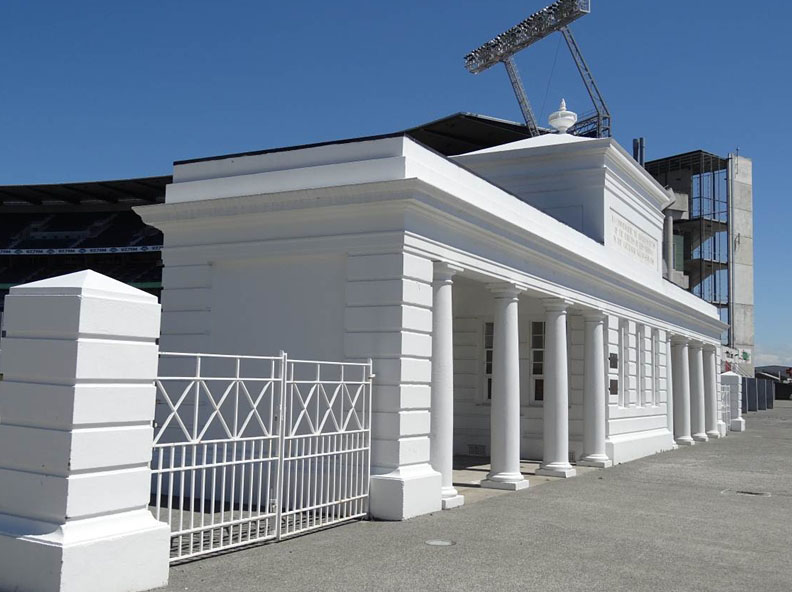
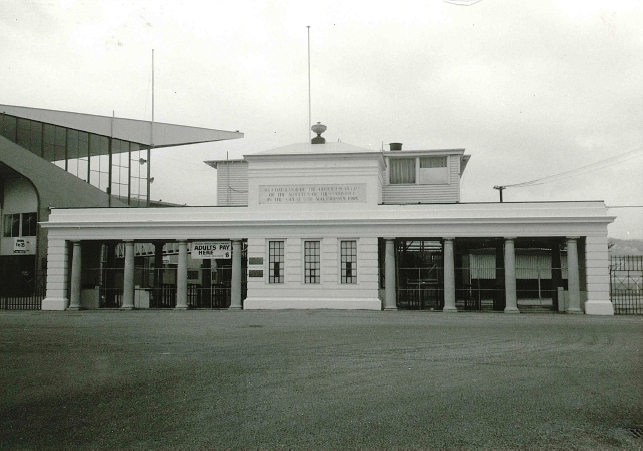
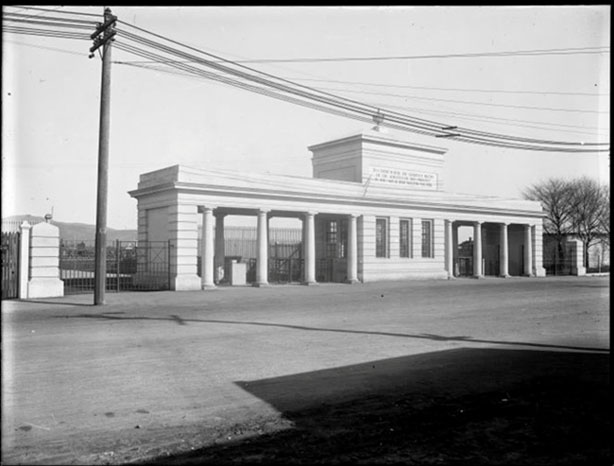
The War Memorial Entrance Gates at Lancaster Park in Christchurch were built in circa 1924 as a memorial to Canterbury athletes who died during World War One. They have social and community significance as a highly distinctive and memorable part of the sporting and social venue of the park.
In 1881 the Canterbury Cricket and Athletics Sports Club Ltd purchased land on the outskirts of the city for a sports club from Benjamin Lancaster. Lancaster Park was the venue for many important sporting fixtures and other events. By World War One, however, the park had struck hard financial times. As the war ended, an extraordinary effort by the Canterbury Commercial Travellers and Warehousemen’s Association raised the money to clear the park’s £8,000 debt, on the condition that it would become a permanent memorial to the men of Canterbury who had died in the war and that the park would be vested in the Crown. Some of the money raised was also set aside to create memorial gates for the athletes of the Province. This was one of the few memorials built for something other than a geographic community. To further cement the park’s connection to the war, it was renamed Victory Park, but in the hearts of Canterbury people it remained Lancaster Park.
The well-known Christchurch architectural firm of J S and M J Guthrie was commissioned to design the gates. The firm designed a number of other war memorials: at Halswell, Rakaia and Christchurch Boys High School, and the Victory Memorial School in St Albans. The building contractor was G L Bull. The ferro-concrete gates, 30.5 long x 3.6 metres wide, comprise two long neo-classical colonnades on either side of a two-storey central structure carrying the inscription ‘To commemorate the glorious deeds of the athletes of this province in the Great War Aug 1914 to Nov 1918’, and above this is an urn. The gates contained the ticket collectors’ office and ten entrance stiles.
The park hosted a wide range of sporting, concerts and other events, and developments occurred accordingly. In 1926 a plaque was added to commemorate the efforts of the Commercial Travellers and Warehousemen’s Association in saving the park. In 1995 the Hadlee Stand, named for a significant Canterbury cricketing family, was built directly behind the memorial gates, significantly changing the view of the gates from the street. In 1998 the name of the park was changed to Jade Stadium, and in 2007 to AMI Stadium. In 2008, in order to restructure the management of the park, it was vested in the Christchurch City Council. The legislation specifically stated that the Council must have regard for the significance of the gates in its management of the park.
The Canterbury earthquake of February 2011 severely damaged the playing surface and buildings of the park but the memorial gates appear to have escaped significant damage. The stadium is not likely to be reopened and some of the stands, including the Hadlee Stand, have been demolished.
In 1881 the Canterbury Cricket and Athletics Sports Club Ltd purchased land on the outskirts of the city for a sports club from Benjamin Lancaster. Lancaster Park was the venue for many important sporting fixtures and other events. By World War One, however, the park had struck hard financial times. As the war ended, an extraordinary effort by the Canterbury Commercial Travellers and Warehousemen’s Association raised the money to clear the park’s £8,000 debt, on the condition that it would become a permanent memorial to the men of Canterbury who had died in the war and that the park would be vested in the Crown. Some of the money raised was also set aside to create memorial gates for the athletes of the Province. This was one of the few memorials built for something other than a geographic community. To further cement the park’s connection to the war, it was renamed Victory Park, but in the hearts of Canterbury people it remained Lancaster Park.
The well-known Christchurch architectural firm of J S and M J Guthrie was commissioned to design the gates. The firm designed a number of other war memorials: at Halswell, Rakaia and Christchurch Boys High School, and the Victory Memorial School in St Albans. The building contractor was G L Bull. The ferro-concrete gates, 30.5 long x 3.6 metres wide, comprise two long neo-classical colonnades on either side of a two-storey central structure carrying the inscription ‘To commemorate the glorious deeds of the athletes of this province in the Great War Aug 1914 to Nov 1918’, and above this is an urn. The gates contained the ticket collectors’ office and ten entrance stiles.
The park hosted a wide range of sporting, concerts and other events, and developments occurred accordingly. In 1926 a plaque was added to commemorate the efforts of the Commercial Travellers and Warehousemen’s Association in saving the park. In 1995 the Hadlee Stand, named for a significant Canterbury cricketing family, was built directly behind the memorial gates, significantly changing the view of the gates from the street. In 1998 the name of the park was changed to Jade Stadium, and in 2007 to AMI Stadium. In 2008, in order to restructure the management of the park, it was vested in the Christchurch City Council. The legislation specifically stated that the Council must have regard for the significance of the gates in its management of the park.
The Canterbury earthquake of February 2011 severely damaged the playing surface and buildings of the park but the memorial gates appear to have escaped significant damage. The stadium is not likely to be reopened and some of the stands, including the Hadlee Stand, have been demolished.