The handsome Otautau Courthouse (Former), a solid and conservative brick building built in 1909 representing the presence of law and justice in the small Southland town of Otautau, stands on the main street. Designed by the Public Works Department, and built by local builders Thomson and Georgeson, the building is a reflection of the town’s importance as a rural centre in the early years of the twentieth century.
The European settlement of Otautau began as a camping place ‘where the itinerant bullock dray paused only long enough for the wayside greeting’ on the way from Riverton to the interior and to the Lakes District beyond. As a flood of hopeful gold miners made their way to Central Otago in the 1860s the settlement developed. The town was surveyed in 1872 and land was set aside in the centre for reserves associated with government buildings. The Police Reserve and the Telegraph Reserve were located next to each other, with the town hall and athenaeum to be located nearby. The Town Board wanted a substantial prosperous-looking town centre, and to encourage this passed a bylaw in 1907 proclaiming that all buildings within a defined area in the centre of town had to be constructed of brick, stone or concrete.
Court sittings were initially held in Otautau’s town hall. The Town Board and the magistrates had approached the Government about the urgent need for proper facilities in Otautau.The District Engineer called for tenders for the construction of a timber courthouse in August 1907. The Public Works Department acceded to the request that the new building be brick. Tenders for the design in brick were finally called for in April 1908, and a tender for between £1,100 and £1,200. The contractors began work in June 1908.
In the early 1980s the Justice Department declared the courthouse was surplus to its requirements. The Wallace County Council eventually acquired it and used it for the Otautau Library. Later it was sold to the Otautau Heritage Trust. It is used for meetings, exhibitions, and workshops by the Otautau & District Creative Arts Trust and the Otautau Museum Trust and according to the museum is one of Otautau’s oldest buildings.
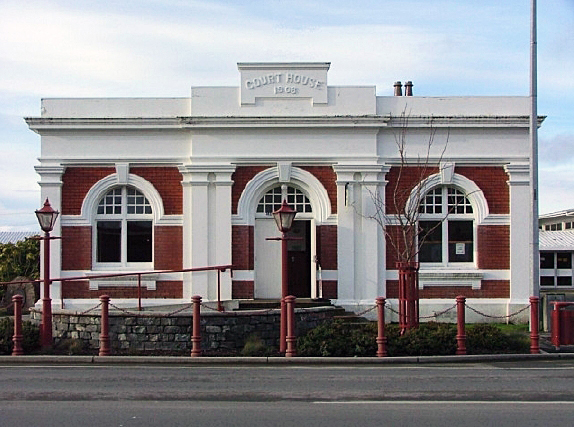
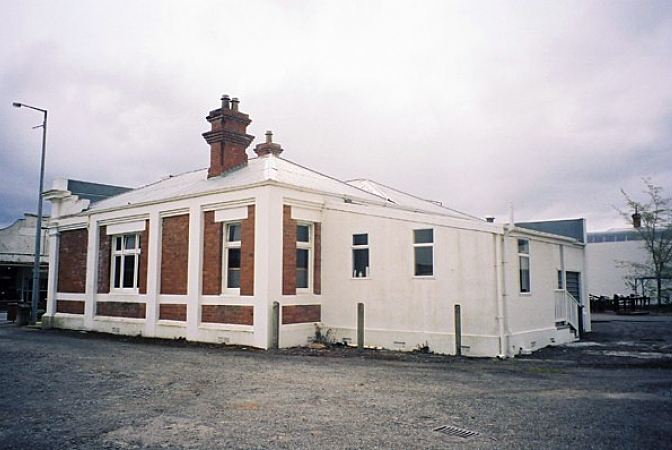
The Otautau Courthouse is a single-storey double brick building, basically square in plan (12.4 by 11.8m). It is brick construction with brick pillars and infill brick which forms the basis for the decorative scheme of the building. It has a double hipped, corrugated iron roof. The principle elevation faces Main Street with its formally styled Classical façade, with a stripped back Palladian motif. The façade is divided into three bays, the central encompassing the formal double-doored entrance, flanked by symmetrically-placed arched and paired casement windows. The roofline is concealed behind a square pediment which proclaims the construction date as 1908.
With its solid formal presence the former Courthouse makes a significant contribution to the streetscape of Otautau. It reflects important aspects of New Zealand history, including the spread of the colonial judicial system into the lower South Island. The Otautau Courthouse (Former) represents the establishment of law in this isolated district. The court was the centre for criminal justice, but also oversaw civil cases, and provided a focus for the administration of justice in the town and district.
The European settlement of Otautau began as a camping place ‘where the itinerant bullock dray paused only long enough for the wayside greeting’ on the way from Riverton to the interior and to the Lakes District beyond. As a flood of hopeful gold miners made their way to Central Otago in the 1860s the settlement developed. The town was surveyed in 1872 and land was set aside in the centre for reserves associated with government buildings. The Police Reserve and the Telegraph Reserve were located next to each other, with the town hall and athenaeum to be located nearby. The Town Board wanted a substantial prosperous-looking town centre, and to encourage this passed a bylaw in 1907 proclaiming that all buildings within a defined area in the centre of town had to be constructed of brick, stone or concrete.
Court sittings were initially held in Otautau’s town hall. The Town Board and the magistrates had approached the Government about the urgent need for proper facilities in Otautau.The District Engineer called for tenders for the construction of a timber courthouse in August 1907. The Public Works Department acceded to the request that the new building be brick. Tenders for the design in brick were finally called for in April 1908, and a tender for between £1,100 and £1,200. The contractors began work in June 1908.
In the early 1980s the Justice Department declared the courthouse was surplus to its requirements. The Wallace County Council eventually acquired it and used it for the Otautau Library. Later it was sold to the Otautau Heritage Trust. It is used for meetings, exhibitions, and workshops by the Otautau & District Creative Arts Trust and the Otautau Museum Trust and according to the museum is one of Otautau’s oldest buildings.
The Otautau Courthouse is a single-storey double brick building, basically square in plan (12.4 by 11.8m). It is brick construction with brick pillars and infill brick which forms the basis for the decorative scheme of the building. It has a double hipped, corrugated iron roof. The principle elevation faces Main Street with its formally styled Classical façade, with a stripped back Palladian motif. The façade is divided into three bays, the central encompassing the formal double-doored entrance, flanked by symmetrically-placed arched and paired casement windows. The roofline is concealed behind a square pediment which proclaims the construction date as 1908.
With its solid formal presence the former Courthouse makes a significant contribution to the streetscape of Otautau. It reflects important aspects of New Zealand history, including the spread of the colonial judicial system into the lower South Island. The Otautau Courthouse (Former) represents the establishment of law in this isolated district. The court was the centre for criminal justice, but also oversaw civil cases, and provided a focus for the administration of justice in the town and district.