The discovery and settlement of the Wairarapa region is connected with several prominent figures of New Zealand’s history. Ancestral figures such as Hau-nui-a-nanaia, Kupe, Whatonga, Tara Ika and Toi have all been said to have connections with the region and are responsible for the naming of many of the Wairarapa’s features and places. It has been estimated that Rangitane settled in the region by about the sixteenth century. Marriage links with Rangitane saw a group of Ngati Kahungunu retreat to the Wairarapa in the subsequent century as the result of internal hapu conflict. The two groups cohabitated mostly in the south Wairarapa for a period, but then the Ngati Kahungunu newcomers negotiated several sections of land for themselves. This process was not seamless and instances of conflict continued between the two iwi over the centuries. The next significant period of change in the area was in the early nineteenth century with the progression south of Te Rauparaha and others. This ushered in an era when many different iwi, including Ngati Whatua, Ngati Awa, Ngati Toa, Ngati Raukawa, Ngati Tama, and Ngati Mutunga, made advances into the region and some Ngati Kahungunu hapu withdrew.
While the Wairarapa was sparsely settled during initial Maori occupation, it has been suggested that by the time European settlement occurred large amounts of the region had already been cleared of the ‘primordial’ forest referred to by Colenso on his later incursion there. The coast, for example, had been almost entirely cleared of forest, and the density of archaeological sites on the coast reflects this. European incursion into the Wairarapa and Tararua only began after the New Zealand Company’s Port Nicholson settlement was established. Based on the reports of the exploring and surveying parties that the company sent out, the southern Wairarapa became one of the first extensive tracts of land to be occupied by Europeans, although the Crown titles, negotiated by Donald McLean, were not obtained until 1853. However, it took substantially longer for settlement to progress beyond Masterton, which was linked to Wellington by road in 1859. Further increase was slow because the northern Wairarapa was heavily forested, as opposed to the south with its relatively clear and large grass plains. In particular the forest north of Mount Bruce was dense with rimu, tawa, matai, maire, kahikatea, and rata, and was known as Forty Mile Bush, which Alfredton is a part of, which was within the larger Seventy Mile Bush that also encompassed places such as Dannevirke and Norsewood. Maori referred to this forest as Te Tapere Nui o Whatonga (The great forest of Whatonga) and an abundance of birdlife resided there amongst giant ancient trees, some of which were large enough for groups of people to shelter within their trunks.
The forest acted as a significant barrier and therefore, while there was some European settlement in the northern Wairarapa before the late nineteenth century, it was not until roads were extended further, and the railway link to Wellington established, that the area was opened up for substantive settlement. In preparation for the construction of the railway the government had an active role in the foundation of several places in the Wairarapa and Tararua regions. Towns such as Mauriceville, Eketahuna, Norsewood and Dannevirke were all initially formed as bases for the railway labourers and were settled mostly by Scandinavian immigrants, made possible through Julius Vogel’s (1835-1899) 1870 Immigration and Public Works Act. Part of the preparation for the railway construction included building a road through the district which had progressed by the mid to late 1870s, as had the initial development of the settlements at Mauriceville and Eketahuna.
Originally named and known as Moroa (‘Oh, a clearing!’), Alfredton was renamed in 1867 for the son of the Queen of England. Borne from lofty ideals, the town failed to thrive in the nineteenth century, with the 1889 Wellington Directory listing just seven residents both there and in Bideford. The Small Farms Association, conceived in 1853 by, among others, Joseph Masters, Charles Carter and William Allen, sought to give the workers of Wellington the opportunity to buy the land that had not been forthcoming from the New Zealand Company. The concept of the Small Farms Association was to sell blocks of 50 acres of farmland with an attached quarter acre in town. This was the practice at Alfredton. Unfortunately, according to one source, the land and soil at Alfredton meant that it was unsuitable for small farms: ‘The only quantity of flat land was in narrow valleys intersected by deep muddy creeks. Much of the terrain was too steep for the planting of crops and there was some poor, hilly clay country’. The swampiness of the surrounding area led to trouble with the roads there, with one man losing his life through being stuck in the mud.
While fires in the region were commonplace during the turn of the century, in 1908 there was a devastating fire in the district surrounding Eketahuna, caused by the particularly dry summer of 1907-8. Fires began in the middle of January that could have been contained save a heavy wind that developed and fanned fires in the district. Eketahuna was not the only town to suffer, with some reports stating that the whole district was ablaze by the 21st of January. Fires continued until the end of the month. While the fire had a major impact on the built heritage of the towns in the district, it also had a major impact on their futures and economy. Timber production, which prior to this was the district’s main source of income, fell into decline and after the fire pastoral farming became the main occupation there. Similarly, there were several earthquakes felt in the region, none more so than the 1942 Wairarapa earthquake. First damaged in the June 24 1942 earthquake, Eketahuna suffered further in the 2 August aftershock, and it has been reported there was more damage during this quake than in the original. This earthquake had an effect on St Aidan’s church, and caused the sanctuary walls to lean outwards ‘spreading open the beams in the apex of the roof,’ and it has been noted by Reverend John C.E. Mutter that ‘we later drilled holes at the entry to the sanctuary and pushed a tie-rod through to pull the walls into vertical again.’
Christianity and religion in the region
Christianity was certainly already well entrenched in Wairarapa by the time European settlers first settled there permanently, and the Anglican church has played a part in the life of the area since its first European settlement: ‘Col. William Wakefield and the New Zealand Company failed to secure the Wairarapa for the Canterbury, Church of England settlement, although Francis Dillon Bell had gained the confidence of the Wairarapa Maori Chiefs who were willing to sell’. Originally, however, Dillon was not successful in his attempts to purchase land because of the squatters who were already resident there.
In the 1840s Christianity was being preached by teachers such as Paraone in the Wairarapa district. Paraone had been sent to the region by Archdeacon William Williams. As early as 1843, 80 people at Mataikona had erected a chapel building at the village there, with as many as 200 people attending Good Friday services. By the end of the 1850s the popularity of the church had declined with the Maori population in the region. Between 1845-9 Colenso made nine trips on foot from Hawke’s Bay to Wellington, taking an inland route through the Rimutakas, preaching and writing of his experiences on the way. The Anglican church had therefore already been established in the region by the time Alfredton was founded, and the strength of the religion continued even though the majority of the first settlers in the area were Scandinavian, and therefore most likely not Anglican themselves.
Historian Irene Adcock suggests that plans were afoot for the construction of a church in Alfredton as early as 1869, with one 50 acre section in the area, and another quarter acre taken up in the town for the purposes of a church by the first vicar of the Wairarapa, Reverend W. Ronaldson. In 1871 the land was secured by the Diocesan Trustees. George and Galbraith Wratten donated the half-acre site for the church, with the majority of the building materials for the church also donated by locals.
The church was not built immediately, however, and in August 1900 Reverend John Walker of St Cuthbert’s Anglican Church in Eketahuna ‘called the first meeting of parishioners to build a church at Alfredton’. St Cuthbert’s Church had been established in 1899. Prior to this the Anglican inhabitants of Alfredton had practised religion in a relatively haphazard manner, as services were held in the town hall. These services, while denominational, did not stop some villagers from attending both Presbyterian services in the morning and Anglican in the afternoon.
In March 1901 Walker wrote to Frederick de Jersey Clere and John Sydney Swan, stating that the inhabitants were collecting for a church, which he hoped would not cost more than £150, as more than that amount would be difficult to raise in such a ‘scattered district.’ The specifications for the church date to April 1901. The construction of the church proceeded quickly, and after the tender for £165.13 was accepted in August 1901, Cecil Kebbell laid the foundation stone for the church on 21 November 1901. Kebbell remained an important part of the life of the church in the following years, serving as a Vicar’s warden for nineteen years. His involvement with the church continued until his death in 1938. An important figure in the life of Alfredton, Kebbell is also notable for seconding a motion in 1906 to allow women the opportunity to vote in the election of church wardens and vestrymen at the Wellington Diocesan Synod. This vote was eventually overturned by the bishop, and women did not gain the right to vote until 1919, despite protestations in the press.
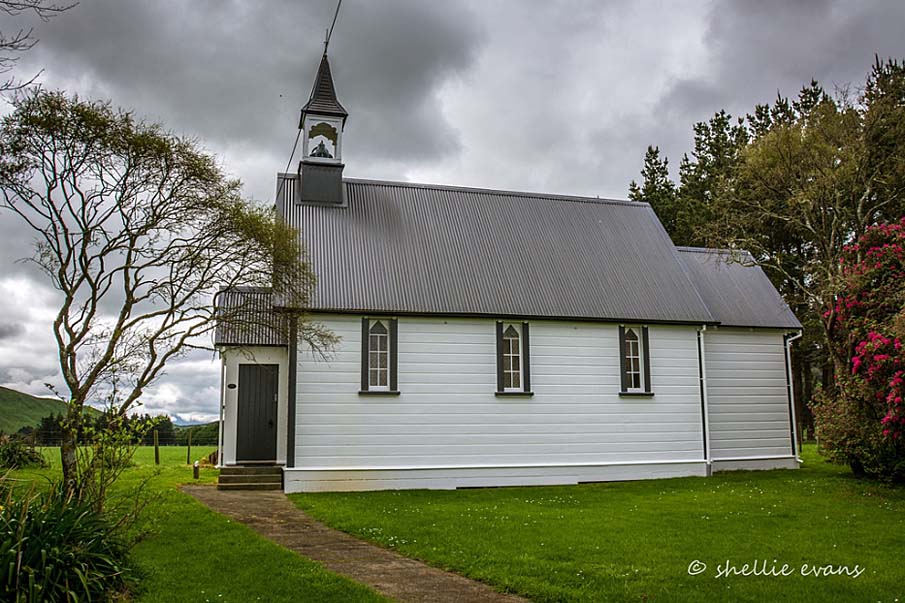
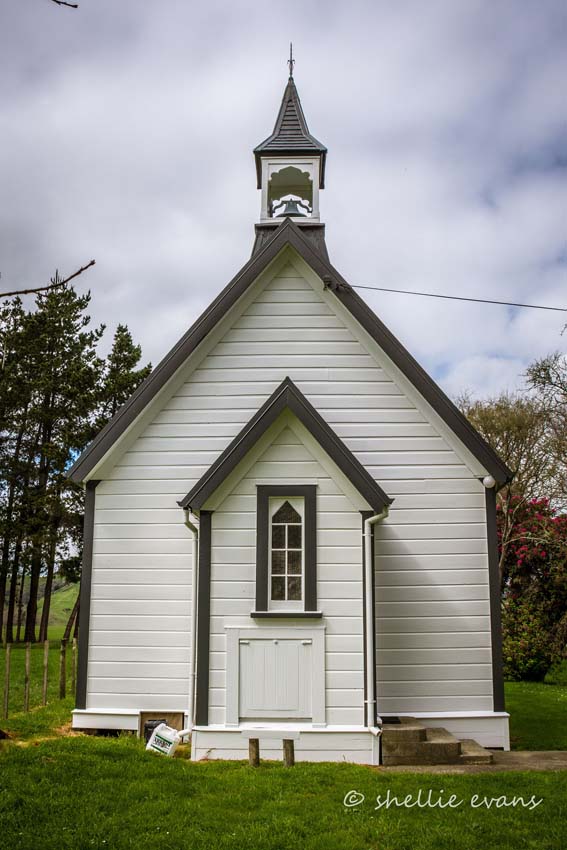
There is a small door in the porch west wall there as ‘after the church was built it was found that coffins could not negotiate the tight turn between nave and outer door in the porch.’ While it has been speculated that the porch was the addition of a builder, there is a letter from Wratten to the architects asking for designs for the porch dating August 1901, and a reply from the architects with plans.
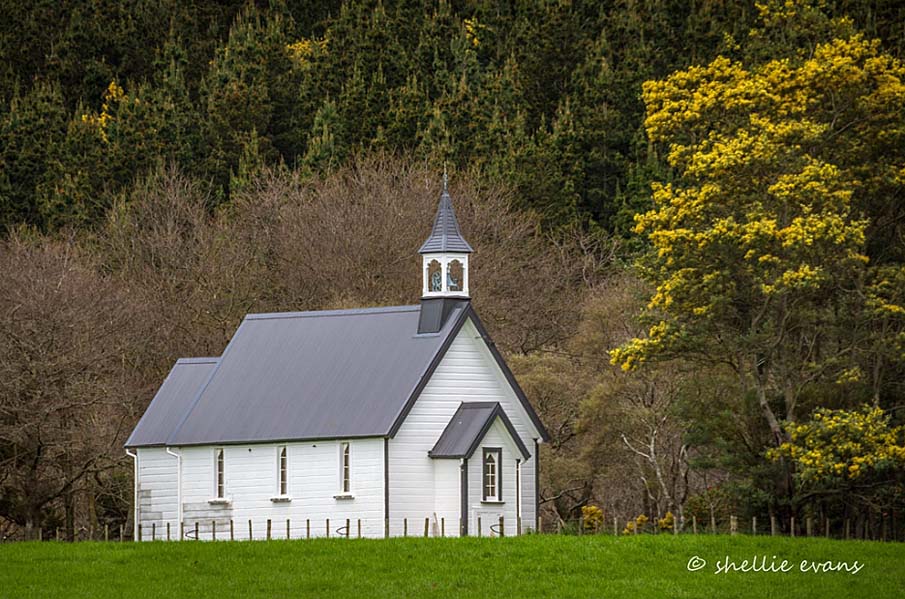
It has been estimated that the church could accommodate around 50 people, in keeping with the small community at Alfredton, and to the specifications of John Walker in his original letter to Clere and Swan. The original specifications also state that the window frames, sashes and sills throughout the church are heart totara. Similarly the remainder of the church is constructed from native timber including matai and rimu. Detailed specifications for the church exist in the Alexander Turnbull Library, including small details such as letters from George Burton, the builder, to the architects asking for instructions on which window clasps to use.
There are features of the church which commemorate members of the Alfredton community, none more so than the stained glass windows in the sanctuary east wall. It has been reported that the Stone-Wigg family had an important role in many aspects of church life from 1939, until tragically the whole family was killed in a house fire in 1956. The three panes of the window depict St Aidan with his pastoral staff on the right, St John on the left and Jesus as the good shepherd shown in the central window. Members of the community in Alfredton remember this event and can identify where the Stone-Wigg house stood.
For reasons of economy there was provision for the chancel to be added to the church at a later date. There is therefore a further long-standing commemoration of a member of the community, Reginald Marsh, in the form of both this and the belfry, which were erected in 1904. Detailed specifications for the bell cote are held at the Alexander Turnbull Library. These date to 1902, however it appears that it was not erected until 1904. The bell cote was designed by John Sydney Swan, and is similar in design to that at St Mark’s church in Kaponga, Taranaki. In reference to St Mark’s church, Maclean states that Swan ‘left his signature on the shingled bellcote steeple - shorter, and viewed from below, squatter than Clere’s.’ The communion rails were donated to the church by the Kebbell family when they left the area for Australia in 1963.
St Aidan’s church has been used for all manner of church services including weddings, baptisms and confirmations since it was constructed. Bishop Fredric Wallis, the third Bishop of Wellington, took the first confirmation service at the church in April 1902.
The font was not included in the original plans for the church, instead being carved by Kebbell. The font is an important part of the church, as it is here that baptisms are carried out. The time of baptism is the addition of a member to the family of the church and is therefore an integral part of the religious ceremony connected with it. The font may also be used at times of confirmation, which marks the time of a mature commitment to the church.
The organ was an important part of the community surrounding the church, with the organ players remembered for their long service. The organ remains in place on the southeast wall; however this is not the original instrument, the first having been sold in 1977 and the current one purchased from the Wesleyan church.
Recent newspaper articles have also been helpful in determining the level of local esteem for the place and show that St Aidan’s Church is still a central focus of the town. On 20 March 2010 the church was deconsecrated by Rt Reverend Bishop Dr. Tom Brown. This does not end the church’s connection with the Anglican faith, however, and a funeral has been carried out at the church more recently. The church remains one of the only historic buildings in Alfredton and is the only church in the area. It is currently otherwise not in use, although there are preparations for the church to be used for the Alfredton school at Christmas 2010. There is keen interest in retaining the church in the town and it has been purchased in September 2010 by The St Aidan's Alfredton Community Trust, who plan on restoring the church for use by the community.