Māori settlement of the Wairarapa
In the pre-contact period, the Wairarapa region’s rich resources and its landscape and seascape determined seasonal resource availability, and consequently Māori settlement patterns. Archaeological information indicates that Māori settled in the Wairarapa in the late 1300s, with several communities living at Palliser Bay through until 1550-1625. Waitaha, Ngāti Māmoe and Te Tini-oawa were the early inhabitants of the Wairarapa region and after these earlier iwi migrated to Te Waipounamu (the South Island) around the sixteenth century, Wairarapa was occupied by hapū from Rangitāne, Ngāi Tara, Ngāti Ira and Ngāti Kahungunu. By the late 1700s, the land around Featherston was occupied by Ngāti Kahungunu hapū Ngāti Kahukuraāwhitia and Ngāti Moe.
In the early 1800s, Māori settlement in the Wairarapa was still based upon the seasonal patterns of the traditional economy. The Featherston area was known as Pae-o-Tū-Mokai. There are various translations of Pāe-o-Tū-Mokai; one kōrero (story) is that the name references Featherston’s reputation as a good place for hunting birds as they appeared very tame. In the 1820s and 1830s, incursions from Taranaki tribes saw many Wāirarapa Māori seek refuge with relatives at Nukutaurua on the Māhia Peninsula and in the Manawatu, returning to the region in the late 1830s – early 1840s.
Arrival of Pākehā settlers and establishment of Featherston township
Dr E. Dieffenbach of the New Zealand Company first sighted the plains of Featherston from a peak in the Tararua Ranges in 1840 and from late 1843, Pākehā settlers from Wellington began to relocate the Wairarapa, establishing homesteads and sheep runs. In 1847, farmer Henry Burling became the first Pākehā settler of Featherston and opened an accommodation house near the settlement of Pae-o-Tū-Mokai on Māori leasehold land; the area became known by Pākehā as ‘Burlings’. The first land sales occurred in 1853, including the Ōwhanga block, which was surveyed three years later by Captain William Mein Smith of the Provincial Government for a new township. The new town was named Featherston after the Provincial Superintendent Dr Isaac Featherston. Featherston ‘almost stifled at birth’ due to the high prices set for the town acres; more valuable sections were selling for up to £32 pounds an acre compared to £1 an acre in the Small Farm Settlements of Greytown and Masterton. The arrival of the railway in the 1870s provided the impetus for further settlement though, and Featherston soon become an important service town.
Featherston during World War One
Featherston played a pivotal role during World War One due to the establishment of Featherston Military Training Camp just east of the township in 1916. Trentham Military Camp in the nearby Hutt Valley was overcrowded with very basic facilities, contributing to the outbreak of diseases in May-July 1915, and the Defence Department soon recognised the need for a second camp to avoid further overcrowding. The Wairarapa plains were viewed as highly suitable for military training and their location ‘within reach’ of Trentham and the Defence Headquarters was a further advantage.
The scale of the Featherston Military Training Camp was unprecedented; it was larger than Featherston township itself with the campsites and training grounds totalling more than 750 hectares. On completion the camp comprised 252 buildings including 90 double huts for trainee soldiers, 16 dining halls, 17 shops, picture theatres and a hospital compound. It could initially accommodate 6500 men, with 2000 of them based at the canvas camp southeast of the main hutment camp. By 1917 the camp required expansion and infrastructure upgrades to accommodate up to 8000 men at a time. More than 60 000 men trained at the camp between 1916 and 1918 before heading to the battlefields of Europe as infantrymen, cavalry, artillerymen and machine gunners, many never to return to New Zealand.
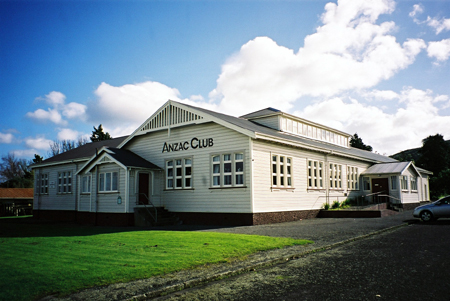
The Featherston Military Training Camp ultimately ‘involved a provincial town in a national contribution’. The camp was well-supported by the local Featherston community during its occupation in World War One, and recruits on leave regularly visited Featherston ‘for food, companionship and entertainment’. Recruits were accompanied by the camp’s Military Police who ensured order was maintained, but by all accounts their presence was unnecessary. The recruits were described as ‘the pick of our manhood’ and Featherston residents were glad to host them in their homes any time. Historian Tim Shoebridge notes that the Featherston community ‘rallied to provide facilities for the men training in their neighbourhood’, as exemplified by the construction and opening of the Anzac Club in 1916 which was entirely funded by early Pākehā settlers of the district. The club could accommodate around 600 people and catered for ‘the social needs of soldiers and their dependents’.
Commemorating the War in Featherston
The first memorials to New Zealanders who lost their lives during the Great War were constructed during the war itself, such as the First World War Memorial Beacon on Quay Street, Auckland (erected late 1915) and the Kaitaia War Memorial, unveiled in March 1916. Featherston’s first memorial was also erected before the war was even over. On 10 December 1917, Minister of Defence Sir Hames Allen unveiled the Soldiers’ Memorial at Featherston Cemetery. This large granite obelisk commemorated soldiers who had died while in training, and was constructed with funds raised by soldiers from the camp. At that time, 19 soldiers from the camp were interred at the cemetery, though that number rose exponentially after the outbreak of the Spanish influenza in late 1918. A total of 180 individuals from the camp are recorded as buried in the cemetery.
After the war, communities throughout New Zealand ‘began planning memorials in earnest’. In March 1919, subscribers to the Wairarapa Anzac Club decided to gift the club to the Featherston Borough Council ‘as a memorial to Wairarapa soldiers who were killed in the great war of 1914-1918’, on the proviso that ‘a suitable monument’ be erected on the plot of grass to the east of the club. A further condition of the gift was that any surplus club funds were to be used towards the monument’s construction. The Wairarapa Anzac Club’s Featherston War Memorial Committee was established with Messrs W.E. Bidwill, A.C. Pearce, D.C. Collins, W.J. Martin, A. Clark, Q. Donald and W. Barton as appointees.
Construction of a ‘Suitable Monument’
By June 1920 the Featherston Borough Council had ‘taken steps in connection with directing attention to the matter of a district war memorial’ and the initial proposal to earmark only £600 (the amount available from the Wairarapa Anzac Club) for the memorial was abandoned. At a public meeting on 30 May 1920, the decision was made to collect further contributions towards the memorial by subscription, and William Bidwell had already obtained promised donations totallying more than £850.
Despite the early planning and fundraising for the memorial, progress was slow. Other Wairarapa memorials were completed before it during the active phase of memorial construction in New Zealand, which saw more than 500 memorials built in the decade after the war. Memorials were unveiled for example in Carterton and Martinborough in 1921, Kaiparoro in 1922 and Greytown and Masterton in 1923.
In May 1925, the Wairarapa Anzac Club rescinded their 1919 motion for the club’s surplus funds to be used for the erection of a memorial to the east of the club, and authorised the expenditure of the funds for the erection of a memorial at the junction of Fitzherbert and Fox Streets, known locally as the Crossroads. The Crossroads was a promiment site in the township, considered more suitable for the memorial’s placement. As historian Jock Phillips notes, the selection of an appropriate site for a war memorial had certain requirements – it had to be ‘prominent’, as befitting a monument to a great event; there should be room for people to gather and hold Anzac Day services; it should be relatively central, and a place where people normally congregated, so that the imagery and wording would be a continuous inspiration’. Historic photos of Featherston indicate the Crossroads was a grassy area with some trees providing shade; a suitable spot for horses to rest and a likely meeting point for the residents of Featherston. In August 1925 the Featherston Borough Council sanctioned the building of the memorial at the Crossroads (a road reserve).
It seems that different designs were prepared for the memorial around this time, with monumental masons T. G. Hoar and Sons of Masterton for example producing plans and a detailed specification for ‘Featherston War Memorial’. Whilst dated to ‘c.1920’, these plans may actually have been produced around 1925, as the accompanying specification references ‘a triangular site’, being the land parcel at the intersection of Fitzherbert, Wallace and Fox Streets rather than the original Anzac Club site. The specification indicates that the trees had been removed by this time, with only stumps remaining.
Hoar’s plans do not reflect the cupola memorial as built, though certain aspects of Hoar’s design were certainly carried through to the completed memorial. These include the quadrangular form, 12 columns (which Hoar proposed to construct of plastered cement, though he included the option of boulder columns), tessellated tile floor, central granite obelisk, and low boulder wall with concrete coping around the perimeter of the site. The final design of the cupola memorial is attributed to local resident and returned serviceman Norman Charles Campbell Shepherd, and was developed by carrier Mitchell Brown Tait of Featherston. Both N.C.C. Shepherd and M.B. Tait were members of the Featherston and District Soldiers’ Memorial Committee which was established to oversee the memorial’s construction (Shepherd was the Secretary). Shepherd was also directly connected to the Featherston Military Training Camp, having worked at the camp headquarters after his premature return from the Front due to rheumatic fever which deemed him unfit for service overseas. Shepherd started as a clerk in the commandant’s office and rose to the rank of staff-sergeant during his time at the camp.
In May 1926, an Evening Post article notes that plans and specifications for the memorial had been submitted for an independent report, which had only yielded an approximate cost to date, so the ‘matter was left in the hands of the chairman to go into with the architect’. Committees were established to raise additional funds as it was considered that the memorial would cost £2000, slightly more than the amount already raised or promised which totalled around £1822.
Outstanding matters concerning the design and costing of the memorial were resolved in the following months and tenders were advertised for the erection of the memorial. Prospective tenderers were to submit their bids by 3 August 1926 to Featherston and District Soldiers’ Memorial Committee Secretary N.C.C Shepherd, with plans and specifications available on application. The successful tenderer was stonemason R.H. Greenfield and the memorial was constructed for the total cost of £1,873. Its completion date of 1927 places it among the latest of New Zealand’s World War One memorials, with 90% of memorials unveiled by the end of 1926.
The Featherston community assisted with the memorial’s construction - ‘farmers brought horses to transport stones handpicked from the Tauherenikau River and people came from all over to set them in place’. The use of river stones from the Tauherenīkau River was particularly symbolic as they ‘marked so many men’s experiences’ of the Featherston Military Training Camp and nearby Tauherenīkau Camp. As part of their training and ‘toughening up’ for war, new recruits had to move the large river stones - by all accounts a gruelling task. The stones were repurposed throughout the camps; at Featherston’s canvas camp for example where the stones were particularly characteristic, they were whitewashed and used by the recruits to demarcate their tents, line pathways and garden edges, and to provide shelter from the high winds which struck the camp. They were also used extensively for decorative effect within the camps, and the painting and decorating of river stones became ‘a serious pastime for many of the soldiers in the tent camps of south Wairarapa’. Historic photos of the camps show elaborate designs created from the river stones, and a 1917 report on the Tauherenīkau C1 Camp noted:
‘Nearly every tent has its own special decoration outside. This decorative work is done mainly with coal dust, red brick, pipe-clay and large and small stones, which are whitewashed, “bluewashed”, or “redwashed”, according to the artistic fancy of the men. Some of the designs are particularly good, representing battleships, artillery, industry etc.’
Unveiling of the Featherston District War Memorial
On 23 April 1927, Featherston and District Soldiers’ Memorial Committee Chair and Featherston Mayor J.W. Card placed a notice in the Wairarapa Age, inviting the public to attend the unveiling ceremony scheduled for Anzac Day. The subsequent unveiling of the memorial by former Minister of Defence Sir James Allen was attended by a ‘big gathering of people from all parts of the Wairarapa, with some from places further afield’. A number of officials were present including mayors, chairs and members of the various Wairarapa councils, and representatives of other bodies and organisations such as the Wairarapa Returned Service Association (R.S.A.). Returned servicemen were provided with seats inside the wall enclosing the memorial, with the public standing outside of the wall around all sides.
Mayor J.W. Card presided over the unveiling, which commenced with music by the Masterton Municipal Band who had been invited to attend. Mayor J.W. Card gave an introductory address which noted that the memorial had been constructed completely free of debt thanks to the generosity of the public in their subscriptions. Sir James Allen also spoke and unveiled the memorial by drawing away the flags which covered it. The Wairarapa Age report on the unveiling describes the memorial as ‘a very beautiful structure of its kind’:
‘It consists of a domed cupola raised on pillars and enclosing an obelisk. The monument and a space of greensward are surrounded by a stone wall. On top of the dome there is a powerful arc light to illuminate the memorial at night’.
After the speeches, the Reverend W.J. Durrad read a passage from Scripture and everyone sang Rudyard Kipling’s ‘Recessional’. The formalities concluded with the band playing ‘Dead March in Saul’ and the laying of floral tributes on the memorial. Afterwards, visitors went to the Anzac Club where the National Women’s Reserve put on afternoon tea and the band provided entertainment.
The Memorial from 1927 to Now
The memorial became the focus of subsequent Anzac Day commemorations in Featherston, and on Anzac Day 1950, United States Ambassador Mr P.M. Scotten unveiled the World War Two roll of honour that had been added to the obelisk. The unveiling ceremony was reportedly ‘brief but impressive’. The Masterton Municipal Band played the Last Post then led a parade to the Anzac Club where Mr Scotten gave the formal address, followed by afternoon tea.
The memorial underwent little change over the following decades apart from removal of the three flagpoles originally placed at each corner of the site, the replacement of the original globe light at the top of the spire, and connection of the memorial to street lighting. In 1991 the Featherston RSA donated $200 ‘to assist with the provision of suitable seating and general beautifying of the memorial triangle’, as per plans proposed by the Featherston Community Board. Two bench seats were added to the grass in front of the northwestern face of the memorial, and existing flax bushes were removed, with new garden beds planted around the perimeter of the site by the Featherston Lioness Club.
In 2006, a staged project by the Featherston Main Street Group to revitalise Featherston’s main street focused on the surrounds of the memorial. No changes were proposed to the memorial itself (apart from cleaning and potential structural reinforcement) but there was a proposal to remove the original perimeter wall which the Main Street Group felt was a barrier to the memorial, and recycle the boulders into four planters. Existing planting inside the wall which had been added over the years and maintained by the RSA and Featherston Lioness Club respectively would also be removed and the whole area would be paved, with flagpoles added. The project additionally proposed to replace the light atop the cupola with modern up-lights inserted in each of the memorial’s four corners.
Heritage New Zealand did not support the proposed dismantling and recycling of the wall on the basis that it was an essential component of the memorial, dating to its original construction. There was also opposition within the local community to the proposed memorial work, with one submission noting that the wall:
‘…is a barrier that separates this sacred area from the hustle and bustle of everyday life. The wall provides a tranquil peaceful area dedicated to our heroes and if it were removed this special feeling would disappear.’
The submission further notes that the wall is of historical importance, having been ‘an integral part of the memorial’ since 1927. Some members of the Main Street Group itself were opposed to the proposal and the Council decided not to proceed with plans on account of the feedback received. The Featherston RSA in particular was delighted by the decision, commenting that it was ‘inexcusable to even consider altering a site that carries so much historical significance’.
On 7 December 2006 the memorial was classified as a historic reserve in the NZ Gazette. In 2019 the memorial remains a key element within the commemorative landscape of Featherston which pays tribute to the town’s significant World War One history, and has recently enhanced by the recent addition of the Featherston Camp Sculpture in the town centre in late 2018. Whilst the civil part of the town’s Anzac Day’s service is now held in the former Anzac Club, the commemoration starts with a march to the memorial for the wreath laying. The memorial has been recognised as a place of remembrance by the New Zealand Poppy Places Trust and is also included within the self-guided Wairarapa World War One Heritage Trail.