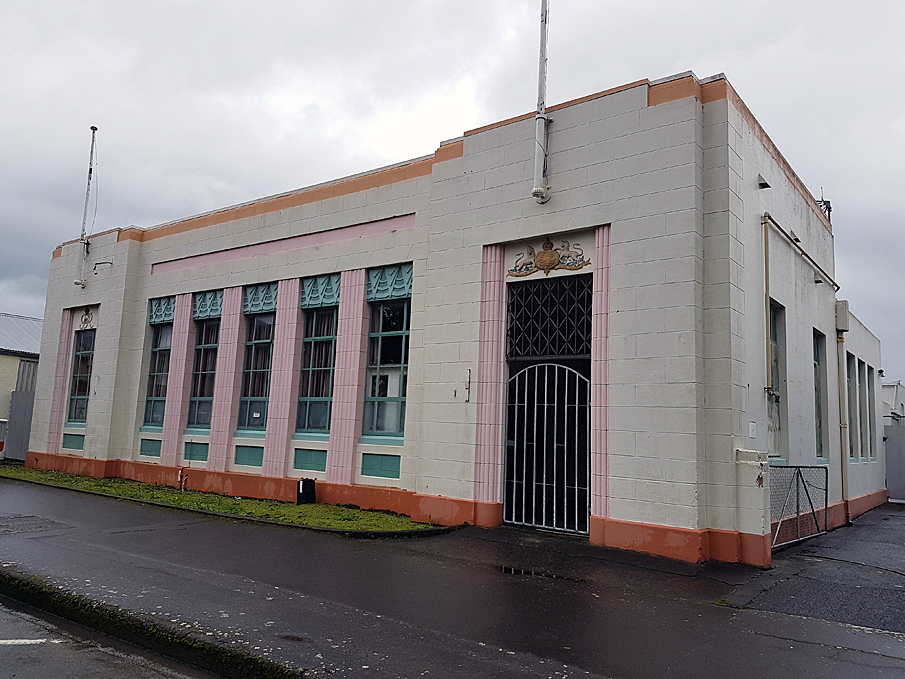
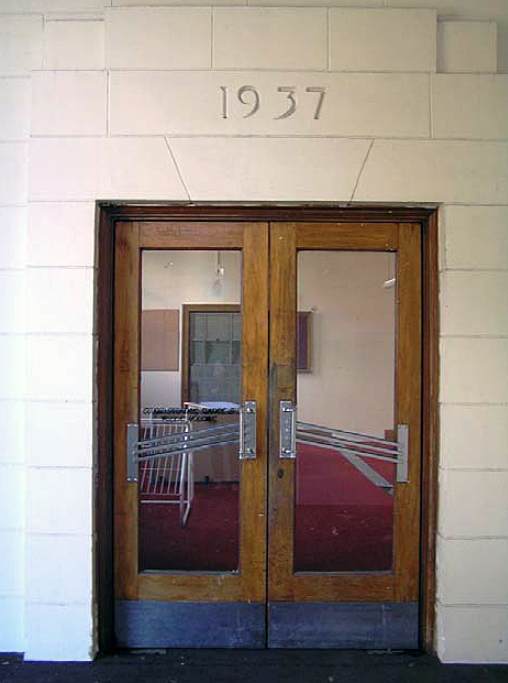
Post Office (Former), a large reinforced concrete building in Pahiatua’s central business area, was completed in 1937. With its Stripped Classical features and Art Deco detailing, Post Office (Former) is a characteristic example of the work of John Thomas Mair (1876-1959) in his role as Government Architect.
European settlement in the Wairarapa was gradual, beginning in the 1850s from the south after lengthy negotiations between the Crown and iwi. However, it was not until the 1870s with the government public works and immigration schemes that Europeans started to earnestly occupy the north Wairarapa. Despite this government push, Pahiatua was not a Crown settlement and it took much local petitioning to acquire public institutions, like a post office building, for the privately established town. However, by the 1930s the tension which characterised this early town and Crown relationship had abated and a large replacement post office was finally begun in 1935, on a site purchased for the purpose in 1926. The new building was opened by the Postmaster General in 1937 and its features reflected the size of the town and its large farming district, such as a substantial mail sorting and public area, private boxes, and banking and telephone facilities, including a toll exchange. As such, Post Office (Former) was the communications hub for the district for 50 years, until the disbanding of the Post Office Department into state owned enterprises in 1987 saw the post office removed from the building and ownership vested with the newly formed Telecom Corporation Limited.
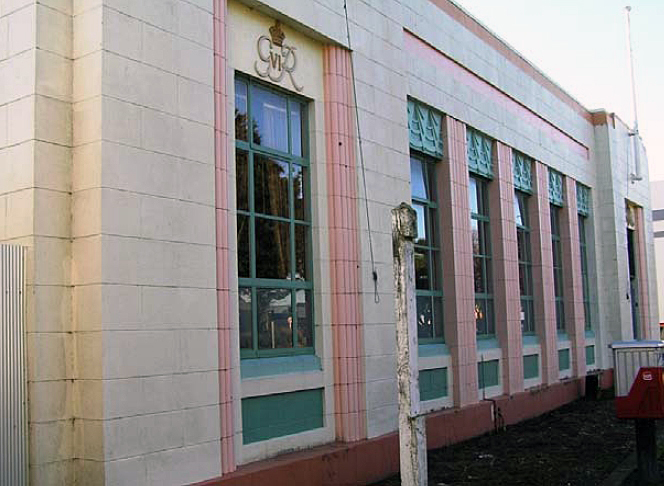
Post Office (Former) is a large, single-storey, painted reinforced concrete building, which features design elements typical in Mair’s work at the time, such as Stripped Classical pilasters and symmetry on the front façade, with some Art Deco inspired panels above its sizeable windows. The integrity of the materials and form of the building is high, due to it undergoing few alterations apart from the removal of a partition wall in the main section of the building, an extension to the toll exchange room at the rear of the building, and this area’s recent conversion into a residential space. Remnants of the building’s former use also remain, such as telephone booths and a mail availability indicator board.
Because it was a post office under the Post Office Department, Post Office (Former) has significance as a vestige of this department’s historical importance due to its dominance of the communications sector in New Zealand until the late twentieth century. As such, the building also has local social value because it connected people through its services, but also informally because it was a central gathering point. Architecturally, Post Office (Former) is a representative example of the work of the important Government Architect, John Thomas Mair, and because the building also retains a high level of integrity it is of architectural significance.