

European exploration of the Waitomo Caves and their glow-worm attractions, dates from 1877 when a local government surveyor, Fred Mace, floated into the caves on a raft. Tourist interest grew steadily in the late 1800s but it wasn't until 1904 that an accommodation house, built by prominent local Maori Tane Tinorau and his wife, was established. That same year the Government nationalised the caves as a tourist feature.
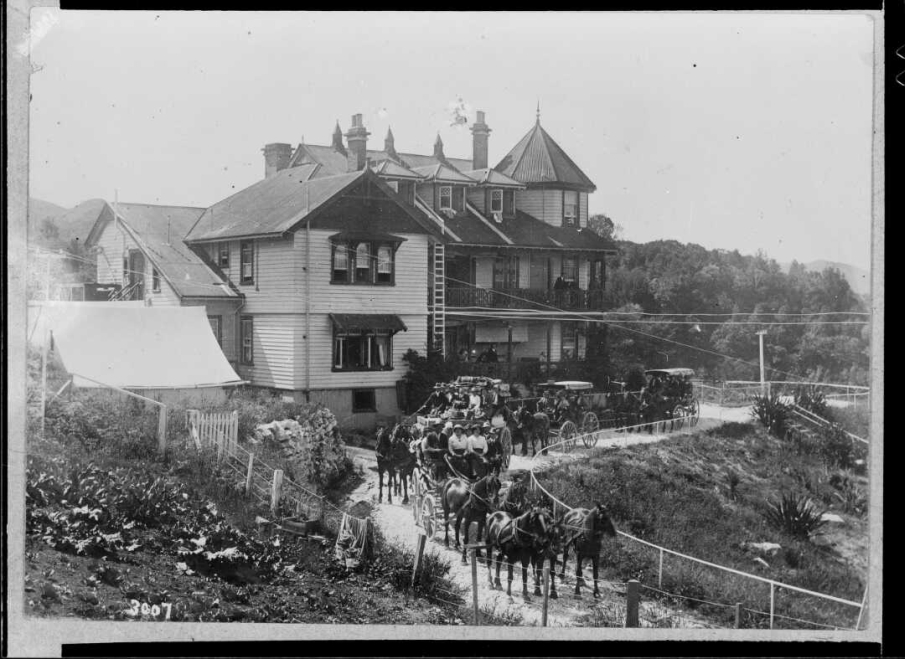
In 1905 the Tourist and Health Resorts Department bought Waitomo House, as it was known and its success persuaded them to improve accommodation. Timber for the 1908 structure was brought into the area on horse-drawn carts, and special facilities were provided for water and electricity since it was remote from town water and power supplies. Water was pumped from the Waitomo Stream and fed back up the slope to the hotel, and electricity was generated by a dynamo powered by a petrol driven motor engine.
With the new portion completed in 1928 the Waitomo Hotel could provide accommodation for up to one hundred visitors. The hotel was promoted as a health resort as well as a tourist attraction, in keeping with the fashionable health movements popular here and overseas.
The hotel continued to operate as a popular tourist venue until the Waitomo, Ruakuri and Aranui Caves were closed to the public in 1970s as a direct result of the harmful effects of air pollution on the fauna of the caves and the damage caused by the constantly lapping water eroding the limestone.
List Entry Information
Status
Listed
List Entry Status
Historic Place Category 2
Access
Able to Visit
List Number
4176
Date Entered
28th June 1990
Date of Effect
28th June 1990
City/District Council
Waitomo District
Region
Waikato Region
Legal description
Hauturu East 20 (RT 275384), Hauturu East 21 (RT 441791), South Auckland Land District
Status
Listed
List Entry Status
Historic Place Category 2
Access
Able to Visit
List Number
4176
Date Entered
28th June 1990
Date of Effect
28th June 1990
City/District Council
Waitomo District
Region
Waikato Region
Legal description
Hauturu East 20 (RT 275384), Hauturu East 21 (RT 441791), South Auckland Land District
Why is this place significant?
Historic Significance
Historical Significance or Value At the turn of the century the Waitomo Caves were an important early attraction in the growing New Zealand tourism industry. Under the control of the Tourist Department, the caves and nearby hotel were, for many years, the most profitable of the department's many enterprises. The earlier portion of the Waitomo Hotel has been closely associated with the renowned caves for over eighty years, and as such is one of the first hotels built by the Tourist and Health Resorts Departments to encourage tourists to visit New Zealand.
Physical Significance
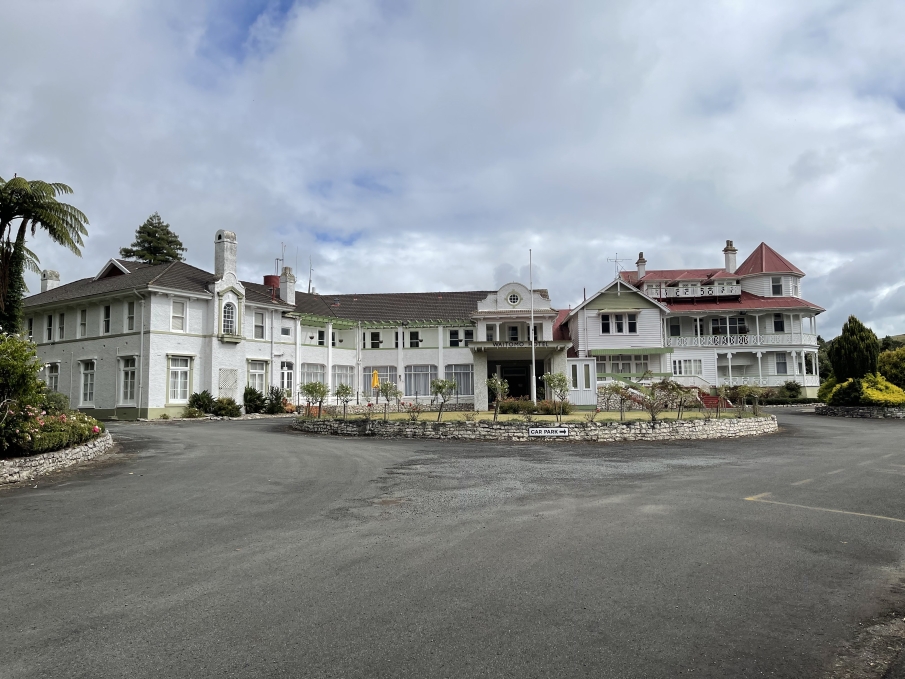
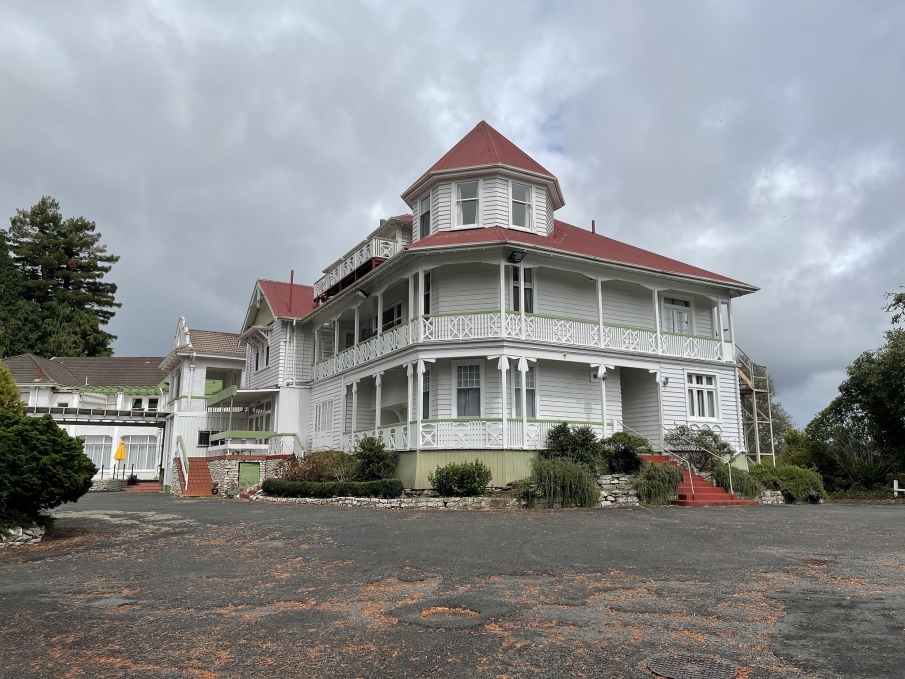
ARCHITECTURAL QUALITY: The Edwardian structure (1908) looks back to the previous century for influence and it espouses a typically Victorian picturesque style with asymmetry as one of the guiding principles. In contrast the concrete additions (1928) have a Spanish Mission influence. This style was popularised and modified in the early 1900s but was based on the mission churches built along the Californian coast in the 1700s. The style became popular in Auckland and other parts of New Zealand especially with the construction of R. Atkinson Abbott's Auckland Grammar School (1916). This was characterised by the use of arches, colonnades, tile roofs, overhanging eaves, and roughcast walls to imitate the thick adobe walls of Californian missions. These two buildings represent the work of two different eras of Government architecture and are fine examples of their respective styles. TOWNMARK/LANDSCAPE VALUE: The hotel is positioned upon the crest of a hill and is the central and pivotal building in the Waitomo Village complex. It commands good views and is also visible from quite long distances.
Why is this place significant?
Historic Significance
Historical Significance or Value At the turn of the century the Waitomo Caves were an important early attraction in the growing New Zealand tourism industry. Under the control of the Tourist Department, the caves and nearby hotel were, for many years, the most profitable of the department's many enterprises. The earlier portion of the Waitomo Hotel has been closely associated with the renowned caves for over eighty years, and as such is one of the first hotels built by the Tourist and Health Resorts Departments to encourage tourists to visit New Zealand.
Physical Significance
ARCHITECTURAL QUALITY: The Edwardian structure (1908) looks back to the previous century for influence and it espouses a typically Victorian picturesque style with asymmetry as one of the guiding principles. In contrast the concrete additions (1928) have a Spanish Mission influence. This style was popularised and modified in the early 1900s but was based on the mission churches built along the Californian coast in the 1700s. The style became popular in Auckland and other parts of New Zealand especially with the construction of R. Atkinson Abbott's Auckland Grammar School (1916). This was characterised by the use of arches, colonnades, tile roofs, overhanging eaves, and roughcast walls to imitate the thick adobe walls of Californian missions. These two buildings represent the work of two different eras of Government architecture and are fine examples of their respective styles. TOWNMARK/LANDSCAPE VALUE: The hotel is positioned upon the crest of a hill and is the central and pivotal building in the Waitomo Village complex. It commands good views and is also visible from quite long distances.
Construction Professional
Name
Campbell, John
Type
Architect
Biography
John Campbell (1857-1942) served his articles under John Gordon (c1835-1912) in Glasgow. He arrived in Dunedin in 1882 and after a brief period as a draughtsman with Mason and Wales joined the Dunedin branch of the Public Works Department in 1883. His first known work, an unbuilt design for the Dunedin Railway Station, reveals an early interest in Baroque architecture. In November 1888 Campbell was transferred to Wellington where in 1889 he took up the position of draughtsman in charge of the Public Buildings Division of the Public Works Department. He remained in charge of the design of government buildings throughout New Zealand until his retirement in 1922, becoming in 1909 the first person to hold the position of Government Architect. Government architecture designed under his aegis evidences a change in style from Queen Anne to Edwardian Baroque. His best-known Queen Anne design is the Dunedin Police Station (1895-8), modelled on Richard Norman Shaw's New Scotland Yard (1887-90). Among his most exuberant Edwardian Baroque buildings is the Public Trust Office, Wellington (1905-09). Although Campbell designed the Dunedin Law Courts (1899-1902) in the Gothic style with a Scottish Baronial inflection, he established Edwardian Baroque as the government style for police stations, courthouses and post offices throughout New Zealand. In 1911 Campbell won the nation-wide architectural competition for the design of Parliament Buildings, Wellington. Although only partially completed, Parliament House is the crowning achievement of Campbell's career.
Name
Mair, John Thomas
Type
Architect
Biography
John Thomas Mair (1876-1959) was born in Invercargill and began his career with the New Zealand Railways on the staff of the Office Engineer, George Troup. In 1906 he travelled to the United States of America where he studied architecture at the University of Pennsylvania. He then worked in the office of George B. Post in New York before travelling to England where he was admitted as an Associate of the Royal Institute of British Architects. He became a Fellow in 1940. On his return to New Zealand he entered private practice, one of his first buildings being the Presbyterian First Church, Invercargill (1915), a prominent building of Romanesque character. He then practised in Wellington, carrying out largely domestic commissions. In 1918 he was appointed Inspector of Military Hospitals by the Defence Department, and in 1920 he became architect to the Department of Education. Following the retirement of John Campbell in 1922, Mair was appointed Government Architect, a position which he held until his retirement in 1942. During this period he was responsible for a variety of buildings, including the Courthouse, Hamilton, the Post Office in High Street, Christchurch, Government Life Office and the Departmental Building, both in Wellington, and the Jean Batten Building, Auckland. Such buildings show a departure from tradition, with the emphasis on function, structure and volume as opposed to a stylistic treatment of the building fabric. A Fellow of the New Zealand Institute of Architects, Mair was made a Life Member in 1942. His son John Lindsay Mair also practised as an architect.
Construction Details
Start Year
1908
Type
Original Construction
Start Year
1927
Finish Year
1928
Type
Addition
Description
Additions
Construction Materials
The original portion (1908) timber framed, clad with shiplap weatherboards. The roof is corrugated iron. The major addition (1928) is plastered reinforced concrete with a tiled roof.
Notable Features
1908 Structure - The balustrading and octagonal turret 1928 Structure - The shaped gables
Construction Professional
Name
Campbell, John
Type
Architect
Biography
John Campbell (1857-1942) served his articles under John Gordon (c1835-1912) in Glasgow. He arrived in Dunedin in 1882 and after a brief period as a draughtsman with Mason and Wales joined the Dunedin branch of the Public Works Department in 1883. His first known work, an unbuilt design for the Dunedin Railway Station, reveals an early interest in Baroque architecture. In November 1888 Campbell was transferred to Wellington where in 1889 he took up the position of draughtsman in charge of the Public Buildings Division of the Public Works Department. He remained in charge of the design of government buildings throughout New Zealand until his retirement in 1922, becoming in 1909 the first person to hold the position of Government Architect. Government architecture designed under his aegis evidences a change in style from Queen Anne to Edwardian Baroque. His best-known Queen Anne design is the Dunedin Police Station (1895-8), modelled on Richard Norman Shaw's New Scotland Yard (1887-90). Among his most exuberant Edwardian Baroque buildings is the Public Trust Office, Wellington (1905-09). Although Campbell designed the Dunedin Law Courts (1899-1902) in the Gothic style with a Scottish Baronial inflection, he established Edwardian Baroque as the government style for police stations, courthouses and post offices throughout New Zealand. In 1911 Campbell won the nation-wide architectural competition for the design of Parliament Buildings, Wellington. Although only partially completed, Parliament House is the crowning achievement of Campbell's career.
Name
Mair, John Thomas
Type
Architect
Biography
John Thomas Mair (1876-1959) was born in Invercargill and began his career with the New Zealand Railways on the staff of the Office Engineer, George Troup. In 1906 he travelled to the United States of America where he studied architecture at the University of Pennsylvania. He then worked in the office of George B. Post in New York before travelling to England where he was admitted as an Associate of the Royal Institute of British Architects. He became a Fellow in 1940. On his return to New Zealand he entered private practice, one of his first buildings being the Presbyterian First Church, Invercargill (1915), a prominent building of Romanesque character. He then practised in Wellington, carrying out largely domestic commissions. In 1918 he was appointed Inspector of Military Hospitals by the Defence Department, and in 1920 he became architect to the Department of Education. Following the retirement of John Campbell in 1922, Mair was appointed Government Architect, a position which he held until his retirement in 1942. During this period he was responsible for a variety of buildings, including the Courthouse, Hamilton, the Post Office in High Street, Christchurch, Government Life Office and the Departmental Building, both in Wellington, and the Jean Batten Building, Auckland. Such buildings show a departure from tradition, with the emphasis on function, structure and volume as opposed to a stylistic treatment of the building fabric. A Fellow of the New Zealand Institute of Architects, Mair was made a Life Member in 1942. His son John Lindsay Mair also practised as an architect.
Construction Details
Start Year
1908
Type
Original Construction
Start Year
1927
Finish Year
1928
Type
Addition
Description
Additions
Construction Materials
The original portion (1908) timber framed, clad with shiplap weatherboards. The roof is corrugated iron. The major addition (1928) is plastered reinforced concrete with a tiled roof.
Notable Features
1908 Structure - The balustrading and octagonal turret 1928 Structure - The shaped gables
ARCHITECT/ENGINEER/DESIGNER: Government Architect's Office, under auspices of; 1908 Structure - John CAMPBELL (1857-1942) 1928 Structure - J.T. MAIR (1876-1959) ARCHITECTURAL DESCRIPTION: The Waitomo Hotel consists of two separate structures which although similar in height are distinctly different in character. The timber structure (1908) is a large Edwardian villa, having verandahs at ground and first floor levels continuous on two facades. There is a two-storeyed bay window on the rounded corner. The bay is continued beyond the roof to form an octagonal turret which has an eight-sided pavilion roof. On the gambrel roof there are three dormer windows behind a continuous elaborate balustrade. This balustrade is repeated at ground floor level and is slightly different from that at first floor. The main facade has a large gable on the left side framing a two-storeyed section of the building which protrudes slightly. This is possibly an addition as its scale is not compatible with that of other elements such as the dormers or the turret. The major part of the complex is the 1928 addition, a two storeyed Spanish Mission style building. It is a considerable contrast with the earlier building in style and character. The ground floor of that part of the building has a colonnaded verandah. An open timber awning extends above the first floor balcony. The facade is enlivened by use of shaped gables which mark the entrances to the building. While the two parts of the building are very different two adjoining gables of a similar scale help unite the structure. MODIFICATIONS: - Balustraded balcony added between dormers at roof level - Section of the ground floor verandah filled in NOTE: Interior modifications not known
ARCHITECT/ENGINEER/DESIGNER: Government Architect's Office, under auspices of; 1908 Structure - John CAMPBELL (1857-1942) 1928 Structure - J.T. MAIR (1876-1959) ARCHITECTURAL DESCRIPTION: The Waitomo Hotel consists of two separate structures which although similar in height are distinctly different in character. The timber structure (1908) is a large Edwardian villa, having verandahs at ground and first floor levels continuous on two facades. There is a two-storeyed bay window on the rounded corner. The bay is continued beyond the roof to form an octagonal turret which has an eight-sided pavilion roof. On the gambrel roof there are three dormer windows behind a continuous elaborate balustrade. This balustrade is repeated at ground floor level and is slightly different from that at first floor. The main facade has a large gable on the left side framing a two-storeyed section of the building which protrudes slightly. This is possibly an addition as its scale is not compatible with that of other elements such as the dormers or the turret. The major part of the complex is the 1928 addition, a two storeyed Spanish Mission style building. It is a considerable contrast with the earlier building in style and character. The ground floor of that part of the building has a colonnaded verandah. An open timber awning extends above the first floor balcony. The facade is enlivened by use of shaped gables which mark the entrances to the building. While the two parts of the building are very different two adjoining gables of a similar scale help unite the structure. MODIFICATIONS: - Balustraded balcony added between dormers at roof level - Section of the ground floor verandah filled in NOTE: Interior modifications not known
Historical and Associated Iwi / Hapū / Whānau
Information Sources
Appendices to the Journals of the House of Representatives (AJHR)
Appendices to the Journals of the House of Representatives
Arrell, 1984
R. Arrell, Waitomo Caves: A Century of Tourism, Waitomo Caves Museum Society Incorporated, 1984.
Morgan, 1984
Vaughan Morgan, A History of Waitomo, Maori and Pakeha Side by Side, Outrigger Publications: Hamilton (n.d.: c1983/4).
Other Information
This historic place was registered under the Historic Places Act 1980. This report includes the text from the original Building Classification Committee report considered by the NZHPT Board at the time of registration. Please note that entry on the New Zealand Heritage List/Rarangi Korero identifies only the heritage values of the property concerned, and should not be construed as advice on the state of the property, or as a comment of its soundness or safety, including in regard to earthquake risk, safety in the event of fire, or insanitary conditions.
Historical and Associated Iwi / Hapū / Whānau
Information Sources
Appendices to the Journals of the House of Representatives (AJHR)
Appendices to the Journals of the House of Representatives
Arrell, 1984
R. Arrell, Waitomo Caves: A Century of Tourism, Waitomo Caves Museum Society Incorporated, 1984.
Morgan, 1984
Vaughan Morgan, A History of Waitomo, Maori and Pakeha Side by Side, Outrigger Publications: Hamilton (n.d.: c1983/4).
Other Information
This historic place was registered under the Historic Places Act 1980. This report includes the text from the original Building Classification Committee report considered by the NZHPT Board at the time of registration. Please note that entry on the New Zealand Heritage List/Rarangi Korero identifies only the heritage values of the property concerned, and should not be construed as advice on the state of the property, or as a comment of its soundness or safety, including in regard to earthquake risk, safety in the event of fire, or insanitary conditions.
Former Usages
General Usage: Accommodation
Specific Usage: Hotel
Web Links
description: Waitomo Hotel
Former Usages
General Usage: Accommodation
Specific Usage: Hotel
Web Links
description: Waitomo Hotel
