

List Entry Information
Status
Listed
List Entry Status
Historic Place Category 2
Access
Private/No Public Access
List Number
428
Date Entered
22nd June 2007
Date of Effect
22nd June 2007
City/District Council
Kaipara District
Region
Northland Region
Extent of List Entry
Registration includes all of the land in RT NA110A/337 and the church building and its fittings and fixtures thereon, including chattels (reredos and baptismal font). The registration does not include a separate timber building in the southern part of the site, currently used as a Sunday school and meeting room.
Legal description
Lot 1 DP 178449 (RT NA110A/337), North Auckland Land District
Status
Listed
List Entry Status
Historic Place Category 2
Access
Private/No Public Access
List Number
428
Date Entered
22nd June 2007
Date of Effect
22nd June 2007
City/District Council
Kaipara District
Region
Northland Region
Extent of List Entry
Registration includes all of the land in RT NA110A/337 and the church building and its fittings and fixtures thereon, including chattels (reredos and baptismal font). The registration does not include a separate timber building in the southern part of the site, currently used as a Sunday school and meeting room.
Legal description
Lot 1 DP 178449 (RT NA110A/337), North Auckland Land District
Why is this place significant?
Cultural Significance
The Church has social and spiritual value because it has served as a centre for community worship and events such as weddings, christenings and funerals in Te Kopuru for over 100 years.
Historic Significance
Historical Significance or Value St Peter's Church has historical value for its long association with people and events in this settlement on the Wairoa River, and as a witness to the former wealth of the town.
Physical Significance
St Peter's Church is architecturally significant because of its association with the architect and priest Henry Barnard Wingfield, its simple wooden Gothic Revival style and its splendid kauri interior.
Why is this place Category 1 / Category 2?
Detail Of Assessed Criteria
(a) The extent to which the place reflects important or representative aspects of New Zealand history St Peter's Church reflects important and representative aspects of New Zealand history, including Anglican religious affiliations in a major timber-milling community in Northland, and changing patterns of settlement in the Kaipara during the nineteenth, twentieth and early twenty first centuries. It provides evidence of the strong community desire in such towns to create and retain their own place of worship, as well as the considerable financial commitment required to establish a church building that was opened free of debt, and to maintain and conserve it. (e) The community association with, or public esteem for, the place The church and its curtilage are held in high regard by its congregation and closely associated with the local community, having been used as a place of worship and gathering for over 100 years. In spite of the diminished population of the town, the efforts required to maintain and conserve the building, and to celebrate its centenary in 2002 reflect the importance accorded to retaining a place of spiritual value, as well as the community values of a tightly-knit rural population.
Why is this place significant?
Cultural Significance
The Church has social and spiritual value because it has served as a centre for community worship and events such as weddings, christenings and funerals in Te Kopuru for over 100 years.
Historic Significance
Historical Significance or Value St Peter's Church has historical value for its long association with people and events in this settlement on the Wairoa River, and as a witness to the former wealth of the town.
Physical Significance
St Peter's Church is architecturally significant because of its association with the architect and priest Henry Barnard Wingfield, its simple wooden Gothic Revival style and its splendid kauri interior.
Why is this place Category 1 / Category 2?
Detail Of Assessed Criteria
(a) The extent to which the place reflects important or representative aspects of New Zealand history St Peter's Church reflects important and representative aspects of New Zealand history, including Anglican religious affiliations in a major timber-milling community in Northland, and changing patterns of settlement in the Kaipara during the nineteenth, twentieth and early twenty first centuries. It provides evidence of the strong community desire in such towns to create and retain their own place of worship, as well as the considerable financial commitment required to establish a church building that was opened free of debt, and to maintain and conserve it. (e) The community association with, or public esteem for, the place The church and its curtilage are held in high regard by its congregation and closely associated with the local community, having been used as a place of worship and gathering for over 100 years. In spite of the diminished population of the town, the efforts required to maintain and conserve the building, and to celebrate its centenary in 2002 reflect the importance accorded to retaining a place of spiritual value, as well as the community values of a tightly-knit rural population.
Construction Professional
Name
Bulford, W. F.
Type
Builder
Biography
No biography is currently available for this construction professional
Name
Wingfield, Rev Henry Barnard
Type
Architect
Biography
Wingfield (c.1865-1953) came to New Zealand when he was a boy and his family settled in Dunedin. He studied architecture before being ordained in 1897. In 1899 he was appointed first vicar at Pokeno and late in 1904 he was appointed to St Alban's in Balmoral, Auckland, where he served for 22 years. In 1926 he was appointed vicar to Holy Trinity Church, Devonport, remaining there until his retirement in 1931. During his life Wingfield devoted time to ecclesiastical architecture and has been credited with the design of St Mary's Church, Pokeno (1899), St Alban's, Waingaro (1907), St Bride's, Otorohanga, St Peter's, Te Kopuru, and additions to St Alban's, Balmoral (1905, 1911 and 1922).
Construction Details
Start Year
1902
Type
Original Construction
Description
Foundation stone laid and Church opened
Start Year
1968
Type
Other
Description
Church reblocked.
Start Year
1976
Type
Modification
Description
Main wall of sanctuary damaged by fire. Wall patched with plywood panel.
Start Year
2002
Type
Other
Description
Conservation programme undertaken.
Construction Materials
Kauri timber, corrugated iron roof, flat iron spire cladding, concrete piles.
Construction Professional
Name
Bulford, W. F.
Type
Builder
Biography
No biography is currently available for this construction professional
Name
Wingfield, Rev Henry Barnard
Type
Architect
Biography
Wingfield (c.1865-1953) came to New Zealand when he was a boy and his family settled in Dunedin. He studied architecture before being ordained in 1897. In 1899 he was appointed first vicar at Pokeno and late in 1904 he was appointed to St Alban's in Balmoral, Auckland, where he served for 22 years. In 1926 he was appointed vicar to Holy Trinity Church, Devonport, remaining there until his retirement in 1931. During his life Wingfield devoted time to ecclesiastical architecture and has been credited with the design of St Mary's Church, Pokeno (1899), St Alban's, Waingaro (1907), St Bride's, Otorohanga, St Peter's, Te Kopuru, and additions to St Alban's, Balmoral (1905, 1911 and 1922).
Construction Details
Start Year
1902
Type
Original Construction
Description
Foundation stone laid and Church opened
Start Year
1968
Type
Other
Description
Church reblocked.
Start Year
1976
Type
Modification
Description
Main wall of sanctuary damaged by fire. Wall patched with plywood panel.
Start Year
2002
Type
Other
Description
Conservation programme undertaken.
Construction Materials
Kauri timber, corrugated iron roof, flat iron spire cladding, concrete piles.
The small Anglican Church of St Peter's, Te Kopuru, dates back to an important period in the settlement's history. Te Kopuru developed into a significant town following the establishment of the kauri timber mill there in 1871. It was one of a number of towns which developed in the area, whose economy derived from the cutting of the kauri forests, the use of the Wairoa River to transport logs to the mill, the Kaipara Harbour to the South into which the river flows as the route for sailing vessels to export the processed timber. The peak years of the timber mill's production were 1901 and 1902. St Peter's Church was built debt free at the peak of this period of wealth. The residents of Te Kopuru sought to establish all the facilities that they believed a modern town should have. Besides the substantial mill itself, and its ancillary wharves, water supply reservoir and cottages for the mill-workers, the 1870s saw the erection of a police lock-up, public hall, school and Post Office. These were followed by a Customs office, grocery, drapery, butchery, tailors' and dressmakers', stables, theatre, hairdressers, billiards saloon, boarding house and bakery. Street lamps were installed in 1903. Against this background of urban development, the Anglican community sought to erect a place of worship. Anglican services had been held in area since the visit of Bishop Selwyn in 1863, with later clergyman holding services in the local hall. A church committee was formed in May 1884. In October 1896 the vicar Rev A.J. Beck (1869-1939; vicar at Northern Wairoa 1896- 1904) established a building fund, with the proviso that no actual attempt would be made to build a church until all the necessary funds were in hand. The foundation stone was laid in May 1902 by Mrs Lucie Beck. The church was opened in September 1902, and dedicated by Ven. Archdeacon Calder (1848-1923) of Auckland. The church was indeed built debt-free, at a cost of ₤247/12/- [$495.20]. St Peter's is one of a group of churches designed by the architect Rev. Henry Barnard Wingfield, then of Pokeno. Its simple wooden Gothic Revival style was an obvious choice for a kauri timber milling town. The kauri used for the interior lining was specially selected to show the beauty of the timber to advantage. The church building became the focus for Anglican and community events in Te Kopuru and the wider Kaipara. As the originally larger neighbouring mill town of Aratapu declined, St Peter's took on a role as the principal Anglican church south of Dargaville. At one stage St Peter's provided financial assistance to the church congregation in Aratapu to enable it to remain solvent. Eventually, the church building at Aratapu was closed and moved across the river to Mititai (NZHPT Register 425, All Saints Church, Mititai). A Sunday School was established at St Peter's in 1902. Mr and Mrs CE Smith served almost continuously as Sunday School Superintendents for 48 years - their service was celebrated by the community with a social gathering in tribute in 1950. St Peter's Mother's Union was formed in 1907, and many of the foundation members were still involved in the union in 1950. Between 1947 and 1980, there was a separate St Peter's Ladies Guild, which was formed to improve the grounds and raise funds for improvements for the church. The Ladies Guild contributed funds for the carpet, the font, the organ ($150 was raised at a single bring and buy event), the Communion cruets, as well as for the general upkeep of the grounds and church interior. In 1952 the Church Committee organised a Golden Jubilee celebration, and a commemorative booklet was published. In 1969, funds to reblock the church were raised by asking parishioners to 'stake a claim' at $1 per block. In 1971, the Anglican, Methodist and Presbyterian churches of Te Kopuru, with the support of the Roman Catholic Church resolved to work closely together, with services being shared between St Peter's and the Te Kopuru Methodist Church (NZHPT Register 426). In 1972, to mark the 70th birthday of the church, the exterior and the ceiling of the interior was repainted. A special celebratory service was held on 2 July 1972 attended by over 100 people. The 80th anniversary was celebrated with a service and luncheon on 4 July 1982, when the Primate of New Zealand Archbishop Paul Reeves officiated. On 5 November 1976, the main wall of the Sanctuary was damaged by fire, necessitating the replacement of interior linings and the carpet. As one example of longstanding community involvement with the church, in 1996 Mrs Elsie Guy celebrated her 100th birthday with a special communion service in the church. She and her late husband Jim had been married at St Peter's on 6 July 1920, and their four children were all baptised there. Mrs Guy was an active member of the Mother's union, Ladies Guild and Women's Fellowship, as well as supporting the Church Committee. In 1997, the Kaipara District Plan became operative. St Peter's Church Te Kopuru was scheduled by Kaipara District Council in its Register of Buildings, Monuments and Places of Heritage Value as a place of 'District', rather than simply 'local', significance. To commemorate the centenary of the church, substantial conservation work was undertaken in 2001-2 with financial support from the ASB Trusts. Making permanent structural repairs to the fire damaged sanctuary was an important part of this work, as was the removal of the pain t from the ceiling to reveal the original kauri finish. A special celebratory service was held on 30 June 2002 followed by a luncheon. The Anglican Primate of New Zealand Bishop John Paterson, together with the Bishop of Te Tai Tokerau, Te Kitohi Pikaahu and Pihopa Kaumātua Ben Te Haara officiated.
The small Anglican Church of St Peter's, Te Kopuru, dates back to an important period in the settlement's history. Te Kopuru developed into a significant town following the establishment of the kauri timber mill there in 1871. It was one of a number of towns which developed in the area, whose economy derived from the cutting of the kauri forests, the use of the Wairoa River to transport logs to the mill, the Kaipara Harbour to the South into which the river flows as the route for sailing vessels to export the processed timber. The peak years of the timber mill's production were 1901 and 1902. St Peter's Church was built debt free at the peak of this period of wealth. The residents of Te Kopuru sought to establish all the facilities that they believed a modern town should have. Besides the substantial mill itself, and its ancillary wharves, water supply reservoir and cottages for the mill-workers, the 1870s saw the erection of a police lock-up, public hall, school and Post Office. These were followed by a Customs office, grocery, drapery, butchery, tailors' and dressmakers', stables, theatre, hairdressers, billiards saloon, boarding house and bakery. Street lamps were installed in 1903. Against this background of urban development, the Anglican community sought to erect a place of worship. Anglican services had been held in area since the visit of Bishop Selwyn in 1863, with later clergyman holding services in the local hall. A church committee was formed in May 1884. In October 1896 the vicar Rev A.J. Beck (1869-1939; vicar at Northern Wairoa 1896- 1904) established a building fund, with the proviso that no actual attempt would be made to build a church until all the necessary funds were in hand. The foundation stone was laid in May 1902 by Mrs Lucie Beck. The church was opened in September 1902, and dedicated by Ven. Archdeacon Calder (1848-1923) of Auckland. The church was indeed built debt-free, at a cost of ₤247/12/- [$495.20]. St Peter's is one of a group of churches designed by the architect Rev. Henry Barnard Wingfield, then of Pokeno. Its simple wooden Gothic Revival style was an obvious choice for a kauri timber milling town. The kauri used for the interior lining was specially selected to show the beauty of the timber to advantage. The church building became the focus for Anglican and community events in Te Kopuru and the wider Kaipara. As the originally larger neighbouring mill town of Aratapu declined, St Peter's took on a role as the principal Anglican church south of Dargaville. At one stage St Peter's provided financial assistance to the church congregation in Aratapu to enable it to remain solvent. Eventually, the church building at Aratapu was closed and moved across the river to Mititai (NZHPT Register 425, All Saints Church, Mititai). A Sunday School was established at St Peter's in 1902. Mr and Mrs CE Smith served almost continuously as Sunday School Superintendents for 48 years - their service was celebrated by the community with a social gathering in tribute in 1950. St Peter's Mother's Union was formed in 1907, and many of the foundation members were still involved in the union in 1950. Between 1947 and 1980, there was a separate St Peter's Ladies Guild, which was formed to improve the grounds and raise funds for improvements for the church. The Ladies Guild contributed funds for the carpet, the font, the organ ($150 was raised at a single bring and buy event), the Communion cruets, as well as for the general upkeep of the grounds and church interior. In 1952 the Church Committee organised a Golden Jubilee celebration, and a commemorative booklet was published. In 1969, funds to reblock the church were raised by asking parishioners to 'stake a claim' at $1 per block. In 1971, the Anglican, Methodist and Presbyterian churches of Te Kopuru, with the support of the Roman Catholic Church resolved to work closely together, with services being shared between St Peter's and the Te Kopuru Methodist Church (NZHPT Register 426). In 1972, to mark the 70th birthday of the church, the exterior and the ceiling of the interior was repainted. A special celebratory service was held on 2 July 1972 attended by over 100 people. The 80th anniversary was celebrated with a service and luncheon on 4 July 1982, when the Primate of New Zealand Archbishop Paul Reeves officiated. On 5 November 1976, the main wall of the Sanctuary was damaged by fire, necessitating the replacement of interior linings and the carpet. As one example of longstanding community involvement with the church, in 1996 Mrs Elsie Guy celebrated her 100th birthday with a special communion service in the church. She and her late husband Jim had been married at St Peter's on 6 July 1920, and their four children were all baptised there. Mrs Guy was an active member of the Mother's union, Ladies Guild and Women's Fellowship, as well as supporting the Church Committee. In 1997, the Kaipara District Plan became operative. St Peter's Church Te Kopuru was scheduled by Kaipara District Council in its Register of Buildings, Monuments and Places of Heritage Value as a place of 'District', rather than simply 'local', significance. To commemorate the centenary of the church, substantial conservation work was undertaken in 2001-2 with financial support from the ASB Trusts. Making permanent structural repairs to the fire damaged sanctuary was an important part of this work, as was the removal of the pain t from the ceiling to reveal the original kauri finish. A special celebratory service was held on 30 June 2002 followed by a luncheon. The Anglican Primate of New Zealand Bishop John Paterson, together with the Bishop of Te Tai Tokerau, Te Kitohi Pikaahu and Pihopa Kaumātua Ben Te Haara officiated.
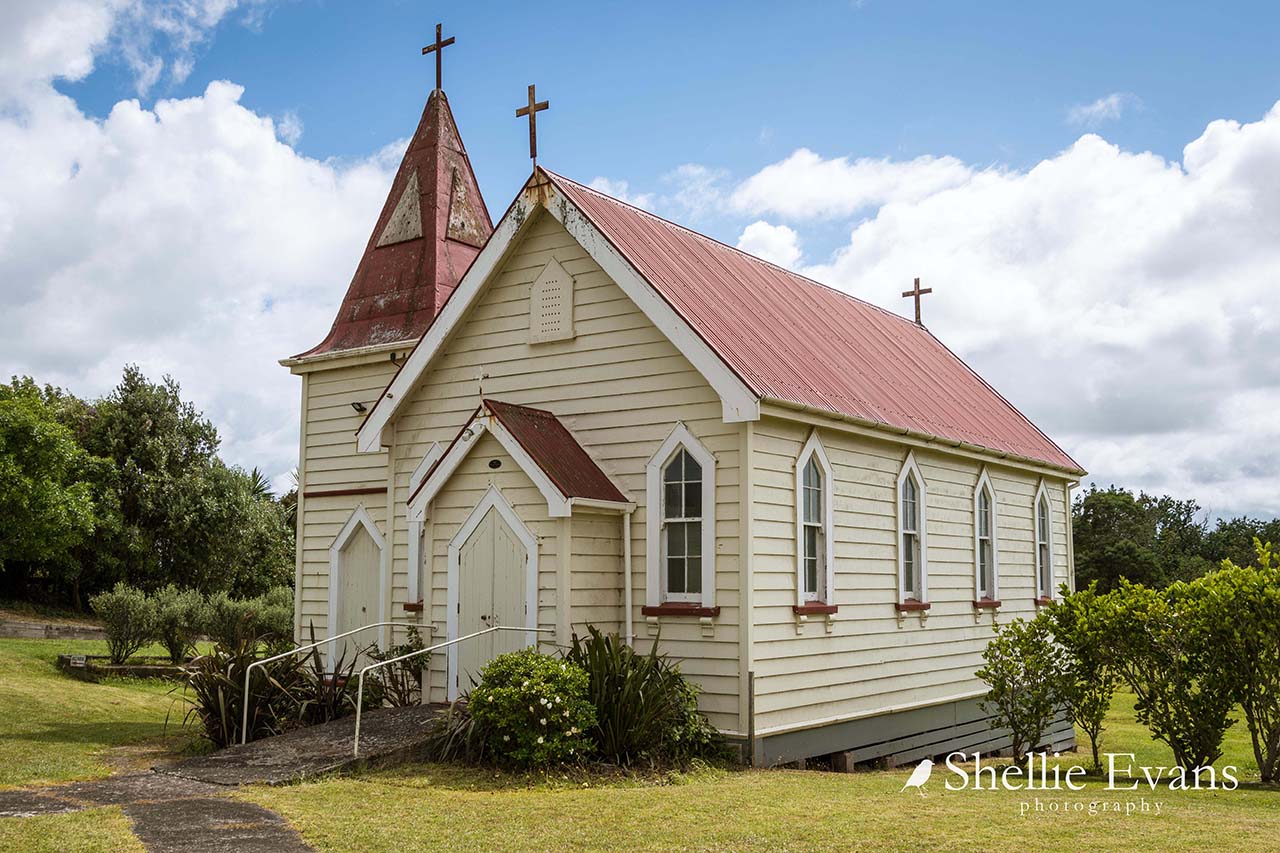
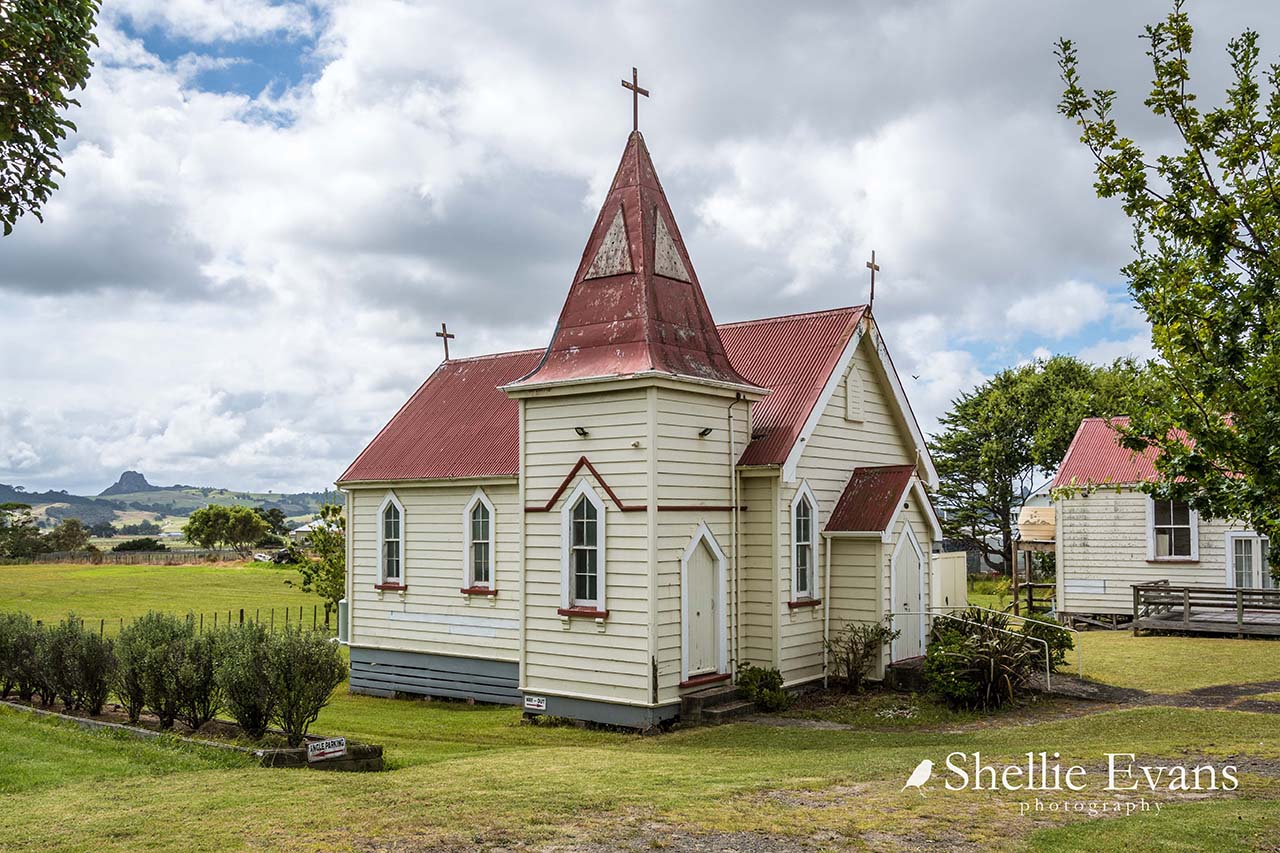
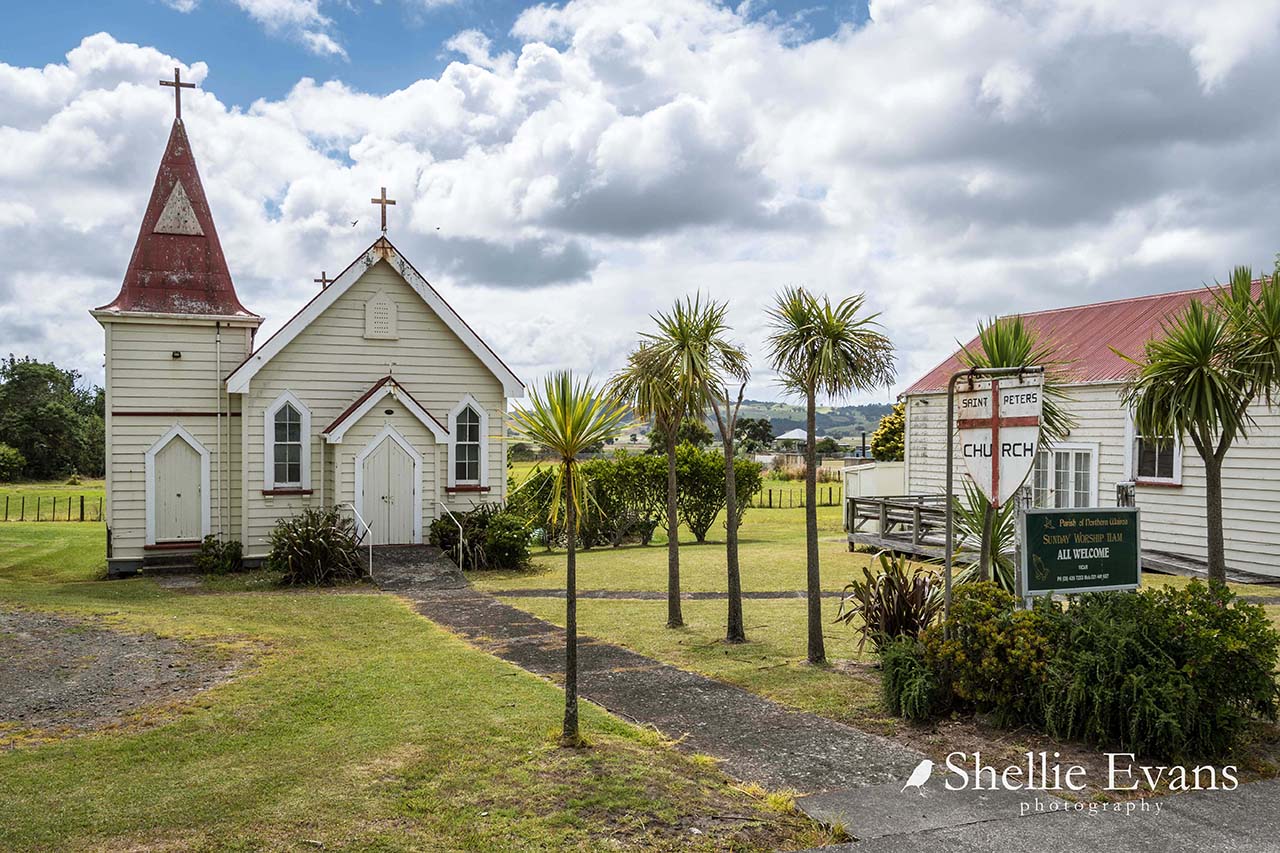
St Peter's Church is situated on the eastern side of the main street of the village of Te Kopuru, 11 km south of Dargaville on the North Kaipara Peninsula. To the southeast its neighbour is the 1880s Te Kopuru School (NZHPT Register 3870). St Peter's is a simple rectangular wooden building, with a square entrance porch facing the road (southwest), and a three sided sanctuary at the north-eastern end. It has a square belfry tower with pyramidal roof surmounted by a wooden cross on its northern side. Exterior The church has timber piles and timber framed walls with painted horizontal weatherboards. The gabled roof is clad in corrugated iron. The square tower on the north-western side supports a splay footed square pyramid clad in sheet iron that rises to a peak surmounted by a plain wooden cross. The windows have timber joinery with opaque glazing and double hung sashes. The upper sash has a triangular apex, echoing the roof line of the church. There are two windows in the southwest end, either side of the entrance porch, four on the southeast side, three on the northwest side and two in the angled walls of the sanctuary. There is one window in the northwest side of the belfry tower. The entrance porch has double doors, with a single door in the belfry tower. The doors, which have vertical boards, have a central apex, again echoing the roofline of the church. There is a plain wooden cross at each gable end, on the summit of the belfry and on the apex of the porch. A concrete ramp with galvanised pipe handrails leads to the entrance porch, while two concrete steps sit outside the tower door. Interior The walls are horizontal match-lining, painted cream. Below the line of the window sills the match-lining is vertical, above a deep wainscot. The ceiling consists of diagonal tongue and groove sarking. This has been oiled. Double kauri doors with leadlight glazing lead from the entrance porch into the body of the church. The kauri floor boards are polyurethaned, with blue carpet with gold fleur-de-lys in the sanctuary and aisles. The roof is supported by A-frame gable trusses. The altar is a rectangular kauri table with four turned legs, placed so the celebrant faces the congregation. The reredos from the original altar was retrieved as part of the conservation work in 2002, and is mounted on the end wall of the sanctuary. On the right of the altar (viewed from the congregation) is an octagonal white painted stone baptismal font There is electric power connected, with incandescent lights and infrared wall heaters.
St Peter's Church is situated on the eastern side of the main street of the village of Te Kopuru, 11 km south of Dargaville on the North Kaipara Peninsula. To the southeast its neighbour is the 1880s Te Kopuru School (NZHPT Register 3870). St Peter's is a simple rectangular wooden building, with a square entrance porch facing the road (southwest), and a three sided sanctuary at the north-eastern end. It has a square belfry tower with pyramidal roof surmounted by a wooden cross on its northern side. Exterior The church has timber piles and timber framed walls with painted horizontal weatherboards. The gabled roof is clad in corrugated iron. The square tower on the north-western side supports a splay footed square pyramid clad in sheet iron that rises to a peak surmounted by a plain wooden cross. The windows have timber joinery with opaque glazing and double hung sashes. The upper sash has a triangular apex, echoing the roof line of the church. There are two windows in the southwest end, either side of the entrance porch, four on the southeast side, three on the northwest side and two in the angled walls of the sanctuary. There is one window in the northwest side of the belfry tower. The entrance porch has double doors, with a single door in the belfry tower. The doors, which have vertical boards, have a central apex, again echoing the roofline of the church. There is a plain wooden cross at each gable end, on the summit of the belfry and on the apex of the porch. A concrete ramp with galvanised pipe handrails leads to the entrance porch, while two concrete steps sit outside the tower door. Interior The walls are horizontal match-lining, painted cream. Below the line of the window sills the match-lining is vertical, above a deep wainscot. The ceiling consists of diagonal tongue and groove sarking. This has been oiled. Double kauri doors with leadlight glazing lead from the entrance porch into the body of the church. The kauri floor boards are polyurethaned, with blue carpet with gold fleur-de-lys in the sanctuary and aisles. The roof is supported by A-frame gable trusses. The altar is a rectangular kauri table with four turned legs, placed so the celebrant faces the congregation. The reredos from the original altar was retrieved as part of the conservation work in 2002, and is mounted on the end wall of the sanctuary. On the right of the altar (viewed from the congregation) is an octagonal white painted stone baptismal font There is electric power connected, with incandescent lights and infrared wall heaters.
Historical and Associated Iwi / Hapū / Whānau
Completion Date
22nd June 2007
Report Written By
Stuart Park
Information Sources
Anon, 1952
St Peter's Te Kopuru, 50 Years of Worship 1902 - 1952
Bradley, 1982
E. K. Bradley, The Great Northern Wairoa, (4th edn.), Auckland, 1982
Hay, 2002
Jude Hay (ed.), St Peter's Te Kopuru, 100 Years of Worship 1902 - 2002, 2002
Other Information
A fully referenced registration report is available from the NZHPT Northland Area Office. Please note that entry on the New Zealand Heritage List/Rarangi Korero identifies only the heritage values of the property concerned, and should not be construed as advice on the state of the property, or as a comment of its soundness or safety, including in regard to earthquake risk, safety in the event of fire, or insanitary conditions.
Historical and Associated Iwi / Hapū / Whānau
Completion Date
22nd June 2007
Report Written By
Stuart Park
Information Sources
Anon, 1952
St Peter's Te Kopuru, 50 Years of Worship 1902 - 1952
Bradley, 1982
E. K. Bradley, The Great Northern Wairoa, (4th edn.), Auckland, 1982
Hay, 2002
Jude Hay (ed.), St Peter's Te Kopuru, 100 Years of Worship 1902 - 2002, 2002
Other Information
A fully referenced registration report is available from the NZHPT Northland Area Office. Please note that entry on the New Zealand Heritage List/Rarangi Korero identifies only the heritage values of the property concerned, and should not be construed as advice on the state of the property, or as a comment of its soundness or safety, including in regard to earthquake risk, safety in the event of fire, or insanitary conditions.
Current Usages
Uses: Religion
Specific Usage: Church
Former Usages
General Usage: Religion
Specific Usage: Church
Current Usages
Uses: Religion
Specific Usage: Church
Former Usages
General Usage: Religion
Specific Usage: Church
Location
Sign up to hear more
Get the latest heritage news, features and events delivered
straight to your inbox.
