

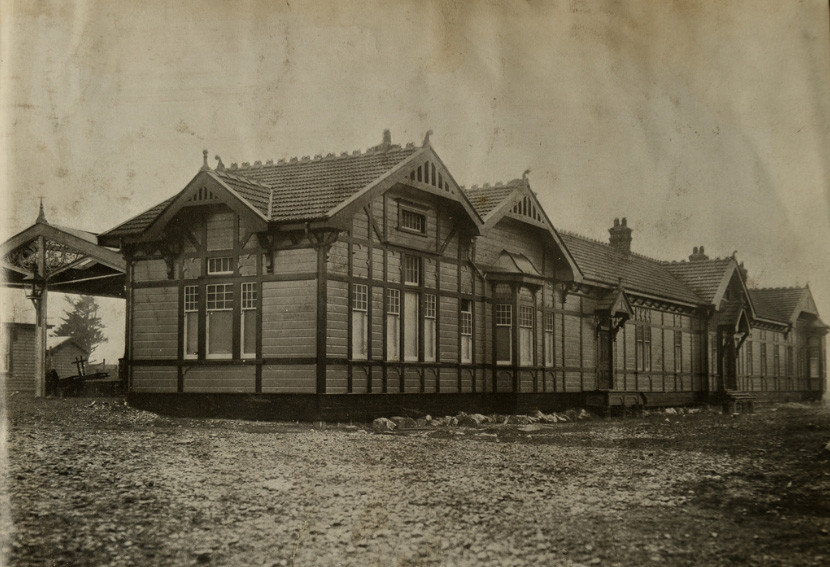
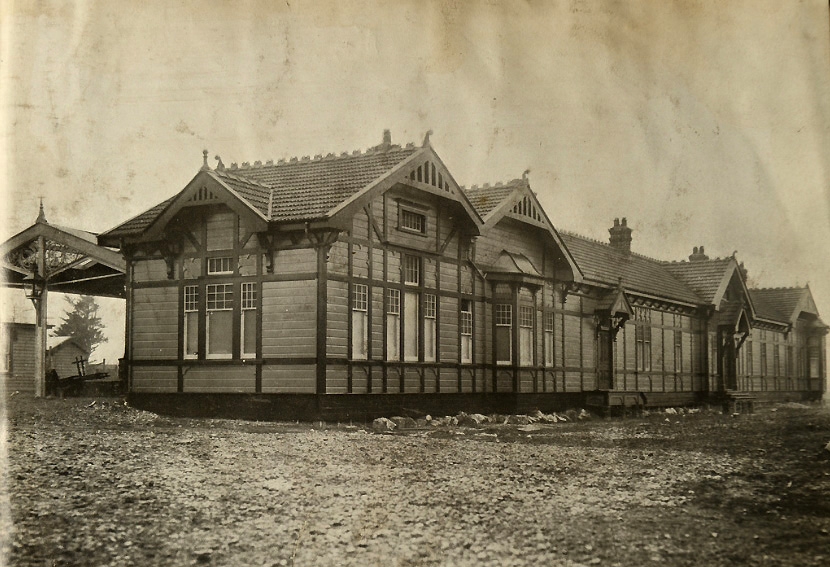
The first station in Dannevirke was opened after the railway line between Woodville and Napier was completed in 1887. Twelve years later Dannevirke residents began agitating for a larger, more convenient building. In 1902 plans for a new building were drawn by the newly appointed NZR Designing Engineer George Troup (1863-1941). The day of its official opening was declared a half-holiday in Dannevirke.
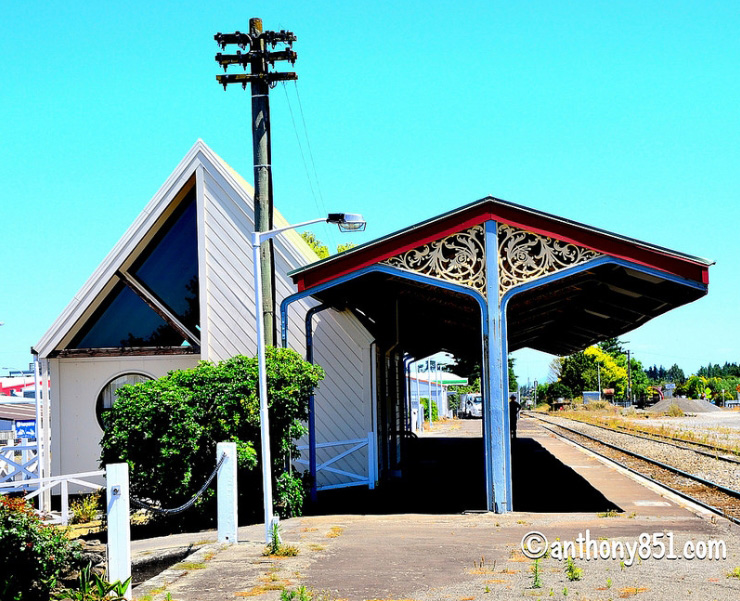
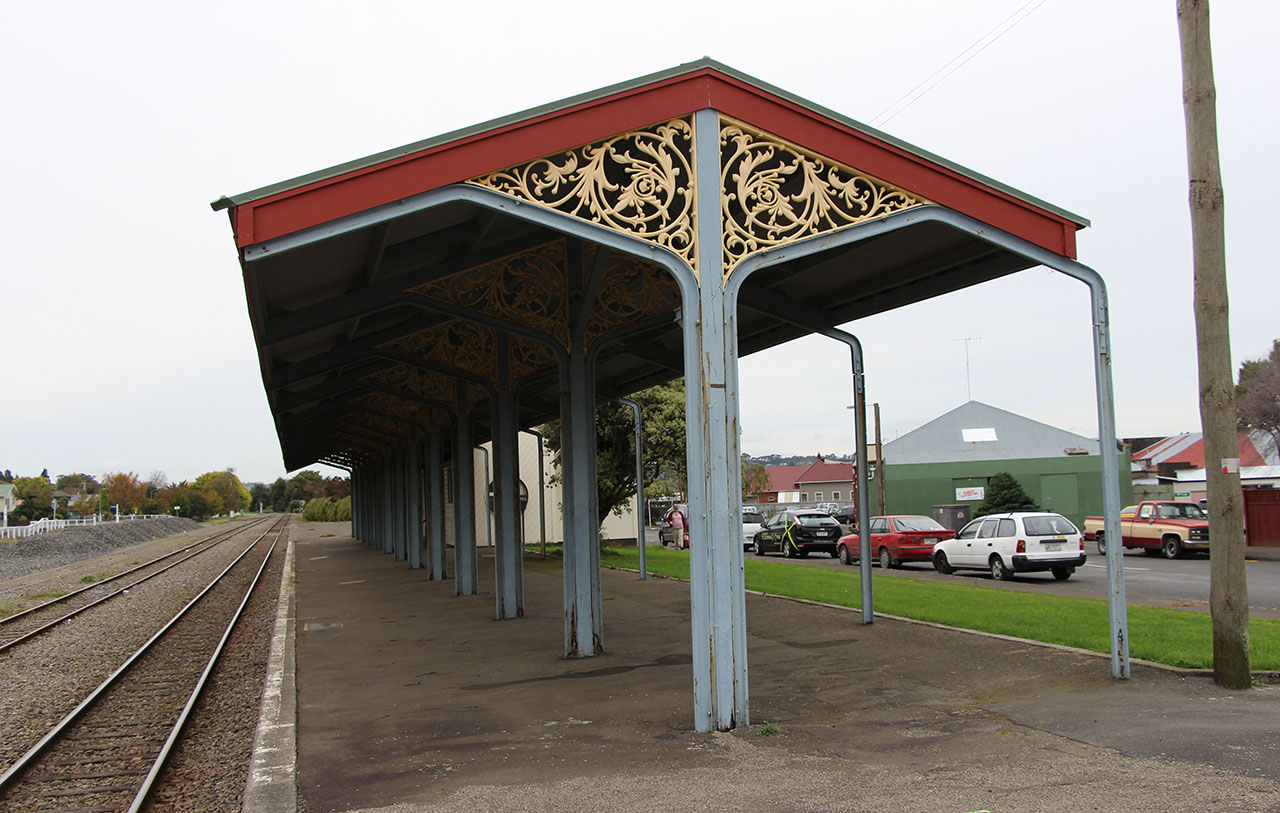
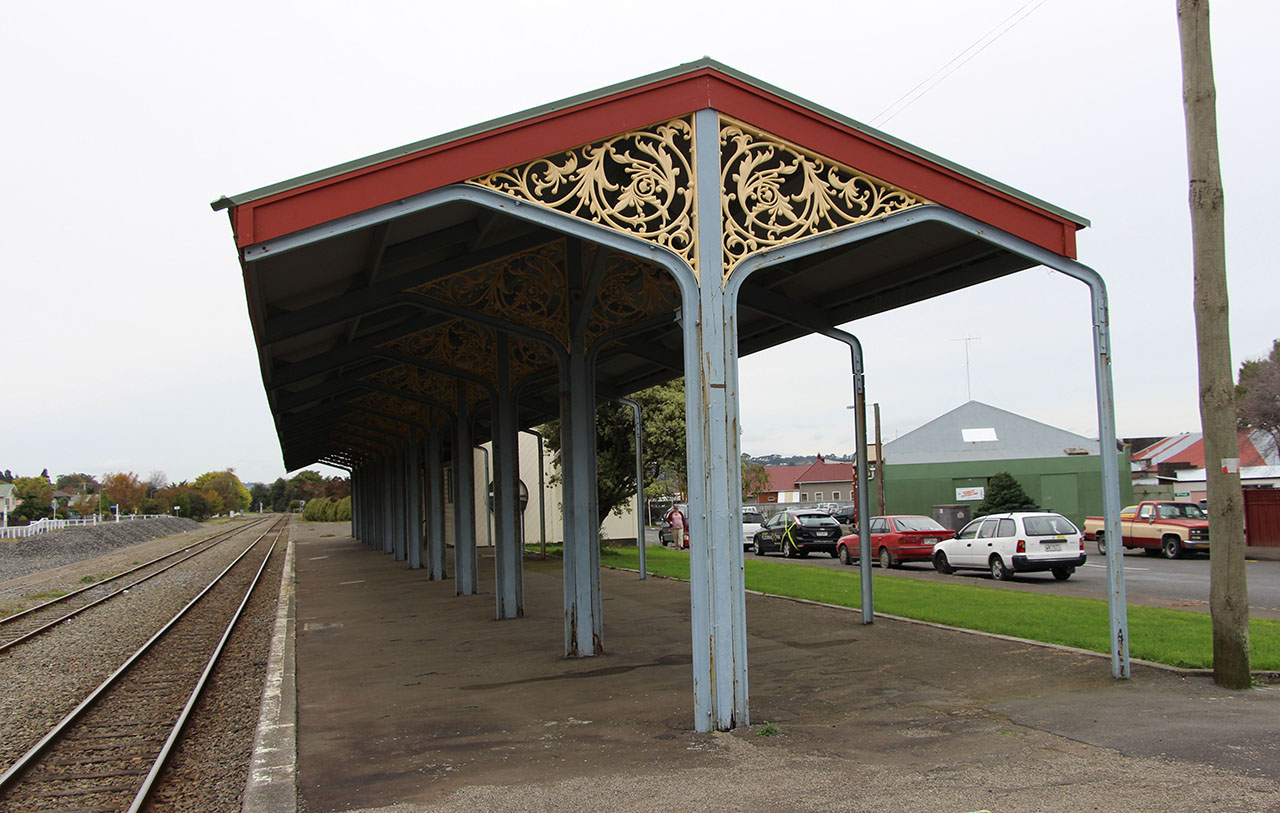
In 1983 plans to renovate the building were abandoned after the costs of the project became apparent. The building was demolished and replaced with a much smaller station building. Only the building's canopy was retained. This consists of cast-iron pillars, brackets with an ornamental pattern of leaves and fronds, and a corrugated iron roof. Seven years later the station office was closed. Neither passenger nor goods trains now stop at the station. The canopy roof was removed and replaced with new corrugated iron in 2003.
List Entry Information
Status
Listed
List Entry Status
Historic Place Category 2
Access
Private/No Public Access
List Number
4415
Date Entered
28th June 1990
Date of Effect
28th June 1990
City/District Council
Tararua District
Region
Horizons (Manawatū-Whanganui) Region
Extent of List Entry
Registration includes the land in NZ Gazette, 18 December 1902, No.103, as shown on Survey Office Plan 8463, Hawkes Bay Registry, and the canopy and platform thereon.
Legal description
SO Plan 8463, Proclamation, (NZ Gazette 18 December 1902, p.103), Hawkes Bay Land District
Location Description
The Canopy is located in front of the present station building on the railway station platform in Hall Street, Dannevirke.
Status
Listed
List Entry Status
Historic Place Category 2
Access
Private/No Public Access
List Number
4415
Date Entered
28th June 1990
Date of Effect
28th June 1990
City/District Council
Tararua District
Region
Horizons (Manawatū-Whanganui) Region
Extent of List Entry
Registration includes the land in NZ Gazette, 18 December 1902, No.103, as shown on Survey Office Plan 8463, Hawkes Bay Registry, and the canopy and platform thereon.
Legal description
SO Plan 8463, Proclamation, (NZ Gazette 18 December 1902, p.103), Hawkes Bay Land District
Location Description
The Canopy is located in front of the present station building on the railway station platform in Hall Street, Dannevirke.
Why is this place significant?
Historic Significance
Historical Significance or Value The Dannevirke Railway Station Canopy and platform have historic and architectural value. The remains of the canopy have some historic significance as an embodiment of NZR's early twentieth-century policy to design more elaborate and substantial railway structures than had been possible in the late nineteenth-century. Campaigned for by Dannevirke residents, the remains of the structure also have local importance and are held in high esteem by the community.
Physical Significance
The only original parts of the canopy structure remaining are the cast-iron pillars and brackets. These have some significance as part of one of the first railway stations designed after Troup's promotion to NZR Designing Engineer. They embody elements that were used in later stations designed by Troup and have aesthetic appeal.
Why is this place Category 1 / Category 2?
Detail Of Assessed Criteria
(e) The community association with, or public esteem for, the place: The Dannevirke Railway Station Canopy is esteemed by the Dannevirke community. A recent indication of this esteem was the community project initiated in 2002 by members of the Dannevirke Host Lion's Club to restore the Canopy. The project was financed by Trans Scenic, and money raised by the Lion's Club. (g) The technical accomplishment or value, or design of the place: The design of the Canopy is an example of one of the very first created by George Troup (1863-1941) following his promotion to the position of NZR Designing Engineer and the new 'age of elegance' in station buildings that ensued as a result (k) The extent to which the place forms part of a wider historical and cultural complex or historical and cultural landscape: The Canopy forms part of a wider historical landscape associated with the railway line. It is located on the 600 metre long concrete platform in Dannevirke where trains using the railway line between Woodville and Napier stopped. The cast-iron pillars and brackets also mark the position of the original Troup station.
Why is this place significant?
Historic Significance
Historical Significance or Value The Dannevirke Railway Station Canopy and platform have historic and architectural value. The remains of the canopy have some historic significance as an embodiment of NZR's early twentieth-century policy to design more elaborate and substantial railway structures than had been possible in the late nineteenth-century. Campaigned for by Dannevirke residents, the remains of the structure also have local importance and are held in high esteem by the community.
Physical Significance
The only original parts of the canopy structure remaining are the cast-iron pillars and brackets. These have some significance as part of one of the first railway stations designed after Troup's promotion to NZR Designing Engineer. They embody elements that were used in later stations designed by Troup and have aesthetic appeal.
Why is this place Category 1 / Category 2?
Detail Of Assessed Criteria
(e) The community association with, or public esteem for, the place: The Dannevirke Railway Station Canopy is esteemed by the Dannevirke community. A recent indication of this esteem was the community project initiated in 2002 by members of the Dannevirke Host Lion's Club to restore the Canopy. The project was financed by Trans Scenic, and money raised by the Lion's Club. (g) The technical accomplishment or value, or design of the place: The design of the Canopy is an example of one of the very first created by George Troup (1863-1941) following his promotion to the position of NZR Designing Engineer and the new 'age of elegance' in station buildings that ensued as a result (k) The extent to which the place forms part of a wider historical and cultural complex or historical and cultural landscape: The Canopy forms part of a wider historical landscape associated with the railway line. It is located on the 600 metre long concrete platform in Dannevirke where trains using the railway line between Woodville and Napier stopped. The cast-iron pillars and brackets also mark the position of the original Troup station.
Construction Professional
Name
Sharpin, W.
Type
Builder
Biography
No biography is currently available for this construction professional
Name
Troup, George Alexander
Type
Architect
Biography
G A Troup (1863-1941) was born in London in 1863 and educated in Scotland. He trained as an architect and engineer under C E Calvert of Edinburgh and came to New Zealand in 1884. After a short time with the Survey Department in Otago he became a draughtsman for New Zealand Railways in Dunedin and then, from 1888, in Wellington. Troup became Chief Draughtsman in 1894. He designed many station buildings throughout the county, some of which are still in use today; these buildings form an important part of New Zealand's landscape. His best known building is the Dunedin Railway Station (1904-07). He also designed the head office building in Wellington for Railways (1901, now demolished). Troup became a Fellow of the Royal Institute of British Architects in 1907. After World War I he was promoted to head the newly established Architectural Branch of New Zealand Railways. On retirement from Railways in 1925 he entered local body politics and was Mayor of Wellington from 1927 to 1931. Troup was prominent in the Presbyterian Church and founded the Presbyterian Young Men's Bible Class Union. He was an elder of the church for 47 years and also served on the governing bodies of several Wellington secondary schools. Education was a life-long interest and he was keenly involved in the training of engineering cadets in New Zealand Railways. Troup was knighted in 1937 and died in 1941. Last updated 1 October 2014 See also: James Veitch. 'Troup, George Alexander', Dictionary of New Zealand Biography, first published in 1993. Te Ara - the Encyclopedia of New Zealand, https://teara.govt.nz/en/biographies/2t49/troup-george-alexander
Construction Details
Start Year
1903
Type
Original Construction
Start Year
1911
Type
Addition
Description
Windows and shutters added to mail room windows/booking office. Chimneys removed.
Start Year
1912
Type
Addition
Description
Four platform seats added,
Start Year
1925
Type
Modification
Description
Bookstall enlarged.
Start Year
1936
Type
Modification
Description
Alterations to bookstall and parcels office.
Start Year
1961
Type
Other
Description
Ambulance building equipped.
Start Year
1983
Type
Other
Description
Station building demolished.
Start Year
2003
Type
Other
Description
Canopy roof replaced with new corrugated iron.
Construction Materials
The remains of the canopy are constructed from cast iron and corrugated iron.
Construction Professional
Name
Sharpin, W.
Type
Builder
Biography
No biography is currently available for this construction professional
Name
Troup, George Alexander
Type
Architect
Biography
G A Troup (1863-1941) was born in London in 1863 and educated in Scotland. He trained as an architect and engineer under C E Calvert of Edinburgh and came to New Zealand in 1884. After a short time with the Survey Department in Otago he became a draughtsman for New Zealand Railways in Dunedin and then, from 1888, in Wellington. Troup became Chief Draughtsman in 1894. He designed many station buildings throughout the county, some of which are still in use today; these buildings form an important part of New Zealand's landscape. His best known building is the Dunedin Railway Station (1904-07). He also designed the head office building in Wellington for Railways (1901, now demolished). Troup became a Fellow of the Royal Institute of British Architects in 1907. After World War I he was promoted to head the newly established Architectural Branch of New Zealand Railways. On retirement from Railways in 1925 he entered local body politics and was Mayor of Wellington from 1927 to 1931. Troup was prominent in the Presbyterian Church and founded the Presbyterian Young Men's Bible Class Union. He was an elder of the church for 47 years and also served on the governing bodies of several Wellington secondary schools. Education was a life-long interest and he was keenly involved in the training of engineering cadets in New Zealand Railways. Troup was knighted in 1937 and died in 1941. Last updated 1 October 2014 See also: James Veitch. 'Troup, George Alexander', Dictionary of New Zealand Biography, first published in 1993. Te Ara - the Encyclopedia of New Zealand, https://teara.govt.nz/en/biographies/2t49/troup-george-alexander
Construction Details
Start Year
1903
Type
Original Construction
Start Year
1911
Type
Addition
Description
Windows and shutters added to mail room windows/booking office. Chimneys removed.
Start Year
1912
Type
Addition
Description
Four platform seats added,
Start Year
1925
Type
Modification
Description
Bookstall enlarged.
Start Year
1936
Type
Modification
Description
Alterations to bookstall and parcels office.
Start Year
1961
Type
Other
Description
Ambulance building equipped.
Start Year
1983
Type
Other
Description
Station building demolished.
Start Year
2003
Type
Other
Description
Canopy roof replaced with new corrugated iron.
Construction Materials
The remains of the canopy are constructed from cast iron and corrugated iron.
The Dannevirke Railway Station Canopy, the sole remnant of the Railway Station constructed in 1903, is a reminder of the shift towards an 'age of elegance' in the design of railway station structures. The expansion of the railways began in 1870 when, to promote settlement and stimulate economic growth, the Government adopted Colonial Treasurer Julius Vogel's (1835-1899) proposal to build a transport network throughout the country. To ensure that the maximum length of line was laid using the funds available, Vogel suggested that the least possible amount should be spent on lines and station buildings. Consequently, in the late nineteenth-century, station buildings in rural areas were purely utilitarian structures. The first station in Dannevirke was opened after the railway line between Woodville and Napier was completed in 1887. Following a petition by local residents, the Government agreed to transfer the small, plain station building from the former terminus in nearby Tahoraiti to Dannevirke. Twelve years later Dannevirke residents began agitating for a larger, more convenient building. In 1901 a second petition was presented to parliament. In 1902 plans for a new building were drawn up and New Zealand Railways (NZR) acquired a site opposite the original station on the town side of the tracks the following year. By 1900 the economy had improved and NZR was able to design and construct more elaborate station buildings in rural areas. In 1902 George Troup (1863-1941) was promoted to the position of NZR Designing Engineer and was responsible for a number of district stations of great architectural merit. The new Dannevirke Station building, one of the very first to be designed after Troup's promotion, reflected this new 'age of elegance' in station buildings. Constructed by a team NZR staff, the Dannevirke Railway Station building cost £2,800 and was completed in 1903. Built of timber with a Marseilles tile roof, the station contained two waiting rooms, one of which was reserved exclusively for women. The building had a luggage and parcels office, a booking office, a lobby, a stationmaster's office, mail, store, porters' and lamp rooms, and a large canopy. Cast-iron pillars supported the canopy. Brackets with an ornamental pattern of leaves and fronds that was used in later stations designed by Troup, added strength to the structure. The day of its official opening was declared a half-holiday in Dannevirke and, in his speech at the opening ceremony, the then Minister of Railways Sir Joseph Ward (1856-1930), stressed that the building 'marked the advance of time'. In 1958 limited financial resources prevented an upgrade the Station building and in 1962 the neglected structure was scheduled for demolition. Despite this the building was retained. In 1983 renewed plans to renovate the building were abandoned after the costs of the project became apparent. The building was demolished and replaced with a much smaller station building. Only the building's canopy was retained. Seven years later the station office was closed. Neither passenger nor goods trains now stop at the station. The canopy roof was removed and replaced with new corrugated iron in 2003. The only remains of the original station building today and the cast-iron posts and brackets.
The Dannevirke Railway Station Canopy, the sole remnant of the Railway Station constructed in 1903, is a reminder of the shift towards an 'age of elegance' in the design of railway station structures. The expansion of the railways began in 1870 when, to promote settlement and stimulate economic growth, the Government adopted Colonial Treasurer Julius Vogel's (1835-1899) proposal to build a transport network throughout the country. To ensure that the maximum length of line was laid using the funds available, Vogel suggested that the least possible amount should be spent on lines and station buildings. Consequently, in the late nineteenth-century, station buildings in rural areas were purely utilitarian structures. The first station in Dannevirke was opened after the railway line between Woodville and Napier was completed in 1887. Following a petition by local residents, the Government agreed to transfer the small, plain station building from the former terminus in nearby Tahoraiti to Dannevirke. Twelve years later Dannevirke residents began agitating for a larger, more convenient building. In 1901 a second petition was presented to parliament. In 1902 plans for a new building were drawn up and New Zealand Railways (NZR) acquired a site opposite the original station on the town side of the tracks the following year. By 1900 the economy had improved and NZR was able to design and construct more elaborate station buildings in rural areas. In 1902 George Troup (1863-1941) was promoted to the position of NZR Designing Engineer and was responsible for a number of district stations of great architectural merit. The new Dannevirke Station building, one of the very first to be designed after Troup's promotion, reflected this new 'age of elegance' in station buildings. Constructed by a team NZR staff, the Dannevirke Railway Station building cost £2,800 and was completed in 1903. Built of timber with a Marseilles tile roof, the station contained two waiting rooms, one of which was reserved exclusively for women. The building had a luggage and parcels office, a booking office, a lobby, a stationmaster's office, mail, store, porters' and lamp rooms, and a large canopy. Cast-iron pillars supported the canopy. Brackets with an ornamental pattern of leaves and fronds that was used in later stations designed by Troup, added strength to the structure. The day of its official opening was declared a half-holiday in Dannevirke and, in his speech at the opening ceremony, the then Minister of Railways Sir Joseph Ward (1856-1930), stressed that the building 'marked the advance of time'. In 1958 limited financial resources prevented an upgrade the Station building and in 1962 the neglected structure was scheduled for demolition. Despite this the building was retained. In 1983 renewed plans to renovate the building were abandoned after the costs of the project became apparent. The building was demolished and replaced with a much smaller station building. Only the building's canopy was retained. Seven years later the station office was closed. Neither passenger nor goods trains now stop at the station. The canopy roof was removed and replaced with new corrugated iron in 2003. The only remains of the original station building today and the cast-iron posts and brackets.
The canopy is located on a 600 metre long concrete platform. It consists of cast-iron pillars that supported the canopy of corrugated iron that has recently been replaced. Brackets with an ornamental pattern of leaves and fronds that was used in later stations designed by Troup, added strength to the structure.
The canopy is located on a 600 metre long concrete platform. It consists of cast-iron pillars that supported the canopy of corrugated iron that has recently been replaced. Brackets with an ornamental pattern of leaves and fronds that was used in later stations designed by Troup, added strength to the structure.
Historical and Associated Iwi / Hapū / Whānau
Completion Date
15th February 2005
Report Written By
Rebecca O'Brien
Information Sources
Dannevirke Advocate
Dannevirke Advocate
Evans, 1977
M. Evans, 'Research Report on Dannevirke Railway Station', May 1977, NZHPT File 12021-008
Furkert, 1953
Frederick William Furkert, Early New Zealand Engineers, Wellington, 1953
Mahoney, 1987
J. D. Mahoney, Down at the Station: A Study of the New Zealand Railway Station, Palmerston North, 1987
Other Information
A fully referenced version of this report is available from the NZHPT Central Region Office Please note that entry on the New Zealand Heritage List/Rarangi Korero identifies only the heritage values of the property concerned, and should not be construed as advice on the state of the property, or as a comment of its soundness or safety, including in regard to earthquake risk, safety in the event of fire, or insanitary conditions.
Historical and Associated Iwi / Hapū / Whānau
Completion Date
15th February 2005
Report Written By
Rebecca O'Brien
Information Sources
Dannevirke Advocate
Dannevirke Advocate
Evans, 1977
M. Evans, 'Research Report on Dannevirke Railway Station', May 1977, NZHPT File 12021-008
Furkert, 1953
Frederick William Furkert, Early New Zealand Engineers, Wellington, 1953
Mahoney, 1987
J. D. Mahoney, Down at the Station: A Study of the New Zealand Railway Station, Palmerston North, 1987
Other Information
A fully referenced version of this report is available from the NZHPT Central Region Office Please note that entry on the New Zealand Heritage List/Rarangi Korero identifies only the heritage values of the property concerned, and should not be construed as advice on the state of the property, or as a comment of its soundness or safety, including in regard to earthquake risk, safety in the event of fire, or insanitary conditions.
Current Usages
Uses: Transport
Specific Usage: Railway station/ platform/ refreshment room
Former Usages
General Usage: Transport
Specific Usage: Railway station/ platform/ refreshment room
Current Usages
Uses: Transport
Specific Usage: Railway station/ platform/ refreshment room
Former Usages
General Usage: Transport
Specific Usage: Railway station/ platform/ refreshment room
Location
Sign up to hear more
Get the latest heritage news, features and events delivered
straight to your inbox.
