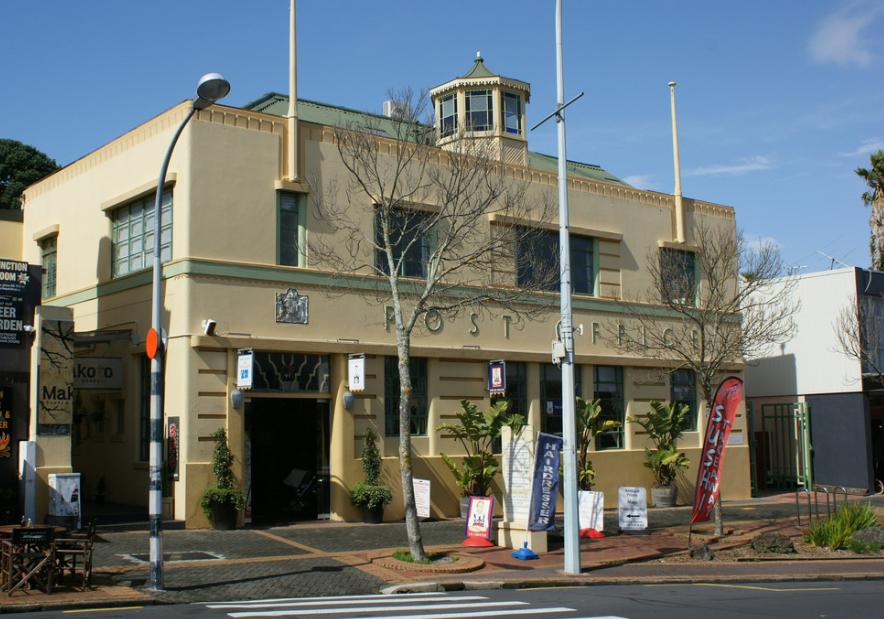
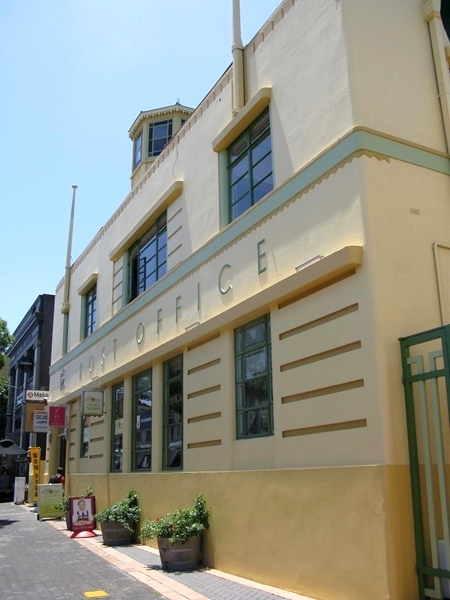
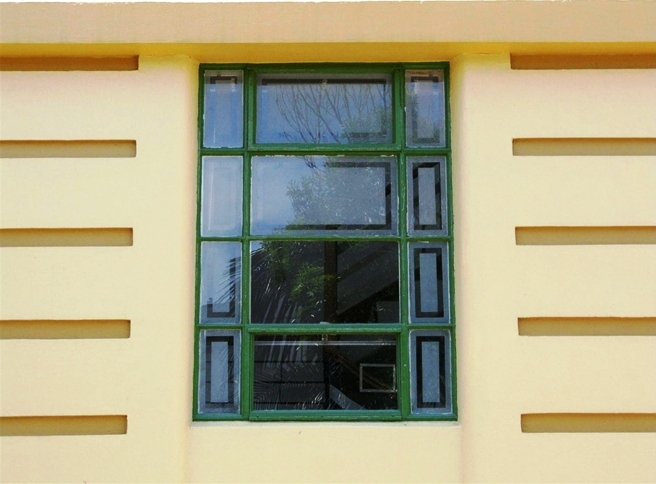
Constructed in 1938, the former post office at Devonport is a reinforced concrete building of Streamline Moderne design. It was erected as part of an expansion programme by the first Labour government to assist in the delivery of major social reforms following the Great Depression, and was used by the local community as a post office until its conversion to other purposes more than fifty years later.
Devonport was an early centre of Maori settlement, which became a British naval station after formal colonisation in 1840, and later a prosperous seaside resort and suburb. Located beside Victoria Road, the site on which the post office was later erected formed part of a Crown Grant issued in 1850 to the Colonial Secretary Andrew Sinclair and others, as trustees of the Grammar School Trust. The Trust leased the land to successive parties for the next 70 years, during which period Victoria Road emerged as the settlement’s main commercial thoroughfare. In 1920 the government purchased the site for the construction of a new post office. However, it was not until after the election of the first Labour government in 1935 that action was taken to replace an earlier structure erected in 1907-8 on the opposite side of Victoria Road.
In 1936, the Labour government drew up a building programme for the construction of new post offices throughout the country. Due to the pressure of work on the Public Works Department, private architects were contracted to prepare plans and specifications for a number of these structures in 1936-7, including at Devonport. The Devonport post office was designed by the architect Norman Wade, who had previously been responsible with his former business partner Alva Bartley for significant buildings in Auckland linked with modern technology, such as the Auckland Electric Power Board headquarters in Queen Street.
Construction began at the end of February 1938 using New Zealand materials where possible, in line with government policy. Building work took approximately eight months to complete, and cost an estimated £15,000. Designed in a Streamline Moderne style that can be seen to have reflected the government’s forward-looking policies, the two-storey structure incorporated a main vestibule facing Victoria Road, a large public space, a room for the postmaster and a spacious mail room at ground floor level. It also contained upstairs family quarters for the local postmaster. The building was opened in November 1938 by F.W. Schramm, the local Member of Parliament, with numerous other dignitaries in attendance.
Post offices such as the new Devonport building facilitated the delivery of state assistance to New Zealand’s citizens as social reforms were introduced by the new government, in addition to undertaking traditional roles in postal provision. The Devonport post office was erected in the same year that the Social Security Act was passed, which introduced a universal social security system. Services carried out by the Post Office expanded even more rapidly after the Second World War (1939-45). In 1964, the Post Office was described as both a social service organisation and one of New Zealand’s largest businesses.
The Devonport post office continued to serve the local community until 1991, after which it was converted into a private museum and visitor attraction, ‘Jackson’s Muzeum of Automobilia, Sounds, Victoriana and Collectables'. New elements were added to the structure, including a gazebo on the top of the front elevation, and a large rear extension. In 2008, the building was converted into a shopping arcade. The latter alterations were overseen by Salmond-Reed Architects, who were given an Auckland Architecture Award in the heritage category by the New Zealand Institute of Architects (2009). The property remains in use for retail purposes and is in private ownership.
Devonport was an early centre of Maori settlement, which became a British naval station after formal colonisation in 1840, and later a prosperous seaside resort and suburb. Located beside Victoria Road, the site on which the post office was later erected formed part of a Crown Grant issued in 1850 to the Colonial Secretary Andrew Sinclair and others, as trustees of the Grammar School Trust. The Trust leased the land to successive parties for the next 70 years, during which period Victoria Road emerged as the settlement’s main commercial thoroughfare. In 1920 the government purchased the site for the construction of a new post office. However, it was not until after the election of the first Labour government in 1935 that action was taken to replace an earlier structure erected in 1907-8 on the opposite side of Victoria Road.
In 1936, the Labour government drew up a building programme for the construction of new post offices throughout the country. Due to the pressure of work on the Public Works Department, private architects were contracted to prepare plans and specifications for a number of these structures in 1936-7, including at Devonport. The Devonport post office was designed by the architect Norman Wade, who had previously been responsible with his former business partner Alva Bartley for significant buildings in Auckland linked with modern technology, such as the Auckland Electric Power Board headquarters in Queen Street.
Construction began at the end of February 1938 using New Zealand materials where possible, in line with government policy. Building work took approximately eight months to complete, and cost an estimated £15,000. Designed in a Streamline Moderne style that can be seen to have reflected the government’s forward-looking policies, the two-storey structure incorporated a main vestibule facing Victoria Road, a large public space, a room for the postmaster and a spacious mail room at ground floor level. It also contained upstairs family quarters for the local postmaster. The building was opened in November 1938 by F.W. Schramm, the local Member of Parliament, with numerous other dignitaries in attendance.
Post offices such as the new Devonport building facilitated the delivery of state assistance to New Zealand’s citizens as social reforms were introduced by the new government, in addition to undertaking traditional roles in postal provision. The Devonport post office was erected in the same year that the Social Security Act was passed, which introduced a universal social security system. Services carried out by the Post Office expanded even more rapidly after the Second World War (1939-45). In 1964, the Post Office was described as both a social service organisation and one of New Zealand’s largest businesses.
The Devonport post office continued to serve the local community until 1991, after which it was converted into a private museum and visitor attraction, ‘Jackson’s Muzeum of Automobilia, Sounds, Victoriana and Collectables'. New elements were added to the structure, including a gazebo on the top of the front elevation, and a large rear extension. In 2008, the building was converted into a shopping arcade. The latter alterations were overseen by Salmond-Reed Architects, who were given an Auckland Architecture Award in the heritage category by the New Zealand Institute of Architects (2009). The property remains in use for retail purposes and is in private ownership.