

The first building on this site seems to have been that of flour millers John and George Orr. It was 30 by 33ft (9 by 10m) with an office at the rear, and walls 16ft high (5m). The building was left in a half-finished state when the Orr’s estate was put in the hands of trustees, as a result of bankruptcy proceedings. The lease was transferred to James Grave in August 1876, and to James Hassell in September 1877.
William Godfrey Neill (d.1900) took up the lease in January 1882. A report from January 1882 describes the building as in the ‘course of erection.’ Neill Brothers were a Dunedin firm with their offices and warehouse in High Street. Neill Brothers announced the opening of their new store in the North Otago Times in March 1882, where they acted as buyers for grain and farm produce. W.G. Neill and his brother Robert set up business as general merchants. Their other brother P.C. Neill was also a well-known Dunedin merchant and businessman.
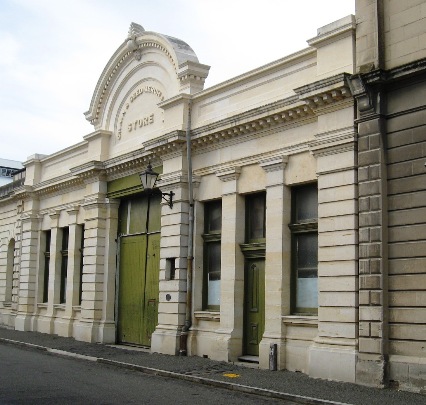
The Oamaru Mail describes the new store, designed by John Lemon and built by stonemasons Messrs Watson. Although only a single storey structure the paper describes the building as ‘one of the most capacious stores in town.’ Its frontage to the railway siding was 66ft (20m), running 126 ft (38m) to the railway line, with 20ft (6m) high walls. With the exception of offices, the whole of the interior was available for storage, with space for 40,000 sacks of grain. The space between the beams increased the capacity to about 50,000 sacks. The floor was concrete with railway lines and a turntable providing access to the store. Water power was used to lift the sacks onto the stacks. The building had ‘a very pleasing substantial appearance, and certainly seems to be specially adapted for doing a large amount of storage at a small cost for labour.’
William Neill was killed in a coach accident in 1900. His brother Robert died four months later. After William’s death the lease was transferred to George Lintott and to Oamaru merchant James Craig in 1905. The North Otago Farmers’ Co-operative took over the lease in 1917. The North Otago Farmers’ Co-operative was formed in 1901 and by 1904 had 760 shareholders. Its first home was on Tyne Street (later used for storage) with its outlet on Thames Street. The aim of the Association was to look after the interests of farmers, and of buying and selling from them through their own agents in various international markets. In 1979 the Association merged with the Canterbury Farmers’ Co-operative Association, renamed Crown Farmers Ltd in 1983.
The building was acquired by the Oamaru Whitestone Civic Trust in 1989. The pediment has been reinstated over the main entrance.
In 2013 Neill Brothers’ Store (Former) remains a significant building in Oamaru’s Harbour/Tyne Historic Area (Register No. 7064).
List Entry Information
Status
Listed
List Entry Status
Historic Place Category 2
Access
Private/No Public Access
List Number
4647
Date Entered
25th September 1986
Date of Effect
25th September 1986
City/District Council
Waitaki District
Region
Otago Region
Extent of List Entry
Extent includes the land described as Lot 6 DP 88 (RT OT18C/521, 800109), Otago Land District, and the building known Neill Brothers' Store (Former), thereon.
Legal description
Lot 6 DP 88 (RT OT18C/521, 800109), Otago Land District
Status
Listed
List Entry Status
Historic Place Category 2
Access
Private/No Public Access
List Number
4647
Date Entered
25th September 1986
Date of Effect
25th September 1986
City/District Council
Waitaki District
Region
Otago Region
Extent of List Entry
Extent includes the land described as Lot 6 DP 88 (RT OT18C/521, 800109), Otago Land District, and the building known Neill Brothers' Store (Former), thereon.
Legal description
Lot 6 DP 88 (RT OT18C/521, 800109), Otago Land District
Construction Professional
Name
Rowland, Mr
Type
Builder
Biography
No biography is currently available for this construction professional
Name
Forrester & Lemon
Type
Architectural Partnership
Biography
The architectural partnership of Forrester and Lemon was established in Oamaru in 1872. Thomas Forrester (1838-1907) was born in Glasgow and educated at the Glasgow School of Art. Emigrating to New Zealand in 1861 he settled in Dunedin and worked under William Mason (1810-97) and William Henry Clayton (1823-77) and later Robert Arthur Lawson (1833-1902). In 1865 he superintended the Dunedin Exhibition and from 1870 he became involved with the supervision of harbour works. Some time after 1885 he became Engineer to the Oamaru Harbour Board and in this capacity designed the repairs to the breakwater following storm damage in 1886 and later the Holmes Wharf. On his death in 1907 he was still in the employ of the Harbour Board. John Lemon (1828-1890) was born in Jamaica and travelled to England before emigrating to New Zealand in 1849. He settled in Oamaru in 1860 and with his brother Charles established a timber merchant's business. By 1869 he was in partnership with his father-in-law, George Sumpter calling themselves "Timber and General Merchants, Land and Commission Agents". This partnership was dissolved in 1872 and Lemon entered into partnership with Forrester. Lemon had no architectural experience at all, but had a wide circle of business contacts and was an efficient administrator. Buildings designed by the partnership of Forrester and Lemon include St Paul's Church (1875-76), the Harbour Board Offices (1876), Queen's (later Brydone) Hotel (1881), Waitaki Boys' High School (1883), The Courthouse (1883) and the Post Office (1883-84), all in Oamaru. Forrester and Lemon contributed greatly to Oamaru's nineteenth century character. On Lemon's death in 1890 the practice was taken over by Forrester's son, John Megget Forrester (1865-1965).
Name
Watson, Messrs
Type
Builder
Biography
No biography is currently available for this construction professional
Construction Details
Start Year
1882
Type
Original Construction
Start Year
2001
startYearCirca
Type
Restoration
Description
Pediment reinstated
Construction Professional
Name
Rowland, Mr
Type
Builder
Biography
No biography is currently available for this construction professional
Name
Forrester & Lemon
Type
Architectural Partnership
Biography
The architectural partnership of Forrester and Lemon was established in Oamaru in 1872. Thomas Forrester (1838-1907) was born in Glasgow and educated at the Glasgow School of Art. Emigrating to New Zealand in 1861 he settled in Dunedin and worked under William Mason (1810-97) and William Henry Clayton (1823-77) and later Robert Arthur Lawson (1833-1902). In 1865 he superintended the Dunedin Exhibition and from 1870 he became involved with the supervision of harbour works. Some time after 1885 he became Engineer to the Oamaru Harbour Board and in this capacity designed the repairs to the breakwater following storm damage in 1886 and later the Holmes Wharf. On his death in 1907 he was still in the employ of the Harbour Board. John Lemon (1828-1890) was born in Jamaica and travelled to England before emigrating to New Zealand in 1849. He settled in Oamaru in 1860 and with his brother Charles established a timber merchant's business. By 1869 he was in partnership with his father-in-law, George Sumpter calling themselves "Timber and General Merchants, Land and Commission Agents". This partnership was dissolved in 1872 and Lemon entered into partnership with Forrester. Lemon had no architectural experience at all, but had a wide circle of business contacts and was an efficient administrator. Buildings designed by the partnership of Forrester and Lemon include St Paul's Church (1875-76), the Harbour Board Offices (1876), Queen's (later Brydone) Hotel (1881), Waitaki Boys' High School (1883), The Courthouse (1883) and the Post Office (1883-84), all in Oamaru. Forrester and Lemon contributed greatly to Oamaru's nineteenth century character. On Lemon's death in 1890 the practice was taken over by Forrester's son, John Megget Forrester (1865-1965).
Name
Watson, Messrs
Type
Builder
Biography
No biography is currently available for this construction professional
Construction Details
Start Year
1882
Type
Original Construction
Start Year
2001
startYearCirca
Type
Restoration
Description
Pediment reinstated
Historical and Associated Iwi / Hapū / Whānau
Completion Date
30th April 2013
Report Written By
Heather Bauchop
Information Sources
Cyclopedia of New Zealand, 1905
Cyclopedia Company, Industrial, descriptive, historical, biographical facts, figures, illustrations, Wellington, N.Z, 1897-1908, Vol. 4 Otago and Southland, Cyclopedia Company, Christchurch, 1905
McCarthy, 2002
Conal McCarthy, Forrester and Lemon of Oamaru, architects, Oamaru, 2002
McDonald, 1962
K C McDonald, 'White Stone Country', Oamaru, 1962
North Otago Times
North Otago Times
Other Information
This place was identified as significant under previous legislation with different information requirements. It remains significant under the current legislation. There is opportunity under our legislation and policies to add to this information. Further information about this place may be available from the Otago/Southland Office of Heritage New Zealand Pouhere Taonga. A fully referenced Upgrade Report is available from the Otago/Southland Area office of NZHPT. This registration is also included in the Harbour/Tyne Street Historic Area (Record no. 7064). Please note that entry on the New Zealand Heritage List/Rarangi Korero identifies only the heritage values of the property concerned, and should not be construed as advice on the state of the property, or as a comment of its soundness or safety, including in regard to earthquake risk, safety in the event of fire, or insanitary conditions.
Historical and Associated Iwi / Hapū / Whānau
Completion Date
30th April 2013
Report Written By
Heather Bauchop
Information Sources
Cyclopedia of New Zealand, 1905
Cyclopedia Company, Industrial, descriptive, historical, biographical facts, figures, illustrations, Wellington, N.Z, 1897-1908, Vol. 4 Otago and Southland, Cyclopedia Company, Christchurch, 1905
McCarthy, 2002
Conal McCarthy, Forrester and Lemon of Oamaru, architects, Oamaru, 2002
McDonald, 1962
K C McDonald, 'White Stone Country', Oamaru, 1962
North Otago Times
North Otago Times
Other Information
This place was identified as significant under previous legislation with different information requirements. It remains significant under the current legislation. There is opportunity under our legislation and policies to add to this information. Further information about this place may be available from the Otago/Southland Office of Heritage New Zealand Pouhere Taonga. A fully referenced Upgrade Report is available from the Otago/Southland Area office of NZHPT. This registration is also included in the Harbour/Tyne Street Historic Area (Record no. 7064). Please note that entry on the New Zealand Heritage List/Rarangi Korero identifies only the heritage values of the property concerned, and should not be construed as advice on the state of the property, or as a comment of its soundness or safety, including in regard to earthquake risk, safety in the event of fire, or insanitary conditions.
Current Usages
Uses: Trade
Specific Usage: Shop
Former Usages
General Usage: Trade
Specific Usage: Warehouse/storage area
Current Usages
Uses: Trade
Specific Usage: Shop
Former Usages
General Usage: Trade
Specific Usage: Warehouse/storage area
Sign up to hear more
Get the latest heritage news, features and events delivered
straight to your inbox.
