

Both iwi history and archaeological evidence show Māori occupation in the Ōtākou / Otago region since the 12th century. Today, Kāi Tahu mana whenua is recognised over a large part of Te Wai Pounamu. Kāti Māmoe and Waitaha shared occupation are always acknowledged. The hapū Kai Te Pahi, Kāti Moki, and Kāti Taoka still maintain their presence and responsibility as kaitiaki in this region. While there were no permanent settlements around George Street, the area near the Toitū Tauraka waka (List No. 9774) was known as Ōtepoti.
The site’s original legal description was section 10, Block XIII, Bell Ward. The section was first owned by Henry Manning and Alexander Mollison purchased this section from him along with part section 11 in 1861 with stables advertised to lease there from March 1862. The White Horse Hotel was built on the site in 1863 by David Forsyth and opened in 1865. By 1876, Mollison was recorded as owning the section with the hotel, stables, and premises. The original portion of the building was erected in 1879 for Mollison, Duthie & Company, Draper and in November 1879 the company announced commencement of the business ‘in that commodious and recently erected brick buildings adjoining the White Horse Hotel’.
The White Horse Hotel continued to run until it was refused a license in 1894 and the building was occupied by William Elder, chemist. In the same year, the front of the old Hotel was altered with the shop front (lower storey only) and filling in of two windows and doorways on the Frederick Street frontage (Figure 3). William Elder’s Estate took over the ownership of Part Section 10 in 1900.
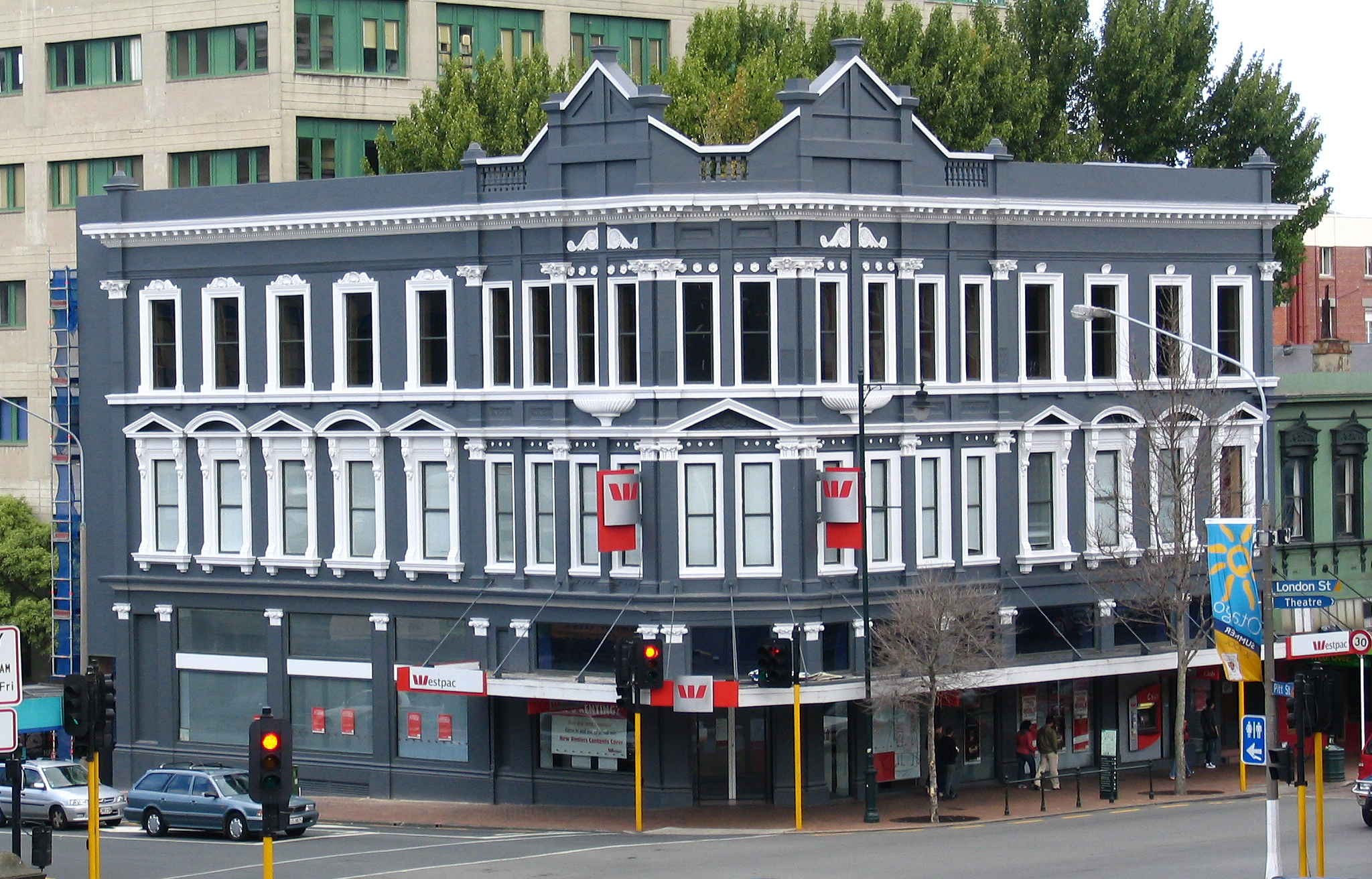
The Mollison building was described in June 1901 as one of the ‘ornaments’ at that end of town: ’It is a three-storey building, with very large cellarage. A verandah of the latest style, with hundreds of feet of glass, gives a fine effect to the premises, and the cornices and carving display much skill on the part of the workmen. There are six large windows of plate-glass, which are splendidly adapted as a means of displaying samples of the many goods which may be purchased within’.
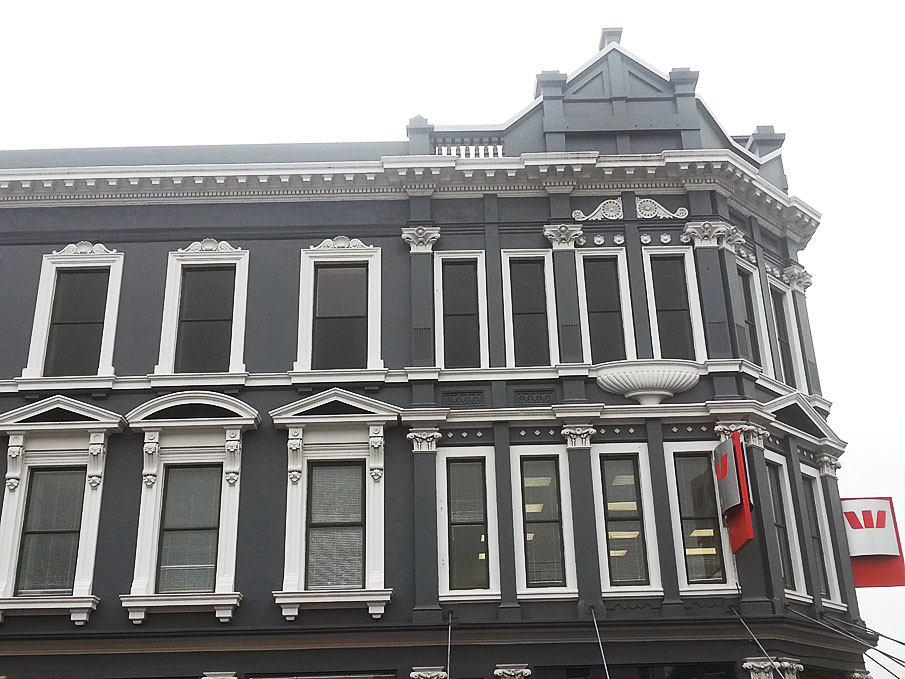
The building has oriel windows on the third storey near the corner of the building. The second storey window near the ends of the building have triangular of segmental pediments. The second story windows on the angled corner have a singular triangular pediment above them. Two triangular pediments and balustraded parapet top the angles corner of the building.
Around 1920 the firm was taken over by A &T Inglis and 4 years later Inglis sold the building to George Hancox, a clothing manufacturer. The Crown Clothing Company occupied the building until 1926. Hancox sold the earlier potion of the building facing George Street to Thomas Newbold, a Methodist minister. Newbold’s wife opened a book store and Newbold’s Bookshop became a Dunedin Institution closing in 1966. The Pacific Fruit Company occupied the corner site from 1931 until 1991. In 1990 the building was saved from demolition by public pressure with the interior gutted and rebuilt and the façade remaining. It was then occupied by Westpac Bank and later ASB Bank with CJ Asian Supermarket opening there in 2020 and continues today.
List Entry Information
Status
Listed
List Entry Status
Historic Place Category 2
Access
Private/No Public Access
List Number
4718
Date Entered
25th September 1986
Date of Effect
25th September 1986
City/District Council
Dunedin City
Region
Otago Region
Extent of List Entry
Extent includes the land described as Lot 3, DP 3293, (RT OT 216/35), Otago Land District, and the building known as Crown Clothing Company Building, thereon.
Legal description
Lot 3 DP 3293, (OT216/35), Otago Land District
Status
Listed
List Entry Status
Historic Place Category 2
Access
Private/No Public Access
List Number
4718
Date Entered
25th September 1986
Date of Effect
25th September 1986
City/District Council
Dunedin City
Region
Otago Region
Extent of List Entry
Extent includes the land described as Lot 3, DP 3293, (RT OT 216/35), Otago Land District, and the building known as Crown Clothing Company Building, thereon.
Legal description
Lot 3 DP 3293, (OT216/35), Otago Land District
Construction Professional
Name
Unknown
Type
Architect
Biography
No biography is currently available for this construction professional
Name
Hislop, James (1859-1904)
Type
Architect
Biography
‘James Hislop (1859-1904) was born in Glasgow and came to New Zealand at a very early age. He was educated at North East Valley School and received his architectural training in the office of Mason and Wales. He also spent two years with the Public Works Department, as district manager of Nelson. In 1880 he entered into business with W.H. Terry who retired three years later. He established his own practice in Dunedin and later entered into a partnership with Edward Walter Walden. In 1889 Hislop designed and supervised the erection of the South Seas Exhibition among a number of prominent buildings both in Otago and elsewhere in the country.’ ‘Among the significant buildings designed by James Hislop, or by the Hislop and Walden partnership are Crown Milling Co. building, Miller Place, Dunedin (c.1880); New Zealand Steam Shipping Co. office, Dunedin; DIC, Christchurch; Evans and Co. Mill, Timaru; National Bank, George Street, Dunedin; Napier Abattoirs (1902); Hallenstein Building, The Octagon; Dunedin City Abattoirs.’ Hislop moved to Wellington around 1903, where he died as the result of an accident in 1904. Source: Heritage New Zealand Review Report for Ferntree Lodge, List No. 368, 27 Jun 2017, Heather Bauchop.
Construction Details
Start Year
1900
Type
Original Construction
Description
Corner Building
Start Year
1879
Type
Original Construction
Description
Building constructed facing George Street
Start Year
1909
Type
Modification
Description
Alter Verandah
Start Year
1924
Type
Modification
Description
Alter Mollison’s Shop
Start Year
1929
Type
Modification
Description
New Shop fronts
Start Year
1951
Type
Addition
Description
Alter Shop for Holsum Bakery Ltd
Start Year
1957
Type
Modification
Description
Alter front of Pacific Fruit Shop
Start Year
1962
Type
Modification
Description
New Verandah for Pacific Fruit Shop
Start Year
1969
Type
Modification
Description
Alter Shop Front for Greensleeves Florists
Start Year
1970
Type
Modification
Description
Alter Cake Shop
Start Year
1977
Type
Modification
Description
Alter Shop front
Construction Professional
Name
Unknown
Type
Architect
Biography
No biography is currently available for this construction professional
Name
Hislop, James (1859-1904)
Type
Architect
Biography
‘James Hislop (1859-1904) was born in Glasgow and came to New Zealand at a very early age. He was educated at North East Valley School and received his architectural training in the office of Mason and Wales. He also spent two years with the Public Works Department, as district manager of Nelson. In 1880 he entered into business with W.H. Terry who retired three years later. He established his own practice in Dunedin and later entered into a partnership with Edward Walter Walden. In 1889 Hislop designed and supervised the erection of the South Seas Exhibition among a number of prominent buildings both in Otago and elsewhere in the country.’ ‘Among the significant buildings designed by James Hislop, or by the Hislop and Walden partnership are Crown Milling Co. building, Miller Place, Dunedin (c.1880); New Zealand Steam Shipping Co. office, Dunedin; DIC, Christchurch; Evans and Co. Mill, Timaru; National Bank, George Street, Dunedin; Napier Abattoirs (1902); Hallenstein Building, The Octagon; Dunedin City Abattoirs.’ Hislop moved to Wellington around 1903, where he died as the result of an accident in 1904. Source: Heritage New Zealand Review Report for Ferntree Lodge, List No. 368, 27 Jun 2017, Heather Bauchop.
Construction Details
Start Year
1900
Type
Original Construction
Description
Corner Building
Start Year
1879
Type
Original Construction
Description
Building constructed facing George Street
Start Year
1909
Type
Modification
Description
Alter Verandah
Start Year
1924
Type
Modification
Description
Alter Mollison’s Shop
Start Year
1929
Type
Modification
Description
New Shop fronts
Start Year
1951
Type
Addition
Description
Alter Shop for Holsum Bakery Ltd
Start Year
1957
Type
Modification
Description
Alter front of Pacific Fruit Shop
Start Year
1962
Type
Modification
Description
New Verandah for Pacific Fruit Shop
Start Year
1969
Type
Modification
Description
Alter Shop Front for Greensleeves Florists
Start Year
1970
Type
Modification
Description
Alter Cake Shop
Start Year
1977
Type
Modification
Description
Alter Shop front
Historical and Associated Iwi / Hapū / Whānau
Completion Date
20th February 2023
Report Written By
Alison Breese
Information Sources
Tod, 1984
Frank Tod, Pubs Galore: History of Dunedin Hotels 1848-1984, Historical Publications, Dunedin, 1984
Other Information
This place was identified as significant under previous legislation with different information requirements. It remains significant under the current legislation. There is opportunity under our legislation and policies to add to this information. Further information about this place may be available from the Otago/Southland Office of Heritage New Zealand Pouhere Taonga. A fully referenced copy of the upgrade report is available on request from the Otago/Southland Area Office of Heritage New Zealand Pouhere Taonga. Please note that entry on the New Zealand Heritage List/Rarangi Korero identifies only the heritage values of the property concerned, and should not be construed as advice on the state of the property, or as a comment of its soundness or safety, including in regard to earthquake risk, safety in the event of fire, or insanitary conditions.
Historical and Associated Iwi / Hapū / Whānau
Completion Date
20th February 2023
Report Written By
Alison Breese
Information Sources
Tod, 1984
Frank Tod, Pubs Galore: History of Dunedin Hotels 1848-1984, Historical Publications, Dunedin, 1984
Other Information
This place was identified as significant under previous legislation with different information requirements. It remains significant under the current legislation. There is opportunity under our legislation and policies to add to this information. Further information about this place may be available from the Otago/Southland Office of Heritage New Zealand Pouhere Taonga. A fully referenced copy of the upgrade report is available on request from the Otago/Southland Area Office of Heritage New Zealand Pouhere Taonga. Please note that entry on the New Zealand Heritage List/Rarangi Korero identifies only the heritage values of the property concerned, and should not be construed as advice on the state of the property, or as a comment of its soundness or safety, including in regard to earthquake risk, safety in the event of fire, or insanitary conditions.
Current Usages
Uses: Trade
Specific Usage: Retail and Commercial - other
Former Usages
General Usage: Accommodation
Specific Usage: Hotel
General Usage: Finance
Specific Usage: Bank
Current Usages
Uses: Trade
Specific Usage: Retail and Commercial - other
Former Usages
General Usage: Accommodation
Specific Usage: Hotel
General Usage: Finance
Specific Usage: Bank
Location
Sign up to hear more
Get the latest heritage news, features and events delivered
straight to your inbox.
