The section on which this house stands was originally part of a larger block purchased by John Logan (1819-95) in 1855. In 1896 Logan sold three sections to Richard Hudson (1842-1903), the founder of Cadbury Schweppes Hudson Ltd. In April 1896 Richard also bought section 28 which included a particularly fine Victorian villa built in 1868. This villa, ‘Linden’ (Record no. 4768), became Hudson’s home. Part of his garden became the site for the home of eldest son Richard Hudson junior (c.1869-1958), with a sunken garden linking the two houses.
It appears Richard junior’s home was built between March 1896, when Hudson bought section 25, and March 1899, when Richard junior and his wife Millie (nee Jacobs) were residing at ‘Daisy Bank’, Royal Terrace. Indeed Stone’s Directories indicate both Hudson senior and junior were resident in Royal Terrace only from c. September 1898.
Two residences were erected in Royal Terrace within the probable time frame, both supervised by architect J.A. Burnside (1856-1920). One tender is advertised just days after the purchase of the site and is perhaps premature. The other dates from February 1897 and represents a more realistic timeframe.
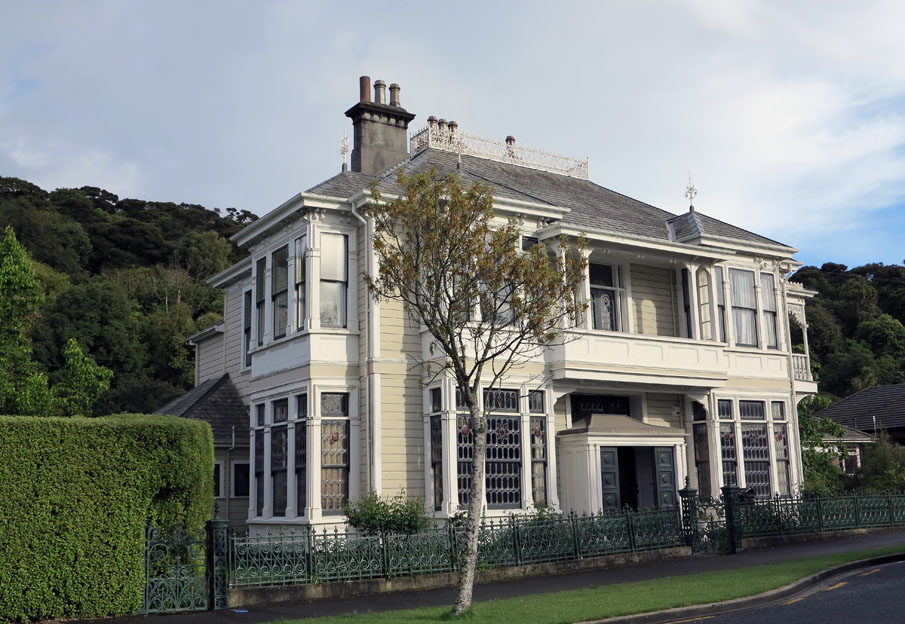
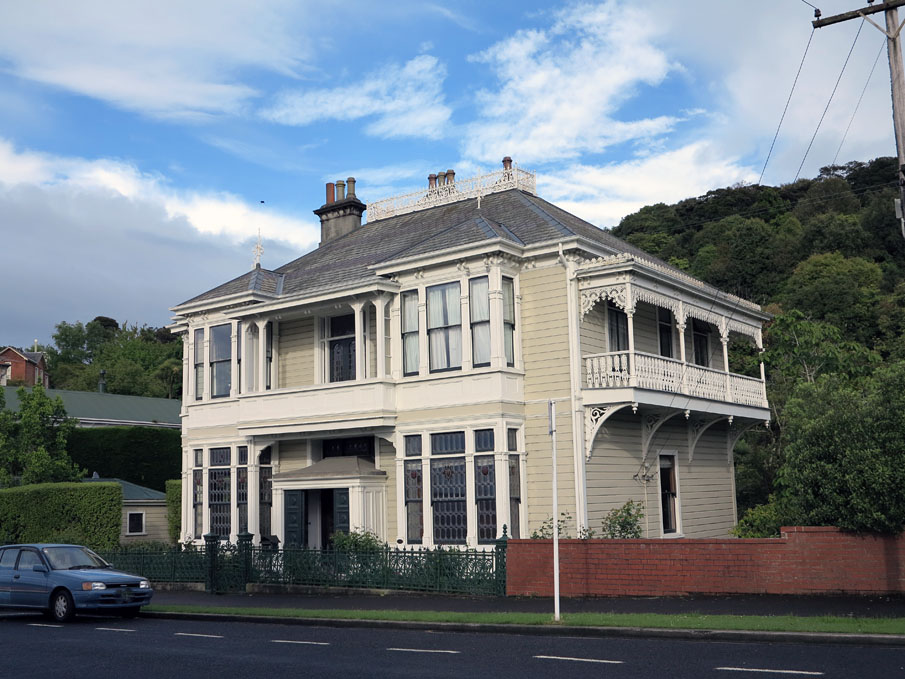
‘Daisy Bank’ was a two-storeyed symmetrical building with a large basement. Built of concrete and wood, it echoed a number of Burnside’s other elegant residential designs. The Italianate exterior, popular in the late-nineteenth century, included a colonial flavour with the north-facing balcony projecting from the first floor. The northern wing of the house was added after the erection of the original building and prior to renovations in 1925-1926. These may have occurred after 1901 when Hudson bought section 24 or following Richard senior’s death in 1903 when ownership was transferred to Richard junior.
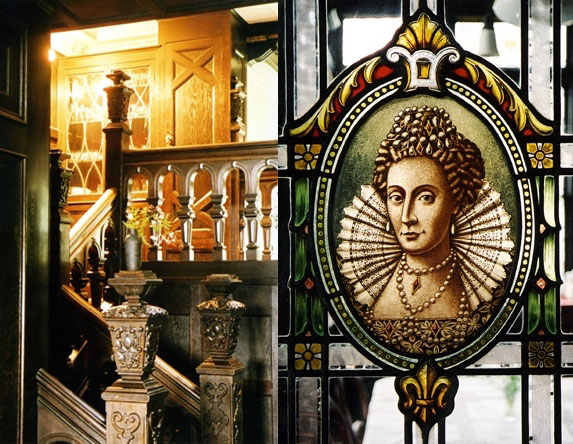
Architect Eric Miller redesigned the ground floor rooms between 1925 and 1926. The main stair was rehung; a small sitting room and entrance porch were erected; the staircase, entrance hall, sitting room and dining room were lined with darkly stained timber panelling featuring richly carved woodwork. Multi-paned leaded sash windows were installed in the dining room, living room, sitting room, and landings, and decorative glass doors were hung between the hall and dining and living rooms.
The rooms are arranged around a central open staircase which rises from the entrance hall. On the ground floor the entrance hall is flanked by the large living room, which extends the length of the house, and the dining room with a decorative fireplace and floor to ceiling wood panelling. There is a small sitting room at the end of the hall. The panelling in the hall, dining and sitting rooms creates a Tudoresque feel, further enhanced by the leadlight windows with their heraldic motifs. The first floor contains four bedrooms and a bathroom.
Further significant alterations were made between 1959 and 1967. These included the addition of a lean-to, a first floor sunroom, and a reconfiguration of the service areas. The current owners renovated the house so as to remedy some of the mid-twentieth century alterations.
The elegant home of Richard Hudson, Daisy Bank, is architecturally, historically and socially significant for its association with the prominent Hudson family and noted architects J.A. Burnside and Eric Miller. It is an example of the wealth and entrepreneurism which established Dunedin as an early commercial centre.
List Entry Information
Status
Listed
List Entry Status
Historic Place Category 1
Access
Private/No Public Access
List Number
4920
Date Entered
14th February 1991
Date of Effect
14th February 1991
City/District Council
Dunedin City
Region
Otago Region
Extent of List Entry
Extent includes the land described as Sec 24A, Sect 25 and Pt Sect 24 Block XIX Town of Dunedin (OT 295/187), Otago Land District and the building known as Daisy Bank thereon, and its fixtures and fittings.
Legal description
Sec 24A, Sec 25 and Pt Sec 24 Blk XIX Town of Dunedin (RT OT 295/187),Otago Land District
Status
Listed
List Entry Status
Historic Place Category 1
Access
Private/No Public Access
List Number
4920
Date Entered
14th February 1991
Date of Effect
14th February 1991
City/District Council
Dunedin City
Region
Otago Region
Extent of List Entry
Extent includes the land described as Sec 24A, Sect 25 and Pt Sect 24 Block XIX Town of Dunedin (OT 295/187), Otago Land District and the building known as Daisy Bank thereon, and its fixtures and fittings.
Legal description
Sec 24A, Sec 25 and Pt Sec 24 Blk XIX Town of Dunedin (RT OT 295/187),Otago Land District
Why is this place significant?
Historic Significance
Historical Significance or Value This historic place was registered under the Historic Places Act 1980. This report includes the text from the original Building Classification Committee report considered by the NZHPT Board at the time of registration. The house at 12 Royal Terrace may be associated with not one, but two of Dunedin's leading families and as such it serves as a visible reminder of the leading position once enjoyed by Dunedin as the commercial capital of New Zealand.
Physical Significance
This historic place was registered under the Historic Places Act 1980. This report includes the text from the original Building Classification Committee report considered by the NZHPT Board at the time of registration. ARCHITECTURAL QUALITY: Situated in Dunedin's Pitt Street - Royal Terrace residential precinct, the Second Hudson House is a slightly unusual example of a type of dwelling which is commonly found in New Zealand's "Victorian capital". An architectural hybrid, the house nevertheless achieves a degree of unity largely because of the skill with which Eric Miller rebuilt the principal ground floor rooms in the mid-1920s. The Second Hudson House may also be compared to the first, at 22 Royal Terrace, with which it bears a certain resemblance with regard to the design and composition of the principal elevation. TOWNSCAPE/LANDMARK VALUE Standing in one of Dunedin's most prestigious residential streets, the Second Hudson House has a considerable impact upon the streetscape of Royal Terrace because of the general symmetry of its principal elevation and its close proximity to the street which is emphasised by the attractive cast-iron fence bordering the footpath in front of the house.
Why is this place significant?
Historic Significance
Historical Significance or Value This historic place was registered under the Historic Places Act 1980. This report includes the text from the original Building Classification Committee report considered by the NZHPT Board at the time of registration. The house at 12 Royal Terrace may be associated with not one, but two of Dunedin's leading families and as such it serves as a visible reminder of the leading position once enjoyed by Dunedin as the commercial capital of New Zealand.
Physical Significance
This historic place was registered under the Historic Places Act 1980. This report includes the text from the original Building Classification Committee report considered by the NZHPT Board at the time of registration. ARCHITECTURAL QUALITY: Situated in Dunedin's Pitt Street - Royal Terrace residential precinct, the Second Hudson House is a slightly unusual example of a type of dwelling which is commonly found in New Zealand's "Victorian capital". An architectural hybrid, the house nevertheless achieves a degree of unity largely because of the skill with which Eric Miller rebuilt the principal ground floor rooms in the mid-1920s. The Second Hudson House may also be compared to the first, at 22 Royal Terrace, with which it bears a certain resemblance with regard to the design and composition of the principal elevation. TOWNSCAPE/LANDMARK VALUE Standing in one of Dunedin's most prestigious residential streets, the Second Hudson House has a considerable impact upon the streetscape of Royal Terrace because of the general symmetry of its principal elevation and its close proximity to the street which is emphasised by the attractive cast-iron fence bordering the footpath in front of the house.
Construction Professional
Name
Burnside, John Arthur
Type
Architect
Biography
Burnside (1856-1920) was born in Dunedin and is believed to be one of the first professional architects who were born and trained in New Zealand. He was articled to the architectural firm of Mason and Wales, remaining with them for two or three years. During this time he won important prizes for designs which he exhibited at international exhibitions. In 1880 he established his own practice at Dunedin. His buildings include Transit House (1880s), Philips Hotel (now Gresham Hotel, 1882) and the Otago Early Settlers' Museum (1908).
Construction Details
Start Year
1896
startYearCirca
Finish Year
1899
finishYearCirca
Type
Original Construction
Start Year
1901
startYearCirca
Type
Modification
Description
North wing added
Start Year
1925
Finish Year
1926
Type
Modification
Description
Interior remodelled
Start Year
1959
Finish Year
1967
Type
Modification
Description
Lean to added and interior modifications
Start Year
1990
Type
Modification
Description
House returned as much as possible to 1926 condition
Construction Materials
Concrete foundations, timber-frame with rusticated weatherboard cladding. Roof clad with two-tone slate cladding. Decorative cast iron roof cresting and balcony ornamentation.
Notable Features
Cast-iron decoration on roof, verandah and fence. Interior joinery and leadlights. Exterior glazing.
Construction Professional
Name
Burnside, John Arthur
Type
Architect
Biography
Burnside (1856-1920) was born in Dunedin and is believed to be one of the first professional architects who were born and trained in New Zealand. He was articled to the architectural firm of Mason and Wales, remaining with them for two or three years. During this time he won important prizes for designs which he exhibited at international exhibitions. In 1880 he established his own practice at Dunedin. His buildings include Transit House (1880s), Philips Hotel (now Gresham Hotel, 1882) and the Otago Early Settlers' Museum (1908).
Construction Details
Start Year
1896
startYearCirca
Finish Year
1899
finishYearCirca
Type
Original Construction
Start Year
1901
startYearCirca
Type
Modification
Description
North wing added
Start Year
1925
Finish Year
1926
Type
Modification
Description
Interior remodelled
Start Year
1959
Finish Year
1967
Type
Modification
Description
Lean to added and interior modifications
Start Year
1990
Type
Modification
Description
House returned as much as possible to 1926 condition
Construction Materials
Concrete foundations, timber-frame with rusticated weatherboard cladding. Roof clad with two-tone slate cladding. Decorative cast iron roof cresting and balcony ornamentation.
Notable Features
Cast-iron decoration on roof, verandah and fence. Interior joinery and leadlights. Exterior glazing.
This historic place was registered under the Historic Places Act 1980. This report includes the text from the original Building Classification Committee report considered by the NZHPT Board at the time of registration. ARCHITECTURAL DESCRIPTION The Second Hudson House stands on the western side of Royal Terrace roughly halfway between London and Logan Streets. A two-storeyed building with a large basement, the house stands on a sloping site and its near symmetrical facade may be viewed against the backdrop of a large garden and the town belt beyond. The exterior of the building is designed in the Italianate style which was popular in late-nineteenth century New Zealand. The major structural and decorative elements within the external composition which signal this style are the hipped roof, three-part sash windows, bracketed eaves, and rusticated weatherboards, in addition to the overall symmetry of the principal elevation. The north-facing balcony projecting from the first floor adds a distinctly colonial flavour to the external appearance of the house which has undergone a number of major alterations since it was first built. Inside the house the modifications which have been made to the building over the years are not all immediately apparent and it is not yet possible to establish a precise chronology of the alterations and additions which have been carried out. In the basement, however, which may be entered via an internal stair beneath the main staircase or through a door off the garden, it is possible to see that the original outer wall on the northern side of the house stood in line with what is now the south wall of the living room. This physical evidence, in conjunction with the plans prepared by Eric Miller, would seem to indicate that the northern wing of the house, beyond the entrance hall and first floor stair landing, was added at some time between the erection of the original building and the execution of the interior renovations designed by Miller (c.1925-26). Given the Italianate style of the house's exterior this addition may have been made by Richard Hudson immediately following his acquisition of the property. Within the house the rooms are arranged around a central open staircase which rises from the entrance hall. On the ground floor the entrance hall is flanked by the large living room, which extends the length of the house, and the dining room, which features a decorative fireplace and floor to ceiling wood panelling. The hall is terminated at the west end by the main staircase and a small sitting-room beyond. The darkly stained panelling in the hall, dining and sitting rooms creates a Tudoresque atmosphere which is further enhanced by the design of the leadlight windows which light the dining, sitting and living rooms and feature the use of heraldic motifs set within ovoid or geometric panes of glass. In keeping with the English ambience created by Eric Miller, the glass doors which open off the hall into both the living and dining rooms are inset with portraits of an Elizabethan man and woman. On the ground floor at the rear of the house an informal living room, kitchen and other service rooms reveal the additive nature of this part of the house. Similarly, on the first floor a sunroom in the south-west corner of the house is clearly a later addition. Four bedrooms and a bathroom are also located on this floor and access to these rooms is provided by two passages which open off the spacious stair landing. (d) MODIFICATIONS c.1899 (?) North wing added, entire building given Italianate exterior detailing. 1925-26 Main stair rehung, chimney from laundry copper in basement removed; small sitting room and entrance porch erected; staircase, entrance hall, sitting room and dining room lined with darkly stained timber panelling, ornamented with richly carved woodwork. Multi-paned leaded sash windows installed in dining room, living room, sitting room, and at landings; decorative glass doors hung between hall and dining and living rooms. Alterations designed by local architect, Eric Miller. 1959-67 Lean-to south side of house erected; triangular bay window south wall of dining room incorporated into extension, window from bay set into end wall of this addition. Sunroom built first floor rear. Window installed north wall of living room. False ceiling erected in east bedroom above living room. 1990 Alterations south and west elevations currently being carried out by present owners. NB: ARCHITECT/ENGINEER/DESIGNER It is not known who designed and/or built the original section of this house which was almost certainly erected before Richard Hudson purchased the property in 1899.
Historical and Associated Iwi / Hapū / Whānau
Completion Date
24th April 2012
Report Written By
Susan Irvine
Information Sources
Galer, 1981
L. Galer, Houses and Homes, Allied Press, Dunedin, 1981
Knight, H. & N. Wales, 1988
Hardwicke Knight and Niel Wales, Buildings of Dunedin: An Illustrated Architectural Guide to New Zealand's Victorian City, John McIndoe, Dunedin, 1988
Otago Daily Times
Otago Daily Times, 1 Jun 1915, p.10.
Otago Witness
Otago Witness
Other Information
A fully referenced Upgrade Report is available from the Otago/Southland Area office of NZHPT Please note that entry on the New Zealand Heritage List/Rarangi Korero identifies only the heritage values of the property concerned, and should not be construed as advice on the state of the property, or as a comment of its soundness or safety, including in regard to earthquake risk, safety in the event of fire, or insanitary conditions.
Historical and Associated Iwi / Hapū / Whānau
Completion Date
24th April 2012
Report Written By
Susan Irvine
Information Sources
Galer, 1981
L. Galer, Houses and Homes, Allied Press, Dunedin, 1981
Knight, H. & N. Wales, 1988
Hardwicke Knight and Niel Wales, Buildings of Dunedin: An Illustrated Architectural Guide to New Zealand's Victorian City, John McIndoe, Dunedin, 1988
Otago Daily Times
Otago Daily Times, 1 Jun 1915, p.10.
Otago Witness
Otago Witness
Other Information
A fully referenced Upgrade Report is available from the Otago/Southland Area office of NZHPT Please note that entry on the New Zealand Heritage List/Rarangi Korero identifies only the heritage values of the property concerned, and should not be construed as advice on the state of the property, or as a comment of its soundness or safety, including in regard to earthquake risk, safety in the event of fire, or insanitary conditions.
Current Usages
Uses: Accommodation
Specific Usage: House
Former Usages
General Usage: Accommodation
Specific Usage: House
Current Usages
Uses: Accommodation
Specific Usage: House
Former Usages
General Usage: Accommodation
Specific Usage: House
Location
Sign up to hear more
Get the latest heritage news, features and events delivered
straight to your inbox.


