

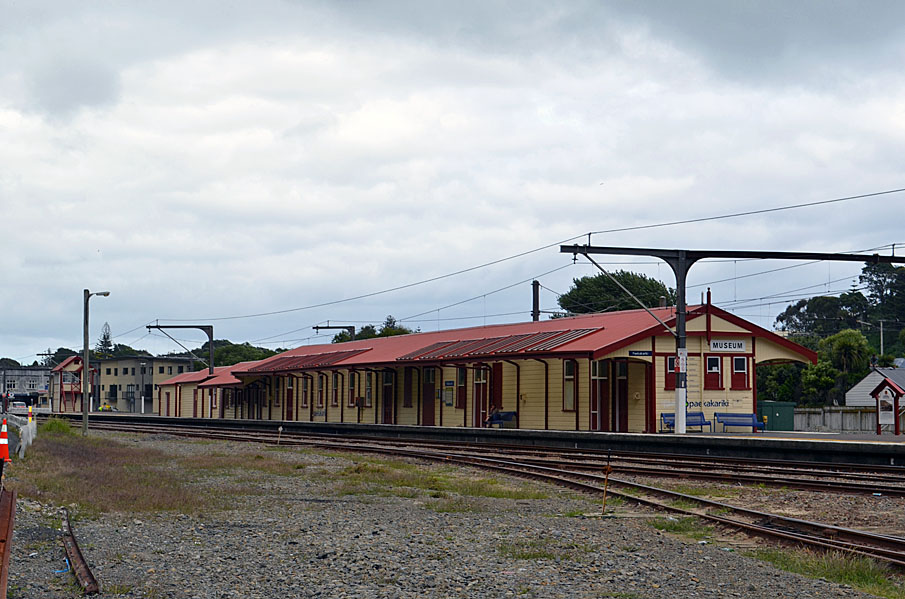
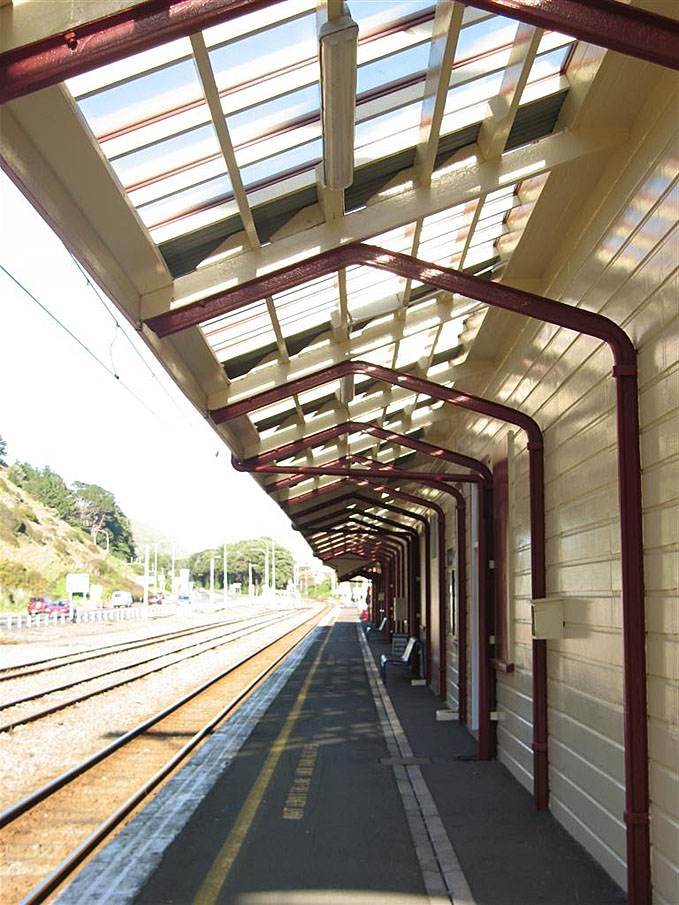
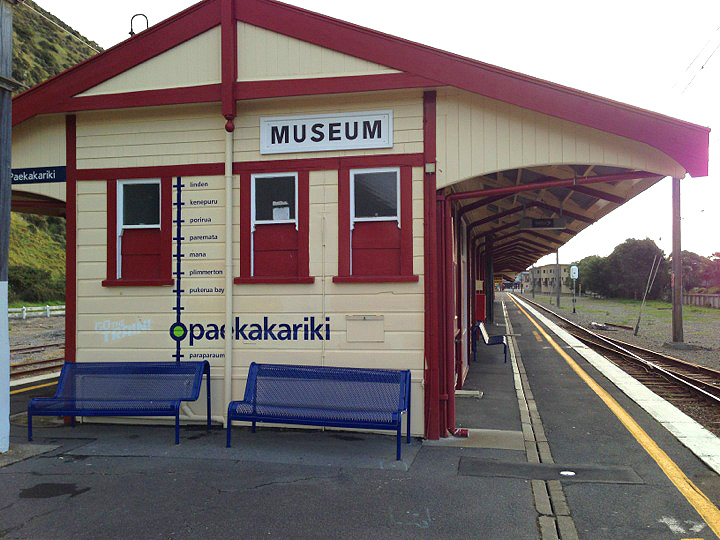
The station is a narrow building with almost identical track facades. It has a low-pitched corrugated roof and rusticated weatherboard cladding. Verandahs run almost the entire length of the main elevations. Sash-windows (now boarded up) and four-panelled doors are situated along each elevation. Internally the building has been much altered.
The Paekakariki Station is a fine example of an island station and one of the oldest extant. Its significance is also enhanced by its location within one of New Zealand's best collections of railway station structures.
List Entry Information
Status
Listed
List Entry Status
Historic Place Category 2
Access
Private/No Public Access
List Number
4959
Date Entered
29th November 1985
Date of Effect
29th November 1985
City/District Council
Kāpiti Coast District
Region
Wellington Region
Extent of List Entry
Extent includes part of the land described as Railway Land, and the building known as Paekākāriki Railway Station. Refer to the extent map tabled at the Rārangi Kōrero Committee meeting on 30 May 2024.
Legal description
Railway Land
Status
Listed
List Entry Status
Historic Place Category 2
Access
Private/No Public Access
List Number
4959
Date Entered
29th November 1985
Date of Effect
29th November 1985
City/District Council
Kāpiti Coast District
Region
Wellington Region
Extent of List Entry
Extent includes part of the land described as Railway Land, and the building known as Paekākāriki Railway Station. Refer to the extent map tabled at the Rārangi Kōrero Committee meeting on 30 May 2024.
Legal description
Railway Land
Construction Professional
Name
Troup, George Alexander
Type
Architect
Biography
G A Troup (1863-1941) was born in London in 1863 and educated in Scotland. He trained as an architect and engineer under C E Calvert of Edinburgh and came to New Zealand in 1884. After a short time with the Survey Department in Otago he became a draughtsman for New Zealand Railways in Dunedin and then, from 1888, in Wellington. Troup became Chief Draughtsman in 1894. He designed many station buildings throughout the county, some of which are still in use today; these buildings form an important part of New Zealand's landscape. His best known building is the Dunedin Railway Station (1904-07). He also designed the head office building in Wellington for Railways (1901, now demolished). Troup became a Fellow of the Royal Institute of British Architects in 1907. After World War I he was promoted to head the newly established Architectural Branch of New Zealand Railways. On retirement from Railways in 1925 he entered local body politics and was Mayor of Wellington from 1927 to 1931. Troup was prominent in the Presbyterian Church and founded the Presbyterian Young Men's Bible Class Union. He was an elder of the church for 47 years and also served on the governing bodies of several Wellington secondary schools. Education was a life-long interest and he was keenly involved in the training of engineering cadets in New Zealand Railways. Troup was knighted in 1937 and died in 1941. Last updated 1 October 2014 See also: James Veitch. 'Troup, George Alexander', Dictionary of New Zealand Biography, first published in 1993. Te Ara - the Encyclopedia of New Zealand, https://teara.govt.nz/en/biographies/2t49/troup-george-alexander
Construction Details
Start Year
1910
Type
Original Construction
Start Year
1910
Type
Addition
Description
Addition of a ladies waiting room, lobby, booking, luggage, and storeroom
Start Year
1957
Type
Other
Description
Station remodelled inside
Construction Professional
Name
Troup, George Alexander
Type
Architect
Biography
G A Troup (1863-1941) was born in London in 1863 and educated in Scotland. He trained as an architect and engineer under C E Calvert of Edinburgh and came to New Zealand in 1884. After a short time with the Survey Department in Otago he became a draughtsman for New Zealand Railways in Dunedin and then, from 1888, in Wellington. Troup became Chief Draughtsman in 1894. He designed many station buildings throughout the county, some of which are still in use today; these buildings form an important part of New Zealand's landscape. His best known building is the Dunedin Railway Station (1904-07). He also designed the head office building in Wellington for Railways (1901, now demolished). Troup became a Fellow of the Royal Institute of British Architects in 1907. After World War I he was promoted to head the newly established Architectural Branch of New Zealand Railways. On retirement from Railways in 1925 he entered local body politics and was Mayor of Wellington from 1927 to 1931. Troup was prominent in the Presbyterian Church and founded the Presbyterian Young Men's Bible Class Union. He was an elder of the church for 47 years and also served on the governing bodies of several Wellington secondary schools. Education was a life-long interest and he was keenly involved in the training of engineering cadets in New Zealand Railways. Troup was knighted in 1937 and died in 1941. Last updated 1 October 2014 See also: James Veitch. 'Troup, George Alexander', Dictionary of New Zealand Biography, first published in 1993. Te Ara - the Encyclopedia of New Zealand, https://teara.govt.nz/en/biographies/2t49/troup-george-alexander
Construction Details
Start Year
1910
Type
Original Construction
Start Year
1910
Type
Addition
Description
Addition of a ladies waiting room, lobby, booking, luggage, and storeroom
Start Year
1957
Type
Other
Description
Station remodelled inside
Historical and Associated Iwi / Hapū / Whānau
Completion Date
22nd November 2001
Report Written By
Helen McCracken
Information Sources
Cassells, 1994
K. R. Cassells, Uncommon Carrier, the history of the Wellington and Manawatu Railway Co. 1882-1908, Wellington, 1994
Churchman, 1990
Geoffrey B. Churchman and Tony Hurst, 'The Railways of New Zealand, a journey through history', Auckland, 1990
Mahoney, 1987
J. D. Mahoney, Down at the Station: A Study of the New Zealand Railway Station, Palmerston North, 1987
Other Information
This place was identified as significant under previous legislation with different information requirements. It remains significant under the current legislation. There is opportunity under our legislation and policies to add to this information. Further information about this place may be available from the Central Regional Office of Heritage New Zealand Pouhere Taonga. Please note that entry on the New Zealand Heritage List/Rarangi Korero identifies only the heritage values of the property concerned, and should not be construed as advice on the state of the property, or as a comment of its soundness or safety, including in regard to earthquake risk, safety in the event of fire, or insanitary conditions.
Historical and Associated Iwi / Hapū / Whānau
Completion Date
22nd November 2001
Report Written By
Helen McCracken
Information Sources
Cassells, 1994
K. R. Cassells, Uncommon Carrier, the history of the Wellington and Manawatu Railway Co. 1882-1908, Wellington, 1994
Churchman, 1990
Geoffrey B. Churchman and Tony Hurst, 'The Railways of New Zealand, a journey through history', Auckland, 1990
Mahoney, 1987
J. D. Mahoney, Down at the Station: A Study of the New Zealand Railway Station, Palmerston North, 1987
Other Information
This place was identified as significant under previous legislation with different information requirements. It remains significant under the current legislation. There is opportunity under our legislation and policies to add to this information. Further information about this place may be available from the Central Regional Office of Heritage New Zealand Pouhere Taonga. Please note that entry on the New Zealand Heritage List/Rarangi Korero identifies only the heritage values of the property concerned, and should not be construed as advice on the state of the property, or as a comment of its soundness or safety, including in regard to earthquake risk, safety in the event of fire, or insanitary conditions.
Current Usages
Uses: Civic Facilities
Specific Usage: Museum
Former Usages
General Usage: Transport
Specific Usage: Railway station/ platform/ refreshment room
Themes
North Island Main Trunk Line
Current Usages
Uses: Civic Facilities
Specific Usage: Museum
Former Usages
General Usage: Transport
Specific Usage: Railway station/ platform/ refreshment room
Themes
North Island Main Trunk Line
Location
Related listings
Sign up to hear more
Get the latest heritage news, features and events delivered
straight to your inbox.
