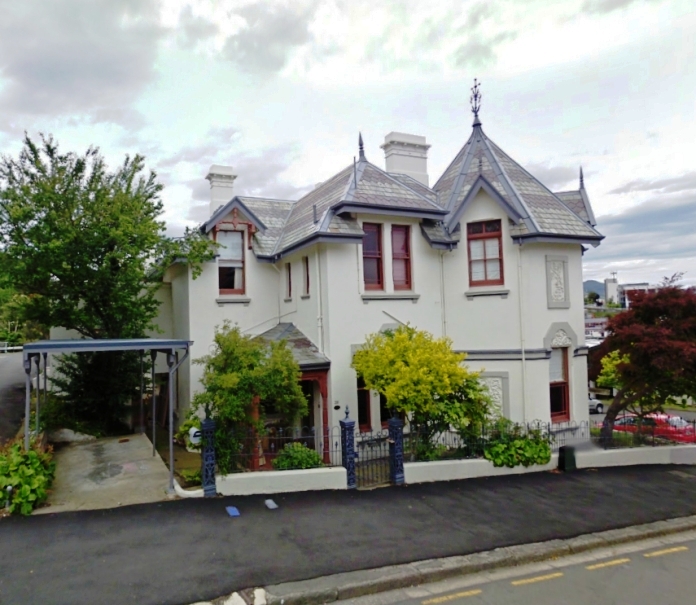
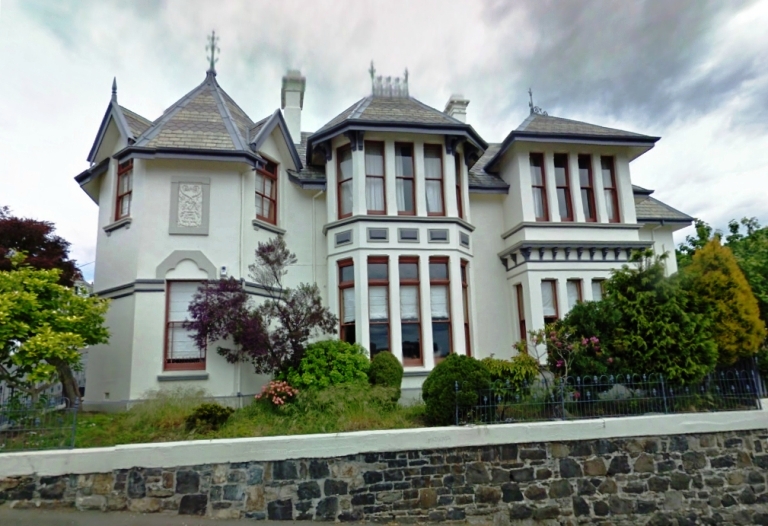
Dr Colquhoun’s Residence and Consulting Rooms, located on a prominent corner section on High Street, represent the status of medical practitioners in nineteenth century New Zealand. The house, wrapped around an earlier residence, served as both residence and consulting rooms, and has historical, architectural, aesthetic and archaeological significance.
It is likely that the first house on this section was built by Andrew Hyslop in the early 1870s. Hyslop advertised for tenders for carpentry and joinery work for cottages on High Street in 1871 – and he leased section 43 at this time. A house was on site by 1877 – an advertisement for the lease of Section 43 notes that there was a seven roomed brick cottage occupied by Mr A. Hyslop, and also a six roomed brick cottage with bathroom, scullery and outbuildings, as well as a brick factory. Hyslop was in financial trouble at this time and forced to sell the leasehold land on High and Clark Streets.
An advertisement from 1883 gives an idea of the dwelling on site, described as a ‘substantial seven-roomed brick residence’ with outbuildings. The building was occupied by Dr Lightbourne (described as ‘late of the Confederate Army, America, and who had earlier practiced from nearby Hope Street).
When Dr Colquhoun bought the property he added to the existing dwelling. Plans show a modest six room dwelling that formed the core of the substantial and grand addition. The contractor was R. Sandiland. The additions enclosed the earlier dwelling with gabled turrets, bay windows and an extra floor.
Dr Daniel Colquhoun was born and educated in Glasgow before studying medicine at Charing Cross Hospital. He came to Dunedin in 1884, where he set up practice. He also accepted the position as lecturer on the practice of medicine at the University of Otago. He was Professor of Medicine at the University of Otago and the first editor of the New Zealand Medical Journal. He was lecturer for 30 years and was a leader of medical education and practice in New Zealand. He died in Dunedin in 1933. Fellow Professor Charles Hercus wrote that Colquhoun was ‘a physician of the old school….Always faultlessly dressed, always driven by a chauffeur, always dignified and pontifical, and frequently in a minority of one in professional discussions, he was withal a most kindly person whose influence for good permeated the whole community.’
In later years the house and medical practice was sold to Dr Moody, and later still to Dr Speight. The last doctor to practice from the residence was Dr Walter Eady in the early 1960s. After Eady sold the practice it was converted to rental accommodation by Miss J. La Hood who altered the residence. After falling into disrepair, it was restored by later owners in the 1990s. In 2016 its grand past is evident in both the interior and exterior.
It is likely that the first house on this section was built by Andrew Hyslop in the early 1870s. Hyslop advertised for tenders for carpentry and joinery work for cottages on High Street in 1871 – and he leased section 43 at this time. A house was on site by 1877 – an advertisement for the lease of Section 43 notes that there was a seven roomed brick cottage occupied by Mr A. Hyslop, and also a six roomed brick cottage with bathroom, scullery and outbuildings, as well as a brick factory. Hyslop was in financial trouble at this time and forced to sell the leasehold land on High and Clark Streets.
An advertisement from 1883 gives an idea of the dwelling on site, described as a ‘substantial seven-roomed brick residence’ with outbuildings. The building was occupied by Dr Lightbourne (described as ‘late of the Confederate Army, America, and who had earlier practiced from nearby Hope Street).
When Dr Colquhoun bought the property he added to the existing dwelling. Plans show a modest six room dwelling that formed the core of the substantial and grand addition. The contractor was R. Sandiland. The additions enclosed the earlier dwelling with gabled turrets, bay windows and an extra floor.
Dr Daniel Colquhoun was born and educated in Glasgow before studying medicine at Charing Cross Hospital. He came to Dunedin in 1884, where he set up practice. He also accepted the position as lecturer on the practice of medicine at the University of Otago. He was Professor of Medicine at the University of Otago and the first editor of the New Zealand Medical Journal. He was lecturer for 30 years and was a leader of medical education and practice in New Zealand. He died in Dunedin in 1933. Fellow Professor Charles Hercus wrote that Colquhoun was ‘a physician of the old school….Always faultlessly dressed, always driven by a chauffeur, always dignified and pontifical, and frequently in a minority of one in professional discussions, he was withal a most kindly person whose influence for good permeated the whole community.’
In later years the house and medical practice was sold to Dr Moody, and later still to Dr Speight. The last doctor to practice from the residence was Dr Walter Eady in the early 1960s. After Eady sold the practice it was converted to rental accommodation by Miss J. La Hood who altered the residence. After falling into disrepair, it was restored by later owners in the 1990s. In 2016 its grand past is evident in both the interior and exterior.