Early history of the site
The land occupied by the Church and Convent of St John the Baptist is situated on high ground to the south of St Georges Bay, an inlet on the Waitemata Harbour. Prior to European colonisation, Maori occupied numerous sites beside the Harbour, and used its associated bays for transport, food-gathering and other purposes. St Georges Bay was located between Te Toangaroa (later known as Mechanics Bay) to the west, and Taurarua (Judge’s Bay) to the east. A headland pa at Taurarua is believed to have been occupied by Te Waiohua before the area was taken over by Ngati Whatua in the eighteenth century.
In September 1840, Ngati Whatua’s offer to transfer a large area of land to the British Crown for the creation of a colonial capital was formally agreed. Parnell initially developed as a separate settlement from the main centre of government at Auckland, being located to the east of the Auckland Domain and Mechanics Bay. The main thoroughfare through Parnell, the Manukau (later Parnell) Road, served as a major early overland route between Auckland and outlying villages further east and south, and became a focus for development. Early buildings erected immediately beside the road included Hulme Court (1843), the Windsor Castle Hotel (circa 1850) and several Anglican-related structures at the top of Parnell Hill such as Kinder House (1857).
The site occupied by the Church and Convent of St John the Baptist formed part of a Crown Grant that was issued in 1842 to William Porter. This was located near the top of Parnell Hill, directly adjoining Parnell Road. In 1853, the land was purchased by a notable Anglican missionary, the Reverend Robert Maunsell (1810-94), who served in several Church Missionary Society (CMS) stations after his arrival in New Zealand in 1835. He was the first minister to conduct a service in Auckland, and had also been involved in a signing of the Treaty of Waitangi at Maraetai.
In June 1858, Maunsell sold Lot 6 on the corner of Parnell Road and Denby Street to another notable clergyman, the Catholic Bishop Jean Baptiste Francois Pompallier (1801-71). The property was declared to be used for religious and educational purposes according to the dictums of the Catholic Church ‘for ever’.
Construction of the Church of St John the Baptist and the first Sisters of Mercy convent (1861)
Chosen by Rome to be the first vicar apostolic of Western Oceania, Bishop Pompallier is considered to be the founder of the Catholic Church in New Zealand. Pompallier established numerous mission stations in the North and South Islands after arriving from France in 1838, and was present at the first signing of the Treaty of Waitangi. Following the creation of Auckland as colonial capital, he established a religious centre at St Patrick’s Cathedral in Hobson Street; and with the division of the New Zealand mission into two administrations in 1848, he additionally created a headquarters in Ponsonby as first Bishop of Auckland. Early churches were established in outlying military ‘Fencible’ settlements, where the Catholic faith was strong among settler-soldier families.
Although Parnell was primarily an early centre for the Anglican church, demand for a Catholic church and other facilities is said to have emerged due partly to many of its inhabitants being military personnel. Pompallier’s purchase occurred in the same month as his departure to visit France and Rome, during which the Pope ratified his status as Bishop of Auckland. The practical task of establishing a church at Parnell is said to have been undertaken by Father Michael O’Hara (1814-99), who was later Catholic chaplain to the colonial military forces. In October 1860, three months before Pompallier’s return, a bazaar was advertised to raise funds for a church, already known as the Church of St John the Baptist in honour of the Bishop’s patron saint.
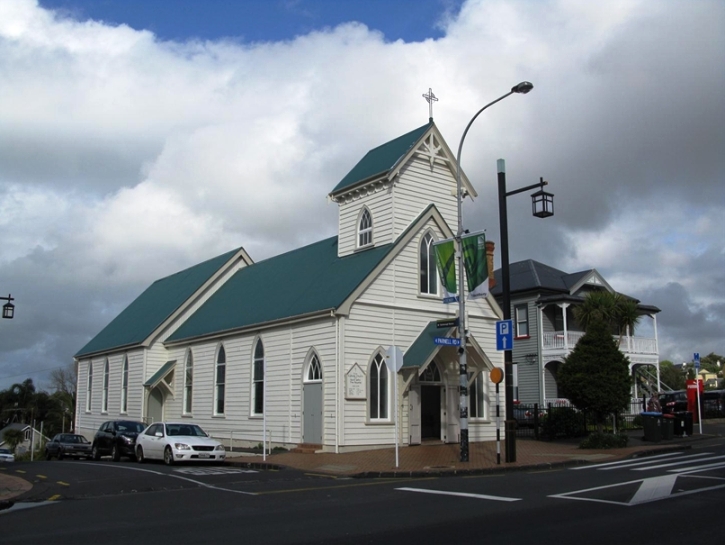
Work may have begun in 1860, the date ascribed to construction of the church in the Cyclopedia of New Zealand (1902). The building is said to have cost an estimated £600 to £700 to erect. The structure was of simple Gothic Revival design, incorporating a rectangular nave with a gabled roof, and a tower and steeple at its west end, directly adjoining Parnell Road. The interior evidently contained a choir loft above the main entrance from Parnell Road, and a sacristy may have existed at the east end of the nave.
The building was blessed by Bishop Pompallier in a ceremony held on 12 May 1861. In his response to thanks from the congregation for the erection of ‘this beautiful church’, the Bishop stated:
‘This tastefully finished church gives credit to the zeal of the Clergy and faithful. I hope and pray that it may last for many years to come as a monument of your piety, and as a place for the holy worship of God for generations to come. I fervently wish that the blessing of this church to-day, as well as the Episcopal Benediction which I am happy to impart to you, may be salutary to yourselves, your families, and posterity.’
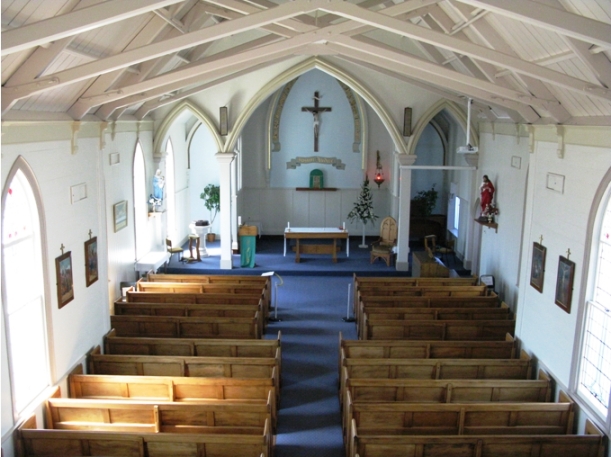
The church is generally considered to have been designed by Edward Mahoney (1824-95), who was responsible for many important religious and commercial buildings in colonial Auckland. The church contains notable features in common with subsequent examples of his work, such as scissor trusses. Along with the Church of the Immaculate Conception in Ponsonby (1858, since removed), the structure is considered to have expressed the simple Gothic Revival forms used by Mahoney before his adoption of cruciform plans and more complex designs from the mid 1860s onwards. Mahoney had arrived from Cork in 1856, and set up the noted practice of Edward Mahoney and Sons in 1876.
Initially, the Church of St John functioned as a chapel of ease attached to St Patrick’s Cathedral. Father Michael O’Hara was its priest until December 1862. During this period, the congregation raised funds to clear final debts. A ‘fancy bazaar’ held in October 1862 by the women of the congregation collected more than £400, leaving a surplus said to be for further additions.
Six months after the church was blessed, Bishop Pompallier purchased an adjoining section to the south, Lot 7, for the establishment of a convent for the Sisters of Mercy. The Sisters were the first canonically consecrated religious women to become established in New Zealand, having arrived with Pompallier from Ireland in 1850. Initially resident at St Patrick’s Cathedral, they extended to a convent adjoining Pompallier’s residence at Mount St Mary in 1853. At the time that land adjoining the Church of St John was purchased, plans were well advanced for building a new Mother Convent at Mount St Mary, which was begun in December 1861. The Order was particularly noted for their role in education and social work in early colonial Auckland, and from at least 1859 held lessons for girls in a rented cottage in Parnell.
A timber convent building was soon erected next to St John’s Church, perhaps by December 1861, the date a photograph showing the structure is believed to have been taken. Like the church, the convent appears to have adopted a simple Gothic Revival style, having traceried windows and a central entrance in its gabled front elevation. A school may have been erected to the rear. The Parnell convent was the Order’s first permanent branch house in the Auckland region, setting a precedent for subsequent establishments at Onehunga (1863), Otahuhu (1866) and Thames (1873). The three or four nuns accommodated in the convent undertook visits to the Colonial Hospital, and also conducted teaching duties for at least 100 pupils, running both a select day school and a school for the poor.
Use as a parish church (1862)
In December 1862, the Church of St John became the centre of an independent parish that encompassed Parnell, Newmarket and Remuera. For the next eleven years, the parish was run by members of the Franciscan Order, who had been recruited by Bishop Pompallier two years previously from the Ara Coeli Monastery in Rome. The Franciscans included Father Ottavio Barsanti (1825/6?-1884), who was frequently in dispute with Pompallier and eventually departed for Australia. In February 1863, the priests held a requiem mass in the church for those who lost their lives in the wreck of the HMS Orpheus, New Zealand’s worst maritime disaster.
Like the Sisters of Mercy, the priests carried out teaching duties nearby. In 1864, Barsanti purchased Lots 21 and 22 to the southeast of the church and convent. The college of St Francis of Assisium run by the Franciscan Fathers was advertised to open in January 1865. A secondary school was evidently conducted by the priests until their departure in 1873.
In 1867, Bishop Pompallier held a mass in the church for the festival of St Francis of Assisi, when the interior was described as completely filled. He left New Zealand the following year, and in 1869 formally resigned as Bishop. In 1873, the Franciscan priests also withdrew from Parnell and the Auckland Diocese. For the next fourteen years, the parish priest was Monsignor Henry Fynes (1822-87), a notable clergyman who also ran the Diocese as Vicar-General during the period between the departure of Pompallier’s successor Bishop Croke in 1874 and the arrival of Archbishop Steins in 1879, and also during a shorter interregnum in 1881-2.
During Fynes’ tenure as parish priest, further land to the south and east was procured, creating a large property owned by the Catholic Church. Acquirements included Lot 8 to the south of the convent, purchased in 1873 for use by the Sisters of Mercy. In 1875, fundraising was carried out ‘for liquidating the debt on the grounds and improvements in conjunction with the convent schools and Church of St. John the Baptist, Parnell.’ Prior to 1888, the church may have been extended a short distance westward, encompassing an enlarged porch on either side of the tower with an additional door being provided in the north side.
During the 1880s, the church continued to be the main focal point for the Catholic parish, which contained an estimated 300 members of the faith. In 1880, Archbishop Steins confirmed 50 children in the church, who had been taught by the Sisters of Mercy and Monsignor Fynes. Following his death in 1887, Monsignor Fynes lay in state in the building prior to being removed to St Patrick’s Cathedral and subsequent burial at Waikumete Cemetery. Mourning décor at St John’s was arranged by the Sisters of Mercy.
Enlargement of the church (1898) and construction of second convent building (1903)
In the 1890s and early 1900s, a considerable expansion of the religious facilities in Parnell took place. This may have been linked with a general increase in population, and the outcomes of the Second Auckland synod in 1888 which emphasised the obligations of parents to send their children to Catholic schools, as well as the need for priests to see to the religious instruction of Catholic children. Throughout the Auckland Diocese, convent schools became an increasingly normal part of Catholic life as nuns took on much of the teaching role at parish level, including the education of young boys. During the 1890s, the Sisters of Mercy expanded to Takapuna (1894), Gisborne (1894) and Devonport (1896). Their facilities in Parnell were also soon improved.
These developments occurred during the Bishopric of Bishop John Edmund Luck (1840-96) and his close colleague and successor, George Michael Lenihan (1858-1910). In 1891, Lenihan was appointed parish priest of Parnell and remained in this post until he succeeded Luck as Bishop in 1897. In 1894, repairs were carried out to the Church of St John to the value of £74. These modifications are said to have involved the removal of the spire because it was unsafe, and its subsequent replacement by a belfry.
Soon afterwards, the parishioners resolved at a meeting in ‘the Schoolchurch’ to enlarge the building ‘owing to the great want of accommodation for the people on Sundays and for the children in school during the week’. It was calculated that 100 additional seats could be accommodated by adding 11½ feet (3.5 metres) to the front and 27 feet (8.2 metres) to the back, as well as by moving the sanctuary to one side of the structure to form a sacristy and confessional. ‘Mr Mahoney’, probably Thomas Mahoney who pledged £5 for the building fund at the same meeting, undertook to submit the plans to the Bishop. Thomas Mahoney had recently become the sole successor to his father’s firm, which was renamed Edward Mahoney and Son in 1895. He continued the practice’s tradition of designing and supervising many Catholic buildings in the Diocese. Respecting the earlier design, the nave extension was erected in a similar style to the existing building, but was slightly taller and wider.
The enlarged church was dedicated by Bishop Lenihan in October 1898. Part of the cost of £550 was raised by annual fetes held by the Hibernian Society. The parish priest, Father Joseph Kehoe also collected £100 in the parish. In the following year, Kehoe commissioned a large fresco painting on the east internal wall of the church from a German-born artist, Wilhelm Dittmer (1868-1909). Dittmer had painted and worked at the Grand Opera House in Vienna, as well as in Germany and France in the late 1880s and 1890s. During his seven years in New Zealand, he became particularly noted for his depictions of Maori, and has since been considered ‘the only European artist in the colonial period whose style…was notably affected by his study of Maori art.’ In 1900, a Baptismal font commemorating the first officiating priest, Father Michael O’Hara, was also presented.
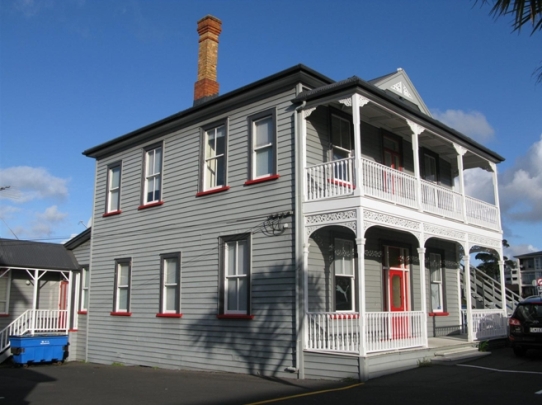
Other major alterations included demolition of the first convent and its replacement by a grander structure on Lot 8, immediately to the south of the earlier building. Costing £640, this consisted of a two-storey timber structure with a prominent double-storey balcony. Its use of a symmetrical frontage with a front verandah and central pediment may have retained visual references to the Sisters’ Mother Convent at Mount St Mary. The new building was designed by the firm of Edward Mahoney and Son, and was opened in March 1903 by Bishop Lenihan. At this time many considered it to be ‘one of the most useful houses of the Order…There are 10 large rooms, four on the basement, and six on the second storey. On the basement are the reception, community and refectory rooms, while the nuns’ cells are situated upstairs.’
The ground floor plan adopted a cruciform hallway, with one of its halls leading to a secondary entrance on the north elevation, which allowed access to the south side of the church. Unlike the first convent, the new structure appears not to have had a chapel when erected. Rather, the Sisters used the relocated sanctuary on the south side of the church as a private choir, where they heard Mass and said Office. The new convent was erected by contractor, George Pollard.
Other contemporary changes on the broader site owned by the Catholic authorities included the construction of a Presbytery for £722. Expansion of the associated school at the rear to a design by Edward Mahoney and Son subsequently occurred in 1922. Three cottages owned by the Church between the Presbytery and Convent are also said to have been removed at a similar time.
Subsequent use and alterations
In 1931, Bishop James Liston (1881-1976) celebrated the 70th anniversary of the church with a high mass in the building. It was noted that earlier in the same year the sanctuary had been beautified, ‘through the generosity and kindness of one or two of the present time Parishioners’. The modifications included new Gothic arches, columns and pelmets. Altar rails were also added. These emphasised the importance of the sanctuary in the existing liturgical order.
Numerous events linked with the birth, marriage and deaths of parishioners have been commemorated inside the church. Marriages include that of the noted weaver Sybil Mary Mulvany (1899-1983) in 1935.
Shifts in the relationship between the Sisters and the church appear to have occurred by 1943, when modifications to the convent building included a rear extension to accommodate a chapel. The kitchen was also enlarged. At this time, the ground floor of the convent incorporated a sitting room and music room at the front of the building, and the chapel and a dining room at the rear. Nuns often carried out music lessons to generate additional income. The kitchen and an attached laundry were accommodated in lean-to’s adjoining the dining room. The alterations were designed by J. O. Owen.
In 1952, the Sisters at the convent continued to educate almost one hundred Catholic children. In 1964, however, the Sisters of Mercy withdrew from Parnell after more than a century of occupation of the site. The school at the rear of church and convent was closed. The convent was subsequently occupied by the Catholic Education Centre, when some elements linked with conventual use were removed including the side porch and a dining room chimney. In 1978, a single-storey staff room and office were added at the rear.
Changes to the church during a similar period included the creation of a forward altar, reflecting liturgical reforms introduced in the 1960s. A lean-to enclosing a confessional on the south side of the nave was also added. In the 1980s, a crying room was formed under the choir loft, and an additional entrance was created in the east wall for access to a car park. In 1997, a major restoration project was carried out, during which paintings of angels were discovered beneath panelling in the entrance porch. More recently, major landscaping on the wider site owned by the Catholic Church occurred, including the removal of school buildings to the north of the church and convent to create an extensive car park. In-ground archaeological features were uncovered.
The convent building has since been tenanted as a commercial office. The church remains in regular use for Catholic worship, a function that it has carried out for more than 150 years.