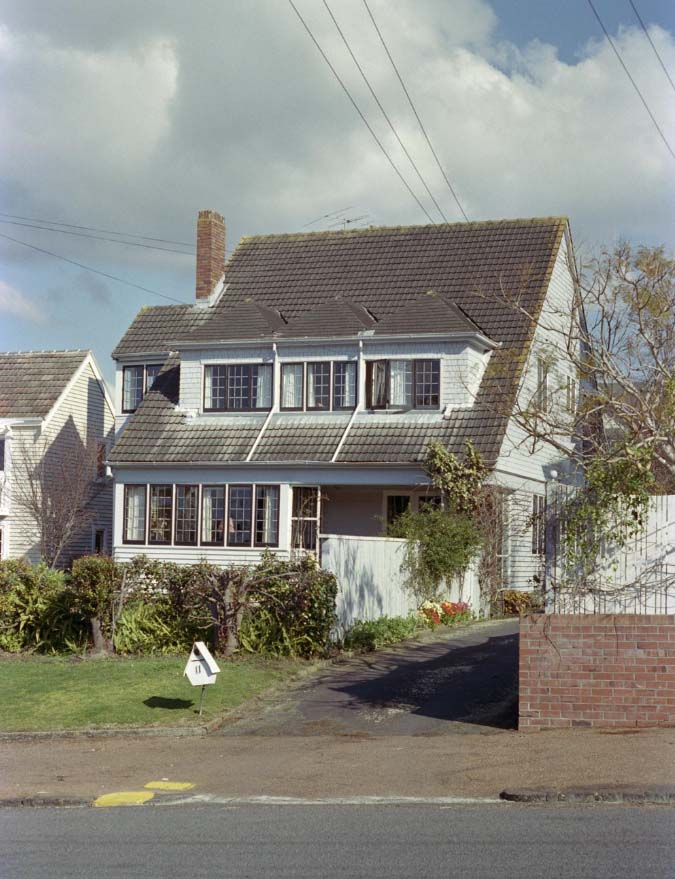
The little-altered Binney House was built in 1935 to an Arts and Crafts design by notable Auckland architect William Bloomfield. Located in the fashionable inner-city Auckland suburb of Parnell, the two-storey timber and shingle-style residence was erected for woolbroker and auctioneer, Edwin Heselden Binney, and his wife Mary. The couple had previously lived next door, in a house designed seven years earlier by a different architect but with a similar appearance (Heard House (Former); List No.4930, Category 2 historic place). Both residences are notable for their close connections with the wealthy Binney family, who had a significant influence on the domestic architecture of Remuera and Parnell, and particularly demonstrate the family’s support of the Arts and Crafts style. Binney House is also significant in its own right as a design by William Swanson Read Bloomfield (1885-1968) of Ngati Kahungunu, considered likely to be the first person of Maori descent to attend architecture school and practice as an architect; and for its later associations with the important New Zealand artist, Don Binney (1940-2012).
The land on which Binney House was built was subdivided from a larger section purchased by the Binney family in 1928. Edwin’s brother the architect Roy Binney had, prior to leaving Auckland in the mid-1920s to settle overseas, designed a large number of Arts and Crafts style houses before and after the First World War, several of which were commissioned by his mother Mary and his brothers and sister. Edwin Binney (1865-1947), an auctioneer and wool broker by profession and his wife Mary Eleanor Gertrude Binney (1878-1948) had obtained plans from Horace Massey, of the architectural partnership Tole and Massey to design their residence at Heard House, where they lived from 1928 until the new Bloomfield design was built in 1935 by the contractor W. Brownlee. The Binneys’ move to their new house occurred after the couple’s son Gordon had married, and shortly before Edwin’s retirement in 1936.
Although better known for his commercial work, William Bloomfield had designed a number of houses in the early phase of his career before it was disrupted by the Great Depression of the 1930s. The Awatea Road residence would have been one of his first designs as the country began to emerge from this major recession. Bloomfield’s work was soon interrupted again by the Second World War (1939-45). However, he returned to domestic architecture in the 1950s, designing a considerable number of houses.
Like the adjoining Heard House, the main distinctive feature of Bloomfield’s design for the Binney House is its Marseille tile roof which oversails to form a verandah below, with a long dormer with a balcony inset into the roof on the first floor; in this case the dormer is formed by three small gables, and the verandah is glassed in. On the ground floor, behind a verandah and sunroom, was a living room stretching the entire width of the house. The remainder of the ground floor was taken up with a dining room and hall. At the rear, a one-storey area contained a kitchen, maid’s rooms and laundry. Upstairs were three bedrooms. Notably, an addition to the Heard House - the small projecting sun porch off one of the bedrooms on the first floor - was replicated in this house as part of the original design. A garage was erected at the rear.
Edwin Binney died in 1947, and Mary a year later, but the family has retained the house, with very few alterations, for more than 80 years. Between 1972 and 2012, the property was owned by the important New Zealand artist, Donald Hall Binney, who also occupied the residence for an extended period. Noted for some of the country’s most distinctive landscape and wildlife paintings, Don Binney was awarded an Order of the British Empire for services to the arts in 1995.
In 2015, Binney House remained in private residential use.
The land on which Binney House was built was subdivided from a larger section purchased by the Binney family in 1928. Edwin’s brother the architect Roy Binney had, prior to leaving Auckland in the mid-1920s to settle overseas, designed a large number of Arts and Crafts style houses before and after the First World War, several of which were commissioned by his mother Mary and his brothers and sister. Edwin Binney (1865-1947), an auctioneer and wool broker by profession and his wife Mary Eleanor Gertrude Binney (1878-1948) had obtained plans from Horace Massey, of the architectural partnership Tole and Massey to design their residence at Heard House, where they lived from 1928 until the new Bloomfield design was built in 1935 by the contractor W. Brownlee. The Binneys’ move to their new house occurred after the couple’s son Gordon had married, and shortly before Edwin’s retirement in 1936.
Although better known for his commercial work, William Bloomfield had designed a number of houses in the early phase of his career before it was disrupted by the Great Depression of the 1930s. The Awatea Road residence would have been one of his first designs as the country began to emerge from this major recession. Bloomfield’s work was soon interrupted again by the Second World War (1939-45). However, he returned to domestic architecture in the 1950s, designing a considerable number of houses.
Like the adjoining Heard House, the main distinctive feature of Bloomfield’s design for the Binney House is its Marseille tile roof which oversails to form a verandah below, with a long dormer with a balcony inset into the roof on the first floor; in this case the dormer is formed by three small gables, and the verandah is glassed in. On the ground floor, behind a verandah and sunroom, was a living room stretching the entire width of the house. The remainder of the ground floor was taken up with a dining room and hall. At the rear, a one-storey area contained a kitchen, maid’s rooms and laundry. Upstairs were three bedrooms. Notably, an addition to the Heard House - the small projecting sun porch off one of the bedrooms on the first floor - was replicated in this house as part of the original design. A garage was erected at the rear.
Edwin Binney died in 1947, and Mary a year later, but the family has retained the house, with very few alterations, for more than 80 years. Between 1972 and 2012, the property was owned by the important New Zealand artist, Donald Hall Binney, who also occupied the residence for an extended period. Noted for some of the country’s most distinctive landscape and wildlife paintings, Don Binney was awarded an Order of the British Empire for services to the arts in 1995.
In 2015, Binney House remained in private residential use.