

The Institute was originally founded under the will of William Leys, a bookbinder and property owner, who died in 1899, and was significantly added to by his brother, Thomson Wilson Leys, with the Auckland Council providing the site. The Institute library contained a reference and lending library on the ground floor, and a recreation room, lecture hall and meeting room on the upper storey. These spaces were widely used and the building became the parent body for a large number of cultural, music and hobby organisations, many of which took the name of the Institute.
The Auckland Public Library had been established in 1880; the Leys Institute library was effectively its first branch library, but was managed by a separate management committee, including members of the Leys family, until 1964 when it was incorporated into the Auckland library system. Thomson Leys was the first President of the Institute, donated thousands of books, spearheaded the introduction of the children’s library in 1908, and set up a building fund. The family’s involvement continued with his son, newspaper editor Sir Cecil Leys, and members of subsequent generations. Donations of money and books also came from other members of the community.
In 1909 a new room for the lending department was added to the side, and in 1922 further additions doubled the lending library space and added a basement. In 1939 a further addition to the rear was added and the basement extended. In 1958 the two-storey Hilary Leys Memorial Wing was built for the children’s library, designed by notable architectural firm of Gummer and Ford and decorated with murals by the Irish-born James Turkington a prominent artist in Auckland whose works made particular reference to New Zealand society. In the early 1960s the library led the way in educating children, and later adults, who had difficulty reading, and provided programmes for the many Polynesian families who had become part of the surrounding population. Architect John Gummer carried out a major restoration project in 1991, funded by the William Leys Trust Fund.
Throughout its history, the building has played a significant role in the community, and as the Ponsonby library, continues to do so today.
List Entry Information
Status
Listed
List Entry Status
Historic Place Category 1
Access
Private/No Public Access
List Number
613
Date Entered
26th November 1981
Date of Effect
26th November 1981
City/District Council
Auckland Council
Region
Auckland Council
Extent of List Entry
Extent includes part of the land described as Pt Allot 13 Sec 8 Suburbs of Auckland (RT NA131/205), North Auckland Land District and the building known as Leys Institute Public Library thereon
Legal description
Pt Allot 13 Sec 8 Suburbs of Auckland (RT NA131/205), North Auckland Land District
Status
Listed
List Entry Status
Historic Place Category 1
Access
Private/No Public Access
List Number
613
Date Entered
26th November 1981
Date of Effect
26th November 1981
City/District Council
Auckland Council
Region
Auckland Council
Extent of List Entry
Extent includes part of the land described as Pt Allot 13 Sec 8 Suburbs of Auckland (RT NA131/205), North Auckland Land District and the building known as Leys Institute Public Library thereon
Legal description
Pt Allot 13 Sec 8 Suburbs of Auckland (RT NA131/205), North Auckland Land District
Why is this place significant?
Historic Significance
Historical Significance or Value The Leys Institute has played a significant role in Ponsonby and Auckland history. The construction of the Institute indicates recognition of the growing boundaries of Auckland and the establishment of Ponsonby. The Institute stands as a monument to the Victorian ideals of education and self-improvement for the community and the philanthropic urge of the Victorian middle class. The history of the Leys Institute is closely linked with the Leys family. The Institute was originally founded under the will of William Leys, a bookbinder and property owner, who died in 1899. His intentions were to provide a free library and Mechanics Institute. The funds he left were inadequate and his brother, T.W. Leys, contributed half the money needed, on condition that the Auckland City Council provided the site. The Council accepted the offer and the Institute was opened in March 1905 by the Mayor, Mr E. Mitchelson. A year later a gymnasium was erected. The involvement of the Leys family did not finish there. T.W. Leys, the first President of the Institute, was succeeded by his son, Sir Cecil Leys. T.W. Leys donated his personal library which was a considerable addition to the Institute. He also set up a trust fund in memory of his wife, which eventually paid for the Hilary Leys Memorial Wing. After the death of the last surviving beneficiary of Leys will in 1965, the Estate passed to the Auckland City Council, and the Institute became a branch library of the Auckland Public Library system. The Institute's main function is as a library, but it also provides a base for various organisations. These include literary, dramatic, musical, debating games and sports clubs. The Institute acts as an important social centre.
Physical Significance
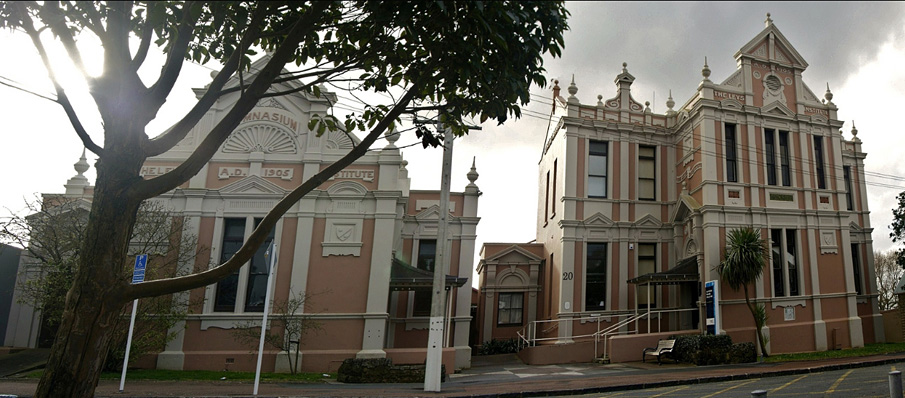
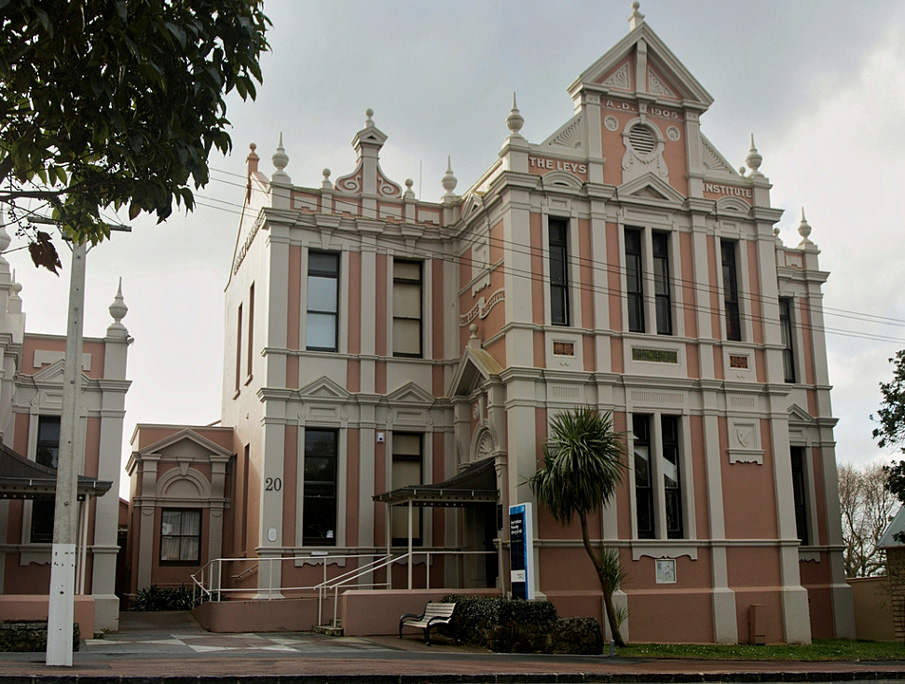
ARCHITECTURAL SIGNIFICANCE: The Leys Institute is an important example of turn of the century Edwardian Baroque architecture, of which there are few examples in Auckland. At this time numerous types of buildings for which there was no set precedent or architectural style were being built. Many of these buildings fulfilled a civic function such as town halls, libraries, police and fire stations. In its earlier phase the architecture was characterised by the use of a elaborate and picturesque skyline. The style changed rapidly to a form more influenced by the Beaux Arts tradition. This period of rapid change is apparent when the Leys Institute and the nearby Ponsonby Post Office (1911) are compared. The Leys Institute is one of several public library buildings in Auckland, each designed at a different time and in a different style. Collectively they are a record of changing philosophies of architectural design and style for such buildings. TOWNSCAPE/LANDMARK SIGNIFICANCE: The intersection is a historic corner of which the library, together with Post Office, Fire Station and public toilet, is a key building. Collectively they form a good streetscape facade.
Why is this place significant?
Historic Significance
Historical Significance or Value The Leys Institute has played a significant role in Ponsonby and Auckland history. The construction of the Institute indicates recognition of the growing boundaries of Auckland and the establishment of Ponsonby. The Institute stands as a monument to the Victorian ideals of education and self-improvement for the community and the philanthropic urge of the Victorian middle class. The history of the Leys Institute is closely linked with the Leys family. The Institute was originally founded under the will of William Leys, a bookbinder and property owner, who died in 1899. His intentions were to provide a free library and Mechanics Institute. The funds he left were inadequate and his brother, T.W. Leys, contributed half the money needed, on condition that the Auckland City Council provided the site. The Council accepted the offer and the Institute was opened in March 1905 by the Mayor, Mr E. Mitchelson. A year later a gymnasium was erected. The involvement of the Leys family did not finish there. T.W. Leys, the first President of the Institute, was succeeded by his son, Sir Cecil Leys. T.W. Leys donated his personal library which was a considerable addition to the Institute. He also set up a trust fund in memory of his wife, which eventually paid for the Hilary Leys Memorial Wing. After the death of the last surviving beneficiary of Leys will in 1965, the Estate passed to the Auckland City Council, and the Institute became a branch library of the Auckland Public Library system. The Institute's main function is as a library, but it also provides a base for various organisations. These include literary, dramatic, musical, debating games and sports clubs. The Institute acts as an important social centre.
Physical Significance
ARCHITECTURAL SIGNIFICANCE: The Leys Institute is an important example of turn of the century Edwardian Baroque architecture, of which there are few examples in Auckland. At this time numerous types of buildings for which there was no set precedent or architectural style were being built. Many of these buildings fulfilled a civic function such as town halls, libraries, police and fire stations. In its earlier phase the architecture was characterised by the use of a elaborate and picturesque skyline. The style changed rapidly to a form more influenced by the Beaux Arts tradition. This period of rapid change is apparent when the Leys Institute and the nearby Ponsonby Post Office (1911) are compared. The Leys Institute is one of several public library buildings in Auckland, each designed at a different time and in a different style. Collectively they are a record of changing philosophies of architectural design and style for such buildings. TOWNSCAPE/LANDMARK SIGNIFICANCE: The intersection is a historic corner of which the library, together with Post Office, Fire Station and public toilet, is a key building. Collectively they form a good streetscape facade.
Construction Professional
Name
Watt, Robert Martin
Type
Architect
Biography
Watt (1860-1907) was born in Scotland and studied architecture in Glasgow with the firm of Barclay Bros. He immigrated to New Zealand about 1878 for health reasons and practised in Auckland both on his own account and, from about 1892, with John Mitchell (c.1859-1947). Mitchell and Watt were appointed architects to the Auckland Education Board in 1892 and while Mitchell undertook new work, Watt was responsible for rebuilding projects and renovations to existing buildings. In 1960 Watt was elected president of the Auckland branch of the New Zealand Institute of Architects. Watt was responsible for the design of the Ley's Institute, Ponsonby (1905-06), and the partnership of Mitchell and Watt was responsible for schools at Te Mata (1905) and Maungatautari (1905), additions to schools at Cambridge (1900) and Dargaville (1905), the Seddon Memorial Technical College (1903-13), and Mt Eden Congregational Church (1900).
Name
W Jones and Son
Type
Builder
Biography
No biography is currently available for this construction professional
Construction Details
Start Year
1905
Type
Original Construction
Description
Institute Built
Start Year
1909
Type
Modification
Description
A new lending department added
Start Year
1927
Type
Modification
Description
Offices altered and additional toilets added. New wireless workshop
Start Year
1939
Type
Modification
Description
Demolition of existing partitions in the lending department Extensive enlargement and remodelling of interior
Start Year
1958
Type
Modification
Description
Hilary Leys Memorial Wing added
Start Year
1922
Type
Modification
Description
Alterations made, designed by Grierson and Aimer, doubling the lending library space, and installing a basement
Type
Modification
Description
Garden developed to the rear of the building at the entrance of the children’s library, and a mural by Murray Grimsdale added.
Period
1980s
Start Year
1991
Type
Modification
Description
Restoration project, including installation of lift
Start Year
2007
Type
Modification
Description
Courtyard area in front of the two buildings developed
Construction Materials
Brick, plastered. Timber framing. Roof timber-framed with metal trusses.
Notable Features
The distinctive facade
Construction Professional
Name
Watt, Robert Martin
Type
Architect
Biography
Watt (1860-1907) was born in Scotland and studied architecture in Glasgow with the firm of Barclay Bros. He immigrated to New Zealand about 1878 for health reasons and practised in Auckland both on his own account and, from about 1892, with John Mitchell (c.1859-1947). Mitchell and Watt were appointed architects to the Auckland Education Board in 1892 and while Mitchell undertook new work, Watt was responsible for rebuilding projects and renovations to existing buildings. In 1960 Watt was elected president of the Auckland branch of the New Zealand Institute of Architects. Watt was responsible for the design of the Ley's Institute, Ponsonby (1905-06), and the partnership of Mitchell and Watt was responsible for schools at Te Mata (1905) and Maungatautari (1905), additions to schools at Cambridge (1900) and Dargaville (1905), the Seddon Memorial Technical College (1903-13), and Mt Eden Congregational Church (1900).
Name
W Jones and Son
Type
Builder
Biography
No biography is currently available for this construction professional
Construction Details
Start Year
1905
Type
Original Construction
Description
Institute Built
Start Year
1909
Type
Modification
Description
A new lending department added
Start Year
1927
Type
Modification
Description
Offices altered and additional toilets added. New wireless workshop
Start Year
1939
Type
Modification
Description
Demolition of existing partitions in the lending department Extensive enlargement and remodelling of interior
Start Year
1958
Type
Modification
Description
Hilary Leys Memorial Wing added
Start Year
1922
Type
Modification
Description
Alterations made, designed by Grierson and Aimer, doubling the lending library space, and installing a basement
Type
Modification
Description
Garden developed to the rear of the building at the entrance of the children’s library, and a mural by Murray Grimsdale added.
Period
1980s
Start Year
1991
Type
Modification
Description
Restoration project, including installation of lift
Start Year
2007
Type
Modification
Description
Courtyard area in front of the two buildings developed
Construction Materials
Brick, plastered. Timber framing. Roof timber-framed with metal trusses.
Notable Features
The distinctive facade
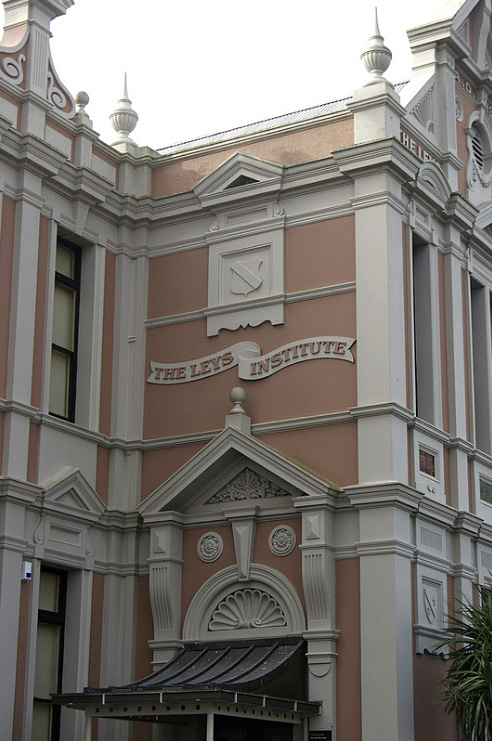
ARCHITECTURAL DESCRIPTION (STYLE): The Leys Institute consists of two buildings which are both Baroque in style. One building (the Institute) is two storeys in height, and the other (the Gymnasium) is one storey high. The facades of both buildings have elongated proportions. Bays of narrow windows are separated by pilasters which culminate in finials. Two of the pilasters on the Institute building culminate in pediments and are flanked by volutes resembling Dutch gables. The central three bay portions of both buildings are stepped forward and have pedimented gables. The window sills and leads are linked by string courses in which the beds of the pediments above the windows are incorporated. MODIFICATIONS: 1908 - A new lending department added 1927 - Offices altered and additional toilets added New wireless workshop 1939 - Demolition of existing partitions in the lending department Extensive enlargement and remodelling of interior 1957 - Hilary Leys Memorial Wing added
ARCHITECTURAL DESCRIPTION (STYLE): The Leys Institute consists of two buildings which are both Baroque in style. One building (the Institute) is two storeys in height, and the other (the Gymnasium) is one storey high. The facades of both buildings have elongated proportions. Bays of narrow windows are separated by pilasters which culminate in finials. Two of the pilasters on the Institute building culminate in pediments and are flanked by volutes resembling Dutch gables. The central three bay portions of both buildings are stepped forward and have pedimented gables. The window sills and leads are linked by string courses in which the beds of the pediments above the windows are incorporated. MODIFICATIONS: 1908 - A new lending department added 1927 - Offices altered and additional toilets added New wireless workshop 1939 - Demolition of existing partitions in the lending department Extensive enlargement and remodelling of interior 1957 - Hilary Leys Memorial Wing added
Historical and Associated Iwi / Hapū / Whānau
Completion Date
11th June 2015
Report Written By
Elizabeth Cox
Information Sources
Auckland Public Libraries
Auckland Public Libraries
Auckland Star
Auckland Star
Colgan, 1980
Wynne Colgan, The Governor's Gift: The Auckland Public Library 1880-1980, Auckland, 1980.
Dictionary of New Zealand Biography
Dictionary of New Zealand Biography
New Zealand Herald
New Zealand Herald, 12 July 1932, p. 6; 28 September 1933, p. 6.
New Zealand Listener
New Zealander Listener
University of Auckland
University of Auckland
Verran, 2004
David Verran, 'Mechanics' Institutes in New Zealand, and their effect on the development of library services.' Paper to LIANZA conference, September 2004
Carlyon, 2008
Jenny Carlyon and Diana Morrow, Urban Village: The Story of Ponsonby, Freemans Bay and St Mary's Bay, Auckland, 2008
Cumming, 1959
Ian Cumming, Glorious Enterprise - The History of the Auckland Education Board, 1857-1957. Christchurch 1959
Education Board
Education Board
Auckland Metro
Auckland Metro
Barr, 1950
Barr, John, Auckland Public Libraries 1880-1950, Auckland, 1950
Leys, 1908
Leys, Thomson W, Report on Municipal Libraries in Great Britain, 1908
New Zealand Libraries
New Zealand Libraries
New Zealand Libraries
New Zealand Libraries
Riding, 2001?
Ridling, Coral, One Man’s Dream: The Leys Institute and the Family who Founded It, Ponsonby U3A Publication No1, [2001?]
Anon, 1906
The Leys Institute, St Mary’s Road, Ponsonby, Auckland NZ, 1906
Other Information
Please note that entry on the New Zealand Heritage List/Rarangi Korero identifies only the heritage values of the property concerned, and should not be construed as advice on the state of the property, or as a comment of its soundness or safety, including in regard to earthquake risk, safety in the event of fire, or insanitary conditions. A fully referenced upgrade report is available on request from the Northern Region Office of Heritage New Zealand
Historical and Associated Iwi / Hapū / Whānau
Completion Date
11th June 2015
Report Written By
Elizabeth Cox
Information Sources
Auckland Public Libraries
Auckland Public Libraries
Auckland Star
Auckland Star
Colgan, 1980
Wynne Colgan, The Governor's Gift: The Auckland Public Library 1880-1980, Auckland, 1980.
Dictionary of New Zealand Biography
Dictionary of New Zealand Biography
New Zealand Herald
New Zealand Herald, 12 July 1932, p. 6; 28 September 1933, p. 6.
New Zealand Listener
New Zealander Listener
University of Auckland
University of Auckland
Verran, 2004
David Verran, 'Mechanics' Institutes in New Zealand, and their effect on the development of library services.' Paper to LIANZA conference, September 2004
Carlyon, 2008
Jenny Carlyon and Diana Morrow, Urban Village: The Story of Ponsonby, Freemans Bay and St Mary's Bay, Auckland, 2008
Cumming, 1959
Ian Cumming, Glorious Enterprise - The History of the Auckland Education Board, 1857-1957. Christchurch 1959
Education Board
Education Board
Auckland Metro
Auckland Metro
Barr, 1950
Barr, John, Auckland Public Libraries 1880-1950, Auckland, 1950
Leys, 1908
Leys, Thomson W, Report on Municipal Libraries in Great Britain, 1908
New Zealand Libraries
New Zealand Libraries
New Zealand Libraries
New Zealand Libraries
Riding, 2001?
Ridling, Coral, One Man’s Dream: The Leys Institute and the Family who Founded It, Ponsonby U3A Publication No1, [2001?]
Anon, 1906
The Leys Institute, St Mary’s Road, Ponsonby, Auckland NZ, 1906
Other Information
Please note that entry on the New Zealand Heritage List/Rarangi Korero identifies only the heritage values of the property concerned, and should not be construed as advice on the state of the property, or as a comment of its soundness or safety, including in regard to earthquake risk, safety in the event of fire, or insanitary conditions. A fully referenced upgrade report is available on request from the Northern Region Office of Heritage New Zealand
Current Usages
Uses: Civic Facilities
Specific Usage: Library
Current Usages
Uses: Civic Facilities
Specific Usage: Library
Sign up to hear more
Get the latest heritage news, features and events delivered
straight to your inbox.
