

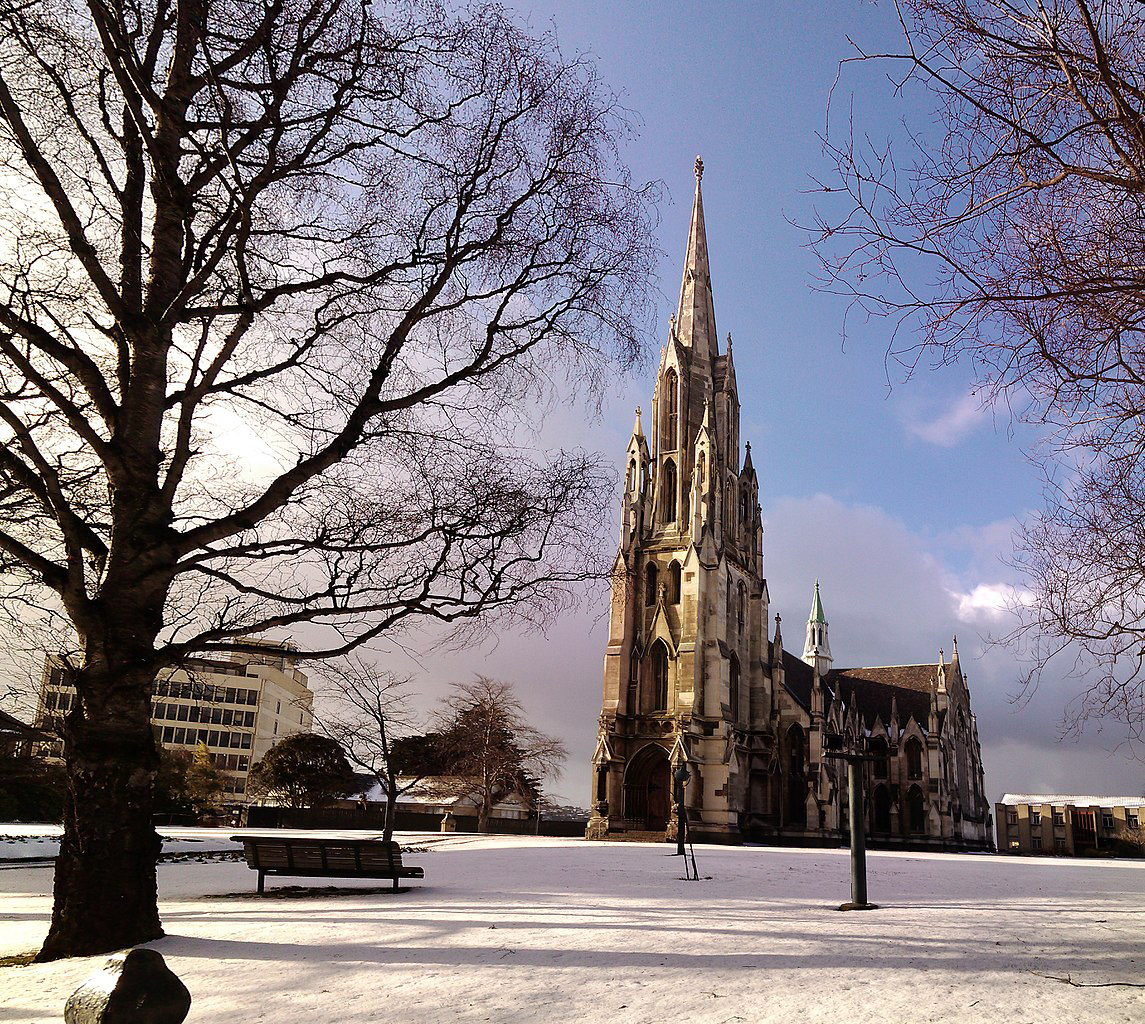
The centrepiece of the area is First Church, set in spacious grounds on the corner of Moray Place. The general area was originally a sizeable hill overlooking central Dunedin. It had been designated as a Church Reserve in 1848 soon after the establishment of the predominantly Presbyterian Otago settlement. The hill became known as Bell Hill from 1851 after the fine bell which hung in the hilltop belfry.
Bell Hill was something of an obstruction to the development of Dunedin and from 1858 the Provincial Council cut away portions of it. In 1862 the decision was made to quarry the hill away in earnest, largely to provide fill for harbour reclamations. The site was virtually levelled except for a platform, left for the church to sit on at the suggestion of its architect R. A. Lawson who had won the competition for its design.
The foundation stone of the Church was laid in 1868 by the first Presbyterian Minister, Dr Thomas Burns, one of the founders of the Otago settlement. It was opened in 1873.
Burlington Street which descends steeply from Moray Place towards the harbour contains several buildings of architectural and historical interest.
List Entry Information
Status
Listed
List Entry Status
Historic Area
Access
Private/No Public Access
List Number
7072
Date Entered
16th December 1994
Date of Effect
16th December 1994
City/District Council
Dunedin City
Region
Otago Region
Extent of List Entry
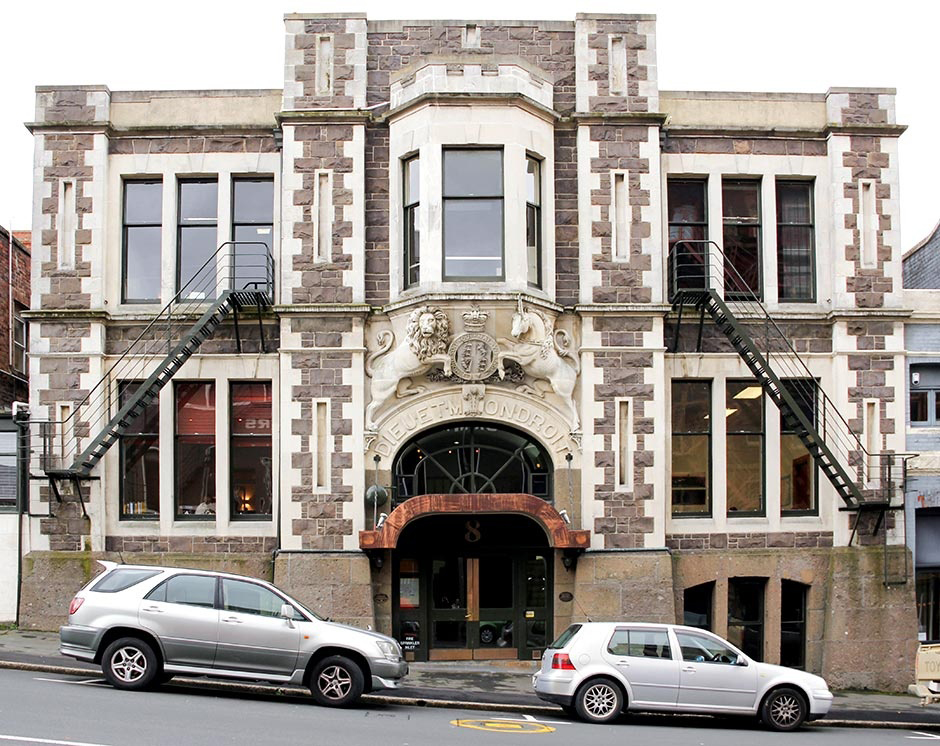
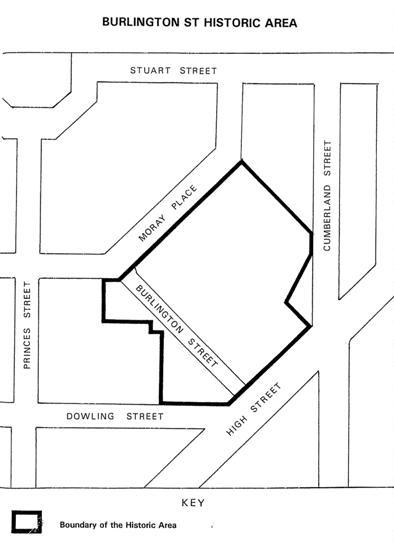
The area comprises Burlington St between High St and Moray Place. It includes First Church; Burns Hall; Commerce Building; RSA Building; and Garrison Hall.
Status
Listed
List Entry Status
Historic Area
Access
Private/No Public Access
List Number
7072
Date Entered
16th December 1994
Date of Effect
16th December 1994
City/District Council
Dunedin City
Region
Otago Region
Extent of List Entry
The area comprises Burlington St between High St and Moray Place. It includes First Church; Burns Hall; Commerce Building; RSA Building; and Garrison Hall.
Why is this place significant?
Cultural Significance
Spiritual: The site on which the First Church stands today was designated as a Church Reserve in 1848 soon after the establishment of the predominantly Presbyterian Otago settlement. The building has spiritual significance to Dunedin's Presbyterians and its presence contributes strongly to the character of the city.
Historic Significance
Historical Significance or Value Historical: This historic area has historical significance in being the remaining aspects of Bell Hill, an early area of building and development of Dunedin City. One of Dunedin's most significant buildings, First Church, is a striking reminder of the Presbyterian settlement of Otago. The other buildings in the area also have strong links to Dunedin's history. Of special interest is Burlington Street's association with the Otago Daily Times and Witness Company which is one of New Zealand's most historic newspapers.
Physical Significance
Architectural: The buildings in Burlington Street cover a wide range of ages and architectural styles, from First Church built in 1868 through to Burns Hall (1906) and the RSA building of the 1920's. First Church was designed by R.A Lawson who later became one of the most prestigious architects in Otago. Among his other designs were Otago Boys High School and the ANZ building in Princes Street. Burlington Street is the centre of the area which was originally Bell Hill, and is an early area of building and development of Dunedin City. Burlington Street (originally named MacAndrew Street) makes an important contribution to the townscape of central Dunedin, descending steeply from Moray Place towards the harbour. The centrepiece of this area is First Church, a fine example of Gothic Revival architecture. The church, its grounds and the other historic buildings that line Burlington Street have great aesthetic appeal as well as architectural and historical links to Dunedin's colonial past. Aesthetic: The grounds and the mature trees of First Church form a pleasant open space and the vista along the steeply descending street to Queens Gardens on High Street has special aesthetic appeal. The rock embankments and stone walls of such buildings as the Garrison Hall, along the side of the street, combine with the trees to form an important streetscape in the central city.
Why is this place significant?
Cultural Significance
Spiritual: The site on which the First Church stands today was designated as a Church Reserve in 1848 soon after the establishment of the predominantly Presbyterian Otago settlement. The building has spiritual significance to Dunedin's Presbyterians and its presence contributes strongly to the character of the city.
Historic Significance
Historical Significance or Value Historical: This historic area has historical significance in being the remaining aspects of Bell Hill, an early area of building and development of Dunedin City. One of Dunedin's most significant buildings, First Church, is a striking reminder of the Presbyterian settlement of Otago. The other buildings in the area also have strong links to Dunedin's history. Of special interest is Burlington Street's association with the Otago Daily Times and Witness Company which is one of New Zealand's most historic newspapers.
Physical Significance
Architectural: The buildings in Burlington Street cover a wide range of ages and architectural styles, from First Church built in 1868 through to Burns Hall (1906) and the RSA building of the 1920's. First Church was designed by R.A Lawson who later became one of the most prestigious architects in Otago. Among his other designs were Otago Boys High School and the ANZ building in Princes Street. Burlington Street is the centre of the area which was originally Bell Hill, and is an early area of building and development of Dunedin City. Burlington Street (originally named MacAndrew Street) makes an important contribution to the townscape of central Dunedin, descending steeply from Moray Place towards the harbour. The centrepiece of this area is First Church, a fine example of Gothic Revival architecture. The church, its grounds and the other historic buildings that line Burlington Street have great aesthetic appeal as well as architectural and historical links to Dunedin's colonial past. Aesthetic: The grounds and the mature trees of First Church form a pleasant open space and the vista along the steeply descending street to Queens Gardens on High Street has special aesthetic appeal. The rock embankments and stone walls of such buildings as the Garrison Hall, along the side of the street, combine with the trees to form an important streetscape in the central city.
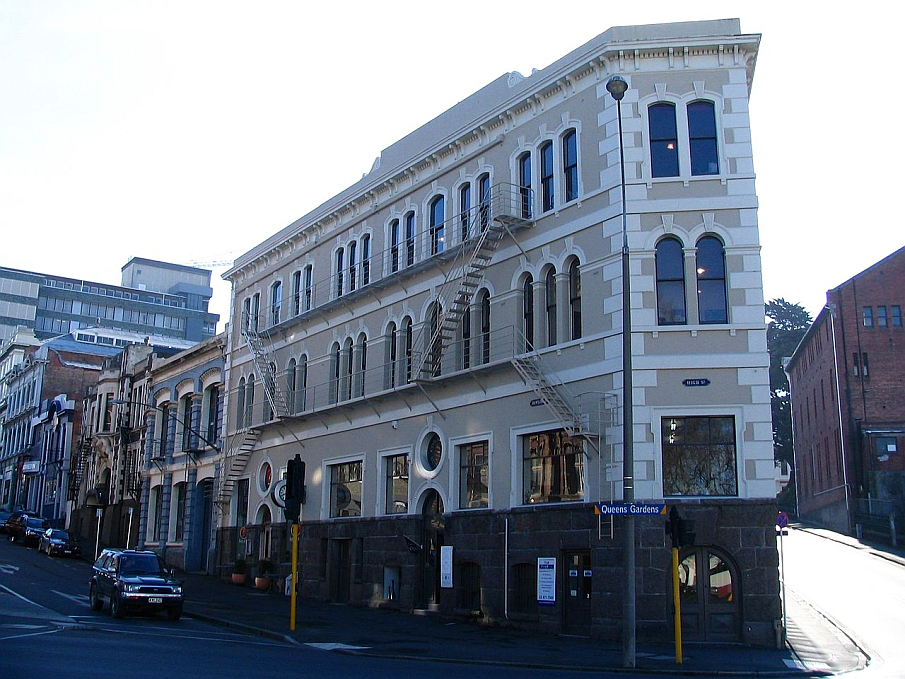
DESCRIPTION OF BOUNDARY: All of Burlington Street between Moray Place and High Street. Buildings on the northern side of High Street between Burlington and Cumberland Streets are also included. STRUCTURES: First Church - Category I Architect: R.A. Lawson Gothic Revival, 1868-73 Brick construction faced with Oamaru Stone, Welsh slate roof Features: tower & spire that reach fifty four metres above the main entrance, fine carved stonework done by Master stonemason Louis Godfrey and sons Widely regarded as being the finest piece of Gothic Revival architecture in New Zealand Burns Hall, Burlington St (First Church Grounds) Architect: J.L.Salmond 1906 Features: plain & unpretentious, facade is distinguished by a centrally stepped gable Named after Dr Thomas Burns RSA Hall, Burlington St/Moray Pl Architect: W.H. Dunning Builder: Fletcher Construction 1920 Originally known as the Soldiers Memorial Hall Garrison Hall, between Burlington/Dowling St - Category II Architect: N.Y.A. Wales 1872 Bluestone construction with Oamaru stone detail (first portion) Features: twin towers and parapet (Dowling St facade) The hall was erected to serve as the Army Volunteers Drill Hall and has since been used as the Chief Post Office and TVNZ Dunedin studio Commerce Building, Burlington St - Category II Architect: Frederick Hardy 1878 Three storey, single storey extension 1887 (extended to three storey 1894) Features: designed to fill angled corner made by the intersection with Dowling St The Otago Daily Times started its long running association with Burlington St when it moved into the building in 1879
DESCRIPTION OF BOUNDARY: All of Burlington Street between Moray Place and High Street. Buildings on the northern side of High Street between Burlington and Cumberland Streets are also included. STRUCTURES: First Church - Category I Architect: R.A. Lawson Gothic Revival, 1868-73 Brick construction faced with Oamaru Stone, Welsh slate roof Features: tower & spire that reach fifty four metres above the main entrance, fine carved stonework done by Master stonemason Louis Godfrey and sons Widely regarded as being the finest piece of Gothic Revival architecture in New Zealand Burns Hall, Burlington St (First Church Grounds) Architect: J.L.Salmond 1906 Features: plain & unpretentious, facade is distinguished by a centrally stepped gable Named after Dr Thomas Burns RSA Hall, Burlington St/Moray Pl Architect: W.H. Dunning Builder: Fletcher Construction 1920 Originally known as the Soldiers Memorial Hall Garrison Hall, between Burlington/Dowling St - Category II Architect: N.Y.A. Wales 1872 Bluestone construction with Oamaru stone detail (first portion) Features: twin towers and parapet (Dowling St facade) The hall was erected to serve as the Army Volunteers Drill Hall and has since been used as the Chief Post Office and TVNZ Dunedin studio Commerce Building, Burlington St - Category II Architect: Frederick Hardy 1878 Three storey, single storey extension 1887 (extended to three storey 1894) Features: designed to fill angled corner made by the intersection with Dowling St The Otago Daily Times started its long running association with Burlington St when it moved into the building in 1879
Historical and Associated Iwi / Hapū / Whānau
Other Information
This historic place was registered under the Historic Places Act 1993. This report includes text from the original Proposal for Registration considered by the NZHPT Board at the time of registration. Please note that entry on the New Zealand Heritage List/Rarangi Korero identifies only the heritage values of the property concerned, and should not be construed as advice on the state of the property, or as a comment of its soundness or safety, including in regard to earthquake risk, safety in the event of fire, or insanitary conditions.
Historical and Associated Iwi / Hapū / Whānau
Other Information
This historic place was registered under the Historic Places Act 1993. This report includes text from the original Proposal for Registration considered by the NZHPT Board at the time of registration. Please note that entry on the New Zealand Heritage List/Rarangi Korero identifies only the heritage values of the property concerned, and should not be construed as advice on the state of the property, or as a comment of its soundness or safety, including in regard to earthquake risk, safety in the event of fire, or insanitary conditions.
Location
Sign up to hear more
Get the latest heritage news, features and events delivered
straight to your inbox.
