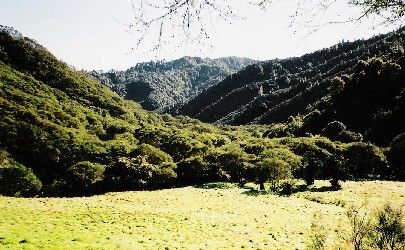
In 1917 the New Zealand government opened up Mangapurua Valley for settlement by servicemen returning from the World War I. Virgin forest was cleared and 35 farms were established. Initially the valley prospered but access remained a problem and following persistent requests for improved access by the residents the government agreed to erect a bridge across the Mangapurua Stream. The bridge was designed by the Public Works Department in October 1933. Construction of the bridge started in January 1935. Concrete was mixed by hand and the reinforcing steel was bent and cut on site. Construction was completed in June 1936. A swing bridge, built in 1919 and located c40 metres upstream, fell into disrepair from this time.
Economic hardship, inaccessibility and erosion resulted in farmers abandoning their farms. By 1942 only three families remained and they were forced to leave as the government closed the valley in May that year. The disappearing roads and fence lines, and the Mangapurua Bridge, are all that remain of this ill fated government settlement. The bridge is a destination for pedestrian traffic only.
In 1993 the Department of Conservation has been undertaking a concrete investigation costing in the vicinity of $10 000 and plan to spend $30 000 - $40 000 on concrete repairs in 1994. Rust has appeared in some places where the reinforcing steel has been exposed.
List Entry Information
Status
Listed
List Entry Status
Historic Place Category 1
Access
Private/No Public Access
List Number
7168
Date Entered
21st April 1994
Date of Effect
21st April 1994
City/District Council
Ruapehu District
Region
Horizons (Manawatū-Whanganui) Region
Extent of List Entry
Extent includes part of the land described as Legal River; Sec 2 SO 36194 (NZ Gazette, 1991, p.3134); Sec 3 Blk IX Whirinaki SD (NZ Gazette 1986, p.5062, p.5067), Wellington Land District, and the structure known as Mangapurua Bridge / Bridge to Nowhere thereon. Refer to the map tabled at the Rārangi Kōrero Committee meeting on 30 January 2025.
Legal description
Legal River; Sec 2 SO 36194 (NZ Gazette, 1991, p.3134); Sec 3 Blk IX Whirinaki SD (NZ Gazette 1986, p.5062, p.5067), Wellington Land District.
Status
Listed
List Entry Status
Historic Place Category 1
Access
Private/No Public Access
List Number
7168
Date Entered
21st April 1994
Date of Effect
21st April 1994
City/District Council
Ruapehu District
Region
Horizons (Manawatū-Whanganui) Region
Extent of List Entry
Extent includes part of the land described as Legal River; Sec 2 SO 36194 (NZ Gazette, 1991, p.3134); Sec 3 Blk IX Whirinaki SD (NZ Gazette 1986, p.5062, p.5067), Wellington Land District, and the structure known as Mangapurua Bridge / Bridge to Nowhere thereon. Refer to the map tabled at the Rārangi Kōrero Committee meeting on 30 January 2025.
Legal description
Legal River; Sec 2 SO 36194 (NZ Gazette, 1991, p.3134); Sec 3 Blk IX Whirinaki SD (NZ Gazette 1986, p.5062, p.5067), Wellington Land District.
Why is this place significant?
Historic Significance
Historical Significance or Value Contrasting the overall success of the resettlement programme for World War I veterans, the Mangapurua Settlement is notorious as a failure. With its reinforced concrete construction, Mangapurua Bridge is very much an enduring symbol of this failed settlement. The failure of the settlement does not diminish the importance of the bridge but rather adds to its renown. Mangapurua Bridge is relatively well-known throughout the Wanganui region, and has been chosen as the dominant feature in the Whanganui National Park logo. Located within this national park and with native bush surrounds, the bridge reflects the change in attitude from using to conserving New Zealand's natural resources.
Physical Significance
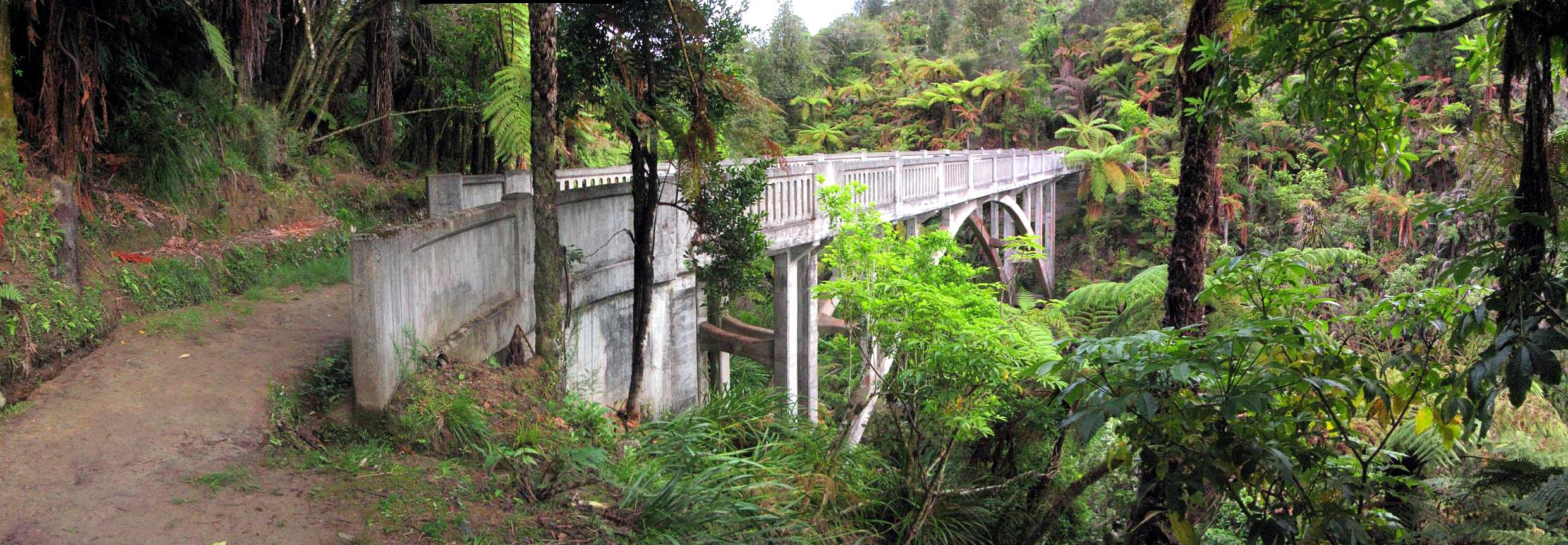
ARCHITECTURAL QUALITY: Mangapurua Bridge is a Public Works Department bridge and is a typical example of its genre, that of the arched reinforced concrete bridge. Bridges such as this were built throughout New Zealand. TOWNSCAPE/LANDMARK VALUE: As a result of its scale and reinforced concrete construction, Mangapurua Bridge is the most significant man-made structure in Whanganui National Park. It is almost engulfed by its native bush surrounds and appears somewhat incongruous. Other man-made structures such as roads and fence lines are disappearing.
Why is this place significant?
Historic Significance
Historical Significance or Value Contrasting the overall success of the resettlement programme for World War I veterans, the Mangapurua Settlement is notorious as a failure. With its reinforced concrete construction, Mangapurua Bridge is very much an enduring symbol of this failed settlement. The failure of the settlement does not diminish the importance of the bridge but rather adds to its renown. Mangapurua Bridge is relatively well-known throughout the Wanganui region, and has been chosen as the dominant feature in the Whanganui National Park logo. Located within this national park and with native bush surrounds, the bridge reflects the change in attitude from using to conserving New Zealand's natural resources.
Physical Significance
ARCHITECTURAL QUALITY: Mangapurua Bridge is a Public Works Department bridge and is a typical example of its genre, that of the arched reinforced concrete bridge. Bridges such as this were built throughout New Zealand. TOWNSCAPE/LANDMARK VALUE: As a result of its scale and reinforced concrete construction, Mangapurua Bridge is the most significant man-made structure in Whanganui National Park. It is almost engulfed by its native bush surrounds and appears somewhat incongruous. Other man-made structures such as roads and fence lines are disappearing.
Construction Professional
Name
Public Works Department
Type
Engineer
Biography
No biography is currently available for this construction professional
Name
Public Works Department
Type
Architect
Biography
No biography is currently available for this construction professional
Name
Public Works Department
Type
Architect
Biography
No biography is currently available for this construction professional
Name
Public Works Department
Type
Engineer
Biography
No biography is currently available for this construction professional
Name
Sandford and Brown, Builders, Raetihi
Type
Builder
Biography
Sandford and Brown, Builders, was a Raetihi firm, and one well known in the Waimarino. In addition to constructing the Mangapurua Bridge, they also built the Raetihi Bridge over the Makotuku, the County Council offices, several houses in the district and extensions to Waimarino Hospital.
Construction Details
Start Year
1935
Type
Original Construction
Construction Materials
Mangapurua Bridge is an arched bridge constructed of reinforced concrete.
Notable Features
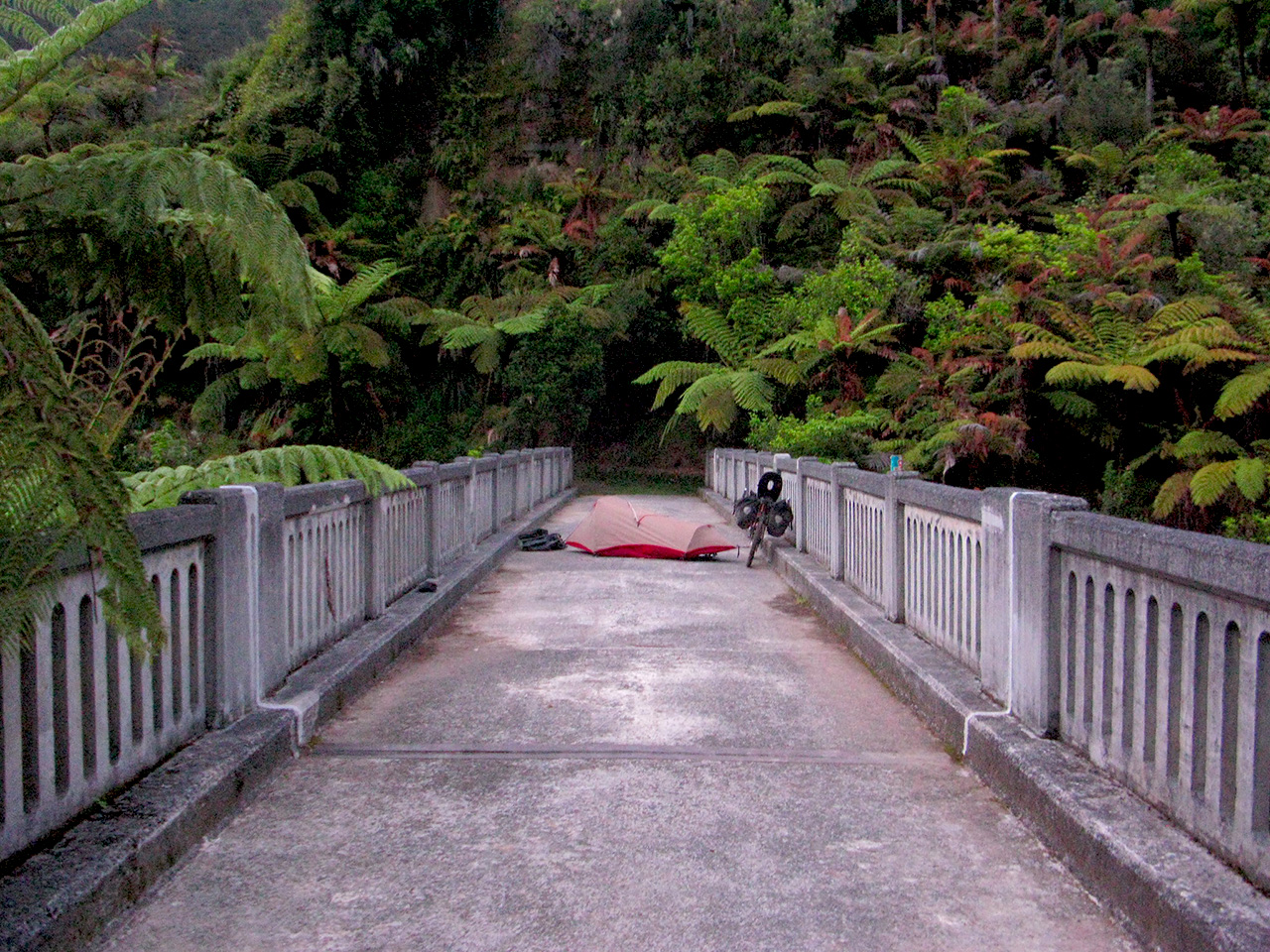
The bridge is capable of carrying vehicular traffic, of which there is none.
Construction Professional
Name
Public Works Department
Type
Engineer
Biography
No biography is currently available for this construction professional
Name
Public Works Department
Type
Architect
Biography
No biography is currently available for this construction professional
Name
Public Works Department
Type
Architect
Biography
No biography is currently available for this construction professional
Name
Public Works Department
Type
Engineer
Biography
No biography is currently available for this construction professional
Name
Sandford and Brown, Builders, Raetihi
Type
Builder
Biography
Sandford and Brown, Builders, was a Raetihi firm, and one well known in the Waimarino. In addition to constructing the Mangapurua Bridge, they also built the Raetihi Bridge over the Makotuku, the County Council offices, several houses in the district and extensions to Waimarino Hospital.
Construction Details
Start Year
1935
Type
Original Construction
Construction Materials
Mangapurua Bridge is an arched bridge constructed of reinforced concrete.
Notable Features
The bridge is capable of carrying vehicular traffic, of which there is none.
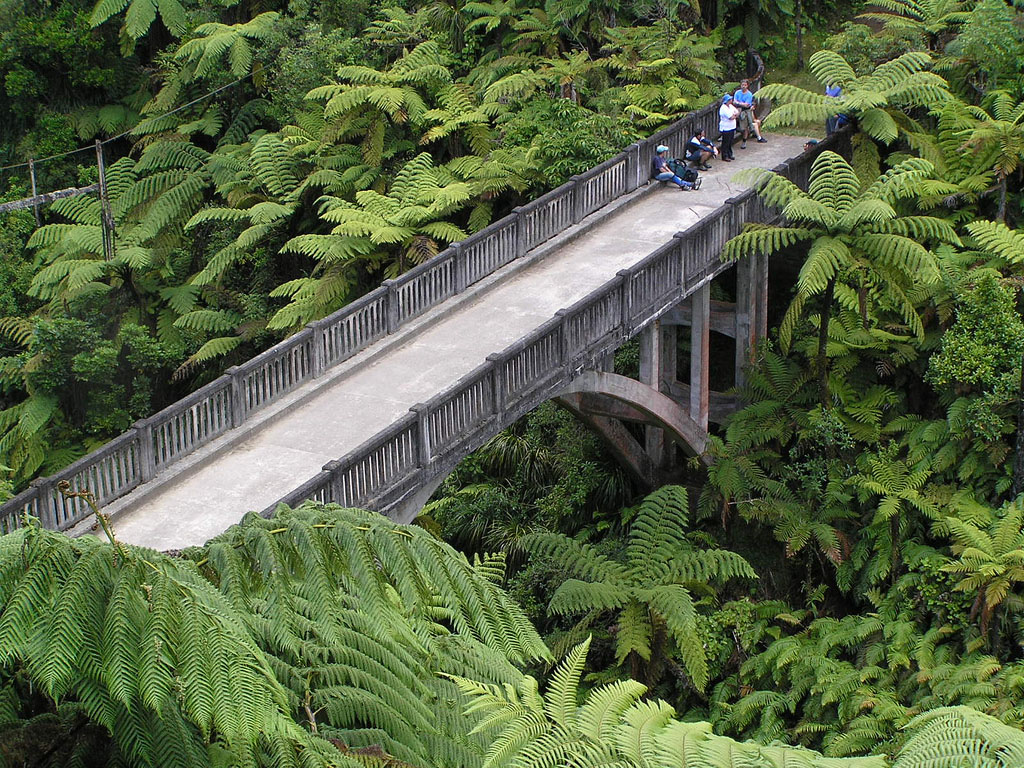
ARCHITECTURAL DESCRIPTION: Mangapurua Bridge is a simply supported arched bridge constructed of reinforced concrete. Approximately 40 metres long, the carraigeway is attached to the crown of the arch and is supported on upright members attached to the haunch of the arch. At either end of the carraigeway is a pier. The bridge is about 36.6 metres above the Mangapurua Stream and has a concrete balustrade on either side. MODIFICATIONS: Nil. The Department of Conservation plans to undertake concrete repairs in 1994.
ARCHITECTURAL DESCRIPTION: Mangapurua Bridge is a simply supported arched bridge constructed of reinforced concrete. Approximately 40 metres long, the carraigeway is attached to the crown of the arch and is supported on upright members attached to the haunch of the arch. At either end of the carraigeway is a pier. The bridge is about 36.6 metres above the Mangapurua Stream and has a concrete balustrade on either side. MODIFICATIONS: Nil. The Department of Conservation plans to undertake concrete repairs in 1994.
Historical and Associated Iwi / Hapū / Whānau
Completion Date
26th November 1993
Information Sources
Allen, 1984
Elizabeth Allen, In the Hills of the Waimarino: the Human Story of the Development of the District, Wanganui: Wanganui Newspapers Ltd, 1984.
Wanganui Chronicle
Wanganui Chronicle
Bates, 1981
Arthur Bates, The Bridge to Nowhere, The Ill Fated Mangapurua Settlement, Wanganui Newspapers, 1981
Lay, 1992
M G Lay, Ways of the World, A History of the World's Roads and of the Vehicles That Used Them, Rutgers University Press, New Brunswick, New Jersey, 1992
Other Information
A registration report is available from the NZHPT Central region office. Please note that entry on the New Zealand Heritage List/Rarangi Korero identifies only the heritage values of the property concerned, and should not be construed as advice on the state of the property, or as a comment of its soundness or safety, including in regard to earthquake risk, safety in the event of fire, or insanitary conditions.
Historical and Associated Iwi / Hapū / Whānau
Completion Date
26th November 1993
Information Sources
Allen, 1984
Elizabeth Allen, In the Hills of the Waimarino: the Human Story of the Development of the District, Wanganui: Wanganui Newspapers Ltd, 1984.
Wanganui Chronicle
Wanganui Chronicle
Bates, 1981
Arthur Bates, The Bridge to Nowhere, The Ill Fated Mangapurua Settlement, Wanganui Newspapers, 1981
Lay, 1992
M G Lay, Ways of the World, A History of the World's Roads and of the Vehicles That Used Them, Rutgers University Press, New Brunswick, New Jersey, 1992
Other Information
A registration report is available from the NZHPT Central region office. Please note that entry on the New Zealand Heritage List/Rarangi Korero identifies only the heritage values of the property concerned, and should not be construed as advice on the state of the property, or as a comment of its soundness or safety, including in regard to earthquake risk, safety in the event of fire, or insanitary conditions.
Current Usages
Uses: Transport
Specific Usage: Bridge/ Viaduct
Former Usages
General Usage: Transport
Specific Usage: Bridge/ Viaduct
Current Usages
Uses: Transport
Specific Usage: Bridge/ Viaduct
Former Usages
General Usage: Transport
Specific Usage: Bridge/ Viaduct