Quick links


Quick links
Quick links
Quick links
Quick links
Quick links
Moorhouse Railway Tunnel
Christchurch-Lyttelton line, LYTTELTON
Private
Historic Place Category 1
List No. 7172
Quick links:
List GalleryLocationDetails
Christchurch-Lyttelton line, LYTTELTON
Private
Historic Place Category 1
List No. 7172
List Entry Information
Status
Listed
List Entry Status
Historic Place Category 1
Access
Private/No Public Access
List Number
7172
Date Entered
21st April 1994
Date of Effect
21st April 1994
City/District Council
Christchurch City
Region
Canterbury Region
Status
Listed
List Entry Status
Historic Place Category 1
Access
Private/No Public Access
List Number
7172
Date Entered
21st April 1994
Date of Effect
21st April 1994
City/District Council
Christchurch City
Region
Canterbury Region
Why is this place significant?
Historic Significance
Historical Significance or Value The Moorhouse Railway Tunnel has historical significance as a result of its contribution to the commercial development of Canterbury through transport. It linked the pastoral plains with the provincial port within the first 20 years of Canterbury settlement and in doing so allowed produce to be exported. While the initiative for building the tunnel was provincial, the Christchurch-Lyttelton railway line has been described as the first important railway in the country (JD Mahoney). The line predates New Zealand's great railway expansion of the 1870s under Julius Vogel. The tunnel is arguably the single most important structure on the line other than the line itself. The tunnel has additional significance in that it was conceived and projected by WS Moorhouse, Canterbury's provincial superintendent, and associated with Edward Dobson, Julius von Haast and Edward Richardson. Today it is maintained by New Zealand Rail Ltd. It is still in use and is essential to the owners operation.
Physical Significance
ARCHITECTURAL QUALITY: Moorhouse Railway Tunnel is a very rare structure in that it was constructed through the flank or wall of an extinct volcano. It has been suggested that it was the first tunnel in the world to do so and this technological development is of very great significance. Within its colonial climate, the Moorhouse Railway Tunnel was an ambitious piece of engineering. It has been described as the first major engineering work in New Zealand (GGT) and a remarkable engineering feat. TOWNSCAPE/LANDMARK VALUE: The tunnel ends are enhanced by the landscape setting but the tunnel itself is largely concealed within the volcano and is not a prominent landmark. It relates to the Heathcote and Lyttelton signal boxes sited at either end of the tunnel.
Why is this place significant?
Historic Significance
Historical Significance or Value The Moorhouse Railway Tunnel has historical significance as a result of its contribution to the commercial development of Canterbury through transport. It linked the pastoral plains with the provincial port within the first 20 years of Canterbury settlement and in doing so allowed produce to be exported. While the initiative for building the tunnel was provincial, the Christchurch-Lyttelton railway line has been described as the first important railway in the country (JD Mahoney). The line predates New Zealand's great railway expansion of the 1870s under Julius Vogel. The tunnel is arguably the single most important structure on the line other than the line itself. The tunnel has additional significance in that it was conceived and projected by WS Moorhouse, Canterbury's provincial superintendent, and associated with Edward Dobson, Julius von Haast and Edward Richardson. Today it is maintained by New Zealand Rail Ltd. It is still in use and is essential to the owners operation.
Physical Significance
ARCHITECTURAL QUALITY: Moorhouse Railway Tunnel is a very rare structure in that it was constructed through the flank or wall of an extinct volcano. It has been suggested that it was the first tunnel in the world to do so and this technological development is of very great significance. Within its colonial climate, the Moorhouse Railway Tunnel was an ambitious piece of engineering. It has been described as the first major engineering work in New Zealand (GGT) and a remarkable engineering feat. TOWNSCAPE/LANDMARK VALUE: The tunnel ends are enhanced by the landscape setting but the tunnel itself is largely concealed within the volcano and is not a prominent landmark. It relates to the Heathcote and Lyttelton signal boxes sited at either end of the tunnel.
Construction Professional
Name
Richardson, Edward
Type
Engineer
Biography
Edward Richardson trained as a civil engineer in London. He worked as a railway engineer in England and in Ireland and in 1852 went to Australia where he worked as a road engineer in Melboune. In 1855 he entered partnership with George Holmes as a general contractor. In 1861 Holmes and Richardson were awarded the contract for the Moorhouse Tunnel and Richardson arrived at Ferrymeade with enough material to begin the first stage of the line to Christchurch. In 1862 Richardson went to Europe to study the technology used for the Mont Cenis tunnel. He returned to Canterbury to supervise the construction and completion of the Moorhouse Tunnel. Following its completion, Richardson remained in New Zealand and became prominent as both a businessman, landowner and public figure. He was a member of the Canterbury Provincial Council for Lyttelton from 1870-76, a member of the House of Representatives for Christchurch West from 1871 and for the City of Christchurch from 1875. He was minister of public works from 1872-77 in the Waterhouse, Fox, Vogel, Pollen and Atkinson governments, and again from 1884-87 when he was ranked third in parliament below Robert Stout and Julius Vogel. He remained on the Legislative Council until his retirement in 1899. He had been appointed CMG in 1879.
Name
Dobson, Edward
Type
Engineer
Biography
Edward Dobson trained in architecture and civil engineering in London and from 1846-49 worked as a railway engineer near Nottingham. He was one of the original purchasers of land under the Canterbury Association, immigrating in 1850 and settling in Canterbury. In 1854 he was appointed provincial engineer for Canterbury. In this capacity, Dobson superintended the Moorhouse Raiway Tunnel. In 1864 he decided on the main route for a road to be built from Christchurch to the West Coast goldfields. The route had been discovered earlier that year by his son Arthur, an engineer, surveyor, geologist and explorer, and continues to be known as Arthur's Pass (1864-66). Edward also drained low-lying land at Rangiora and is said to have reclaimed 10 000 acres by doing so. Dobson resigned as provincial engineer in 1868 and moved to Australia the following year where he worked as an engineer for a railway compny in Melbourne and as a water supply engineer in Melbourne and in Geelong. Returning to New Zealand in 1876, he formed a partnership with his son Arthur in 1878. Dobson and Son were responsible for many engineering works between 1878 and 1885 including the upgrading of the Timaru waterworks, the supply of water to the Canterbury Plains, the surveying of a railway line through the Southern Alps, and a report on the public water supply in Christchurch (1882). He was elected a member of the Institute of Civil Engineers in 1881. Having lectured since the 1860s and written a number of engineering papers, Dobson then helped establish the School of Engineering at Canterbury College in 1887. He lectured part-time until 1892 and was the author of several engineering books.
Construction Details
Start Year
1861
Type
Original Construction
Start Year
1876
Finish Year
1877
Type
Modification
Description
Altered from 5'3" to 3'6" dual gauge
Start Year
1925
Finish Year
1928
Type
Other
Description
Electrification
Start Year
1970
startYearCirca
Type
Other
Description
Deselisation
Construction Materials
Random rubble stone construction fixed with cement and with an ashlar springer.
Notable Features
Route through the flank of an extinct volcano
Construction Professional
Name
Richardson, Edward
Type
Engineer
Biography
Edward Richardson trained as a civil engineer in London. He worked as a railway engineer in England and in Ireland and in 1852 went to Australia where he worked as a road engineer in Melboune. In 1855 he entered partnership with George Holmes as a general contractor. In 1861 Holmes and Richardson were awarded the contract for the Moorhouse Tunnel and Richardson arrived at Ferrymeade with enough material to begin the first stage of the line to Christchurch. In 1862 Richardson went to Europe to study the technology used for the Mont Cenis tunnel. He returned to Canterbury to supervise the construction and completion of the Moorhouse Tunnel. Following its completion, Richardson remained in New Zealand and became prominent as both a businessman, landowner and public figure. He was a member of the Canterbury Provincial Council for Lyttelton from 1870-76, a member of the House of Representatives for Christchurch West from 1871 and for the City of Christchurch from 1875. He was minister of public works from 1872-77 in the Waterhouse, Fox, Vogel, Pollen and Atkinson governments, and again from 1884-87 when he was ranked third in parliament below Robert Stout and Julius Vogel. He remained on the Legislative Council until his retirement in 1899. He had been appointed CMG in 1879.
Name
Dobson, Edward
Type
Engineer
Biography
Edward Dobson trained in architecture and civil engineering in London and from 1846-49 worked as a railway engineer near Nottingham. He was one of the original purchasers of land under the Canterbury Association, immigrating in 1850 and settling in Canterbury. In 1854 he was appointed provincial engineer for Canterbury. In this capacity, Dobson superintended the Moorhouse Raiway Tunnel. In 1864 he decided on the main route for a road to be built from Christchurch to the West Coast goldfields. The route had been discovered earlier that year by his son Arthur, an engineer, surveyor, geologist and explorer, and continues to be known as Arthur's Pass (1864-66). Edward also drained low-lying land at Rangiora and is said to have reclaimed 10 000 acres by doing so. Dobson resigned as provincial engineer in 1868 and moved to Australia the following year where he worked as an engineer for a railway compny in Melbourne and as a water supply engineer in Melbourne and in Geelong. Returning to New Zealand in 1876, he formed a partnership with his son Arthur in 1878. Dobson and Son were responsible for many engineering works between 1878 and 1885 including the upgrading of the Timaru waterworks, the supply of water to the Canterbury Plains, the surveying of a railway line through the Southern Alps, and a report on the public water supply in Christchurch (1882). He was elected a member of the Institute of Civil Engineers in 1881. Having lectured since the 1860s and written a number of engineering papers, Dobson then helped establish the School of Engineering at Canterbury College in 1887. He lectured part-time until 1892 and was the author of several engineering books.
Construction Details
Start Year
1861
Type
Original Construction
Start Year
1876
Finish Year
1877
Type
Modification
Description
Altered from 5'3" to 3'6" dual gauge
Start Year
1925
Finish Year
1928
Type
Other
Description
Electrification
Start Year
1970
startYearCirca
Type
Other
Description
Deselisation
Construction Materials
Random rubble stone construction fixed with cement and with an ashlar springer.
Notable Features
Route through the flank of an extinct volcano
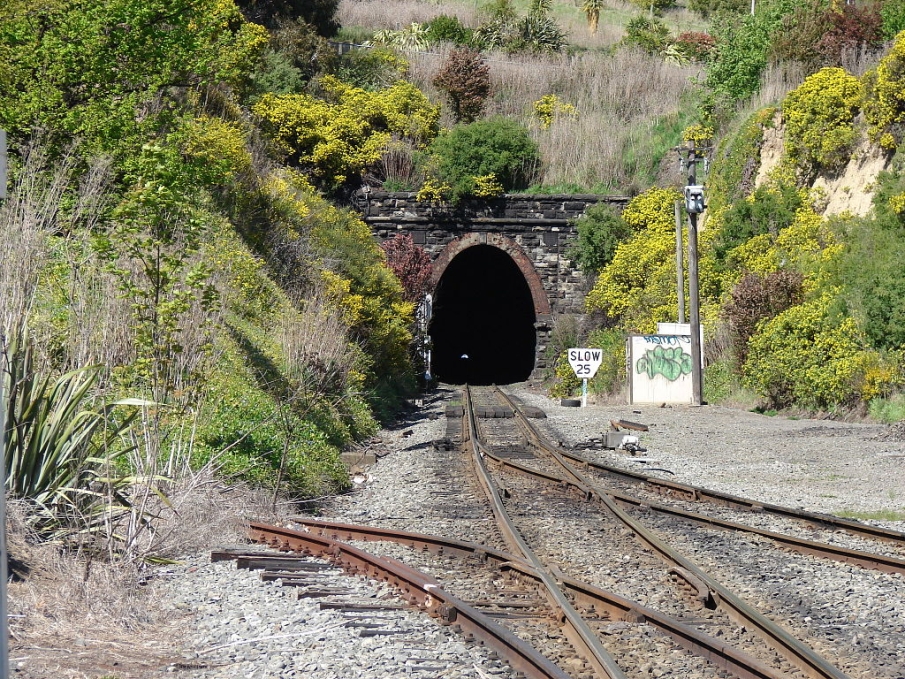
ARCHITECT/ENGINEER/DESIGNER: Edward DOBSON, Provincial Engineer Julius von HAAST, Provincial Geologist Edward RICHARDSON, Contractor's Engineer CONTRACTOR: Holmes and Co, Melbourne Julius von HAAST (1822-1887): Johann Franz Julius von Haast was a German geologist. He came to New Zealand in 1858 to report to Germany about immigration prospects. Having made explorations in the Nelson and West Coast regions, Haast then requested that he examine the site of the proposed Moorhouse Tunnel. Following his report, which was favourable, the contract was let and the tunnel completed. Haast was then given the post of Canterbury's provincial geologist in 1861. In 1863 he married Edward Dobson's daughter. As provincial geologist, Haast explored and mapped out the province which included Westland. He crossed Haast Pass in 1863 though did not discover it. He correctly predicted that an artesian water supply would lie beneath the Canterbury Plains. From his alpine expeditions he gathered geological, topographical and botanical information. His collections led to the rapid expansion of the provincial museum and he was appointed director in 1868. BW Mountfort's new building was opened in 1870. Haast helped establish the Canterbury Collegiate Union in 1871 which in turn promoted the establishment of Canterbury College. He was its first professor of geology in 1876. He was elected a Fellow of the Royal Society in 1867. He was knighted by the emporer of Austria in 1875. He received honorary doctorates from the university of Tubingen in 1862 and Cambridge University in 1886. In 1886 he visited the Colonial and Indian Exhibition in London, representing New Zealand as a commissioner. He had been appointed CMG in 1883. ARCHITECTURAL DESCRIPTION: Moorhouse Railway Tunnel is 2.6 kilometres (129 chains) long and was built through the flank or wall of an extinct volcano. The tunnel has an elliptical cross-section and an ashlar springer. Tunnel ends appear to be of squared rubble brought to course. On either side of the arch at keystone level is a plaque, one commemorating the contractors and the other commemorating WS Moorhouse and E Dobson. The portals of the Lyttelton Railway Tunnel have an elliptical shape and random rubble masonry construction. The Lyttelton portal was altered by the construction of the Lyttelton Road Tunnel in the early 1960s. Part of the portal surffered a collapse in a heavy rainfall event in the late 2000s and had to be repaired. The Heathcote portal however retains its original appearance and form.
ARCHITECT/ENGINEER/DESIGNER: Edward DOBSON, Provincial Engineer Julius von HAAST, Provincial Geologist Edward RICHARDSON, Contractor's Engineer CONTRACTOR: Holmes and Co, Melbourne Julius von HAAST (1822-1887): Johann Franz Julius von Haast was a German geologist. He came to New Zealand in 1858 to report to Germany about immigration prospects. Having made explorations in the Nelson and West Coast regions, Haast then requested that he examine the site of the proposed Moorhouse Tunnel. Following his report, which was favourable, the contract was let and the tunnel completed. Haast was then given the post of Canterbury's provincial geologist in 1861. In 1863 he married Edward Dobson's daughter. As provincial geologist, Haast explored and mapped out the province which included Westland. He crossed Haast Pass in 1863 though did not discover it. He correctly predicted that an artesian water supply would lie beneath the Canterbury Plains. From his alpine expeditions he gathered geological, topographical and botanical information. His collections led to the rapid expansion of the provincial museum and he was appointed director in 1868. BW Mountfort's new building was opened in 1870. Haast helped establish the Canterbury Collegiate Union in 1871 which in turn promoted the establishment of Canterbury College. He was its first professor of geology in 1876. He was elected a Fellow of the Royal Society in 1867. He was knighted by the emporer of Austria in 1875. He received honorary doctorates from the university of Tubingen in 1862 and Cambridge University in 1886. In 1886 he visited the Colonial and Indian Exhibition in London, representing New Zealand as a commissioner. He had been appointed CMG in 1883. ARCHITECTURAL DESCRIPTION: Moorhouse Railway Tunnel is 2.6 kilometres (129 chains) long and was built through the flank or wall of an extinct volcano. The tunnel has an elliptical cross-section and an ashlar springer. Tunnel ends appear to be of squared rubble brought to course. On either side of the arch at keystone level is a plaque, one commemorating the contractors and the other commemorating WS Moorhouse and E Dobson. The portals of the Lyttelton Railway Tunnel have an elliptical shape and random rubble masonry construction. The Lyttelton portal was altered by the construction of the Lyttelton Road Tunnel in the early 1960s. Part of the portal surffered a collapse in a heavy rainfall event in the late 2000s and had to be repaired. The Heathcote portal however retains its original appearance and form.
Historical and Associated Iwi / Hapū / Whānau
Information Sources
Archives New Zealand (Chch)
Archives New Zealand (Christchurch)
Dictionary of New Zealand Biography
Dictionary of New Zealand Biography
University of Canterbury
University of Canterbury
Institute of Professional Engineers in NZ (IPENZ)
Institute of Professional Engineers in NZ
Other Information
A fully referenced Registration Report is available from the NZHPT Southern region office. Please note that entry on the New Zealand Heritage List/Rarangi Korero identifies only the heritage values of the property concerned, and should not be construed as advice on the state of the property, or as a comment of its soundness or safety, including in regard to earthquake risk, safety in the event of fire, or insanitary conditions.
Historical and Associated Iwi / Hapū / Whānau
Information Sources
Archives New Zealand (Chch)
Archives New Zealand (Christchurch)
Dictionary of New Zealand Biography
Dictionary of New Zealand Biography
University of Canterbury
University of Canterbury
Institute of Professional Engineers in NZ (IPENZ)
Institute of Professional Engineers in NZ
Other Information
A fully referenced Registration Report is available from the NZHPT Southern region office. Please note that entry on the New Zealand Heritage List/Rarangi Korero identifies only the heritage values of the property concerned, and should not be construed as advice on the state of the property, or as a comment of its soundness or safety, including in regard to earthquake risk, safety in the event of fire, or insanitary conditions.
Former Usages
General Usage: Transport
Specific Usage: Tunnel
Web Links
description: Engineering NZ Heritage
url: https://www.engineeringnz.org/our-work/heritage/heritage-records/lyttelton-railway-tunnel/
Former Usages
General Usage: Transport
Specific Usage: Tunnel
Web Links
description: Engineering NZ Heritage
url: https://www.engineeringnz.org/our-work/heritage/heritage-records/lyttelton-railway-tunnel/
Get the latest heritage news, features and events delivered
straight to your inbox.