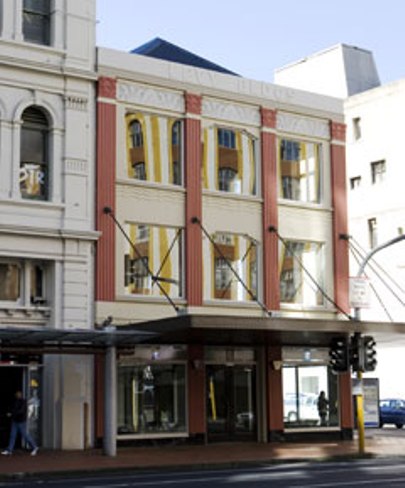
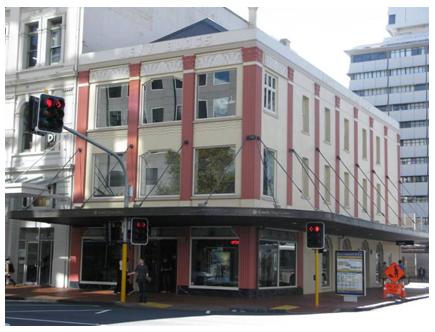
The three-storey Levy Buildings modernised in an Art Deco-style by Auckland architects Wade and Bartley in 1934, were constructed in Auckland’s Custom Street East in 1897 to a design by Edward Bartley and occupied by tea merchants Gilmore, Younghusband and Company. The place is one of a number of impressive nineteenth- and early twentieth-century former merchandising warehouse buildings located on the north side of Custom Street East, historically part of waterfront city’s point of commercial contact with the rest of the colony and wider world. The place has considerable historical and social value as the location of the Young Women’s Christian Association (YWCA) Down Town Club (1942-5), a venue created during the Second World War at vice-regal request as place where women, their friends and members of the armed forces could socialise without comprising their respectability. During adaptive re-use and seismic strengthening (2005-08) building fabric from the 1934 refurbishment was recovered and missing material reinstated.
Prior to European arrival, the site formed part of a shallow bay that bounded an area of foreshore known as Onepanea. Following the establishment of colonial Auckland in 1840, the projected position of Customs Street out in Commercial Bay was identified in 1841 preceding staged reclamations in place by 1882. In late 1882, auctioneers and land agents Stephen Cochrane and James Dacre leased Lot 96 from the Auckland Harbour Board. Following a long economic depression, Auckland architect Edward Bartley called for tenders in June 1897 for the erection of a warehouse.
The building of three storeys with brick external brick walls, timber floors, timber columns and a timber Queen truss roof was subleased to wholesale tea merchants, one of several merchants with tea interests to establish in the Customs Street East vicinity. Front window openings appear to have been comparatively large, possibly to allow greater natural light for tea blending. The firm later known as Gilmore and Company was founded by former plantation manager George Gilmore in 1882, capitalising on demand for tea, a food staple consumed at a higher rate per head of population than in Britain and endorsed by the colony’s increasingly active temperance movement.
In 1918 Australian general merchant and ship-owner Burns Philp bought the firm to open a New Zealand branch to enhance its Pacific Island trade - a trade dominated by Auckland in the 1880s. A single-storey store addition was built to the rear, prior to tea merchants Johnston Limited subleasing. Following occupation by several small tenancies, the furniture company Quigleys Limited held the Harbour Board lease for almost five decades commencing 1935. An Art Deco refurbishment designed by Auckland architects Wade and Bartley in 1934 included remodelling of the exterior and the addition of plate glass windows. Quigleys closed when managers Max and Maurice Levy were called up for military service in 1942. A seven-day-a-week venue run by the YWCA, known as the Down Town Club (which was also the headquarters of the Women’s National Service Corps) was established at the request of Lady Newall, wife of the Governor-General, and occupied the building until January 1945. Popular with uniformed servicemen including Americans stationed in the South Pacific, the club had some 5000 members. Nine businesses occupied the building in 1947 commencing more than two decades of multiple tenancies. In 1992, the property vested in Auckland Council. After demolition consent lapsed in 2001, the structure was strengthened and transformed into boutique office and retail accommodation in Auckland’s Britomart precinct.
Prior to European arrival, the site formed part of a shallow bay that bounded an area of foreshore known as Onepanea. Following the establishment of colonial Auckland in 1840, the projected position of Customs Street out in Commercial Bay was identified in 1841 preceding staged reclamations in place by 1882. In late 1882, auctioneers and land agents Stephen Cochrane and James Dacre leased Lot 96 from the Auckland Harbour Board. Following a long economic depression, Auckland architect Edward Bartley called for tenders in June 1897 for the erection of a warehouse.
The building of three storeys with brick external brick walls, timber floors, timber columns and a timber Queen truss roof was subleased to wholesale tea merchants, one of several merchants with tea interests to establish in the Customs Street East vicinity. Front window openings appear to have been comparatively large, possibly to allow greater natural light for tea blending. The firm later known as Gilmore and Company was founded by former plantation manager George Gilmore in 1882, capitalising on demand for tea, a food staple consumed at a higher rate per head of population than in Britain and endorsed by the colony’s increasingly active temperance movement.
In 1918 Australian general merchant and ship-owner Burns Philp bought the firm to open a New Zealand branch to enhance its Pacific Island trade - a trade dominated by Auckland in the 1880s. A single-storey store addition was built to the rear, prior to tea merchants Johnston Limited subleasing. Following occupation by several small tenancies, the furniture company Quigleys Limited held the Harbour Board lease for almost five decades commencing 1935. An Art Deco refurbishment designed by Auckland architects Wade and Bartley in 1934 included remodelling of the exterior and the addition of plate glass windows. Quigleys closed when managers Max and Maurice Levy were called up for military service in 1942. A seven-day-a-week venue run by the YWCA, known as the Down Town Club (which was also the headquarters of the Women’s National Service Corps) was established at the request of Lady Newall, wife of the Governor-General, and occupied the building until January 1945. Popular with uniformed servicemen including Americans stationed in the South Pacific, the club had some 5000 members. Nine businesses occupied the building in 1947 commencing more than two decades of multiple tenancies. In 1992, the property vested in Auckland Council. After demolition consent lapsed in 2001, the structure was strengthened and transformed into boutique office and retail accommodation in Auckland’s Britomart precinct.