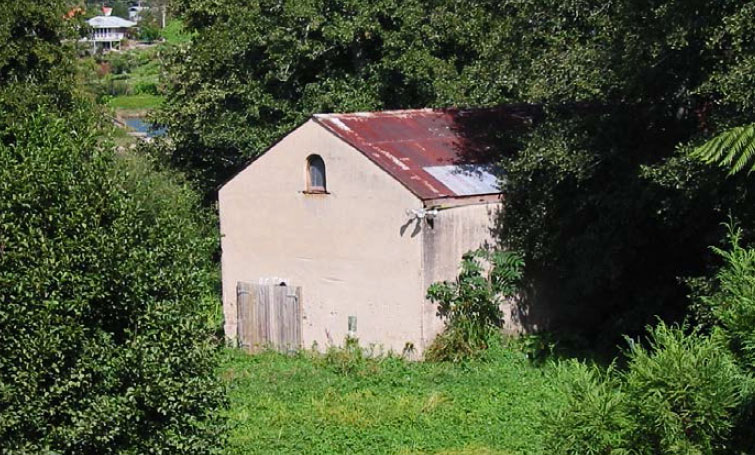
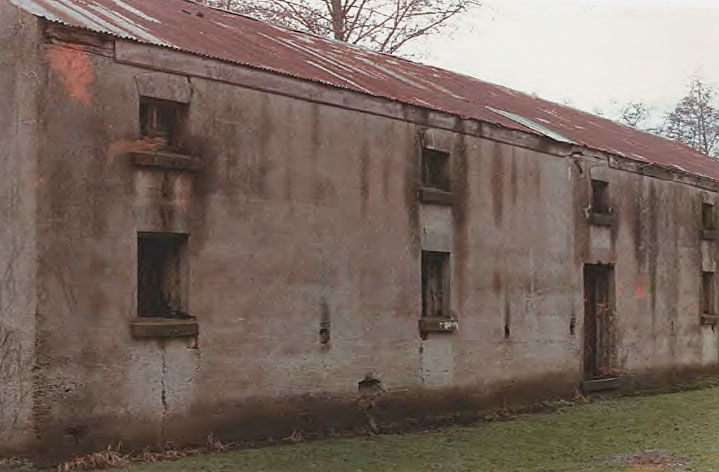
The former Flourmill Store is the only standing remnant of one the most important colonial flour mills in the Waikato, and is a pioneering example of mass concrete construction. It was commissioned in 1878 for use as a granary within the riverside complex at Lamb's Mill, Ngaruawahia. The mill had been established in 1871 at the confluence of the Waikato and Waipa Rivers to grind wheat and other grains produced by Maori and other farmers. Its foundation reflected a significant change in flour processing after the third New Zealand - or Waikato - War (1863-1864), with Pakeha mills replacing smaller Maori-owned operations in the region. The concrete store was erected soon after the installation of steam-operated production at the mill, demonstrating substantial investment and confidence in the plant during the economic boom of the 1870s. Optimism was increased by the arrival of the railway from Auckland to the town in 1877, enabling distribution to be carried out by train as well as by river.
Promoted as the first concrete building in the Waikato, the store was erected alongside the Waikato River, close to the mill and other structures. It was designed as a two-storeyed granary, rectangular in plan, with a series of small windows lighting its upper floor. Its concrete walls were chosen for their fire- and rat-proof qualities, incorporating imported Portland cement. They also contained strands of ungalvanised barbed wire, leading its architect - T.H. White - to claim it as the earliest reinforced concrete building in the Southern Hemisphere. The subsequent history of the store is less well-known, but it was evidently used for storing finished products rather than grain after the mill was taken over by the Waikato Steam Navigation and Coal Mining Company in 1883. With the regional flour business in decline, it was then employed in association with a local revival of flax production, being part of the Walsh Brothers' operations from 1889 to around 1915. The building has since been adapted by the Ngaruawahia Regatta Association to house canoes for their annual regatta. The Association was formed in 1896 to preserve Maori customs, at a time when it was feared that they would disappear.
The building is of considerable historical value for its connections with the development of agriculture and flour production in the Waikato, as well as the late nineteenth-century revival of flax. It is significant as the only visible remnant of the largest colonial flour mill in the region, demonstrating changes in ownership, technology and the scale of production after the third New Zealand War. It is particularly important as it is the oldest known concrete building in the region, and a pioneering example of rudimentary reinforced concrete construction in New Zealand. It is the earliest known concrete building erected by T.H. White who trained in Britain and France, the main centres of innovation in nineteenth-century concrete technology. The building has strong connections with the development of Ngaruawahia, reflecting the town's commercial importance in the nineteenth century. It is highly significant for its historical and cultural links with the Waikato River, including the activities of the Ngaruawahia Regatta Association.
Promoted as the first concrete building in the Waikato, the store was erected alongside the Waikato River, close to the mill and other structures. It was designed as a two-storeyed granary, rectangular in plan, with a series of small windows lighting its upper floor. Its concrete walls were chosen for their fire- and rat-proof qualities, incorporating imported Portland cement. They also contained strands of ungalvanised barbed wire, leading its architect - T.H. White - to claim it as the earliest reinforced concrete building in the Southern Hemisphere. The subsequent history of the store is less well-known, but it was evidently used for storing finished products rather than grain after the mill was taken over by the Waikato Steam Navigation and Coal Mining Company in 1883. With the regional flour business in decline, it was then employed in association with a local revival of flax production, being part of the Walsh Brothers' operations from 1889 to around 1915. The building has since been adapted by the Ngaruawahia Regatta Association to house canoes for their annual regatta. The Association was formed in 1896 to preserve Maori customs, at a time when it was feared that they would disappear.
The building is of considerable historical value for its connections with the development of agriculture and flour production in the Waikato, as well as the late nineteenth-century revival of flax. It is significant as the only visible remnant of the largest colonial flour mill in the region, demonstrating changes in ownership, technology and the scale of production after the third New Zealand War. It is particularly important as it is the oldest known concrete building in the region, and a pioneering example of rudimentary reinforced concrete construction in New Zealand. It is the earliest known concrete building erected by T.H. White who trained in Britain and France, the main centres of innovation in nineteenth-century concrete technology. The building has strong connections with the development of Ngaruawahia, reflecting the town's commercial importance in the nineteenth century. It is highly significant for its historical and cultural links with the Waikato River, including the activities of the Ngaruawahia Regatta Association.