

List Entry Information
Status
Listed
List Entry Status
Historic Place Category 2
Access
Private/No Public Access
List Number
7377
Date Entered
24th April 1997
Date of Effect
24th April 1997
City/District Council
Auckland Council
Region
Auckland Council
Legal description
pt Blk XVIII Deeds Plan City 45 and being part of the land reclaimed from the sea
Status
Listed
List Entry Status
Historic Place Category 2
Access
Private/No Public Access
List Number
7377
Date Entered
24th April 1997
Date of Effect
24th April 1997
City/District Council
Auckland Council
Region
Auckland Council
Legal description
pt Blk XVIII Deeds Plan City 45 and being part of the land reclaimed from the sea
Why is this place significant?
Cultural Significance
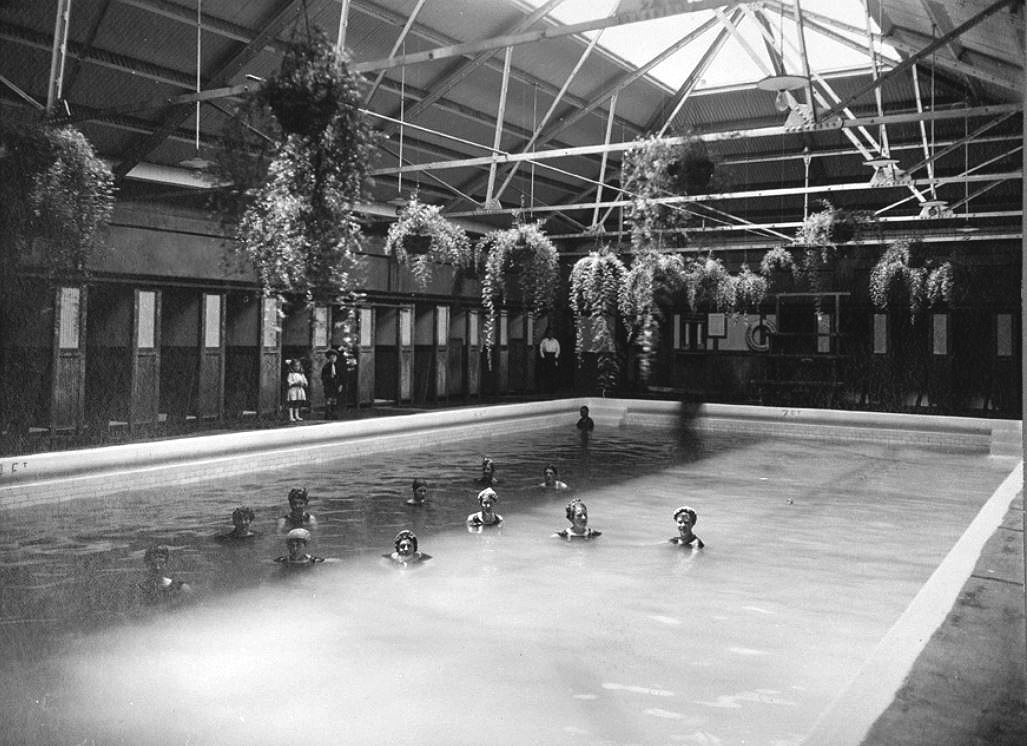
This historic place was registered under the Historic Places Act 1993. The following text is from the original Historic Place Assessment Under Section 23 Criteria report considered by the NZHPT Board at the time of registration. Cultural: All year round availability and separate pools for the sexes made Auckland's Tepid Baths a popular amenity early this century. Reference was made at the opening in 1914 to their great medicinal value making for the good health of the community, as well as enjoyment. By the late 1950s use of the slipper bath facilities had declined as living standards rose and inner city redevelopment took place. The Tepid Baths, like all of the city's pools, suffered a further decline in patronage in the 1970s and 1980s as more Aucklanders installed swimming pools on their own properties. The advent of aquatic pursuits such as windsurfing and rival entertainments such as thermal pools and water slides at Helensville and Waiwera also had an effect. A million dollar face lift in 1986 resulted in a shortening of the main pool from 33 yards to 25 metres and the addition of spas, saunas and gymnasium facilities to better compete with commercial health centres catering for the population's increasing interest in health and physical fitness. This led to a revival in the Bath's popularity with Aucklanders. New York's Wall Street Journal featured Auckland's Tepid Baths on a list of the world's nine best pools in 1989. Social: Over their eighty four years the baths have provided for a diversity of uses such as swimming, lifesaving and aquarobics. Air New Zealand also at one stage used the pool to train their staff for emergency evacuation of aircraft. The Tepid Baths continue to be popular recreational venue in the city.
Historic Significance
Historical Significance or Value This historic place was registered under the Historic Places Act 1993. The following text is from the original Historic Place Assessment Under Section 23 Criteria report considered by the NZHPT Board at the time of registration. Historical: Auckland's Tepid Baths were the most elaborate of three salt water baths built by Auckland City Council between 1912 and 1914. These amenities replaced two earlier Council baths at Customs Street and Albert Street, built in 1881 and 1885 respectively. Two of the three new baths, Parnell and Shelly Beach, were tidal pools. The Tepid Baths by contrast were fully enclosed within a building and provided two tiled baths and twelve private slipper baths. The latter offered a choice of hot or cold, fresh or salt-water. A newspaper account of the opening described the main pool as "the largest inland pool in New Zealand". Two of the staff appointed in 1914 were men of considerable significance in New Zealand swimming, and had long careers at the baths. The Supervisor for 28 years was Malcolm Champion, the first New Zealander to win an Olympic Gold Medal. Duncan Anderson held a full time teaching post at the Baths, and from 1914 was dubbed "Professor" Anderson until he retired in 1948. The baths were converted from salt water to fresh water in 1974. Twelve years later Auckland Tepid Baths Ltd, a private company founded by John Fay and John Hulbert, took over management from the council and upgraded and added new facilities. The Council renegotiated a new ground lease, effectively for ten years, with Ports of Auckland. Ownership of the baths and the fixing of admission charges remained with council but otherwise the facility was run by Fay and Hulbert. The lease expired at the end of September 1996. The building faces an uncertain future as planning proceeds for the forthcoming America's Cup Challenge which is likely to be based in Auckland's viaduct basin.
Physical Significance
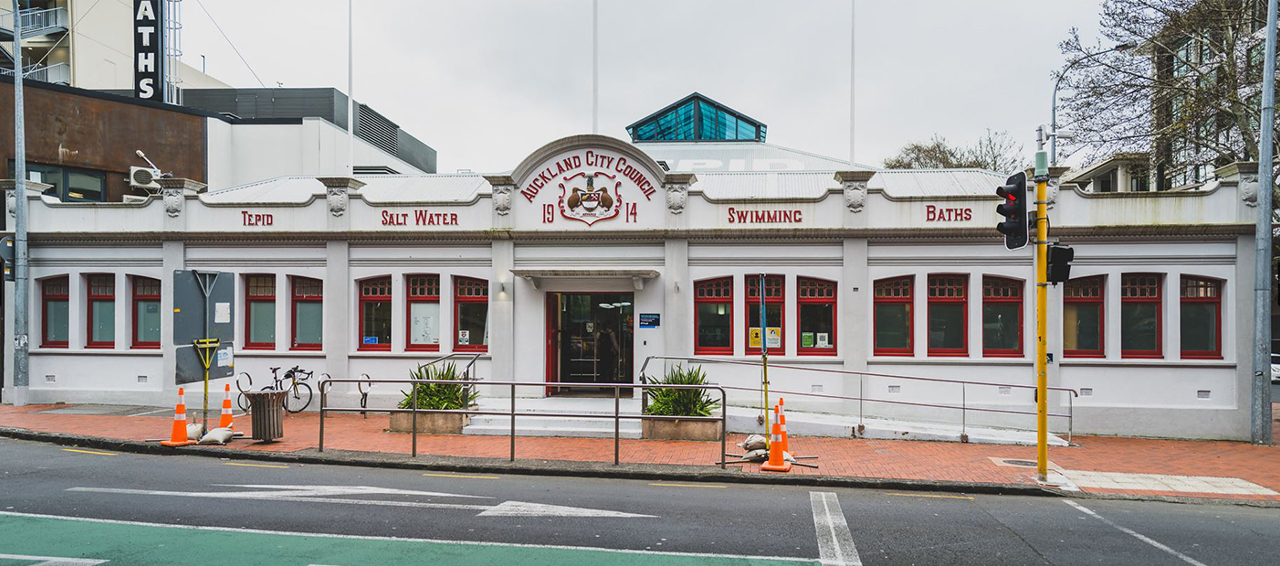
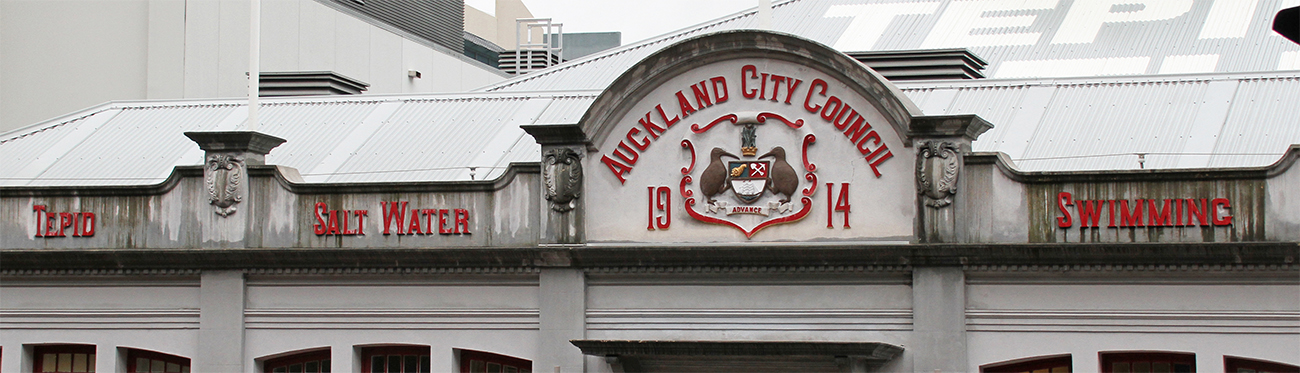
This historic place was registered under the Historic Places Act 1993. The following text is from the original Historic Place Assessment Under Section 23 Criteria report considered by the NZHPT Board at the time of registration. Architectural: The Tepid Baths, Auckland, was designed in Edwardian Free Style of the period 1901-1915. Style indicators are: - Brick construction with contrasting colours; although the present colour scheme is contemporary from our own time, the original scheme would have followed much the same contrasts. - Pilasters, or more correctly piers in the case of this building, dividing up the main and side elevations into regular bays. - Piers projecting above the parapet with stylized capitals. - Use of segmented or basket arch window heads in conjunction with the Diocletian window motif located within each bay (i.e., a triptych window combination). - Classical motifs in the form of an arched bay at parapet level over the main entrance, hood moulding over the main doors, and decorative escutcheons on the flanking piers. Archaeological: Auckland's Tepid Baths occupy part of a reclamation undertaken c1876. During the intervening years until 1911, when Customs Street West was reconstructed, the area was occupied by buildings accommodating maritime related industries. Details of the particular uses on this specific site have not been researched. The extent to which physical evidence of early structures may have survived the 1911 road reconstruction, or the construction of the Baths building itself in 1913-1914 is not known and would require an archaeological assessment. Technological: The Tepid Baths were designed so that heated salt water circulated constantly through both main pools, gravity fed from the condensers of the Tramway Company's powerhouse further up Hobson Street. Prior to construction of the baths this heated water had gone to waste at a rate of 2,000 gallons a minute. Upon the closing of the Tramway Power Station in April 1924 "the Teps" went unheated for a year until a coal-fired heating system and filtration plants with steam pumps were introduced. A new boiler with auto-stoker was installed in 1941 to be replaced by a gas-fired boiler in 1972.
Why is this place Category 1 / Category 2?
Detail Of Assessed Criteria
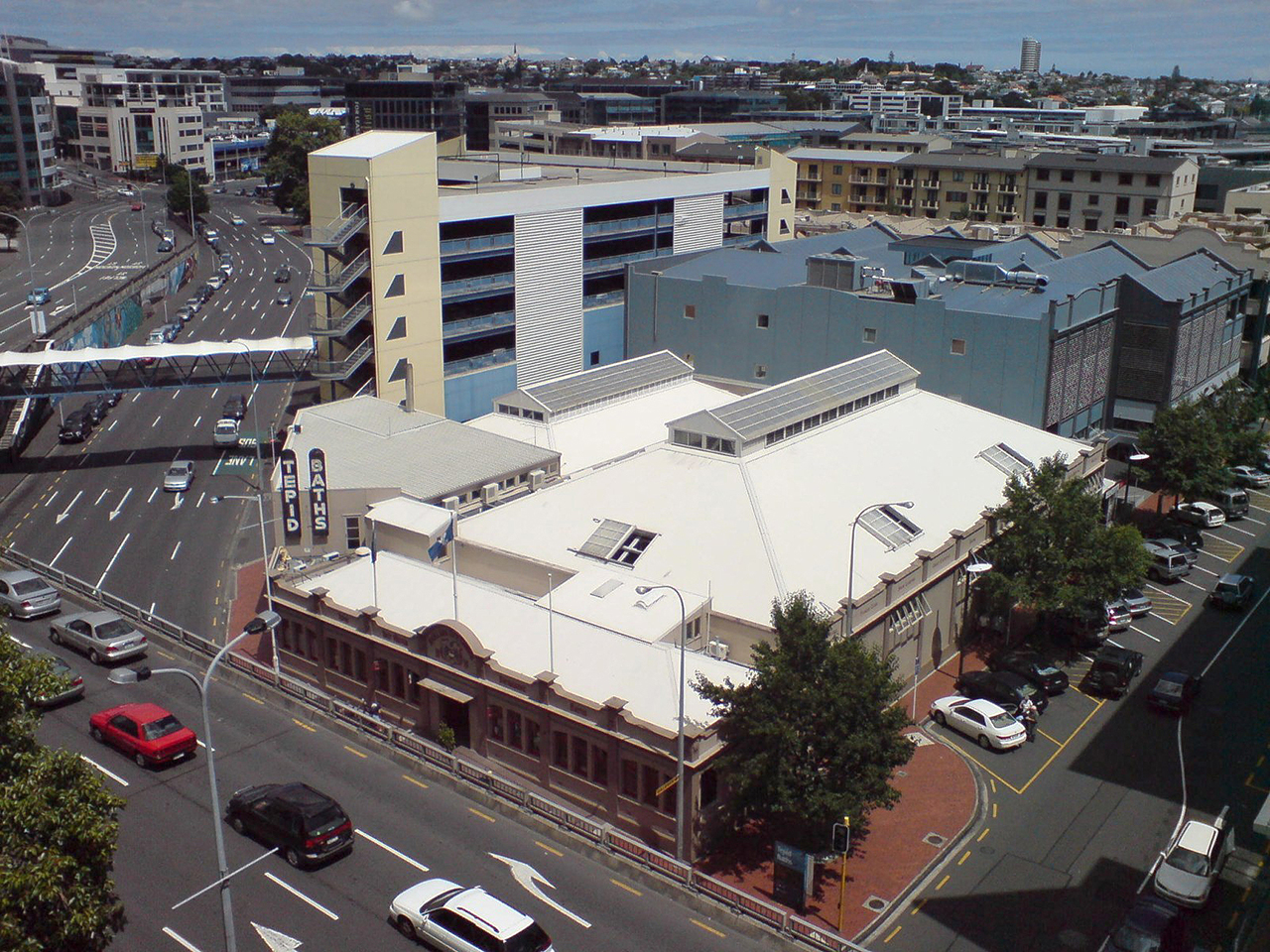
This historic place was registered under the Historic Places Act 1993. The following text is from the original Historic Place Assessment Under Section 23 Criteria report considered by the NZHPT Board at the time of registration. (a) The extent to which the place reflects important or representative aspects of New Zealand history: The provision of recreational facilities to promote community health was an early priority for local authorities. The Tepid Baths are Auckland's, and possibly New Zealand's, oldest surviving public swimming baths. They reflect the importance ascribed to swimming for health and recreation, municipal facilities having been provided in Auckland since the 1880s. They have provided a year round venue for swimming and lifesaving instruction, important skills in a country where outdoor pursuits and opportunities for water-based recreation are an important part of everyday life. The baths have also adapted from an initial focus on the medicinal value of bathing in warm salt water through to the present day emphasis on swimming for personal physical fitness and recreation. (b) The association of the place with events, persons, or ideas of importance in New Zealand history: Events: Swimming carnivals were regularly held at the Baths until the mid 1980s, fostering interest in swimming as a competitive sport. Persons: Malcolm Champion (1883-1938), the first New Zealander to win an Olympic gold medal, was the custodian of the Auckland Tepid Baths from their opening in 1914 until the year before his death in 1939. Champion, a freestyle swimmer, was the New Zealand representative in the successful Australasian 4x200m swimming relay at the Stockholm Olympics in 1912. New Zealand did not compete under its own name until the 1920 Antwerp Olympic Games in Belgium. It was not until the 1928 Olympics that another gold medal was won by a New Zealander. The cafe attached to the baths bears Malcolm Champion's name. Teacher and coach at the Baths for 38 years, "Professor" Duncan Anderson, was the author of 'All About Swimming', a book which sold 30,000 copies in three editions. He is credited with introducing the modern crawl stroke to New Zealand swimming, and trained a considerable number of New Zealand champion swimmers. Ideas: The Tepid Baths were constructed during the Mayoralty of C.J Parr and while W.E Bush was City Engineer. Both men were influenced by the emerging discipline of town planning. Parr in particular was interested in public health and believed that no opportunity to enhance recreational facilities should be allowed to go by default. (g) The technical accomplishment or value, or design of the place: DATE: 1914 ARCHITECT: Auckland City Engineer, Mr W.E. Bush STYLE CODE: 29. Edwardian Free style, 1901-1915 DESIGN: The Auckland Tepid Baths is essentially a utilitarian structure originally designed for the purpose of accommodating more than 12 baths and a main pool. Thus, although the place has an architecturally designed frontage on Hobson Street, in Edwardian Freestyle, this portion should not be considered to be the whole design. The design in its entirety consisted, as it basically still does, of a single storey entrance part containing the ticket office, and small baths originally called "slipper" baths but now used for such purposes as a cafe, spa pool, swimming school, steam bath, and heated pool. Behind this part of the building, the photographs show a large, rectangular structure, containing a covered in main pool. As a built entity, the entire structure was therefore enabled to function according to the purpose for which it was designed, by virtue of the integral water pumping and filtration system housed at the sub-floor and roof levels. The Auckland Tepid Baths appear to have been designed as a covered in baths. This makes the design similar to other large near contemporary public baths for which information is available, namely the Bath House at Rotorua (1908), the Municipal Baths, Invercargill (1927), and the Blue Baths, also at Rotorua (1931-34). The concept of artificially heated water may have been an innovation for 1914 since the Bath House and the Blue Baths at Rotorua merely took advantage of naturally heated water. The basic rectangular plan of the Auckland Tepid Baths, with it's architecturally designed main facade, appears to have been - at least from photographic evidence - a conventional design for public bath houses built by local authorities in the period 1898-1960. (m) Such additional criteria not inconsistent with those in paragraphs (a) to (k): There are six registered bath houses; the Blue Baths, Rotorua, 1931-34, Cat.I; the Bath House, Rotorua, 1908, Cat.I; Municipal Baths, Invercargill, 1927, Cat.II; No.2 Bathhouse, Te Aroha, c.1880, Cat.II; Maori No.7 Bathhouse, Te Aroha, 1892, Cat II; Coronation Bath House, Queenstown, 1911, Cat.II. Of this group only the first three are comparable structures - the last three being 19th century wooden bath houses. In purely comparative terms the Tepid Baths in Auckland are functionally and architecturally on equal terms with the Category II Municipal Baths, Invercargill. The architectural style and technical complexity of the other two bath houses at Rotorua are of a greater level of significance. This places the Auckland Tepid Baths in a middle bracket if one were to rank the listed baths in order of type, i.e., the Auckland Baths fit into the category of city council baths as distinct from the large government sponsored thermal baths, or small local Victorian thermal baths, also government sponsored and built for the New Zealand Tourism Department at the turn of the century . City council baths are therefore not well represented in the register - one thinks of examples which have been demolished in the past such as the Thorndon Baths, Wellington, built in 1898, and, more recently, the Riddiford Baths, Lower Hutt, built c.1928. The Tepid Baths, Auckland, merit Category II registration as an example of a type of public bath house design favoured by local authorities, with the additional merit of being a surviving pre World War One example.
Why is this place significant?
Cultural Significance
This historic place was registered under the Historic Places Act 1993. The following text is from the original Historic Place Assessment Under Section 23 Criteria report considered by the NZHPT Board at the time of registration. Cultural: All year round availability and separate pools for the sexes made Auckland's Tepid Baths a popular amenity early this century. Reference was made at the opening in 1914 to their great medicinal value making for the good health of the community, as well as enjoyment. By the late 1950s use of the slipper bath facilities had declined as living standards rose and inner city redevelopment took place. The Tepid Baths, like all of the city's pools, suffered a further decline in patronage in the 1970s and 1980s as more Aucklanders installed swimming pools on their own properties. The advent of aquatic pursuits such as windsurfing and rival entertainments such as thermal pools and water slides at Helensville and Waiwera also had an effect. A million dollar face lift in 1986 resulted in a shortening of the main pool from 33 yards to 25 metres and the addition of spas, saunas and gymnasium facilities to better compete with commercial health centres catering for the population's increasing interest in health and physical fitness. This led to a revival in the Bath's popularity with Aucklanders. New York's Wall Street Journal featured Auckland's Tepid Baths on a list of the world's nine best pools in 1989. Social: Over their eighty four years the baths have provided for a diversity of uses such as swimming, lifesaving and aquarobics. Air New Zealand also at one stage used the pool to train their staff for emergency evacuation of aircraft. The Tepid Baths continue to be popular recreational venue in the city.
Historic Significance
Historical Significance or Value This historic place was registered under the Historic Places Act 1993. The following text is from the original Historic Place Assessment Under Section 23 Criteria report considered by the NZHPT Board at the time of registration. Historical: Auckland's Tepid Baths were the most elaborate of three salt water baths built by Auckland City Council between 1912 and 1914. These amenities replaced two earlier Council baths at Customs Street and Albert Street, built in 1881 and 1885 respectively. Two of the three new baths, Parnell and Shelly Beach, were tidal pools. The Tepid Baths by contrast were fully enclosed within a building and provided two tiled baths and twelve private slipper baths. The latter offered a choice of hot or cold, fresh or salt-water. A newspaper account of the opening described the main pool as "the largest inland pool in New Zealand". Two of the staff appointed in 1914 were men of considerable significance in New Zealand swimming, and had long careers at the baths. The Supervisor for 28 years was Malcolm Champion, the first New Zealander to win an Olympic Gold Medal. Duncan Anderson held a full time teaching post at the Baths, and from 1914 was dubbed "Professor" Anderson until he retired in 1948. The baths were converted from salt water to fresh water in 1974. Twelve years later Auckland Tepid Baths Ltd, a private company founded by John Fay and John Hulbert, took over management from the council and upgraded and added new facilities. The Council renegotiated a new ground lease, effectively for ten years, with Ports of Auckland. Ownership of the baths and the fixing of admission charges remained with council but otherwise the facility was run by Fay and Hulbert. The lease expired at the end of September 1996. The building faces an uncertain future as planning proceeds for the forthcoming America's Cup Challenge which is likely to be based in Auckland's viaduct basin.
Physical Significance
This historic place was registered under the Historic Places Act 1993. The following text is from the original Historic Place Assessment Under Section 23 Criteria report considered by the NZHPT Board at the time of registration. Architectural: The Tepid Baths, Auckland, was designed in Edwardian Free Style of the period 1901-1915. Style indicators are: - Brick construction with contrasting colours; although the present colour scheme is contemporary from our own time, the original scheme would have followed much the same contrasts. - Pilasters, or more correctly piers in the case of this building, dividing up the main and side elevations into regular bays. - Piers projecting above the parapet with stylized capitals. - Use of segmented or basket arch window heads in conjunction with the Diocletian window motif located within each bay (i.e., a triptych window combination). - Classical motifs in the form of an arched bay at parapet level over the main entrance, hood moulding over the main doors, and decorative escutcheons on the flanking piers. Archaeological: Auckland's Tepid Baths occupy part of a reclamation undertaken c1876. During the intervening years until 1911, when Customs Street West was reconstructed, the area was occupied by buildings accommodating maritime related industries. Details of the particular uses on this specific site have not been researched. The extent to which physical evidence of early structures may have survived the 1911 road reconstruction, or the construction of the Baths building itself in 1913-1914 is not known and would require an archaeological assessment. Technological: The Tepid Baths were designed so that heated salt water circulated constantly through both main pools, gravity fed from the condensers of the Tramway Company's powerhouse further up Hobson Street. Prior to construction of the baths this heated water had gone to waste at a rate of 2,000 gallons a minute. Upon the closing of the Tramway Power Station in April 1924 "the Teps" went unheated for a year until a coal-fired heating system and filtration plants with steam pumps were introduced. A new boiler with auto-stoker was installed in 1941 to be replaced by a gas-fired boiler in 1972.
Why is this place Category 1 / Category 2?
Detail Of Assessed Criteria
This historic place was registered under the Historic Places Act 1993. The following text is from the original Historic Place Assessment Under Section 23 Criteria report considered by the NZHPT Board at the time of registration. (a) The extent to which the place reflects important or representative aspects of New Zealand history: The provision of recreational facilities to promote community health was an early priority for local authorities. The Tepid Baths are Auckland's, and possibly New Zealand's, oldest surviving public swimming baths. They reflect the importance ascribed to swimming for health and recreation, municipal facilities having been provided in Auckland since the 1880s. They have provided a year round venue for swimming and lifesaving instruction, important skills in a country where outdoor pursuits and opportunities for water-based recreation are an important part of everyday life. The baths have also adapted from an initial focus on the medicinal value of bathing in warm salt water through to the present day emphasis on swimming for personal physical fitness and recreation. (b) The association of the place with events, persons, or ideas of importance in New Zealand history: Events: Swimming carnivals were regularly held at the Baths until the mid 1980s, fostering interest in swimming as a competitive sport. Persons: Malcolm Champion (1883-1938), the first New Zealander to win an Olympic gold medal, was the custodian of the Auckland Tepid Baths from their opening in 1914 until the year before his death in 1939. Champion, a freestyle swimmer, was the New Zealand representative in the successful Australasian 4x200m swimming relay at the Stockholm Olympics in 1912. New Zealand did not compete under its own name until the 1920 Antwerp Olympic Games in Belgium. It was not until the 1928 Olympics that another gold medal was won by a New Zealander. The cafe attached to the baths bears Malcolm Champion's name. Teacher and coach at the Baths for 38 years, "Professor" Duncan Anderson, was the author of 'All About Swimming', a book which sold 30,000 copies in three editions. He is credited with introducing the modern crawl stroke to New Zealand swimming, and trained a considerable number of New Zealand champion swimmers. Ideas: The Tepid Baths were constructed during the Mayoralty of C.J Parr and while W.E Bush was City Engineer. Both men were influenced by the emerging discipline of town planning. Parr in particular was interested in public health and believed that no opportunity to enhance recreational facilities should be allowed to go by default. (g) The technical accomplishment or value, or design of the place: DATE: 1914 ARCHITECT: Auckland City Engineer, Mr W.E. Bush STYLE CODE: 29. Edwardian Free style, 1901-1915 DESIGN: The Auckland Tepid Baths is essentially a utilitarian structure originally designed for the purpose of accommodating more than 12 baths and a main pool. Thus, although the place has an architecturally designed frontage on Hobson Street, in Edwardian Freestyle, this portion should not be considered to be the whole design. The design in its entirety consisted, as it basically still does, of a single storey entrance part containing the ticket office, and small baths originally called "slipper" baths but now used for such purposes as a cafe, spa pool, swimming school, steam bath, and heated pool. Behind this part of the building, the photographs show a large, rectangular structure, containing a covered in main pool. As a built entity, the entire structure was therefore enabled to function according to the purpose for which it was designed, by virtue of the integral water pumping and filtration system housed at the sub-floor and roof levels. The Auckland Tepid Baths appear to have been designed as a covered in baths. This makes the design similar to other large near contemporary public baths for which information is available, namely the Bath House at Rotorua (1908), the Municipal Baths, Invercargill (1927), and the Blue Baths, also at Rotorua (1931-34). The concept of artificially heated water may have been an innovation for 1914 since the Bath House and the Blue Baths at Rotorua merely took advantage of naturally heated water. The basic rectangular plan of the Auckland Tepid Baths, with it's architecturally designed main facade, appears to have been - at least from photographic evidence - a conventional design for public bath houses built by local authorities in the period 1898-1960. (m) Such additional criteria not inconsistent with those in paragraphs (a) to (k): There are six registered bath houses; the Blue Baths, Rotorua, 1931-34, Cat.I; the Bath House, Rotorua, 1908, Cat.I; Municipal Baths, Invercargill, 1927, Cat.II; No.2 Bathhouse, Te Aroha, c.1880, Cat.II; Maori No.7 Bathhouse, Te Aroha, 1892, Cat II; Coronation Bath House, Queenstown, 1911, Cat.II. Of this group only the first three are comparable structures - the last three being 19th century wooden bath houses. In purely comparative terms the Tepid Baths in Auckland are functionally and architecturally on equal terms with the Category II Municipal Baths, Invercargill. The architectural style and technical complexity of the other two bath houses at Rotorua are of a greater level of significance. This places the Auckland Tepid Baths in a middle bracket if one were to rank the listed baths in order of type, i.e., the Auckland Baths fit into the category of city council baths as distinct from the large government sponsored thermal baths, or small local Victorian thermal baths, also government sponsored and built for the New Zealand Tourism Department at the turn of the century . City council baths are therefore not well represented in the register - one thinks of examples which have been demolished in the past such as the Thorndon Baths, Wellington, built in 1898, and, more recently, the Riddiford Baths, Lower Hutt, built c.1928. The Tepid Baths, Auckland, merit Category II registration as an example of a type of public bath house design favoured by local authorities, with the additional merit of being a surviving pre World War One example.
Construction Details
Start Year
1914
Type
Original Construction
Construction Details
Start Year
1914
Type
Original Construction
Historical and Associated Iwi / Hapū / Whānau
Other Information
A copy of the original report is available from the NZHPT Northern Region office The Tepid Baths restoration won the New Zealand Project Management Institute's Public Sector Project of the Year Award in 2012. Please note that entry on the New Zealand Heritage List/Rarangi Korero identifies only the heritage values of the property concerned, and should not be construed as advice on the state of the property, or as a comment of its soundness or safety, including in regard to earthquake risk, safety in the event of fire, or insanitary conditions.
Historical and Associated Iwi / Hapū / Whānau
Other Information
A copy of the original report is available from the NZHPT Northern Region office The Tepid Baths restoration won the New Zealand Project Management Institute's Public Sector Project of the Year Award in 2012. Please note that entry on the New Zealand Heritage List/Rarangi Korero identifies only the heritage values of the property concerned, and should not be construed as advice on the state of the property, or as a comment of its soundness or safety, including in regard to earthquake risk, safety in the event of fire, or insanitary conditions.
Former Usages
General Usage: Civic Facilities
Specific Usage: Bathhouse/ mineral baths/ geothermal baths
Former Usages
General Usage: Civic Facilities
Specific Usage: Bathhouse/ mineral baths/ geothermal baths
