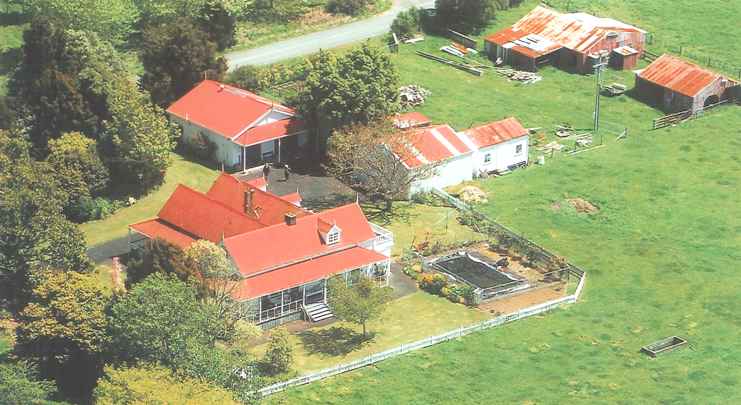
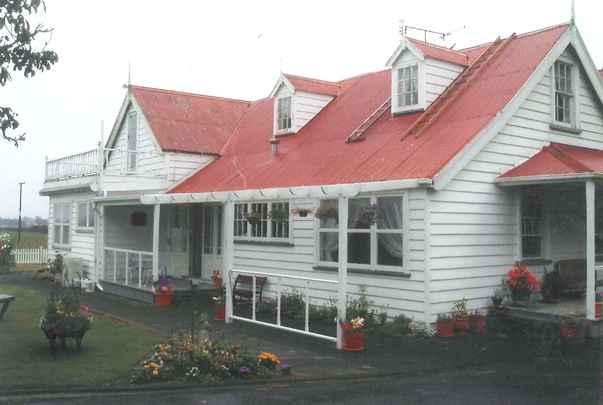
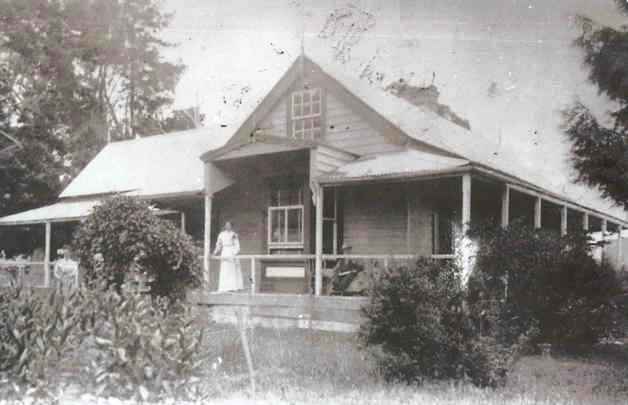
The early history of 'Homewood' and its date of construction are unclear. Local and family tradition states that the house and the property extending down to the Waipa River on both sides of Hodgson Road, plus some land on the east side of the River, was owned from 1840 by John Vittoria Cowell and his wife Keke Tumohe (aka Martha Cowell aka Mata Kaora, aka Martha Risdon). The imputed association of the house to the Cowell family is not challenged by the community and there is no known contrary information.
John Vittoria Cowell (1813 -1880) arrived in New Zealand on 13 February 1822 as a young boy with his father John, stepmother Mary Ann Risdon Cowell (aka Martha; nee Howe) and Reverend John Butler of the Church Missionary Society (CMS). John senior was one of Samuel Marsden's lay missionaries and a twine-spinner. In the Roll of Early Settlers and descendants in the Auckland Province John Vittoria Cowell's first place of residence is recorded as Kororareka in 1823, by which time his father had dissolved his connection with the CMS. The family was back in Sydney by February 1824 and still there in 1828. A 'Mr. Cowell' was involved in the Elizabeth incident in 1830, travelling as supercargo (trading master) and interpreter on its voyage from Sydney to Kapiti and thence with Te Rauparaha and Ngati Toa to Akaroa Harbour where several locals were killed and the chief Tamaiharanui, his wife and daughter were captured and killed aboard the vessel, apparently with the connivance of the Pakeha on board. However, as it could not be established which Cowell had been involved, father or son, 'Mr Cowell' was acquitted in the subsequent trial. Decades later it was reported that John V. Cowell used to boast, when drunk, of his exploits in the Elizabeth affair to his guests at his Te Rore hotel. However, another report states that Cowell bitterly regretted his involvement. Family opinion is that involvement with the affair was more in character for the son, i.e. J.V., and the government held the same view when denying him compensation for land confiscated in 1864.
John V. Cowell was established at Kawhia as a trader by late 1830-31. In 1832 he and Edward Lee established a trading post at the mouth of the Awaroa River, at the eastern end of the Kawhia Harbour on 5250 acres (2125 hectares) they had purchased. His father also settled at Kawhia in c.1831; having left Marsden's service he became a trader with a successful business based at Kawhia. John senior's wife Mary Ann is believed to have been the first European woman at Kawhia. Mary Ann died in March 1832. John senior married again, to Rewa, Ngati Hikairo, but he was widowed for the third time in 1838 and then cared for by Tawariki, who was possibly a common law wife, until his death in October 1839. In recognition of John Cowell's mana, soon after he was buried 'the chiefs called a great convocation to confer some suitable gift upon his son, and those chiefs present unanimously agreed' to gift John Vittoria Cowell 40,000 acres (over 16100 hectares) 'on the banks of the Waipa river about 40 miles [64 km] from Kawhia'. It seems that soon after this Cowell shifted his trading station inland to the Te Pahu-Te Rore area to the land now occupied by Homewood.
The area of Cowell's newly acquired property on the Waipa River had been heavily populated and exploited by Maori who utilised the Waipa River as an easy accessway into the interior and its fertile soils, copious natural resources of food and technological materials. There are nine recorded pa sites in the immediate Te Pahu-Te Rore area, plus artefact findspots and undefended terraces and storage pits. A large puriri on the property was reputedly used for burials and/or tangi by local Maori.
The number of Maori in the area encouraged missionaries and traders to establish posts and as the growing of wheat and other European crops flourished the Waipa became a prosperous district. In the 1840s-50s the Waipa River was very busy as the main transport route to the mission stations upstream at Waipa and Otawhao [Te Awamutu], the Roman Catholic and Anglican churches at Rangiaowhia and the Maori communities living throughout this area who were harvesting wheat, root crops, oats, fruit, pigs and flax for the Auckland market. The produce was taken via tracks and streams to the Waipa River then by canoe along the river to its confluence with the Waikato River and thence to Onehunga. 'Homewood' is situated approximately two kilometres west of the Waipa River just upstream from Te Rore which was usually the navigable limit for boats other than waka, although on occasions the river was navigable through to Pirongia. A ford existed a few kilometres upstream from Te Rore. The main Maori track over Pirongia from the Kawhia and Aotea Harbours and down to the Waipa River is now in part Hodgson and Rosborough Roads which run past Homewood and down to the approximate location of the former trading store on the eastern bank. On the western bank tracks from Raglan (to the west) and Whatawhata (to the north) converge at Homewood and continue south (the latter part is now Grey's Road).
In c.1840 John Vittoria Cowell married Keke of Ngati Apakura as his customary wife. Keke Tumohe was the daughter of the prominent chief Tumohe Taraunahi and his wife Pinenga. Keke's whanau at Rangiaowhia would have been amongst those with whom John Cowell was trading. Keke Tumohe was the half-sister of the Rangiaowhia chief Wiremu Toe Toe Tumohe who was instrumental in the acquisition of a printing press gifted to him by Emperor Maxmillian when he visited Austria in 1857. On 16 August 1845 Keke was christened by Reverend John Whiteley at the Methodist mission station on the shore of Kawhia Harbour. She took the name Martha Risdon, the same name as her husband's stepmother, and she and John Vittoria Cowell were married in law and in the view of the church the same day. Their three daughters were christened then as well. On their marriage record in 1845 their residence is noted as Kawhia.
Precisely when the Cowells moved to Te Rore is not known; they may have resided intermittently at both Kawhia and Te Rore for a time. In a document dated 4 February 1841 J V Cowell states that at the time of writing he was still in business with Edward Lee for the collection of pork and flour at his place at Pouewe, Kawhia. In April 1841 John Cowell was one of the 'lawless drunken set' of Pakeha living at Kawhia, according to Ensign Best. In Dieffenbach's account of his trip in April 1841 from Kawhia Harbour, across Pirongia Mountain to the Waipa, he states re April 23rd: ' we arrived at the banks of the Waipa, and were welcomed in the house of an Englishman, a trader and old settler. Our English host had a quantity of tobacco hung up to dry, which he had grown here. On the 24th we crossed the Waipa in a canoe, and reached the Church missionary station of Otawao [sic], which is about nine miles distant from our resting-place of the night before.' Dieffenbach's host is presumed to be John Cowell, as no other traders are known to have lived on the west bank at this time. Homewood is nearly two kilometres from the river, rather than on its banks, so the description is presumably of what was then Cowells' home. Dieffenbach does not mention Cowell's wife but in April 1841 Keke was away in Sydney with one of her daughters; while there she purchased several ornamental trees. Dieffenbach's reference to the crop of tobacco implies his host had been utilising the property for at least one growing season.
It has not been firmly established that 'Homewood' itself was built by Cowell, but material evidence observed by the current owners is strongly indicative of this. During re-decorating, the current owners saw a list of names with dates 1841 and 1848 written in indelible pencil on the boards on one interior wall (now obscured) in the north end of the house. The names include 'Ernest Dieffenbach 1841' and several names dated 1848 including John Morris, builder. These may not be actual signatures but a compilation of visitors' names written at a later date, perhaps when the house was built, or when the house became a bush hotel. Further examination is required for evidence that the wall boards are in their original location and not recycled from another building.
The core of the house, the east-west section, may be a prefabricated kitset house from a pattern book put out by Thomas Allom and Sampson Kempthorne of Auckland and Parramatta, Australia. According to the current owners, Ministry of Works architect Mac Campin was researching this aspect before his death. He believed it was related to the house Claybrook in Auckland, and that both Claybrook and Homewood are the same pattern as the design called Homewood in the pattern book. Further support for an early date is that the current floor plan could suggest a two-roomed cottage at the northern end with a central entrance in its north wall, and perhaps a brick chimney on its eastern side. There may have been lean-tos on the south side.
According to the shipping manifest for the barque Nerio, seen by the current owners, Mata Cowell returned from a visit to Sydney in 1841-42 with a large collection of trees, shrubs and lilies. This included three camellias, three cedars, a rhododendron 'General Ellis', a Magnolia campbellii and 48 azaleas. Only one of the azaleas remains, and that only as a cutting from the original which was uprooted in a storm. According to a report by H.C.M. Norris some pine trees attributed to Charles Edenborough were cut down in 1968 after they were affected by poisoning of gorse. However these trees were estimated then to be 120 years old, which places them in the 1840s rather than in Edenborough's time.
The Cowells are believed to have had three separate contemporaneous buildings: a trading store, a bush hotel/residence and a small house. One of these was on the east bank of the river opposite the rest of the property. It is assumed that the bush hotel, which may have existed by 1845, is Homewood, but this has not been proven, problems being that descriptions for the location and appearance of the bush hotel are non-specific. The bush hotel may have been Mata [Keke] Cowell's main residence, but again, this is unclear. Information relating to the location and function of the other two Cowell buildings is also contradictory or unclear.
The tradition that Johnny and Mata Cowell ran a bush hotel, either from Homewood or from another house, is very strong in family and local memory. Research on bush hotels undertaken by Heather Bauchop has found that:
From the mid 1840s the government recognised that it was necessary to provide accommodation for travellers to the interior regions. A 'Bush Licence' was 'A special licence, granted in respect of a remote accommodation house or public house, entitling the holder to sell liquor esp. as a convenience to the travelling public.' The earliest reference given for the term was Edward Jerningham Wakefield's 1848 The hand-book for New Zealand. Wakefield states that 'under the amended Licensing Ordinance 'bush licenses' were granted for the convenience of Travellers at rates fixed by the Governor and Executive Council, according to the traffic of the place.' The1844 ordinance does not refer specifically to a bush licence [but] is what E.J. Wakefield understands as a bush license, and what seems to be understood as an Accommodation House, a term dating from the mid-1840s.
The Cowells received many notable visitors including Rev. Octavius and Mrs Hadfield in 1853. In late December 1854 Mr and Mrs James Shepperd, teachers who were en route to Rev. John Morgan's mission station at Te Awamutu, called at Te Rore where according to Mrs Sheppard 'there is a kind of bush hotel and store kept by Mr John Cowell who had a lovely orchard and some very beautiful daughters, one of whom kindly lent me her saddle and skirt'. Some time in the 1840s-50s Te Wherowhero visited and gifted two pear trees. Ferdinand von Hochstetter's map of his journey up the Waipa River placed 'Mr Cowell' as a dot on the east bank of the Waipa River, with 'Pa Orakiokio' [Horokiokio] just downstream. Hochstetter was only on the River itself and did not explore the banks either side.
In 1853 the local Maori community was building a flour mill on the Cowell's farm for a cost of £320, on the western side of the Waipa River on the Mangakara Stream. The mill is shown on a major bend of the river on an official map. The water race for the mill is reported to have begun from the Grey Road area as a six foot (1.8 metres) deep trench channelling water into glazed pipes then narrower pipes down to a water wheel to power the mill.
The Cowells acquired (or renewed) a liquor license in 1857. Isaac Hodgson, a visitor in 1857, described the Cowell house as a commodious 12-room dwelling with stable, cow-byre and bakery, and stated that this was the same house as on his second visit in 1874 prior to his purchase of the property.
Like other Pakeha-Maori, Cowell was distrusted by the colonial establishment, especially when inter-racial tensions became heightened over the pressure for more acquisition of land from Maori. In 1858 the local Government Magistrate, Francis Dart Fenton, claimed that Cowell was stirring rebellion and also accused two members of the extended family of incest. In retaliation, Cowell arranged for the stealing of Fenton's horses. He also refused Fenton accommodation at his hotel.
The house existed at a time of intense trouble between the colonial government and tangata whenua Tainui and the King Movement. In 1863-64 Cowell had all his vast land holdings confiscated under the New Zealand Settlements Act 1863 and his property was involved in the subsequent skirmishes and conflict between the local people and colonial and imperial forces.
Immediately prior to the arrival of the troops Mata and John Cowell fled to Rangiaowhia with their daughters, but were forced to leave again when that was sacked. In 1872 Mata was granted 100 acres (40.5 hectares) at Orua Bay, Manukau Heads, in compensation and a further 300 acres (121 hectares) in the Puahue Block in 1887. Mata died in October 1896. John V. Cowell died on 12 July 1880 at the age of 67. Their son John continued to live at Kawhia, playing an active role in land claims, running a mail service and working as an assistant in the Native Land Court.
On 28 January 1864 a force of nearly 3000 soldiers made camp in a large canvas town at Te Rore 'by the river side, where General Cameron, close by the ruins of a house belonging to Mr. John Cowell, that had been fired by the natives upon the advance of the soldiers, fixed his headquarters. A redoubt was thrown up on each side of the river.' The Commissariat brought supplies to the camp from Ngaruawahia and Onehunga by steamer and dray; Te Rore was the furthest upstream the steamers could go. Local tradition places the store on the east bank of the Waipa; this is also confirmed by military descriptions. However military records relating to the building burnt in 1864 place the building on the east bank, whereas archaeological evidence for a burnt structure exists on the west bank on the site believed by family to be the small house, Johnny Cowell's 'retreat'. A watercolour painted in 1864 and copied by J.O. Hamley shows the military steamer at Te Rore. It shows one building and two tents on the eastern bank and four buildings and a tent on the western bank, which suggests the army did utilise existing buildings on both sides of the river. A small building, possibly also a store and hostel, that remained on the east bank and was used by the Militia as a canteen, was eventually shifted further north to Allcock's farm. Part of this building still exists.
It was from Te Rore that Cameron attacked Rangiaowhia and the Hairini ridge settlements, skirting the very strong defensive work at Paterangi, only five km from Te Rore. The main body of troops left from Te Rore on February 20th and the supply team the following day.
According to Heather Garrett, the Quartermaster Charles Edenborough, was established at 'Homewood'. This has not been verified but Edenborough acquired the land in 1867. The Forest Rangers were allocated land around Harapepe, approximately two km from Homewood, and the 2nd Regiment of the Waikato Militia received land around Pirongia (then called Alexandra). A stockade was subsequently built at Harapepe in 1866, and maintained initially by the Waikato Militia and later by the Armed Constabulary. The Armed Constabulary built a road from Harapepe past Homewood to Pirongia along the western side of the Waipa.
SUBSEQUENT OWNERS
Charles Alan [Allan] Edenborough received some of Cowell's confiscated land as his military allotment for service as quartermaster in the Second Regiment of Waikato Militia. According to research done by the late Jim Mandeno, Edenborough received title in 1867, also the year he was probably struck off pay. Mandeno speculated the house was built by Edenborough at about this time. Edenborough married Grace Allan at Pirongia, then called Alexandra, in 1867. Homewood was only about three kilometres from the place where surveyor Richard Todd was killed on 28 November 1870, and less than five kilometres from the Confiscation Line. By c.1874 the house was at the junction of several roads or tracks, and the river crossing below was at or close to the junction of several other tracks. On a sketch map of the Waikato-Waipa-Piako region drawn in c. 1873-75 by Captain Stuart Newall of the Armed Constabulary, one of only two houses shown as being substantial (the other is Schnakenburg's mission house at Raglan) is marked 'Edenborough' at the current house's location.
Edenborough sold the house and property to Isaac Hodgson in 1874 in a land swap which saw Edenborough receive shares in the sawmill business of Piper and Hodgson at Duvauchelles, Banks Peninsula. The Edenborough family moved to Auckland where he went into partnership with Alexander Bell Donald, a trader and ship-owner. From c.1878 to 1918 the firm of Donald and Edenborough bought about 15 ships to serve the Pacific Island produce trade between Auckland and Samoa, Tahiti and Rarotonga, with sailing boats working between the islands and steamers making the longer journeys. In July 1881 Charles Edenborough and his wife, Grace, 'were among the survivors on board the firm's Ovalau when it was wrecked at Huahine in the Society Islands.' The firm became involved with political developments in the Cook Islands, as their agent was also the British consul there, and Charles Edenborough was involved in a political incident between Germany and Britain in Apia in 1889. According to the current owners, Edenborough was tried and imprisoned for participating in 'blackbirding', the kidnap of Pacific Islanders for sugar plantation work, but this had not been verified. Edenborough retired from the business in the mid 1890s and the firm became A.B. Donald Limited. Edenborough died at Awanui in 1898.
Isaac Hodgson had visited Homewood in 1857 when looking for land to buy, but settled in Akaroa. He was a partner in the sawmilling business of Piper and Hodgson. He married Margaret Donnet (c.1838-1905) daughter of John Donnet.
In 1880 Hodgson's farm is described as a notable farm: '700 acres, all of good soil and first class quality'. His produce included mangold-wurzel, oats, potatoes, 'horse beans', wheat, cattle, horses and sheep. On the property were 'a very commodious and elegant family residence containing twelve rooms with outbuildings, stables, etc' and an acre of orchard and ornamental trees. The Waikato Times frequently reported Hodgson's farming activities, including selling a Berkshire boar, two sows and cattle, growing two types of potatoes for sale and harvesting mustard. In the 1902 Cyclopedia of New Zealand, Hodgson is recorded as having 'many valuable horses which have received numerous awards at various shows' and also that Mr Hodgson's services as a judge of cattle are much sought after.' Hodgson was a prominent member of the community for many years. He was elected to the Raglan County Council in 1881, served on the Pirongia Highway Board and Pirongia Road Board including time as chairman in 1885; he was on the Harapepe School committee, Mangapiko Licensing Committee, Te Awamutu Presbyterian Church committee, the Waikato Agricultural & Pastoral Association committee and was elected as Director of the Farmers Co-operative Association in 1885. Hodgson played a part in the trout fishing industry by building a receiving dam on Stony Creek on his farm in 1886. On March 27 1886 the Waikato Times reported that: 'A very pleasant day's amusement in the shape of a picnic was given to the children of the Harapepe and Te Rore schools on the 17th. Mr J [sic] Hodgson very kindly allowed the committee the use of his garden and shrubbery, and also provided many of the good things consumed'. The Hodgsons had nine children, many of whom remained on the farm or elsewhere in the district. Hodgson's wife Margaret died in 1905, and after his death in 1920 the property transferred to their two unmarried daughters, one of whom (Mary) subsequently married the farm's teamster John O'Regan.
As the most substantial building in the district, the house was used sometimes for community activities. Part of the house was used as a school room for the Edenborough and Hodgson children as well as others in the district prior to the building of the Te Rore school. According to Trevor Clark, son of Pony Clark of Clark & McMillan undertakers and cabinetmakers, around the late 19th - early 20th centuries funerals and weddings used to be held in the billiard room prior to school halls being built, as there was no other large enough room in the community.
During the time Mary and John O'Regan lived in the house, they made many changes to the building. In 1925 they had electricity installed and a water closet toilet in the wash-house, in the 1940s an additional window was installed, the western (back) verandah partly glazed in and canvas awning installed; the bottom half of stairs was removed and the lower landing boarded up; a semi en-suite was installed in the lounge making it a bedroom. The dormer windows removed and the gaps covered with iron; glazing bars in several windows and doors were removed. They lived in the house for many years until first leasing it then selling it to Francis Pinfold in 1953.
The Pinfolds also undertook many renovations including having the house re-piled, the bathroom and kitchen renovated; the coal range replaced with a space heater and two bedrooms altered. The upper storey was boarded up. The en-suite was removed from the front lounge and its fireplace modernised, replacing the elaborate kauri mantelpiece and over-mantel with a plainer rimu mantelpiece. The skirting boards in the back section were replaced with rimu skirting boards and the back verandah was demolished, its walls enclosed and new windows installed.
In 1960 the Pinfolds sold the property to Charles and Mary Davison and in 1966 they sold to Les and Heather Garrett who remain as owner-occupiers. The Garretts have also undertaken many structural and aesthetic changes to the house. In 1967 a fire in the kitchen meant minor repairs were needed; the 'Wahini' storm in 1968 damaged part of the roof, a barge board and a finial, trees were up-rooted and there was severe damage to out-buildings. Some changes were made with the intention of restoring lost features of the house such as the dormer windows, the stairs, making the some of the upper floor usable with new flooring, installing verandahs and restoring the front door; the concrete steps were replaced with wooden structures. The Garretts received funding from the New Zealand Historic Places Trust for some of these renovations. In 2001 the old gig shed/car shed collapsed and was replaced with a new shed. In 2002 the westernmost of the pair of oaks was felled for safety reasons.
The property continues to be used for school gatherings, Girl Guides' activities, vintage motorcycle enthusiasts' meets and other community groups.