Early History
The coastal area to the north of Dunedin, around what is now known as Waikouaiti, was a resource rich area for iwi. The Matainaka Lagoon (now known as Hawksbury Lagoon) was a major whitebait spawning area (as indicated by its Maori name), and the Waikouaiti River was a rich source of food. In the nineteenth century the centre of the takiwa (tribal area) was at Puketeraki overlooking Waikouaiti Bay. There are several very early sites in this immediate area.
There were scattered small camps of people associated with Huriawa and Puketeraki for collecting shellfish, eels, and other sites at places like Matanaka and Brinns Point where there was a good view of the rest of the coast line. Herries Beattie records that a waka was known to have been built at Matainaka; Beattie writes that the waka ‘Kura-matakitaki, was made at Matainaka (near Waikouaiti) by Rimurapa and Horuwai sometime before the whalers came. Pahi was anxious to secure it and this he did by giving greenstone in exchange’.
The Waikouaiti landscape quickly changed from its Maori roots following the arrival of the Magnet immigrant ship from Sydney, Australia, in 1840 to accommodate the needs of the new settlers. Prebble and Mules write: ‘Waikouaiti in many ways was a formative place for the development of Southern New Zealand society. Sealing camps, whaling stations, missions and farms are all facets of the colonial south, but nowhere was the induction of these characteristic ventures of Takata Bola (Pakeha) culture as prominent as in Waikouaiti.’
Waikouaiti
The catalyst for Pakeha settlement to the area was provided by John (Johnny) Jones (1808/1809? - 1869), who had interests in whaling vessels working in New Zealand waters. Waikouaiti grew up around Jones’ settlement. It was given a further boost with the 1862 Dunstan gold rush, with Waikouaiti a landing place and a stopping point on the main northern inland route to Central Otago. The township was initially known as West Hawksbury, with Waikouaiti the name of the port at the river mouth.
The land on which the Waikouaiti BNZ stands is situated at the highest point of the main street. It was originally granted to Johnny Jones in 1861. Title to the land was issued to the Bank of New Zealand in 1872.
Early settlers saw the establishment of banking institutions as integral to the ‘welfare of the community.’ The lack of a bank drew many a lament: ‘The community are daily sustaining irreparable losses in consequence of not having the ordinary means of transacting business; money becomes scarce, and every individual is compelled to avoid entering into many highly profitable schemes for the benefit of the settlement. Newly arrived immigrants are inconvenienced from having no place of safety to deposit their cash. It is an invariable question, Where is the Bank? They are told there is not one. They express their disgust, and blame the colonists as destitute of energy.’
Banks provided a safe place to leave money and operated as a reputable money lender. These roles were not only essential at the national economic level but in the daily dealings of every colonist.
The Bank of New Zealand (BNZ) opened for business on 16 October 1861 in Auckland, with the main Auckland branch built between 1866 and 1868. Its founders quickly turned their attention to the south, as without co-operation from these provinces there was little prospect of long-term success for the institution.
Banks were designed to symbolise wealth, position, strength and trustworthiness. The BNZ embodied these characteristics and gained additional substance from its home grown origins as a ‘colonial institution.’ A bank’s premises were designed to portray an image of trustworthiness and wealth. The BNZ was not alone in this philosophy. Over the course of the next few years, the various banking institutions tried to surpass each other with the edifices they built, to promote their success.
Architect Robert Arthur Lawson’s first tender notice for the erection of the Bank of New Zealand in Waikouaiti was advertised in September 1867, six months after the tender for Milton.
Scottish-born Lawson trained in Perth and Edinburgh before emigrating to Australia in 1854. He moved to Dunedin in 1862 after winning the competition for the design of First Church (Register No. 60, Category 1). In the 1860s Lawson was establishing his career. He designed many buildings for the Presbyterian Church (at least 13 before 1870), and by the end of that decade designed commercial premises, including banks. A catalogue of Lawson’s work indicates that in 1869 he designed premises for the Bank of New Zealand in Timaru, Milton, Waikouaiti and Port Chalmers. His other early commercial work included warehouses and offices in for Dunedin’s Sargood, King and Company (Manse Street, 1863), and the neighbouring building for Ironmongers Oliver and Ulph. He also designed Oamaru’s Star and Garter Hotel (Category 1, Register no.3219), and premises for merchants A & T Inglis on George Street, Dunedin.
Through the late 1860s and into the 1870s the BNZ was establishing branches through Otago. Amongst these Robert Lawson designed bank buildings for Milton (1867, since demolished), Palmerston (1869), Mataura (1873), Clinton (1875) and Balclutha (1875). Lawson's design for the Waikouaiti BNZ is a more modest and scaled down version of his earlier larger and more 'palatial' design for the now-demolished Milton bank building which was completed in 1867. His Balclutha BNZ was built in 1875 of concrete to a similar scale and layout to the Waikouaiti bank. In Canterbury Lawson designed a building for the Timaru BNZ (since demolished), with tenders advertised in October 1869.
The design of the Waikouaiti BNZ is representative of the character of many of the rural bank buildings of this period. Similar to the Waikouaiti Bank of New Zealand are the following registered buildings: Eltham (1916, Register no. 826); BNZ in Hamilton, (1878, Register no. 768); Feilding (1901; Register no. 1225); Greytown (1879 Register no. 1302). The Bank of New Zealand at Waikouaiti is, however, the earliest of these buildings. The more modest scale and decoration of many of these rural bank buildings contrasts with the magnificence of those built during the 1870-80s in cities like Dunedin and Invercargill and larger rural centres such as Oamaru. The BNZ in Waikouaiti, therefore, fits into the period of tentative development of banking architecture, and as such it makes a statement of modest dependability rather than grand self-promotion.
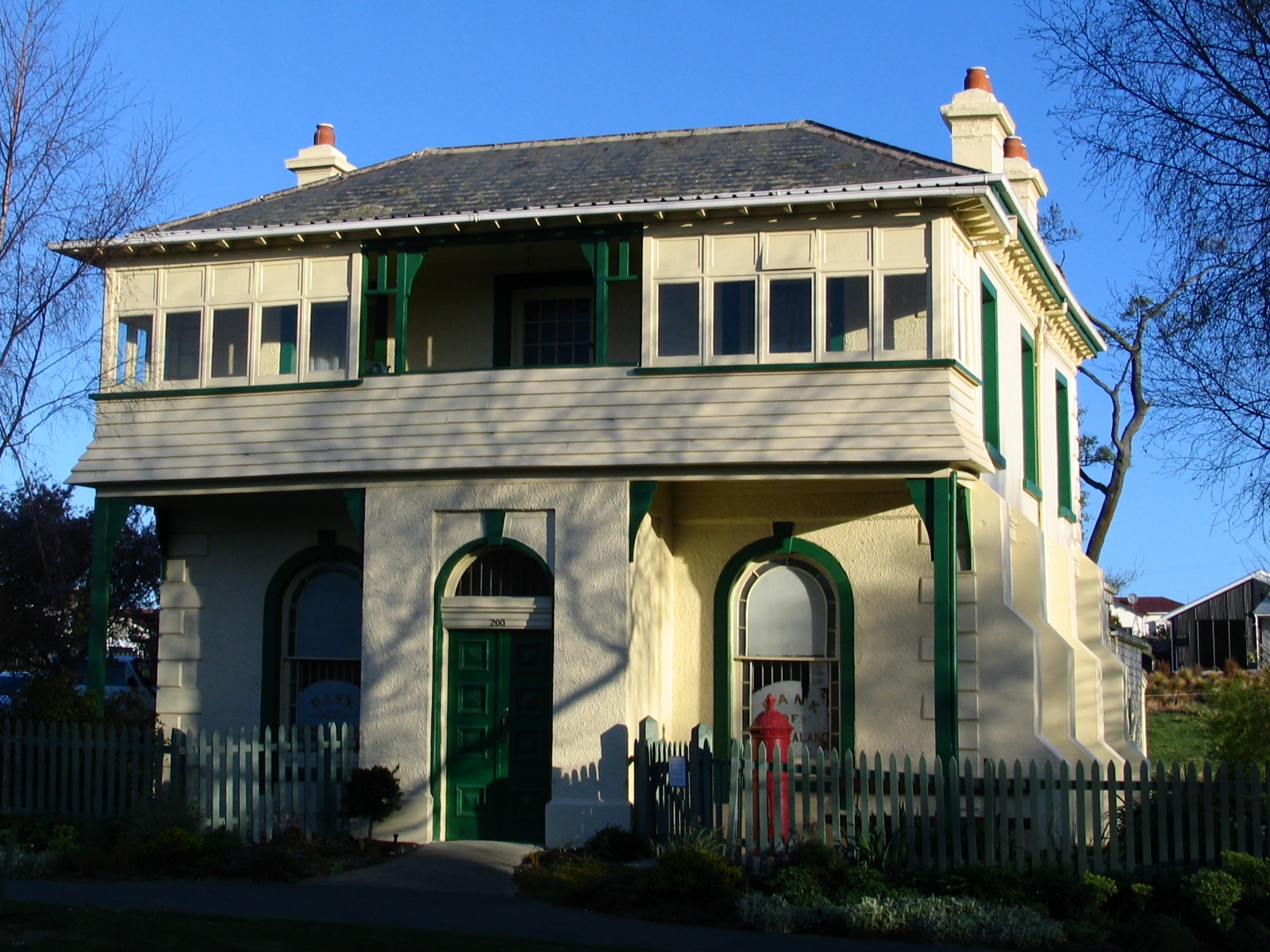
At Waikouaiti the townspeople were pleased with the development of the bank in their town, noting ‘with pleasure several improvements which have of late been prosecuted in the district by our farmers and settlers that speaks of stability and permanency.’ Since its construction it has remained a landmark for the town, being the first notable building in the town when approached from the south.
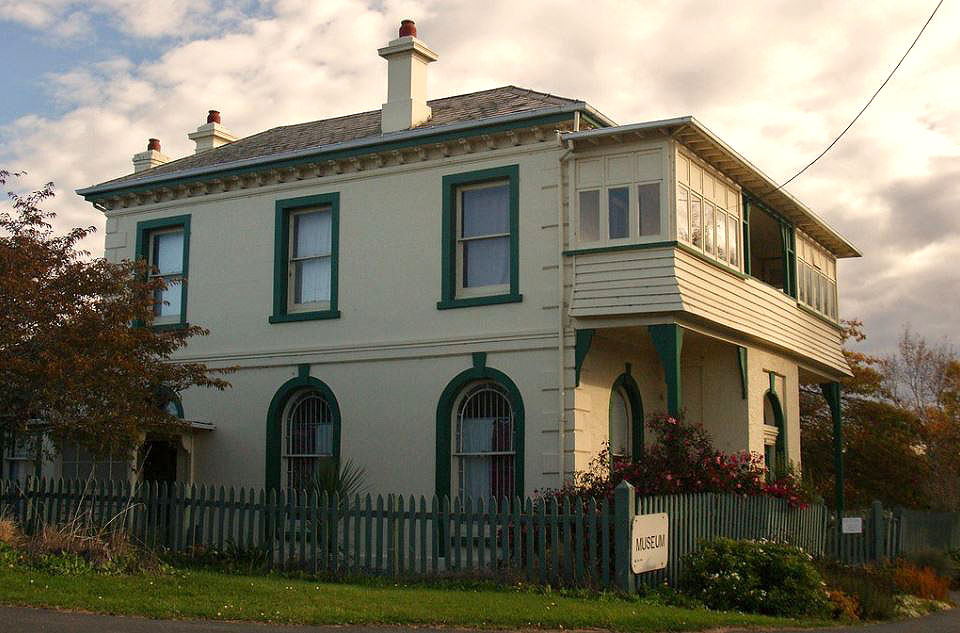
Construction seems to have been delayed as the BNZ’s foundation stone was not laid until 17 April 1869 by BNZ agent H. Pizey. The townspeople turned out in force for the ceremony. A time capsule with coins, a copy of the Wailkouaiti Herald and a scroll commemorating the event was concealed in the stone. Construction was expected to be completed within three months. The Southland Times reported ‘We may remark that the site selected for the Bank is at the junction of Kildare-street with the Main North Road, fronting the latter, and will be built with the beautiful light-brown Pleasant Valley stone.’ The plans show a ‘substantial building…without much pretension to architectural effect, but it will have boldly rusticated coignes, and there will be a projecting porch, 10 ft. [3m] square, to cover the principal doorway. The building will have a frontage of 31ft. and a depth of 50ft [9.4 by 15.2m], and the banking room will occupy the front part to the full width, and to a depth of 18ft [5.4m]. There will be a communication with the manager’s room on one side, and with the residence portion of the building on the other. A strong-room will be built at a distance from any external wall.’ At the rear of the two storey section was a single storey masonry section.
During the 1870s in New Zealand more bank buildings were constructed or re-constructed than at any other period during the nineteenth century. The number of BNZ buildings almost tripled. During this decade capital from abroad was invested freely in New Zealand. Properties rose to high values and money was freely lent upon mortgage. Early designs were relatively restrained. Banking historian Robin Griffin notes with regard to the architecture that ‘the New Zealand bank architects of the 1870s were feeling their way with reasonably economic, bland buildings in young townships so as not to offend either local citizenry with unaccustomed ostentatious displays of wealth or the directors and shareholders with wasteful expenditure’.
In 1885 the building was extended. Lawson advertised for the tenders in May of that year. It is unclear what this tender related to. It may have related to the comparatively utilitarian single storey weatherboard addition beyond the original section single storey masonry portion. The single storey weatherboard addition does not exist in the earliest photograph of the bank, c. 1880s, but is in existence by 1906. It is possible the kitchen was added at this time.
The history of the bank reflected the economic slowdown of the later nineteenth century. Banks consolidated their agencies - the BNZ in Waikouaiti was reduced to an agency of the Palmerston branch (whose own premises were constructed in 1871). The building (minus the banking chamber which still housed the agency) was leased to various tenants.
The bank remained an agency from 1899-1927. The see-saw nature of its status illustrates the rivalry between Waikouaiti and its nearby neighbour Palmerston. Small towns were in competition for scarce resources and the history of the bank, swinging between agency and branch, illustrates this rivalry.
When the bank returned to branch status in 1927, alterations were made to bring it up to standard. The alterations to the building at this time appear to have been limited to the addition of the balcony to the first floor of the front elevation, the addition of a side porch and some minor additions to the rear single storey additions. The internal alterations to the building appear to have been superficial, with insertion of panel ceilings being laid under the earlier lath and plaster ceilings. Thus much of the original features and spatial qualities of the original building remain. This 1927 interior fit out is still largely intact in 2013. The bank returned to agency status again in 1937. An outbuilding was added on the Kildare Street front which housed a garage and cow byre or dairy. It has been suggested that this building was relocated to here from another property, perhaps from Matanaka Farm (Category 1 historic place, Register no, 7787), though this is has not yet been established.
The BNZ finally closed in the 1960s. Extensive repairs and maintenance work were required, beyond what the bank was prepared to undertake. The building was taken over by the Waikouaiti Early Settlers’ Association. Title was transferred to farmer Charles McCallum, runholder Arthur Heckler and solicitor Edwin Laing in 1964 and to the Waikouaiti Early Settlers’ Association Incorporated in 1981.
The Waikouaiti Early Settlers’ Association was founded in 1890. They established the Waikouaiti Museum in 1966 following the gifting of the BNZ building to the association in 1964. The association’s name was changed to Waikouaiti District Museum Society in 1991.
Repairs were made in the passage and the hall in 2002 with rotten boards, joists, bearers and piles replaced. In 2006 further works were carried out to make the building watertight – work on the spouting and drainage. The work was supported by funding from the Community Trust of Otago and the Bendigo Trust.
In 2013 the Bank of New Zealand (Former) remains a historical attraction on the main street of Waikouaiti.