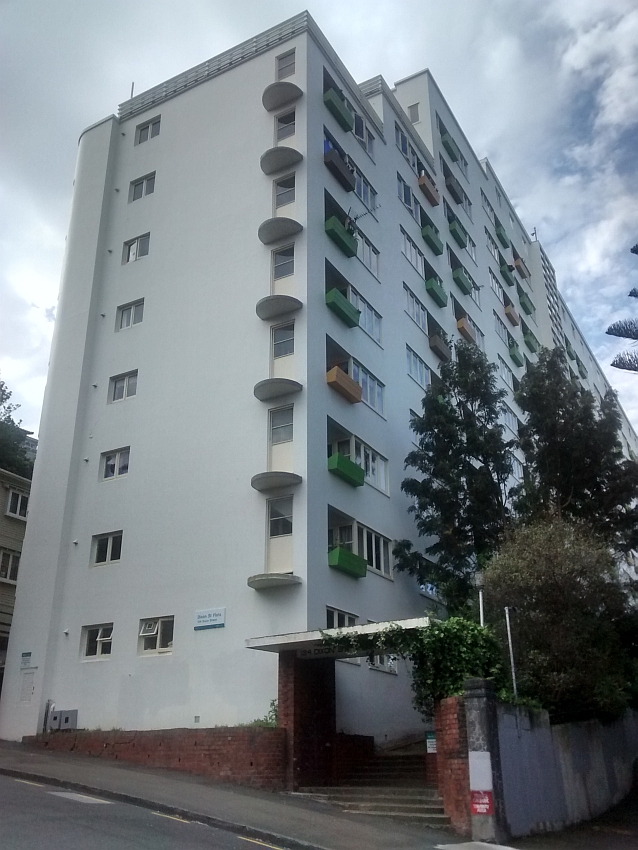
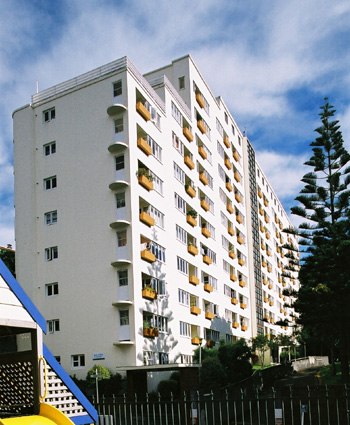
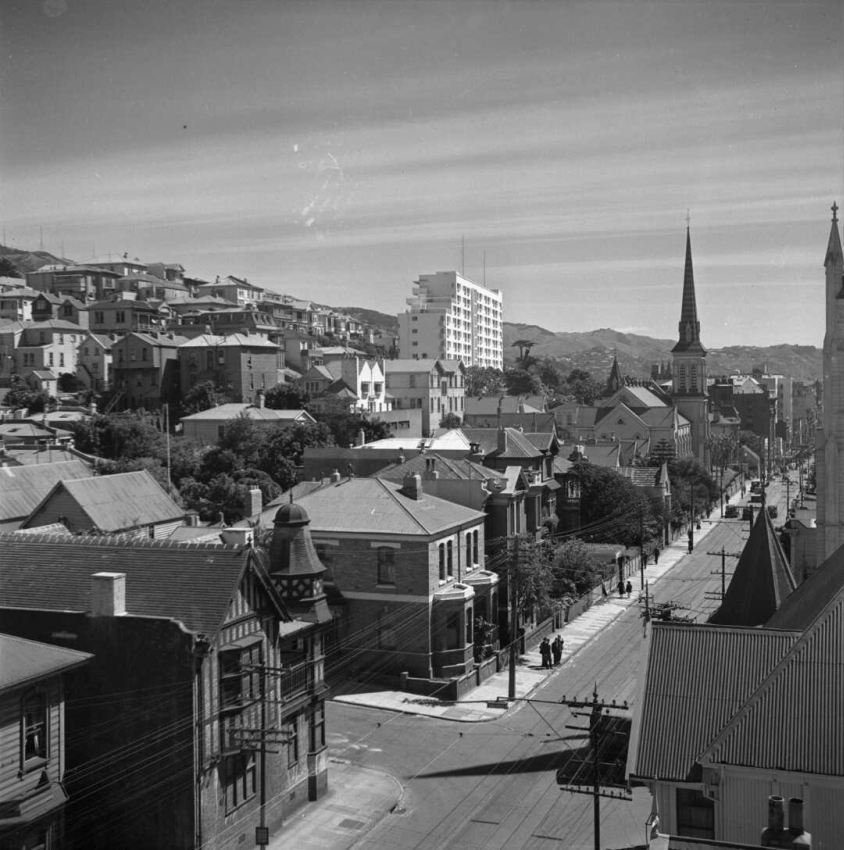
The Dixon Street Flats in central Wellington were completed in 1944 as part of the first Labour Government's state housing programme. They are considered to be the archetype of Modernist apartment blocks in New Zealand.
During the Depression a rapid decline in building construction combined with the mass movement into cities of those looking for work caused an acute housing shortage. The demand caused the price of rental accommodation to soar and many living in the inner city had little choice but to stay in sub-standard, expensive accommodation. Following the principle that decent housing was a fundamental right for all New Zealanders, after their election in 1935 the Labour Government embarked on an extensive housing scheme. Although the scheme is best known for its production of suburban houses, 13 concrete apartment blocks were also erected, as a response to the severity of the housing shortage and critical lack of labour and timber materials caused by the Second World War. Built of load-bearing, reinforced concrete, the Dixon Street Flats were the second block of apartments to be erected by the government after the first apartments were completed in Berhampore, Wellington. Although apartment-style living had been first introduced into New Zealand cities in the 1920s, the Dixon Street Flats marked a new era of domestic architecture.
Given the freedom to experiment, the chief architect of the newly formed Department of Housing Construction Gordon Wilson [1900-1959], designed the Dixon Street Flats according to the principles of the Modernist Movement. Modernist architecture is distinguished by its austere, machine-made and streamlined appearance. The Movement was started in Europe in the 1920s and became strongly associated with the political left. Although not supported by documentary evidence, the esteemed Modernist architect Ernst Plischke, a refugee from Nazi Germany then employed by the Department of Housing Construction, is popularly thought to have had considerable influence over the Dixon Street design. Built between 1941 and 1944 by the Wellington contractor J. L. Wilkins, the ten-storey building was the first slab apartment block in New Zealand. Slab apartment blocks were only one unit deep to maximise privacy and sunlight. Containing 115 one-bedroom units and 1 two-bedroom unit for the caretaker, it was of a magnitude unprecedented in the history of domestic architecture in New Zealand and caused considerable excitement in the local press. The flats were opened, unfinished, on 4 September 1943 - three weeks before the election. The aim was to highlight the Labour Government's progressive outlook and support of the political left. Labour won the election and the flats were finally completed, 100 weeks overdue, in the following year.
Indicating the desperate shortage of housing in the city, 752 applications had been received for the 115 units by 1943. Before completion, the government had let 11 of the units to the Women's Auxiliary Air Force and Army Corps. Upon completion, 20 per cent (later increased to 50 per cent) of the units were allocated to returned servicemen and their wives. The rest were reserved for the elderly, childless couples, and people who had 'interests other than babies and gardens'. Despite the high demand and the praise Wilson received for the building's design, the Dixon Street Flats was criticised by the general public, the main opposition party in government, and even the Labour party itself. The units were not suitable for families and, in a country where the detached, suburban house was held to be every New Zealander's dream, apartment blocks were unpleasantly associated with the slum-like, crowded tenements of Europe. They were also unexpectedly expensive. A single unit cost £1619, approximately £269 more than the average cost of a three-bedroom state house. These factors combined to limit the number of apartment blocks erected by the Labour Government before their fall from power in 1949. Yet the monolithic, modernist design of the Dixon Street Flats was perpetuated in subsequent apartment blocks and as such, the flats can be considered the archetype of modernist apartments in New Zealand. Now managed by Housing New Zealand, the Dixon Street Flats have remained in state hands since their completion and, despite minor changes to the building, continue to serve as a landmark in New Zealand's architectural history.
The Dixon Street Flats have great national, architectural significance. It is a key building in the development of Modern architecture in New Zealand and is one of the first examples of that style in New Zealand. The adoption of a style associated with the political left provides a strong statement of the New Zealand Government's political allegiance during the Second World War and the building has cultural importance for this reason. The building is also noteworthy as the first slab apartment block and as the largest piece of domestic architecture then built in New Zealand. The adoption of the design in subsequent flats makes the Dixon Street building the seminal design in the development of Modernist architecture in New Zealand. The Dixon Street Flats also have historical significance as part of the first Labour Government's extensive housing programme and they highlight the state's awareness of the need to cater for diverse social groups.
During the Depression a rapid decline in building construction combined with the mass movement into cities of those looking for work caused an acute housing shortage. The demand caused the price of rental accommodation to soar and many living in the inner city had little choice but to stay in sub-standard, expensive accommodation. Following the principle that decent housing was a fundamental right for all New Zealanders, after their election in 1935 the Labour Government embarked on an extensive housing scheme. Although the scheme is best known for its production of suburban houses, 13 concrete apartment blocks were also erected, as a response to the severity of the housing shortage and critical lack of labour and timber materials caused by the Second World War. Built of load-bearing, reinforced concrete, the Dixon Street Flats were the second block of apartments to be erected by the government after the first apartments were completed in Berhampore, Wellington. Although apartment-style living had been first introduced into New Zealand cities in the 1920s, the Dixon Street Flats marked a new era of domestic architecture.
Given the freedom to experiment, the chief architect of the newly formed Department of Housing Construction Gordon Wilson [1900-1959], designed the Dixon Street Flats according to the principles of the Modernist Movement. Modernist architecture is distinguished by its austere, machine-made and streamlined appearance. The Movement was started in Europe in the 1920s and became strongly associated with the political left. Although not supported by documentary evidence, the esteemed Modernist architect Ernst Plischke, a refugee from Nazi Germany then employed by the Department of Housing Construction, is popularly thought to have had considerable influence over the Dixon Street design. Built between 1941 and 1944 by the Wellington contractor J. L. Wilkins, the ten-storey building was the first slab apartment block in New Zealand. Slab apartment blocks were only one unit deep to maximise privacy and sunlight. Containing 115 one-bedroom units and 1 two-bedroom unit for the caretaker, it was of a magnitude unprecedented in the history of domestic architecture in New Zealand and caused considerable excitement in the local press. The flats were opened, unfinished, on 4 September 1943 - three weeks before the election. The aim was to highlight the Labour Government's progressive outlook and support of the political left. Labour won the election and the flats were finally completed, 100 weeks overdue, in the following year.
Indicating the desperate shortage of housing in the city, 752 applications had been received for the 115 units by 1943. Before completion, the government had let 11 of the units to the Women's Auxiliary Air Force and Army Corps. Upon completion, 20 per cent (later increased to 50 per cent) of the units were allocated to returned servicemen and their wives. The rest were reserved for the elderly, childless couples, and people who had 'interests other than babies and gardens'. Despite the high demand and the praise Wilson received for the building's design, the Dixon Street Flats was criticised by the general public, the main opposition party in government, and even the Labour party itself. The units were not suitable for families and, in a country where the detached, suburban house was held to be every New Zealander's dream, apartment blocks were unpleasantly associated with the slum-like, crowded tenements of Europe. They were also unexpectedly expensive. A single unit cost £1619, approximately £269 more than the average cost of a three-bedroom state house. These factors combined to limit the number of apartment blocks erected by the Labour Government before their fall from power in 1949. Yet the monolithic, modernist design of the Dixon Street Flats was perpetuated in subsequent apartment blocks and as such, the flats can be considered the archetype of modernist apartments in New Zealand. Now managed by Housing New Zealand, the Dixon Street Flats have remained in state hands since their completion and, despite minor changes to the building, continue to serve as a landmark in New Zealand's architectural history.
The Dixon Street Flats have great national, architectural significance. It is a key building in the development of Modern architecture in New Zealand and is one of the first examples of that style in New Zealand. The adoption of a style associated with the political left provides a strong statement of the New Zealand Government's political allegiance during the Second World War and the building has cultural importance for this reason. The building is also noteworthy as the first slab apartment block and as the largest piece of domestic architecture then built in New Zealand. The adoption of the design in subsequent flats makes the Dixon Street building the seminal design in the development of Modernist architecture in New Zealand. The Dixon Street Flats also have historical significance as part of the first Labour Government's extensive housing programme and they highlight the state's awareness of the need to cater for diverse social groups.