Taumarunui was an important Maori settlement long before Tasman visited New Zealand. As with Maori, European settlers initially established themselves on the coasts, eventually working their way inland, so Taumarunui, in the centre of the North Island surrounded by difficult terrain, was settled relatively late by Europeans compared to much of New Zealand. The King Country has been described as 'New Zealand's last frontier'. Even in the mid-19th Century, Taumarunui was peopled mostly by Maori, with only the occasional Pakeha. The Maori inhabitants were initially not particularly welcoming of Pakeha, wishing to retain sovereignty over their land. It is still referred to as 'Taumarunui Maori Township' on some official documents. For the first few decades of Pakeha settlement, land was available only for lease. The area finally opened up in the late 19th century with the development of the main trunk railway and the apparently insatiable demand for timber. For many years sawmilling was by far the main industry in the King Country, with sheep farming next in importance.
When the first Post Office opened in Taumarunui in 1885 (under the name 'Taumaranui') as part of the Hamilton Postal District, it was primarily intended to service railway construction. Mail was brought from Te Awamutu by Maori on horseback, a journey that took 2-3 days - there was no proper road. The PO was to close just two years later. It was not until 1900 when the Main Trunk line reached Ongarue and the track formation work had reached Taumarunui that European settlement of Taumarunui really got started. The PO reopened in 1902 in Langmuir & Richards Store. Langmuir incorporated postal duties into his travelling salesman duties, delivering mail to Ongarue once a week, staying the night then returning the following day with mail and stores for Taumarunui.
The railway reached Taumarunui in 1903, and on the first of January the PO was placed under the administration of the Railway Department. 'The small railway station, situated then on the eastern side of the railway, served also as a Public Works Pay Office, Post Office, registration office for births, marriages and deaths [one of] the only buildings of a permanent nature in this hamlet'. By 1904 Alexander Hatrick's Wanganui River services began, serving settlers, tourists and those wanting to connect with the railway. Taumarunui became known all over the world as the start of Hatrick's Wanganui River Trip. The local newspapers began in 1906, allowing the Postmaster to include notices on the daily mail services and for The Junction Hotel to advertise 'telegrams promptly attended to'. The town's population started to boom after the Main Trunk Railroad was opened in 1908.
A purpose built post office was opened on the 19 June 1909 in Miriama Street. It incorporated the postmaster's residence and a paddock. On the 12 June 1911 a telephone system was introduced, with 26 subscribers. By 1912 additions were made due to a rapid increase in business. However, these were also soon outgrown and the postmaster was required to move out so his accommodation could be converted to workspace. Subsidiary buildings included the 1918 Benzine store and a garage. By at least January 1927 there were calls by the local chamber of commerce and others for a brand new post office.
Initial approval was given, plans were developed and tenders called for the current building in 1929, but as the Great Depression deepened and government revenue fell, Public Works spending was slashed. Work on the new Post Office, originally intended to be completed by the end of 1932, was put on hold. However, the government was repeatedly lobbied by both the MP Mr F Langstone and by the Taumarunui Borough Council to resume work, emphasising the inadequacy of the 1909 building to serve a population, which had grown four-fold. .
The Government Architect's plans for the Post Office had been announced in September 1931, 7 months after the Hawkes Bay earthquake. However, when permission to resume work on the Post Office was granted by Cabinet on 12 Oct 1933, the plans had been revised with earthquakes in mind. The Government Architect, JT Mair, took part in the reconstruction of Napier after the February 1931 earthquake, designing new government buildings such as the Ministry of Works building and the telephone exchange. It appears that his experiences working in that environment led to the revision of the plans to incorporate earthquake strengthening and perhaps fire resistant qualities. It was expected that 'the building will be the most modern and outstanding edifice in Taumarunui, with the exception of the Public Hospital'.
A tender for the work of £14,156 was accepted in January 1934, with construction beginning soon after on the previously empty paddock next to the 1909 Post Office. While the builder awarded the tender, WH Whittaker, was based in Auckland, he was known in the district for his work on other local buildings such as the Technical School and the Enterprise buildings.
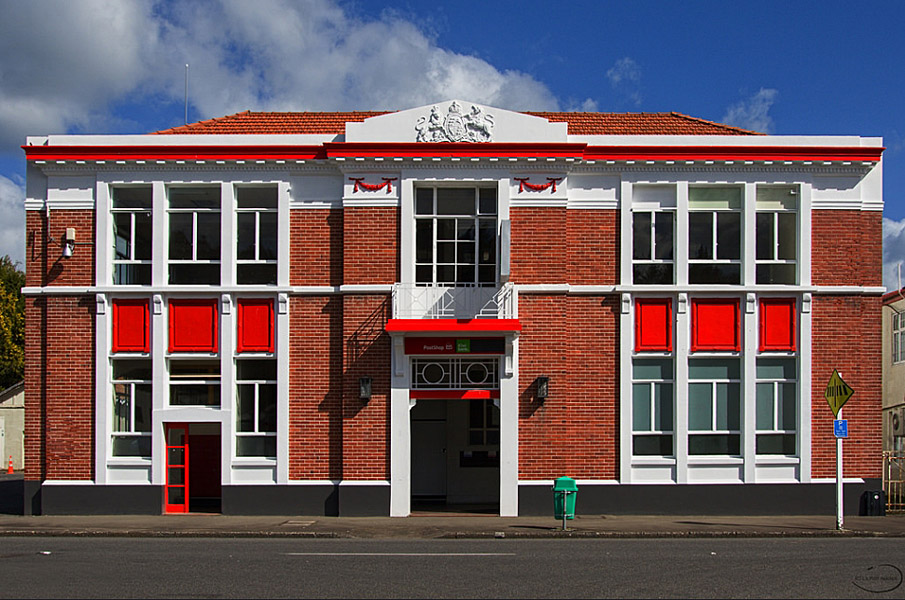
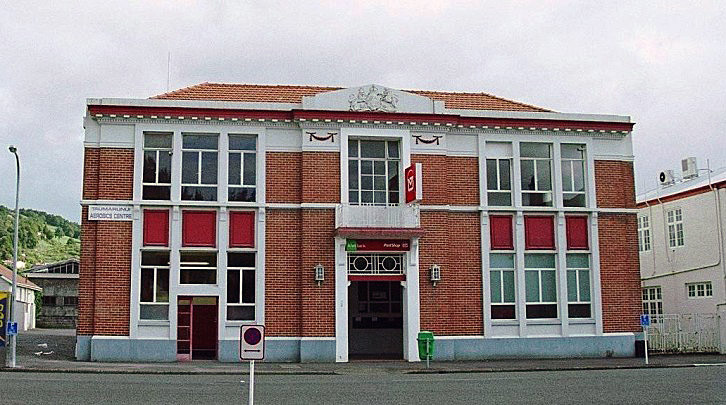
The building was described at the time as being in the Renaissance style, two storied reinforced concrete with brick panels on the frontage and a Marseilles tiled roof. The combination of reinforced concrete with brick features can be seen in other buildings of the period, such as the Auckland Railway Station (1929) and the Tui Brewery building (begun 1935). The combination of new technology with a classical finish is perhaps best seen in the F de J Clere AMP building opened in Wellington in 1925 which Mair is likely to have seen. It was 'a style that influenced much public and commercial architecture of the 1920s in the United States. [The AMP] building displays the traditional approach of finance houses and insurance companies - a clinging to the classical and formal qualities of architecture'. Appropriate for a building that incorporated the Post Office Savings Bank. In addition, the fasces are a classical symbol of governmental power and authority, and seen 'prominently among the architectural ornaments of a number of government buildings in Washington: on and around the speakers' podium in the chambers of both the Senate and the House of Representatives, at the entrance to the National Archives, etc'. Mair studied and started his architectural career in the United States, so it is likely that he maintained an interest in the developments there.
One of the features of the Post Office building was the use of large windows to give plenty of natural light. The skylights have since been covered over, suggesting the plan may have been too successful. The design was frequently described as spacious, allowing for future growth. At the rear of the section another smaller building was constructed for the linesmen, known as the P&T shed, currently sometimes referred to as 'the white shed.' The PO was responsible for all government vehicles, so the project also included a new garage for servicing vehicles and a petrol pump, no longer in existence. A 'destructor' was also installed (possibly an incinerator or a rubbish compactor).
In a pattern begun during the depression, wherever possible, Mair used locally-sourced materials and workmanship. This included the roofing made by the Taumarunui Winstone's tile works and joinery by Messrs Ross and Harnett. According to the Taumarunui Press, the counter Ross & Harnett built “... is said to be of a better finished article than could have procured in Wellington or elsewhere and reflects great credit on the Taumarunui firm.”
Work went well and it was completed ahead of schedule in 1935, fifty years after the first Post Office was opened in Taumarunui.
Taumarunui long ago arrived at the stage in its progress when it needed a postal building fitting its size and the requirements of the large volume of business that is done in the local post office. The new building no doubt will be an edifice that will add dignity to the town and that will give the local officials the equipment which will enable them to handle the growing business of the office adequately for many years to come... It was only after persistent representations to the Government that Taumarunui got its new post office.
The new post office provided a focal point for civic pride, expressing recognition of the area's growth and renewed economic confidence. The post office was a substantial undertaking for the area, budgeted at £14,500 in 1934, against 38 other building consents for Taumarunui in the same year with a total expected value of £8,457 (more than double the previous year). Despite many new homes being built, rental accommodation was at a premium and the number and value of building permits had swelled again after the depression.
The new building was not just important to Taumarunui, but to the whole district. In preparing for the opening, the Mayor of the Ohura County Council, Jason Caird, 'said the speakers should stress the importance of having Taumarunui made a district post office centre. Why should we be under Hamilton? A movement was on foot to have the centre shifted from Hamilton to New Plymouth, but it should be shifted now to Taumarunui as the centre of the King Country'. This sentiment was expressed at least twice on the day of opening. Planning for the opening included senior representatives from the Taumarunui Borough Council, Taumarunui County Council, Manunui Town Board, Kaitieke County Council, Ohura County Council, not to mention the local Hospital Board, the Public Works Department and of course the local Postmaster, Mr OE List. The festivities were jointly paid for by the various local councils represented.
Although the wiring for telegraph and telephone departments (including the latest manual telephone exchange, known as a branching multiple) were not finished, the building was opened 25 January 1935 on what was described as a “red letter day for Taumarunui” by the Hon Adam Hamilton, Post Master General. (Earlier in the day a young boy climbed onto the dais and sternly announced the Post Office officially open, but his speech was cut short by another boy pinching his leg. ) The Post Office is believed to be the first building opened in Taumarunui by a Government Minister. It was the first visit by a MP for some years. The public was invited to the event and shops were closed for an hour and a half in support. Some of Miriama Street was cordoned off to traffic. Lines of flags were borrowed from either the Auckland City Council or the Auckland GPO to decorate the streets and the dais, constructed in front of the Post Office by the Taumarunui Borough Council with the assistance of Mr Hooker of the Public Works Department. The Union Jack flew from the new Post Office flagpole. A large crowd of 2-3,000 residents of the district attended the opening ceremony.
Speeches were given by the Taumarunui Mayor (CA Boles), F Langstone MP and the Postmaster General (the Hon Adam Hamilton). Langstone noted that Taumarunui was at the apex of three districts: Auckland, Wellington and Taranaki. He predicted that as a result of coal deposits and the large tract of native forests Taumarunui would become one of the largest inland boroughs in New Zealand. Regarding the Post Office building, he stated:
... as far as post offices went in country districts it was all that they could desire. When they saw the joinery work, the rimu doors and the magnificent counter, they would appreciate the value and suitability of New Zealand timbers for this class of work.
They were joined on the dais by the chairmen and representatives of the various local bodies, the Chief Postmaster from Hamilton, the Te Kuiti postmaster, the Taumarunui Postmaster and various other dignitaries. Mr R Stewart represented Whittaker and Co.
The first stamp from the stamp vending machine in the vestibule was sold to Hon Mr Hamilton, who also sent the first telegram, addressed to the Prime Minister. There was a rush by children to buy stamps as mementoes of the occasion.
At the time it opened, the Taumarunui Post Office employed: a postmaster, a supervisor, five exchange attendants and clerks, ten telephonists and clerks, two messengers, four message-boys, one postman, one line foreman, two linemen, a lineman chauffeur and a faultman. The telephone exchange operated 24 hours and served approximately 480 subscribers.
The building is designed for the comfort and safety of not just the public but staff as well (despite being designed in a period of high levels of unemployment), emphasising fresh air, natural light, spaciousness and an attention to detail.
Peter Shaw's father ran a furnishing shop in Taumarunui in the 1950s. Shaw remembers how the Post Office post box lobby provided an opportunity for local businessmen to meet and talk while they collected their mail.
Thinking ahead, the NZPO retained the old post office building, but sublet it to various government departments, as retaining the land would allow for the new post office to expand if required. However, in December 1966 a demolition permit for the old post office was issued to allow for the construction of a new court house which required part of the site occupied by the old building. The new courthouse was completed in 1970.
Plans were drawn in 1951 to sympathetically alter the garages, which still appear in an aerial photograph taken in October 1967, but they have since been demolished or removed.
In 1987 the government split off Telecom and Post Bank Ltd (Postbank), with the third component, NZ Post [Shop], remaining in building. Later Kiwibank was incorporated. In Nov 1990 internal alterations were planned, these included the renovation of the ground floor toilets and reorganising the shop space. In 1998 Opus approved the occupancy by Exercise Fitness studio on 1st Floor. They altered some of the flooring, eventually moving out in mid-2004.
On the 5 October 1999 approval was given for the vacant P&T building at the rear to be used as workshop for six people to produce garden furniture. They vacated the building after at least two years occupancy in April this year.
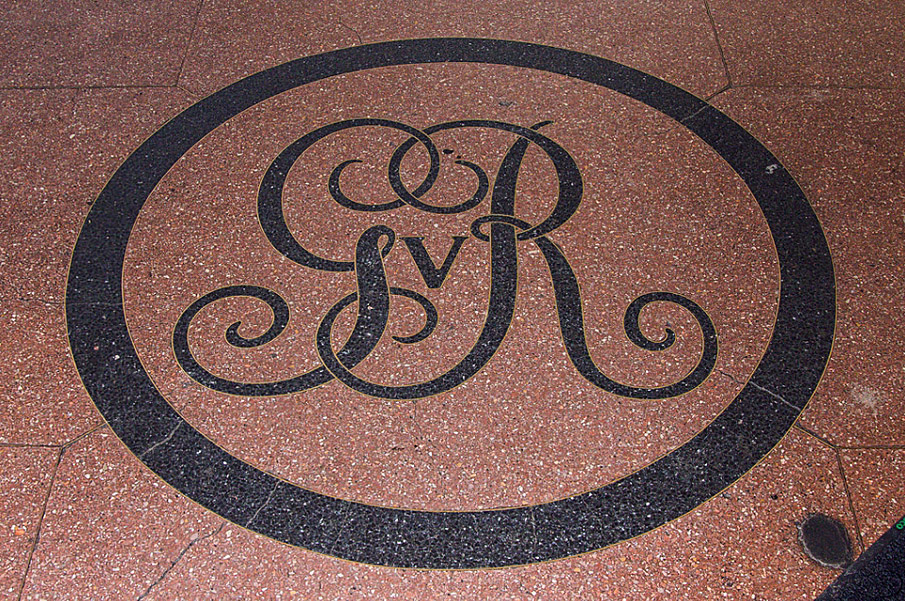
The main building has been in continuous use as a Post Office since it was opened in 1935, an increasingly rare occurrence, and is a good example of government building design of the early 1930s, incorporating some of the lessons learned from the Hawkes Bay earthquake. The building was designed as the world was coming out of a period of instability and beginning to hope again. This was a time where the Post and Telegraph Department was one of the largest government departments and an important source of government income. The building's owners would have wanted a building that conveyed dependability. Solidarity, stability, power and authority is conveyed through the architect's use of a very high stud, thick concrete walls, design minimizing risk from earthquake and fire, plus subtle quality detailing. Despite some minor alterations and a need for maintenance, it is still arguably one of the most impressive buildings in Taumarunui. Like many rural communities, Taumarunui is struggling to find a significant point of difference to encourage strong growth again, with the Post Office standing as a somewhat run-down symbol of more prosperous, optimistic times.