

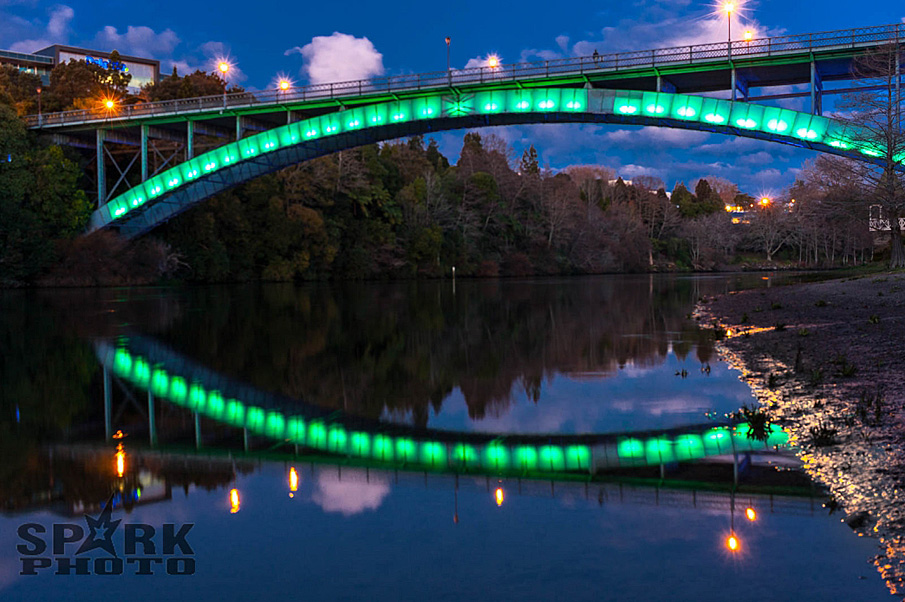
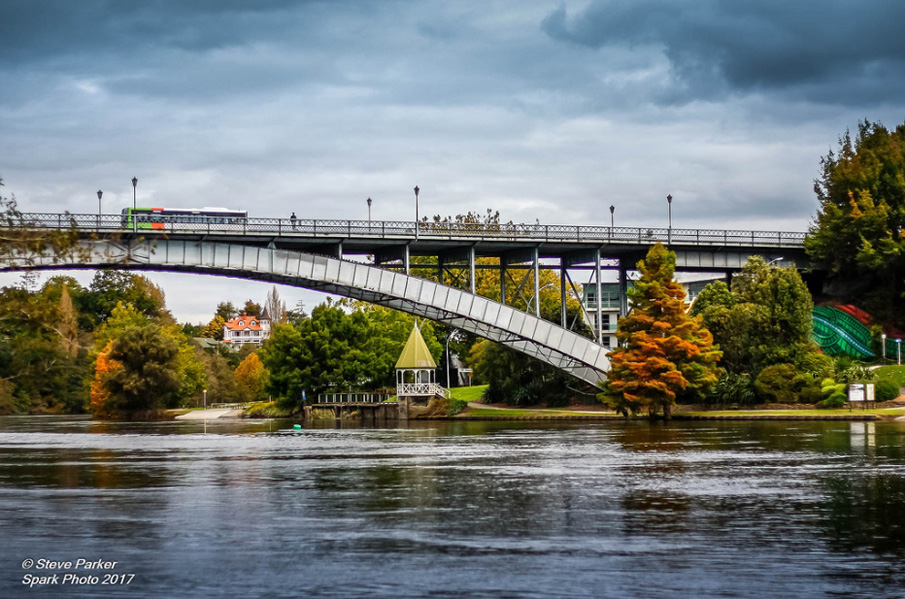
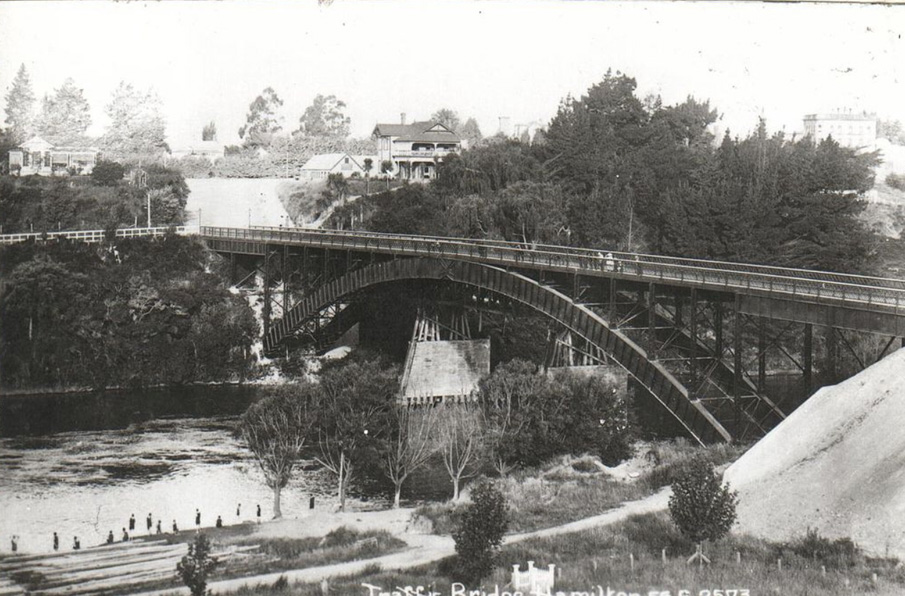
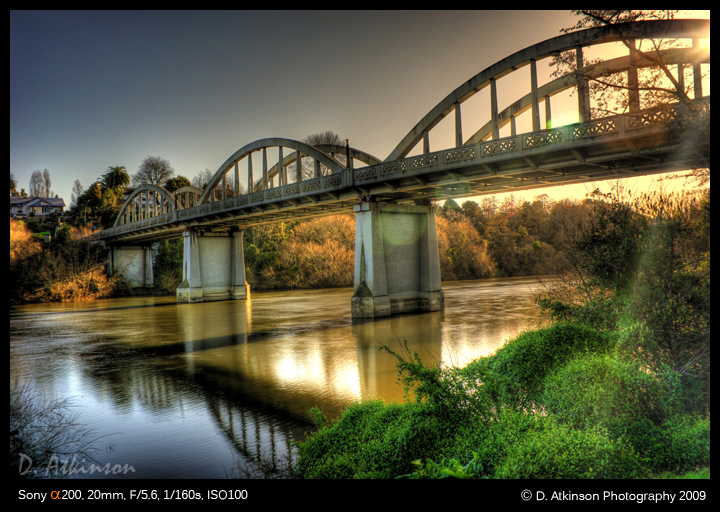
The bridge is of open spandrel construction, with a three-pinned central arch of 104 m and two approach spans. Its design was unusual in New Zealand for the combined length and low height of its main span. The structure is believed to have been partly conceived by Waddell and Harrington of Kansas City, who had created the first vertical lift-bridge in the world, while the prominent New Zealand engineer James Fulton supervised its construction for the borough. The international nature of the project was reinforced by the steelwork being prefabricated in Britain by the Cleveland Bridge Company, and shipped over for erection on site. The reinforced concrete deck of the original structure was designed to carry trams, and accommodated two traffic lanes with a separate pavement for pedestrians. Later subsidence of the foundations led to a lighter, steel-framed deck being installed in the 1930s, which was claimed as the earliest of its type outside Canada. This was removed during a widening of the carriageway for safety reasons in 1992.
Victoria Bridge is nationally significant as one of the most accomplished steel-arch road bridges in New Zealand erected by a local authority. It was an ambitious project, designed and supervised by engineers of national and international renown. It increases our understanding of this country's engineering and trading links with North America and Britain, and makes a valuable contribution to the history of transport and technology in New Zealand, including the rise of motorised traffic in provincial towns. The structure has considerable historical value for demonstrating the leadership and ambition of local authorities, including borough councils, in the years after New Zealand became a Dominion in 1907. It reflects Hamilton's growth and prosperity in the early 1900s and its position as the major settlement in the Waikato. The bridge is important for marking the earliest crossing of the Waikato in colonial Hamilton and is a significant local landmark. It enjoys public esteem as an elegant addition to the urban landscape, and has additional value for its association with other historic bridges over the Waikato River.
List Entry Information
Status
Listed
List Entry Status
Historic Place Category 1
Access
Able to Visit
List Number
772
Date Entered
30th August 1990
Date of Effect
30th August 1990
City/District Council
Hamilton City
Region
Waikato Region
Status
Listed
List Entry Status
Historic Place Category 1
Access
Able to Visit
List Number
772
Date Entered
30th August 1990
Date of Effect
30th August 1990
City/District Council
Hamilton City
Region
Waikato Region
Construction Professional
Name
Waddell and Harrington
Type
Engineer
Biography
No biography is currently available for this construction professional
Name
Fulton, James Edward
Type
Engineer
Biography
Fulton (1854-1928) was one of New Zealand's most prominent engineers. Born in Dunedin in 1854 he worked for a short time as an engineer in flax mill. He was then appointed cadet in the Public Works Department. In 1875 he was transferred to Napier where in 1878 he was promoted to Assistant Engineer in 1878. In 1880 he entered private practice. In 1882 he was Resident Engineer for the Palmerston-Waikanae section of the Wellington-Manawatu Railway, and in 1889 he became manager and locomotive superintendent of the railway. From 1897 he designed and built the Kelburn Cable Tramway, the original Kelburn Viaduct across Tinakori Gully and numerous bridges, including the Ballance Bridge over the Manawatu River, and the Otaki, Ohau, Rangitikei, Lower Shotover Bridges. He designed and built railways for timber companies in the Central North Island. In 1906 he visited the United States, Great Britain, and Europe to study advances in bridge and railway engineering. He worked on the Leamington Bridge on his return. He was an active member of professional engineering bodies in New Zealand and is now commemorated by the Fulton Bequest for the present day Institution of Professional Engineers in New Zealand.
Construction Details
Start Year
1864
Finish Year
1877
Type
Other
Description
Site of ferry crossing
Start Year
1877
Finish Year
1908
Type
Other
Description
Site of Union Bridge
Start Year
1908
Finish Year
1910
Type
Original Construction
Description
Construction of Victoria Bridge
Start Year
1920
startYearCirca
Type
Modification
Description
Tar seal over jarrah timber road surface
Start Year
1937
Type
Modification
Description
Replacement of concrete deck
Start Year
1976
Finish Year
1979
Type
Modification
Description
Repairs and repainting
Start Year
1992
Type
Modification
Description
Widening of deck and conservation
Notable Features
Registration covers the structure, its fixtures and finishes. It also includes recent modifications.
Construction Professional
Name
Waddell and Harrington
Type
Engineer
Biography
No biography is currently available for this construction professional
Name
Fulton, James Edward
Type
Engineer
Biography
Fulton (1854-1928) was one of New Zealand's most prominent engineers. Born in Dunedin in 1854 he worked for a short time as an engineer in flax mill. He was then appointed cadet in the Public Works Department. In 1875 he was transferred to Napier where in 1878 he was promoted to Assistant Engineer in 1878. In 1880 he entered private practice. In 1882 he was Resident Engineer for the Palmerston-Waikanae section of the Wellington-Manawatu Railway, and in 1889 he became manager and locomotive superintendent of the railway. From 1897 he designed and built the Kelburn Cable Tramway, the original Kelburn Viaduct across Tinakori Gully and numerous bridges, including the Ballance Bridge over the Manawatu River, and the Otaki, Ohau, Rangitikei, Lower Shotover Bridges. He designed and built railways for timber companies in the Central North Island. In 1906 he visited the United States, Great Britain, and Europe to study advances in bridge and railway engineering. He worked on the Leamington Bridge on his return. He was an active member of professional engineering bodies in New Zealand and is now commemorated by the Fulton Bequest for the present day Institution of Professional Engineers in New Zealand.
Construction Details
Start Year
1864
Finish Year
1877
Type
Other
Description
Site of ferry crossing
Start Year
1877
Finish Year
1908
Type
Other
Description
Site of Union Bridge
Start Year
1908
Finish Year
1910
Type
Original Construction
Description
Construction of Victoria Bridge
Start Year
1920
startYearCirca
Type
Modification
Description
Tar seal over jarrah timber road surface
Start Year
1937
Type
Modification
Description
Replacement of concrete deck
Start Year
1976
Finish Year
1979
Type
Modification
Description
Repairs and repainting
Start Year
1992
Type
Modification
Description
Widening of deck and conservation
Notable Features
Registration covers the structure, its fixtures and finishes. It also includes recent modifications.
Historical and Associated Iwi / Hapū / Whānau
Completion Date
21st November 2001
Report Written By
Martin Jones
Information Sources
Gibbons, 1977
P.J. Gibbons, Astride the River: A History of Hamilton, Christchurch, 1977
Hudson, 1993
Patrick Hudson, Bridges of New Zealand, Wellington, 1993
Murray-North Ltd., 1990
Murray-North Ltd., 'Victoria Bridge Upgrading Investigations', unpublished report, Hamilton, 1990 (held by NZHPT, Auckland)
New Zealand Historic Places Trust (NZHPT)
New Zealand Historic Places Trust
Thornton, 2001
Geoffrey Thornton, Bridging the Gap, Early Bridges in New Zealand 1830-1939, Auckland, 2001
Other Information
This place was identified as significant under previous legislation with different information requirements. It remains significant under the current legislation. There is opportunity under our legislation and policies to add to this information. Further information about this place may be available from the Lower Northern Office of Heritage New Zealand Pouhere Taonga. Please note that entry on the New Zealand Heritage List/Rarangi Korero identifies only the heritage values of the property concerned, and should not be construed as advice on the state of the property, or as a comment of its soundness or safety, including in regard to earthquake risk, safety in the event of fire, or insanitary conditions.
Historical and Associated Iwi / Hapū / Whānau
Completion Date
21st November 2001
Report Written By
Martin Jones
Information Sources
Gibbons, 1977
P.J. Gibbons, Astride the River: A History of Hamilton, Christchurch, 1977
Hudson, 1993
Patrick Hudson, Bridges of New Zealand, Wellington, 1993
Murray-North Ltd., 1990
Murray-North Ltd., 'Victoria Bridge Upgrading Investigations', unpublished report, Hamilton, 1990 (held by NZHPT, Auckland)
New Zealand Historic Places Trust (NZHPT)
New Zealand Historic Places Trust
Thornton, 2001
Geoffrey Thornton, Bridging the Gap, Early Bridges in New Zealand 1830-1939, Auckland, 2001
Other Information
This place was identified as significant under previous legislation with different information requirements. It remains significant under the current legislation. There is opportunity under our legislation and policies to add to this information. Further information about this place may be available from the Lower Northern Office of Heritage New Zealand Pouhere Taonga. Please note that entry on the New Zealand Heritage List/Rarangi Korero identifies only the heritage values of the property concerned, and should not be construed as advice on the state of the property, or as a comment of its soundness or safety, including in regard to earthquake risk, safety in the event of fire, or insanitary conditions.
Current Usages
Uses: Transport
Specific Usage: Bridge/ Viaduct
Web Links
description: Engineering NZ Heritage
url: https://www.engineeringnz.org/our-work/heritage/heritage-records/victoria-bridge-hamilton/
Current Usages
Uses: Transport
Specific Usage: Bridge/ Viaduct
Web Links
description: Engineering NZ Heritage
url: https://www.engineeringnz.org/our-work/heritage/heritage-records/victoria-bridge-hamilton/
Location
Related listings
Sign up to hear more
Get the latest heritage news, features and events delivered
straight to your inbox.
