Historical Description and Analysis:
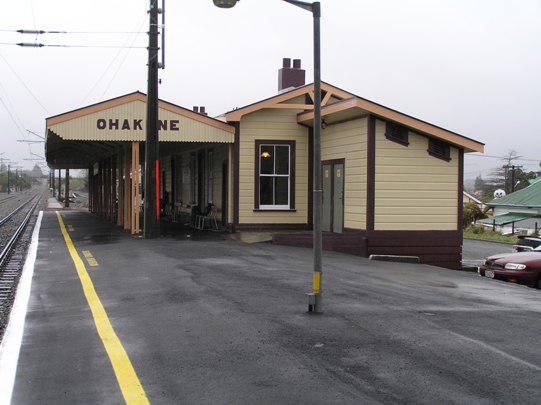
The Ohakune Railway Station was [built circa 1908] when the North Island Main Trunk (NIMT) [was likewise completed]. In the early 20th century the Station provided the impetus for the settlement and development of the North Island's Central Plateau. Together with the Signal Box, built at Paekakariki Station in 1909 and relocated to Ohakune Junction in 1991, these structures are integral components and the centrepieces of the rail heritage precinct at Ohakune Junction.
Ohakune and the NIMT:
The origin of Ohakune's place name is uncertain, but it is believed to have been derived from the personal name, Hakune, which means be deliberate or careful. Despite the name being of Maori origin there is little evidence of pre-European settlement at Ohakune, although it is recorded that in the mid-1600s there was a small pa on the site of present day Ohakune Village. Although this settlement no longer existed, several iwi and hapu used the area as a hunting ground until European settlement began at Ohakune in the late 19th century. At this time Ohakune was an area of pristine sub-alpine native bush, criss-crossed by a complex web of walking paths. What would become the location of the Ohakune Railway Station and Signal Box was a fairly open and level area of land on the western side of Mt Ruapehu.
The relatively untouched nature of the Central Plateau, with its timber resources and land for settlement, were significant motivators for the connecting of North Island's two main cities, Auckland and Wellington, by rail. The concept of the NIMT was promoted by Julius Vogel (1835-1899), then the Colonial Treasurer in William Fox's government, as part of his bold expansionist policy which was adopted by the House in 1870. This policy planned to purchase Maori land for European settlement, and to bring thousands of assisted immigrants to New Zealand, to construct roads, railways, bridges, and telegraph lines.
From the mid-1860s Maori in the central North Island had repelled European encroachment by establishing, and staunchly upholding, the restricted area known as the Rohe Potae, and the governments of the late 19th century saw the construction of the NIMT as a tool for gaining access to the King Country. In 1883, after a decade of persistent approaches from the government regarding the area, talks between officials and some King Country chiefs regarding the establishment of the railway through their land began in earnest. A series of rigorous negotiations was then initiated with two Ngati Maniapoto leaders, Wahanui Hautare and Rewi Maniapoto.
There seems to have been a feeling that the railway and European incursion into the King Country was inevitable, but these chiefs wanted to make sure that it was on their terms. In late 1884 Wahanui announced his intention to cooperate with the government over the railway, and he laid out a set of conditions before the House of Representatives on 1 November 1884. The conditions included the right of the King movement to manage their own affairs, the banning of liquor from Waikato-Ngati Maniapoto territory, the right of his people to have sole responsibility for administering their ancestral lands, and that they were compensated for the land which was used. Following this, in early 1885 surveyors were allowed into the Rohe Potae to locate possible railway routes. Because of the tenuous relationship between the Crown and King Country iwi it was felt that the negotiation process was essential. However, by only consulting with Wahanui and Maniapoto the government purposely side-stepped King Tawhiao and other leaders who opposed the railway. Therefore, this initial agreement was not universal and accordingly there were instances of resistance, such as the destruction of surveying marks.
Despite some opposition, surveying and construction plans continued and on 15 April 1885 it was Wahanui who wielded the shovel that turned the NIMT's first sod, which was then ceremonially wheeled away by Premier Robert Stout. Prior to the chiefs allowing surveyors into the Rohe Potae, possible railway corridors through the King Country were only speculative because there had not been any previous opportunity to map it in detail. There were several proposed routes for the NIMT and John Rochfort (1832-1893) surveyed for a possible corridor through the Central Plateau between 1883 and 1887 and he based himself at Ohakune. This was said to be his tour de force because he had to start from scratch and cover a large and topographically complex area. After much debate and delay it was Rochfort's route that NIMT eventually followed. The Maori land that this route required progressively passed into Crown ownership under the Public Works Acts of 1882 and 1894. This legislation stipulated that construction could not begin until the governor issued a proclamation detailing the middle-line that each successive section would take.
As the railway was designed to facilitate settlement in the Central Plateau, the government also began surveying townships with the plan that these towns would exploit the Plateau's rich timber resources. The timber would be milled for housing and other uses until the land was cleared, at which time it could be utilised for agricultural or horticultural purposes. People then began settling in the Ohakune area on the understanding that the construction of the railway, essential for the transport of timber, was imminent. As the railhead got closer the population of the township increased, and in the two years before the railway was officially completed in 1908, Ohakune's population rose exponentially from under 100 to 600 residents. A significant contributor to this was the fact that the railway was directly responsible for creating and maintaining employment opportunities in the area.
Ohakune Railway Station:
In 1905 Ohakune became a centre of operations for the 'final push' to complete the NIMT. With this came important engineers such as F.W. Furkert, J.J. Hay, and P.S. Hay, the workforce for the construction of the track, viaducts, buildings, and residences, as well as operating staff and support businesses. With the approach of the southern railhead Ohakune required [temporary] station [buildings] and [work on the permanent railway station only began in 1907]. The Ohakune [station yard and buildings were] constructed away from the township, adjacent to the tracks on Urunga Street, now known as Thames Street. At the time [that buildings first started being erected] the [yard] was the centre of activity at the southern end of the railway and between 1906 and the NIMT's completion, the Raurimu and Waimarino coaches ferried passengers from the railhead at Ohakune to its northern counterpart over the 'cobbled' Horopito to Ohakune Coach Road. Therefore, during this period Ohakune was not only the railhead, but the area's transport hub as well.
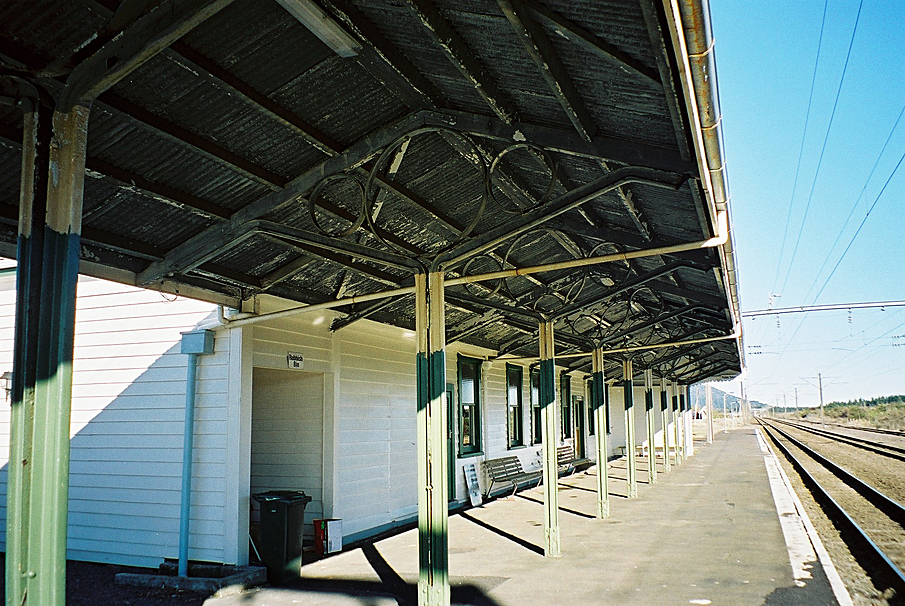
Ohakune Railway Station is a representative Troup era, medium-sized 'Class B' station, typical of those constructed at the larger central North Island stations along the NIMT. The Station was described as [an 'imposing' and] 'semi-palatial structure' [with] its size [indicating] the relative importance of the destination. Ohakune Railway Station also features a large, open-end, wooden canopy with decorative scalloped ends which shelters the platform. Constructed from timber, most likely from one of the Railways Department's, or another, local mill, the building featured a manager's office, ticket office, and passenger and public conveniences such as ladies waiting rooms connecting to the female toilet block. For years the Station was the travel headquarters and vital communications link for the town, as well as one of Ohakune's principal buildings.
The completion of the NIMT is said to be 'one of the pivotal moments in New Zealand history' because ‘...it ended the South Island's 30-year lead in rail development and confirmed the North's growing economic and demographic supremacy.' Therefore, the Junction and Station were also of vital importance to Ohakune's post-railway construction economy. From 1908 Ohakune's economy was dominated by the sawmilling industry which used the NIMT to transport its product around the North Island. The industry began declining in the late 1920s, however, the quality of the land which had been cleared allowed for the growth of Ohakune as a market garden centre from the 1930s. In the absence of good roads, rail was the essential means of distributing this produce around the North Island.
With the influx of passengers and freight, the Station required permanent administration and service staff. Ohakune's first station master was Mr P. Cooney who was appointed in 1908. Other staff included two clerks, one cadet, four guards, one acting guard, and three porters. By 1909 the staff employed at the station had increased to about 40, including locomotive drivers and firemen. Therefore, the facilities, services, and staffing at the station are all indicative of the significance of the stop in the early 20th century. These were expanded further when the branch line to Raetihi was begun in 1912. From this time the station area was distinguished from the township, or Village, by being referred to as the Junction. By 1917 operational and passenger needs had outgrown the space available in the Station and it was therefore extended and altered to compensate.
Ohakune was an important strategic stop for passengers and from 1908 the services available at the station were gradually expanded to meet passenger demand. Initially the management of station services, such as the Bookstall, and the Refreshment Rooms which were built in the station in 1909, were leased out. In 1917 railcar dinning facilities were removed and the Railways Department established it's sometimes maligned Railway Refreshment Rooms. The Department did not take over control of the Ohakune Refreshment Rooms until the lease expired in March 1926. This was part of their programme to assume responsibility for ‘all the important Refreshment Rooms,' and because it was believed that the acquisition of Ohakune's would ‘prove to be a quite profitable one.' The Department made immediate costly alterations and extensions to the existing Refreshment Rooms to bring it up to ‘a suitable standard of convenience and cleanliness.' These renovations included building a store-room and office behind the counter area, a cool room and pantry, additional lighting, and a telephone connection between the kitchen and signal box, presumably to allow the signalman to notify the kitchen staff when the train was approaching. With its Railway Refreshment Rooms, Ohakune Railway Station became part of a ritual central to travel in New Zealand during the mid-20th century; people scurrying to obtain scones, fruitcake, and tea or coffee during the 10 minute scheduled train stops. From 1909 Ohakune had one of the longest scheduled stops on the NIMT, only surpassed by the much larger stations of Frankton and Palmerston North, and this continued until the mid-20th century.
Ohakune's ‘refresh' was open day and night, with staff working a day shift one week and late the next. The Ohakune ‘refresh' was generally popular and busy, but this was increased during special events such as the Centennial Exhibition. Between 1944 and 1948 it is estimated that each of the four trains which stopped at the Station every night contained 300 to 400 passengers, many of whom were hungry for the sandwiches and other goods made by the ‘refresh girls.' However, in amongst this hustle and bustle, other patrons had time to relax. The warmth of the fireplace in the Refreshment Rooms was reportedly legendary, and people enjoyed having their cup of tea in front of it while soaking up the picturesque surroundings. This suggests that the rooms were a well-known stop, not just with the hurried express train passengers, but with local people, who used it as a meeting place and for refreshments before and after going to the pictures. ‘Picture trains' were particularly popular in the 1940s and they transported patrons from outlying areas into Ohakune on weekend evenings to go shopping, or to the cinema, and dances. It was a consequence of this continued popularity, as well as the belief that traffic at the Junction was likely to increase with the need for the distribution of local vegetable produce, that it was viable to renovate and expand the ‘refresh' in 1948, as well as provide extra office spaces for clerical staff in the Station.
In contrast to the levity which would have been present in and around the Station on these occasions, the building was sometimes the scene of gravity and despair. The most significant occurrence of this was when it was the centre of relief efforts during the devastating Raetihi Fire of 1918. High winds and dry late summer conditions meant that on 18 and 19 March bush fires sprung up throughout the Waimarino area and as far away as Mangaweka and Taumarunui. The fires were so severe that smoke could be seen from Wellington, and Feilding was shrouded in an ‘uncanny darkness' for most of the day. As a result of the fires, farms and residential buildings in the Raetihi district and township suffered significant damage and it was fortunate that the branch line had been completed the previous year because this enabled relief trains to be sent to the town. Over 300 refugees were transported to Ohakune Railway Station where it was then organised for them to be billeted among local residents.
In the late 1920s the Railways Department offered employees first aid and ambulance training. This initiative came about because of the hazardous nature of rail work and also because rail was the most efficient means of transporting patients. The staff at Ohakune seem to have been enthusiastic, because in 1927 they had the seventh highest uptake for the training in New Zealand, behind the much larger stations of the main centres, and others such as Frankton and Wanganui. Even later, when the Ohakune branch of St John's Ambulance was established in 1937, patients were brought to the Station and then transferred to the hospital. In this way, Ohakune Railway Station was literally a life-line to many people in the district in the early to mid-20th century.
However, by the 1960s improvements to roads meant that rail operations changed dramatically. Initially passenger and then freight returns declined and non-essential services at stations like Ohakune were closed, such as the Refreshment Rooms in 1960. In 1964 Ohakune Railway Station became the base of CTC operations in the area. As such the system was installed in the building, but to minimise the risk of fire damaging the system and thereby jeopardizing the safe operating of the rail traffic, other services were moved out of the Station. The building was significantly reduced in length at the southern end and the c.1914-17 extensions to the Station, including areas such as the ‘refresh' kitchen, battery room, and utility spaces, were also demolished around this time. It was also because of the installation of the CTC system that Ohakune Junction's signal boxes were removed, as well as the water tanks, and other structures at the Junction. However, the lean-to at the northern end of the Station which housed the female toilets was extended slightly with the addition of male public toilets 1965.
The role of the Station continued to diminish throughout the 1960 and 1970s. When the branch line to Raetihi was closed in 1968 Ohakune's status as a junction went with it, although the name has persisted when referring to the station area of the town. In 1977 the signalling system was centralised to Taumarunui and all of the associated staff based at Ohakune were either transferred or made redundant, and when combined with the move from rail to road freight, Ohakune suffered. This was compounded by some passenger services, such as the Silver Star, not scheduling stops at Ohakune, and the reduction in numbers of track gang staff because of the mechanisation of a lot of their work.
The physical downsizing and rearranging of the Station in this period is reflective of its reduced status and changing function. However, the fortunes of the Junction were partially reversed with the opening of Turoa Ski field in 1979 which attracted tourists and visitors to the area, with many travelling by train. This revitalised the Village and the importance of the Junction to its survival was reaffirmed, although this was again threatened in 1989 with the proposed demolition of the Ohakune Railway Station. This was the catalyst for the creation of the rail heritage society which became Main Trunk Rail Ohakune Inc. (MTRO), and this group and others in the community worked to make sure the Station was retained. Tourist access to Ohakune was also imperilled in late 2006 with the announcement that the Overlander service was to be cancelled. The resulting public outcry pressured Toll to continue the service albeit with a reduced off-season schedule.
From the early 1990s, the Junction was leased from the Ruapehu District Council by MTRO. Their aim, after their successful efforts to retain the Station, was to restore the Junction to its former glory, which was given further impetus and publicity by the threatened Overlander service stoppage. The society gathered railway memorabilia and local artefacts for display in their museum and reception room in the Junction's Way and Works office. This group were also responsible for the retrieval from New Plymouth of the c.1934 turntable which had been installed at Ohakune Junction when the larger K-class locomotives came into operation, as well as the Ex-Paekakariki North End Signal Box.
However, the MTRO's plans to restore the Station suffered a serious setback after an early morning arson attack on 2 December 2003 left the northern end and south side of the Station with fire, smoke, and water damage. This was not the first fire at the station with previously recorded fires in 1928 and 1935. However, this fire seems to have caused more destruction than previous ones with a regrettable result being that one of the two original ‘Ohakune' name panels was lost. However, the damage which occurred was not comprehensive, meaning that the majority of the heritage fabric and values of the building were not seriously undermined.
Plans to restore and repair damaged areas were underway soon after the event and were spurred on by enormous community support for the project as well as that of MTRO, Rail Heritage Trust of New Zealand, and the Ruapehu District Council. The New Zealand Historic Places Trust was consulted throughout the process and supported the plans. By December 2006 the majority of the structural repairs and restoration was completed with the toilet block being demolished and a new one added which adhered to the original [circa 1908] footprint of the building. The new toilet block is sympathetic to the form of the Station but is distinguishable as a recent addition. Although the fire destroyed the original fire-place surround in the women's waiting room, an interesting feature which it revealed from behind cladding was the original twisted brick chimney. Part of the restoration process involved inserting bracing in the interior of this chimney to minimise the risk of damage from earthquake.
The repair and restoration of the fire affected areas at Ohakune Railway Station has ensured the building's ongoing viability. Adaptive re-use has seen the twisted brick chimney become the centrepiece of the Pathways of the Ancestors office, which is a combined tourism promotions venture between the Ruapehu, Rangitikei, and Wanganui District Councils. The southern end of the building incurred some smoke damaged during the fire. However, this was repaired and a larger kitchen installed, which encompassed the old storeroom area, in order for a café to open and re-establish the tradition of refreshment being available in the Station. In the absence of the train passenger numbers of the past, the café will mostly service locals and tourists staying in the town. The promotion of the rail heritage values of the Station and the nearby Signal Box by MTRO and the Ruapehu District Council will also play an important role in the continued relevance of the buildings.
Signal Box:
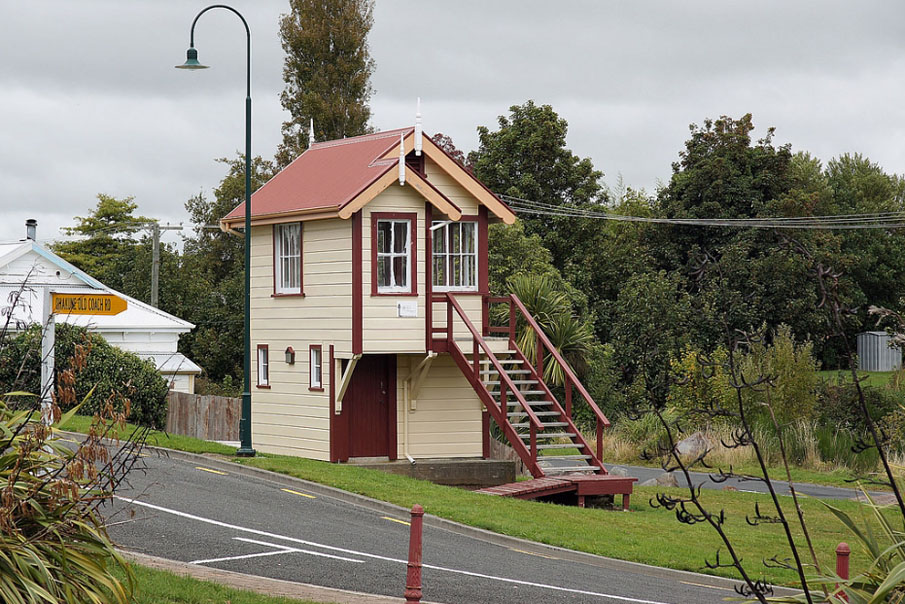
The Signal Box now at Ohakune Railway Station was built in 1909 and was originally the North End Signal Box at Paekakiriki.
Since its relocation to Ohakune, the Signal Box has become an important part of the Ohakune Junction heritage precinct because it is [an architecturally] representative, and rare, example of the signal boxes which were built at major stations on the NIMT soon after its inception. Like Ohakune Railway Station, the Signal Box's use, fall into relative obscurity, and then its revitalisation, is indicative of the broader history of the NIMT and changes in rail management and operations in the late 20th century.
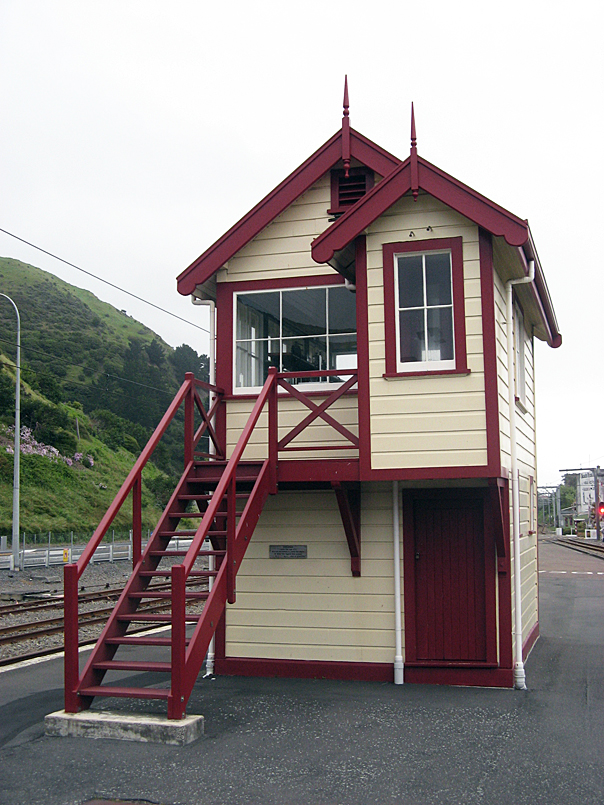
Signal boxes were constructed to a standard design throughout the country and the Signal Box is a typical example of this. This Signal Box is a two-storey building clad with rusticated weather boards. The upper room, which is accessed by an exterior staircase, features large windows which gave the signalman an un-impeded and excellent view of the activities in the rail yard, but more importantly, along the mainline. Despite being a service building it has decorative features, such as finials on the apexes of its roof gables, and barge-boards, which although not ornately detailed, are indicative of the Signal Box's early 20th century design and construction. The upper storey still has the signal levers, and the operational machinery occupies most of the space on the ground level. The wide-spread use of this standard design is confirmed by photographic evidence from Ohakune and other contemporaneous stations with signal boxes, such as Taihape. However, despite their original proliferation signal boxes are now rare.
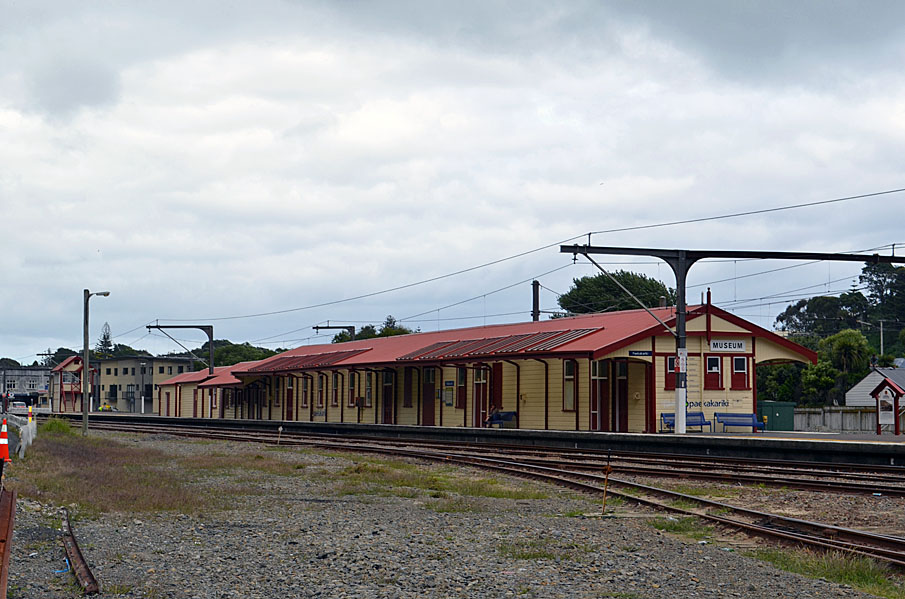
The signalling system in the pair of Paekakariki signal boxes was up and running in 1910, but the buildings became obsolete when CTC system operations were moved to Wellington in 1985. Because it was no longer a functioning part of the station at Paekakariki, and therefore superfluous, the North End Signal Box was threatened with demolition. The New Zealand Historic Places Trust had bestowed a ‘C' category on this signal box and helped negotiate its eventual relocation to Ohakune by MTRO in late 1991.
Whereas Paekakariki's signal boxes faced demolition in the mid 1980s, Ohakune's signal boxes were removed in the mid-1960s and coincided with a general downsizing of operations at that station. This is also well before the establishment of MTRO or other rail and heritage groups which could have advocated for the retention of one or both of the original signal boxes.
Like Paekakariki, the working signal boxes at Ohakune were at the north and south ends of the station adjacent to the NIMT. However, although on the Station side of the NIMT like the original Ohakune signal boxes, its position away from the railway tracks between the Station and Thames Street, and also its orientation, is not one which would have been used for functioning signal boxes.