In 1910 members of the Wellington Philosophical Society formed the Astronomical Section in order to build a public astronomical observatory, a facility the city was lacking. Public fundraising and a Government contribution elicited the necessary funds and it was built on what was then a military reserve adjacent to the Wellington Botanic Garden. The observatory’s first telescope was a 13cm Cooke refractor; this was replaced by astronomer Thomas King’s superior 14cm Grubb telescope following his death in 1916.
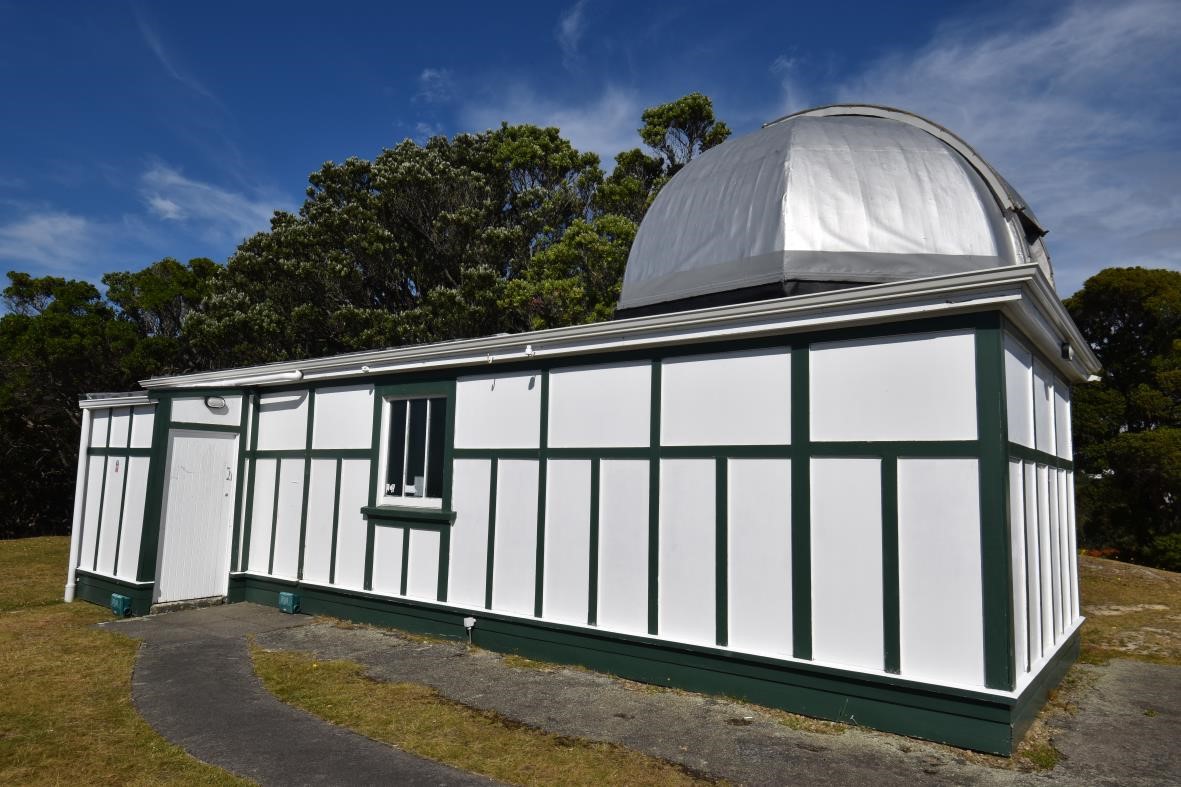
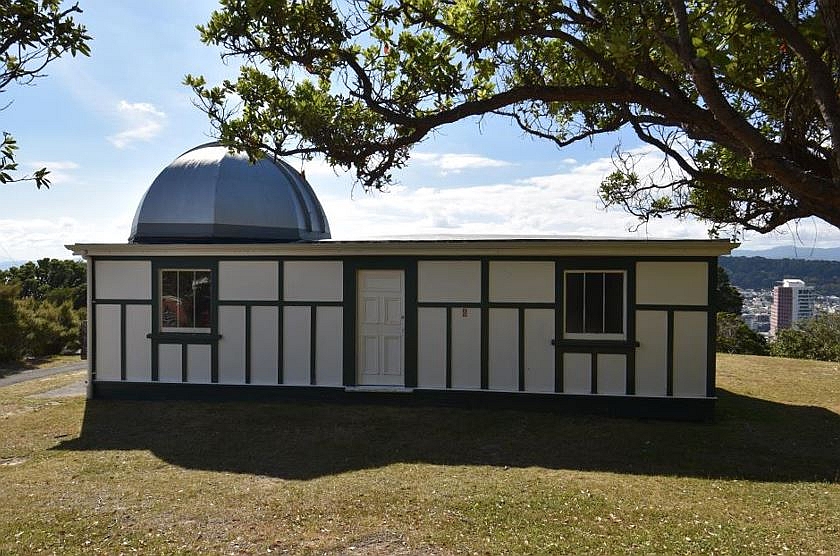
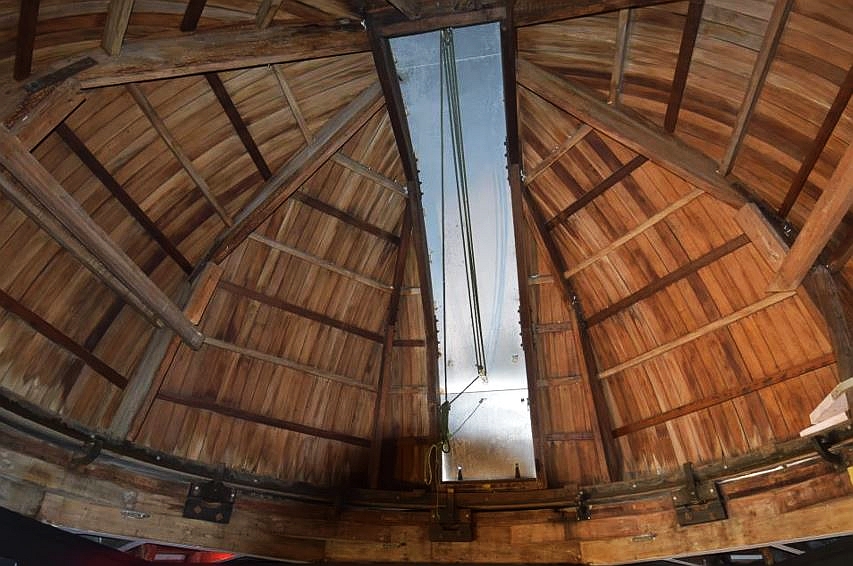
The observatory was a utilitarian timber and fibrolite building consisting of an ante-room and an instrument room topped with a revolving dome clad in butyl rubber. The dome was made of rimu rafters and sarking and kauri bearers and included a telescope shutter that was opened by a rope pulley. The dome sat on metal rails and was revolved manually on wheels using a timber rod.
The observatory was regularly opened to the public, though turnouts did not always meet expectations. Public viewing continued until the outbreak of the Second World War; after that the new Carter Observatory fulfilled this public function. In 1918 Government Astronomer Charles Adams initiated what became a long-running sunspot monitoring programme at the Thomas King Observatory and in the 1930s it was used by Ivan Thomsen, later the Carter Observatory director, and Frank Bateson, one of the Mt John Observatory founders. It was taken over by the Wellington Astronomical Society in 1974 and was the group’s astronomical headquarters until the early 1990s. Following restoration in 1995 the building was transferred to the Carter Observatory. It hosted public solar observations in the early 2000s. Thomas King’s telescope was put in storage in 2014 following a break in and its vandalism. The building is now used for temporarily exhibitions and public programmes organised by Space Place at Carter Observatory.


List Entry Information
Status
Listed
List Entry Status
Historic Place Category 2
Access
Private/No Public Access
List Number
9024
Date Entered
1st July 2021
Date of Effect
21st July 2021
City/District Council
Wellington City
Region
Wellington Region
Extent of List Entry
Extent includes part of the land described as Sec 1223 Town of Wellington and part of the land described as Sec 1231 Town of Wellington (NZ Gazette 1998, p.68), Wellington Land District and the building known as Thomas King Observatory thereon. (Refer to map in Appendix 1 of the List entry report for further information).
Legal description
Sec 1223 Town of Wellington and Sec 1231 Town of Wellington (NZ Gazette 1998, p.68), Wellington Land District.
Status
Listed
List Entry Status
Historic Place Category 2
Access
Private/No Public Access
List Number
9024
Date Entered
1st July 2021
Date of Effect
21st July 2021
City/District Council
Wellington City
Region
Wellington Region
Extent of List Entry
Extent includes part of the land described as Sec 1223 Town of Wellington and part of the land described as Sec 1231 Town of Wellington (NZ Gazette 1998, p.68), Wellington Land District and the building known as Thomas King Observatory thereon. (Refer to map in Appendix 1 of the List entry report for further information).
Legal description
Sec 1223 Town of Wellington and Sec 1231 Town of Wellington (NZ Gazette 1998, p.68), Wellington Land District.
Why is this place significant?
Historic Significance
Historical Significance or Value Founded by the Wellington Philosophical Society, an organisation that included both professional and amateur scientists in its ranks, and later the headquarters of the Wellington Astronomical Society, Thomas King Observatory is historically significant as a representation of the dominance of amateur practitioners in the history of Pākehā astronomy in Aotearoa New Zealand. This is most obviously reflected in its name, which commemorates an important amateur astronomer. The decades-long use of the observatory for a sunspot programme also associates the place with the history of astronomical monitoring and research in this country.
Why is this place Category 1 / Category 2?
Detail Of Assessed Criteria
(a) The extent to which the place reflects important or representative aspects of New Zealand history Thomas King Observatory reflects the popularisation of astronomy from the late nineteenth century and efforts made to provide amateur astronomers and members of the public with a facility to pursue this interest. It also demonstrates the important role amateurs played in the history of science in this country. (b) The association of the place with events, persons, or ideas of importance in New Zealand history Thomas King Observatory is associated with many important figures in the history of New Zealand astronomy. Its founders include prominent astronomers Charles Adams and Thomas King (later the building’s namesake) and it was subsequently used by Ivan Thomsen and Frank Bateson, both of whom made important contributions to New Zealand astronomy. (k) The extent to which the place forms part of a wider historical and cultural area Thomas King Observatory is located within the epicentre of astronomical activity in the capital city of Wellington and is one of five observatories (three extant) constructed in the immediate vicinity between 1869 and 1942. Summary of Significance or Values The contribution of amateurs to the history of New Zealand science is considerable and the field of astronomy is no exception. Thomas King Observatory is a good representation of this contribution, constructed as it was by the Astronomical Section of the Wellington Philosophical Society and used by amateurs and members of the public for many decades. High-profile astronomers associated with the place include Charles Adams, Ivan Thomsen, Frank Beatson and Thomas King, whose close association is reflected in its name. Thomas King Observatory is one of three extant observatories within the immediate vicinity and is in a part of Wellington closely associated with astronomy and scientific monitoring, research and public education.
Why is this place significant?
Historic Significance
Historical Significance or Value Founded by the Wellington Philosophical Society, an organisation that included both professional and amateur scientists in its ranks, and later the headquarters of the Wellington Astronomical Society, Thomas King Observatory is historically significant as a representation of the dominance of amateur practitioners in the history of Pākehā astronomy in Aotearoa New Zealand. This is most obviously reflected in its name, which commemorates an important amateur astronomer. The decades-long use of the observatory for a sunspot programme also associates the place with the history of astronomical monitoring and research in this country.
Why is this place Category 1 / Category 2?
Detail Of Assessed Criteria
(a) The extent to which the place reflects important or representative aspects of New Zealand history Thomas King Observatory reflects the popularisation of astronomy from the late nineteenth century and efforts made to provide amateur astronomers and members of the public with a facility to pursue this interest. It also demonstrates the important role amateurs played in the history of science in this country. (b) The association of the place with events, persons, or ideas of importance in New Zealand history Thomas King Observatory is associated with many important figures in the history of New Zealand astronomy. Its founders include prominent astronomers Charles Adams and Thomas King (later the building’s namesake) and it was subsequently used by Ivan Thomsen and Frank Bateson, both of whom made important contributions to New Zealand astronomy. (k) The extent to which the place forms part of a wider historical and cultural area Thomas King Observatory is located within the epicentre of astronomical activity in the capital city of Wellington and is one of five observatories (three extant) constructed in the immediate vicinity between 1869 and 1942. Summary of Significance or Values The contribution of amateurs to the history of New Zealand science is considerable and the field of astronomy is no exception. Thomas King Observatory is a good representation of this contribution, constructed as it was by the Astronomical Section of the Wellington Philosophical Society and used by amateurs and members of the public for many decades. High-profile astronomers associated with the place include Charles Adams, Ivan Thomsen, Frank Beatson and Thomas King, whose close association is reflected in its name. Thomas King Observatory is one of three extant observatories within the immediate vicinity and is in a part of Wellington closely associated with astronomy and scientific monitoring, research and public education.
Construction Professional
Name
McClean and Grey
Type
Builder
Biography
No biography is currently available for this construction professional
Name
Campbell, John
Type
Architect
Biography
John Campbell (1857-1942) served his articles under John Gordon (c1835-1912) in Glasgow. He arrived in Dunedin in 1882 and after a brief period as a draughtsman with Mason and Wales joined the Dunedin branch of the Public Works Department in 1883. His first known work, an unbuilt design for the Dunedin Railway Station, reveals an early interest in Baroque architecture. In November 1888 Campbell was transferred to Wellington where in 1889 he took up the position of draughtsman in charge of the Public Buildings Division of the Public Works Department. He remained in charge of the design of government buildings throughout New Zealand until his retirement in 1922, becoming in 1909 the first person to hold the position of Government Architect. Government architecture designed under his aegis evidences a change in style from Queen Anne to Edwardian Baroque. His best-known Queen Anne design is the Dunedin Police Station (1895-8), modelled on Richard Norman Shaw's New Scotland Yard (1887-90). Among his most exuberant Edwardian Baroque buildings is the Public Trust Office, Wellington (1905-09). Although Campbell designed the Dunedin Law Courts (1899-1902) in the Gothic style with a Scottish Baronial inflection, he established Edwardian Baroque as the government style for police stations, courthouses and post offices throughout New Zealand. In 1911 Campbell won the nation-wide architectural competition for the design of Parliament Buildings, Wellington. Although only partially completed, Parliament House is the crowning achievement of Campbell's career.
Construction Details
Start Year
1912
Type
Original Construction
Start Year
1915
Type
Other
Description
King telescope installed
Type
Modification
Description
Anteroom extended
Start Year
1995
Type
Restoration
Construction Materials
Timber; fibrolite; butyl rubber
Notable Features
Cooke Refractor telescope
Construction Professional
Name
McClean and Grey
Type
Builder
Biography
No biography is currently available for this construction professional
Name
Campbell, John
Type
Architect
Biography
John Campbell (1857-1942) served his articles under John Gordon (c1835-1912) in Glasgow. He arrived in Dunedin in 1882 and after a brief period as a draughtsman with Mason and Wales joined the Dunedin branch of the Public Works Department in 1883. His first known work, an unbuilt design for the Dunedin Railway Station, reveals an early interest in Baroque architecture. In November 1888 Campbell was transferred to Wellington where in 1889 he took up the position of draughtsman in charge of the Public Buildings Division of the Public Works Department. He remained in charge of the design of government buildings throughout New Zealand until his retirement in 1922, becoming in 1909 the first person to hold the position of Government Architect. Government architecture designed under his aegis evidences a change in style from Queen Anne to Edwardian Baroque. His best-known Queen Anne design is the Dunedin Police Station (1895-8), modelled on Richard Norman Shaw's New Scotland Yard (1887-90). Among his most exuberant Edwardian Baroque buildings is the Public Trust Office, Wellington (1905-09). Although Campbell designed the Dunedin Law Courts (1899-1902) in the Gothic style with a Scottish Baronial inflection, he established Edwardian Baroque as the government style for police stations, courthouses and post offices throughout New Zealand. In 1911 Campbell won the nation-wide architectural competition for the design of Parliament Buildings, Wellington. Although only partially completed, Parliament House is the crowning achievement of Campbell's career.
Construction Details
Start Year
1912
Type
Original Construction
Start Year
1915
Type
Other
Description
King telescope installed
Type
Modification
Description
Anteroom extended
Start Year
1995
Type
Restoration
Construction Materials
Timber; fibrolite; butyl rubber
Notable Features
Cooke Refractor telescope
The human presence in Wellington is said to begin with the explorer Kupe, who travelled to Aotearoa New Zealand from Hawaiki, the ancestral Polynesian homeland of Māori. He left his mark on the land by naming places, such as the islands Matiu and Mākaro in the harbour, before returning home. Following permanent settlement, the rangatira Tara, son of Whātonga and the eponymous ancestor of Ngāi Tara, travelled south from Māhia Peninsula and settled at the harbour, which came to be known as Te Whanganui-a-Tara, the great harbour of Tara. In the seventeenth century Ngāti Ira of Hawke’s Bay joined Ngāi Tara and extensive intermarriage occurred between the two tribes. Other iwi who made a home in the region included Ngāti Kahungunu, Rangitāne, Ngāi Tahu and Ngāti Māmoe. Te Ātiawa, Ngāti Tama and Ngāti Mutunga migrated south from Taranaki in the 1820s and early 1830s during a period of great upheaval associated with the introduction of Pākehā muskets into te ao Māori. Initially based on the Kāpiti Coast, the Taranaki people moved further south to Wellington, where they became dominant. Kāinga (villages) were located in the Thorndon area (the future site of the Thomas King Observatory), including Pakuao at the north end of Tinakori Road, Raurimu at the intersection of Hobson Street and Fitzherbert Terrace, Tiakiwai nearby, and Pipitea Pā on the shoreline. Prior to the entrance of the Taranaki tribes, occupancy of Te Whanganui a Tara was concentrated in the eastern and southern coasts, as the western portion of the harbour was seen as vulnerable to attack from the north. Pākehā Settlement Thorndon was part of the highly controversial and much disputed purchase of Te Whanganui-a-Tara by the New Zealand Company in 1839 for the site of what became known as Wellington. After the New Zealand Company shifted the fledgling settlement to Lambton Harbour from Petone in April 1840, the northern end became known as Thorndon, after the English home of New Zealand Company director Lord Petre. The Company divided the new settlement into 1100 town and country sections, which were sold to investors and potential settlers before they had even left England. Company surveyor William Mein Smith prepared the plan for the settlement of Wellington. He chose a rigid grid plan when the settlement was proposed for flat land at Petone, but the unruly terrain at the southern end of the harbour meant a series of inter-connected grids was required in Wellington. The land on which the Thomas King Observatory would be built was within the town belt that circled the new town. Astronomy in Aotearoa New Zealand Aotearoa New Zealand has a centuries-old indigenous tradition of tātai arorangi or Māori astronomy, in which astronomical knowledge was applied to practices such as food production, house building and sea navigation. Communities had a good working understanding of tātai arorangi through its application to regular tasks like gardening and hunting, while deeper knowledge resided with tohunga kōkōrangi and tohunga tātai arorangi, the ‘teachers and specialists’. The negative impacts of Pākehā colonisation had a deleterious effect on the preservation and enactment of this knowledge, yet it was not entirely lost. In the late 20th century traditional methods of sea navigation were revived and in the early 2000s celebrations of Matariki, the Māori new year, grew in popularity. Between 1769 and 1777 British navigator and explorer James Cook and expedition astronomers made numerous astronomical observations to calculate the latitude and longitude of Aotearoa New Zealand places for navigation and mapping purposes. After 1840 British settlers brought their own tradition of amateur astronomy to the country. Until the late nineteenth century British astronomical research was an almost wholly amateur endeavour with private individuals funding their own work, while many enthusiasts simply enjoyed looking at celestial objects with whatever equipment their means allowed. In Aotearoa New Zealand astronomy largely remained the province of amateurs until the second half of the twentieth century and there was little scope for dedicated professional astronomical work. Archdeacon Arthur Stock became the country’s first dedicated professional astronomer in 1869 when he was appointed official observer at the Colonial Observatory in Wellington, but this was a part-time post and the only one of its kind. Joseph Ward and John Grigg, both renowned local astronomers active in the late nineteenth and early twentieth centuries, pursued their work on a strictly amateur basis. It was not until 1965, when the Mt John Observatory was established at Lake Tekapo by the universities of Canterbury and Pennsylvania that Aotearoa New Zealand had the capacity to host significant, professional astronomical research. The importance of amateurs in local astronomy is consistent with the hegemony of ‘gentlemen scientists’ and the concomitant lack of professionalism and government-funded scientific research in the nineteenth and early twentieth centuries. The formation of the New Zealand Geological Survey in 1865 followed by the New Zealand Institute two years later heralded the beginnings of institutional and centralised science, but dominated by well-resourced amateurs, they ‘did not professionalise science…to any large degree’. This only occurred with the formation of the Department of Scientific and Industrial Research (DSIR) in 1926. It must be noted that local astronomy was not mere stargazing; ‘amateur’ is not intended to connote dilettante. Amateurs made important contributions to astronomical knowledge. Additionally, astronomy was bound up with the establishment of the new colony. The execution of land surveys and maps by surveyors who used astronomical methods and instruments were ‘part of the wider process of colonisation’ in which Māori land was transferred to the Crown and Pākehā settlers. Astronomy was also essential for timekeeping. This, combined with the advent of major astronomical events in the late nineteenth century, such as the transits of Venus in 1874 and 1882 and the transits of Mercury in 1878 and 1881 popularised Pākehā astronomy and spurred local astronomers to ‘systematically observe their patch of southern sky’. Kelburn Observatories In Wellington, the seat of government from 1865, what became the suburb of Kelburn evolved into the epicentre of the city’s astronomical activity. The Government's Colonial Observatory was the first astronomical building there, constructed in 1869 for the purpose of time keeping, but it was demolished to make way for Premier Richard Seddon’s grave in 1906. A new site was chosen closer to the top of the hill for the new Hector Observatory (renamed the Dominion Observatory in 1925), which continued to keep New Zealand’s time. The Thomas King Observatory followed in 1912. Two further observatories were built, first the Wellington City Observatory in 1924 (no longer extant), followed by the Carter Observatory (now known as Space Place at Carter Observatory) in 1942. As a group these observatories were the site of a wide range of work beyond the astronomical, including geomagnetism, meteorology, seismology, tidal studies and trigonometrical surveys. A New Observatory In 1910 members of the Wellington Philosophical Society (later to merge with the Royal Society of New Zealand) were concerned with the lack of public facilities for astronomical observations and discussed plans for a new observatory. Government Astronomer Charles Adams, Transit Observer at the Colonial Observatory Thomas King, Wellington College master Algernon Gifford and Marist priest and astronomer David Kennedy formed the Astronomical Section of the Wellington Philosophical Society to pursue the planned public observatory and building funds were raised with Government support. An arrangement was made with the Government for the observatory to be constructed on land that was part of the ‘Garden Battery Reserve’, the local naval gun emplacement protecting the harbour. A timber-framed fibrolite observatory was designed by Government Architect and Society member John Campbell, possibly in his spare time, and was constructed by local builders McLean and Grey in 1912. It was officially called the King Edward VII Memorial Observatory but this name was seldom used. The observatory first housed a 13cm Cooke refractor telescope. When Thomas King died in 1916 his superior 14cm Grubb telescope made in 1882 was donated to the Society by his sister, leading to the renaming of the observatory in his name after the Second World War. Astronomical Activities Upon opening regular public open-nights were organised to give the Wellington people a chance to view the heavens. Although the Astronomical Section was somewhat disappointed by low turnouts, occasionally the observatory was overrun with visitors. In 1924, for example, when Mars made a close approach to Earth, police officers were required to control the crowds. Public viewing continued regularly until the 1930s but declined after the Second World War, being eclipsed by the new Carter Observatory. The Thomas King Observatory has been used for a number of scientific and public uses contributing to the development of astronomy in New Zealand. Government Astronomer Charles Adams made early use of the observatory. As an astronomer he had many interests, coordinating a number of long-running nationwide programmes. Initiated by Adams and continued by staff of the Dominion and Carter observatories, the Thomas King Observatory was used continuously from 1918 until the mid-1960s for the sunspot programme, which combined New Zealand's results with other international findings at Zurich Observatory. In the 1930s other prominent astronomers used the observatory including Ivan Thomsen (later director of the Carter Observatory) and Frank Bateson (one of the founders of the Mt John Observatory). Use declined in the post-war years, but revived in the 1970s and 1980s through extensive use by the newly formed Wellington Astronomical Society (WAS), which took over the building in 1974. Later History In 1992 WAS decided to dispose of the observatory. The building had become very rundown and was vandalised in September of that year. WAS wanted to demolish most of the building and salvage the dome but Carter Observatory director Wayne Orchiston successfully argued for a ‘stay of execution’ and it was formally transferred to this institution in 1998, following restoration work. Thomas King’s Grubb telescope was refurbished by astronomer Gordon Hudson in 2001. The observatory was used for public solar observations in the early 2000s. The telescope removed from the building in 2014 following a break-in when it was vandalised. Since 2017 the observatory has hosted occasional artist exhibitions and public programmes organised by Space Place at Carter Observatory.
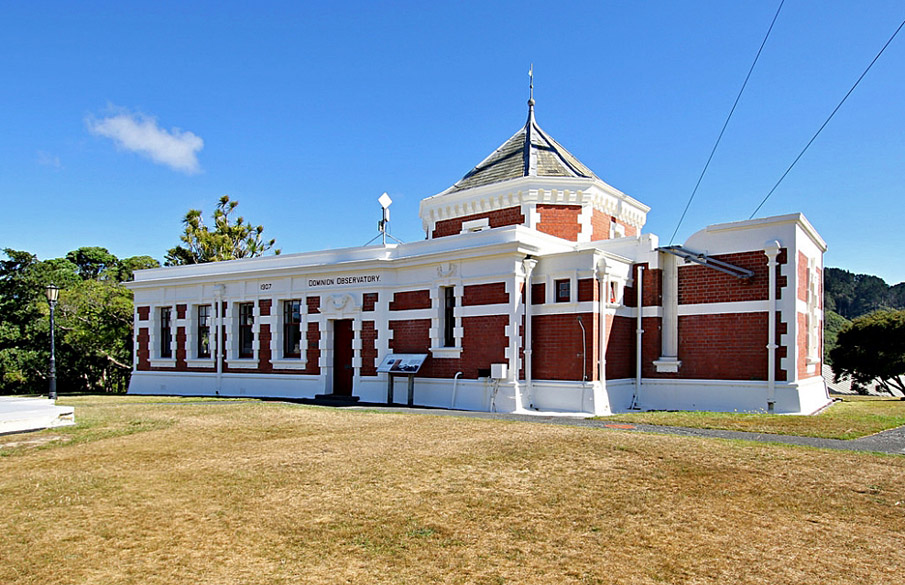
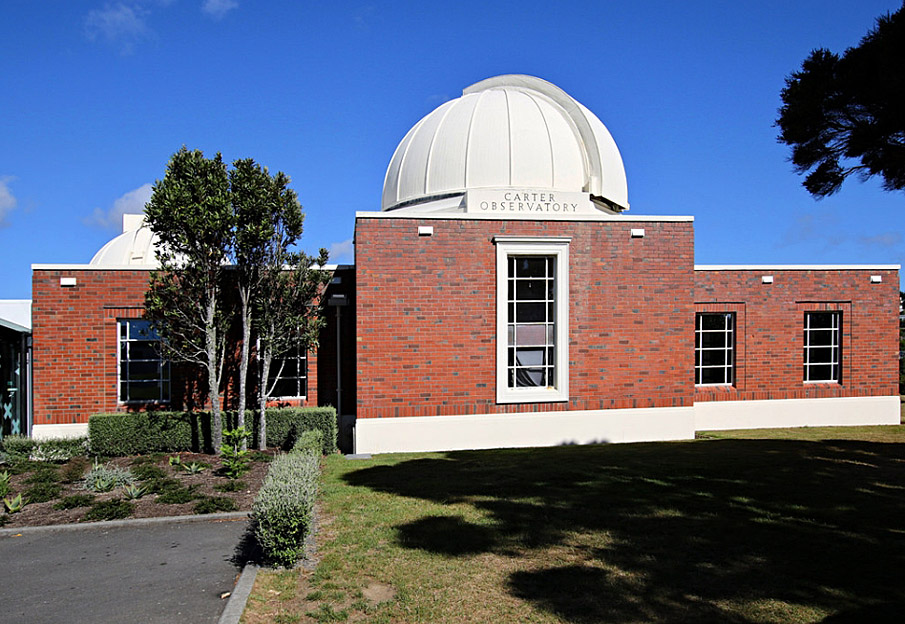
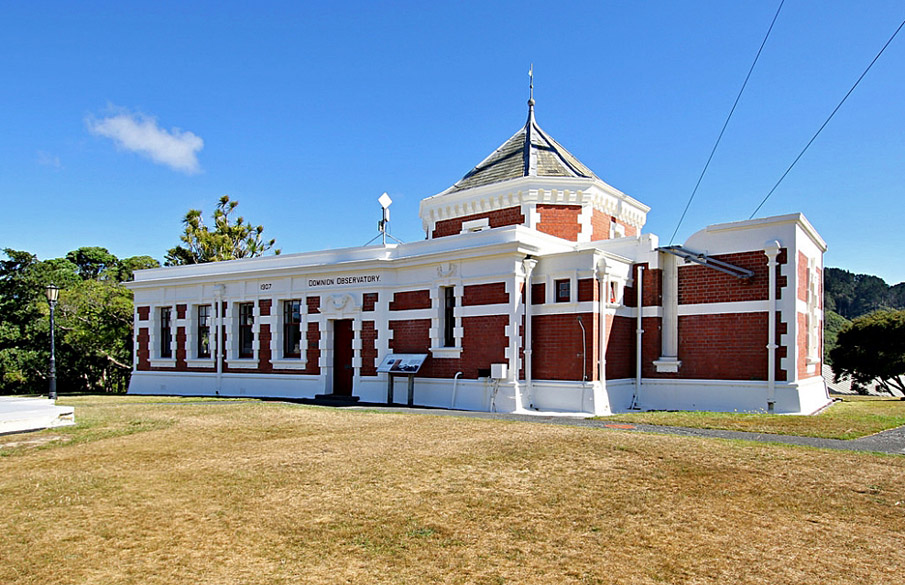
Current Description Thomas King Observatory is adjacent to the Wellington Botanic Garden on the city side and commands an excellent view of the harbour. It is one of three astronomical observatories in the immediate vicinity; the other two are the 1940 Carter Observatory (List No. 3596, Category 2 historic place) and the 1907 Dominion Observatory (List No. 4700, Category 1 historic place). The building sits on a grassy rise and is surrounded by mature pōhutukawa trees to the west and south and mānuka bushes and two survey piers to the north. The timber-framed observatory is clad in fibrolite sheets faced with timber battens and consists of an ante-room and an instrument room topped with a revolving dome. There are two entry points, one via a small porch on the east elevation and the other a painted five-panel timber door on the west elevation. There are two three-panel timber windows on the west elevation and one three-panel timber window on the east elevation. All are glazed with opaque safety glass. The roof, including the dome, is clad in butyl rubber covered in bituminous aluminium paint with a metallic sheen finish. The dome’s shutter opening is functional. The floor of the entry porch is the original concrete slab with two well-worn timber doorsteps leading to the ante-room entrance. The original panelled timber door retains the brass knob and plate. The hardboard walls and ceiling of the anteroom are painted white and vinyl has been laid over the tongue and groove flooring. Two sets of modern spotlights have been installed on the ceiling in line with its recent use as a gallery. The ante-room is plain and non-descript. Three vinyl-clad steps lead to the instrument room, which is separated from the ante-room by a glazed door (non-original). The instrument room originally housed the observatory’s telescope, which is now in storage. Despite missing this vital piece of equipment, the building’s original function is obvious because the dome is very intact. The dome is made of rimu rafters and sarking and kauri bearers and includes a functional telescope shutter on one panel that it opened by a rope pulley. The dome revolves by way of a metal rail and wheels and is operated manually with a timber rod. The walls of the instrument room are lined with painted hardboard and two timber shelves have been installed at an unknown date. A three panel window on the west elevation provides some natural light; this is augmented by a small spotlight on the floor.
Historical and Associated Iwi / Hapū / Whānau
Completion Date
5th May 2021
Report Written By
Kerryn Pollock and HistoryWorks
Information Sources
Dictionary of New Zealand Biography
Seymour, 1997
J. B. Seymour, 'A History of the Thomas King Observatory, Wellington', Honorary Research Associate Carter Observatory, Wellington, 1997
Journal of the Royal Astronomical Society of New Zealand
Orchiston, 2016
Orchiston, Wayne, Exploring the history of New Zealand astronomy: trials, tribulations, telescopes and transits. Cham: Springer International Publishing, 2016.
Other Information
Disclaimer Please note that entry on the New Zealand Heritage List/Rārangi Kōrero identifies only the heritage values of the property concerned, and should not be construed as advice on the state of the property, or as a comment of its soundness or safety, including in regard to earthquake risk, safety in the event of fire, or insanitary conditions. Archaeological sites are protected by the Heritage New Zealand Pouhere Taonga Act 2014, regardless of whether they are entered on the New Zealand Heritage List/Rārangi Kōrero or not. Archaeological sites include ‘places associated with pre-1900 human activity, where there may be evidence relating to the history of New Zealand’. This List entry report should not be read as a statement on whether or not the archaeological provisions of the Act apply to the property (s) concerned. Please contact your local Heritage New Zealand office for archaeological advice. A fully referenced New Zealand Heritage List report is available on request from the Central Region Office of Heritage New Zealand Pouhere Taonga. Other Heritage Recognition This place is part of a Local Purpose Reserve (Community and Administrative Bldgs) (NZ Gazette 1998, p.69.)
Historical and Associated Iwi / Hapū / Whānau
Completion Date
5th May 2021
Report Written By
Kerryn Pollock and HistoryWorks
Information Sources
Dictionary of New Zealand Biography
Seymour, 1997
J. B. Seymour, 'A History of the Thomas King Observatory, Wellington', Honorary Research Associate Carter Observatory, Wellington, 1997
Journal of the Royal Astronomical Society of New Zealand
Orchiston, 2016
Orchiston, Wayne, Exploring the history of New Zealand astronomy: trials, tribulations, telescopes and transits. Cham: Springer International Publishing, 2016.
Other Information
Disclaimer Please note that entry on the New Zealand Heritage List/Rārangi Kōrero identifies only the heritage values of the property concerned, and should not be construed as advice on the state of the property, or as a comment of its soundness or safety, including in regard to earthquake risk, safety in the event of fire, or insanitary conditions. Archaeological sites are protected by the Heritage New Zealand Pouhere Taonga Act 2014, regardless of whether they are entered on the New Zealand Heritage List/Rārangi Kōrero or not. Archaeological sites include ‘places associated with pre-1900 human activity, where there may be evidence relating to the history of New Zealand’. This List entry report should not be read as a statement on whether or not the archaeological provisions of the Act apply to the property (s) concerned. Please contact your local Heritage New Zealand office for archaeological advice. A fully referenced New Zealand Heritage List report is available on request from the Central Region Office of Heritage New Zealand Pouhere Taonga. Other Heritage Recognition This place is part of a Local Purpose Reserve (Community and Administrative Bldgs) (NZ Gazette 1998, p.69.)
Current Usages
Uses: Civic Facilities
Specific Usage: Art Gallery
Uses: Research
Specific Usage: Observatory
Former Usages
General Usage: Research
Specific Usage: Observatory
Current Usages
Uses: Civic Facilities
Specific Usage: Art Gallery
Uses: Research
Specific Usage: Observatory
Former Usages
General Usage: Research
Specific Usage: Observatory
Location
Related listings


Sign up to hear more
Get the latest heritage news, features and events delivered
straight to your inbox.