Early History
The Māori history of Mornington is recalled in the name Pokohiwi, reflecting the ‘shoulder’ of the hill behind the harbour, but may also recall a historical figure from the Ngatiruahikihiki hapū. As Dunedin’s population exploded with the gold rushes, so settlements developed on the hills surrounding the harbour. In 1862, Australian David Mailer subdivided this hill land, naming it Mornington. Pākehā settlers moved to this hill suburb, twenty minutes’ walk (downhill!) to the Customs House at the bottom of High Street and Dunedin’s commercial heart. From 1883, the Mornington cable car and tramway system encouraged more people to live up the hill – removing the end of day climb back up the hill from town.
A Presbyterian Church in Mornington
Church services began in Mornington in the 1860s, but it was not until the late 1870s and early 1880s that Presbyterian services were formalised in Mornington. In 1877 the St Andrew’s Session applied to the Dunedin Presbytery to sanction the site of a proposed new church at Mornington. In 1878 the Deacon’s Court submitted plans for approval and recommended that the Synod sanction a grant towards purchasing a site. In May 1880, the Session of First Church offered the services of their missionary Robert Wood and public worship began in the Mornington Town Hall. The services were so popular that it became apparent that a permanent place of worship was needed.
At a meeting on 22 May 1880, the Presbyterians of Mornington met in the town hall and agreed that the site purchased by the Synod on Glen (now Glenpark) Avenue be adopted and that a church be erected there. A committee formed to canvass the district for subscriptions to the building fund, and a committee of management was appointed.
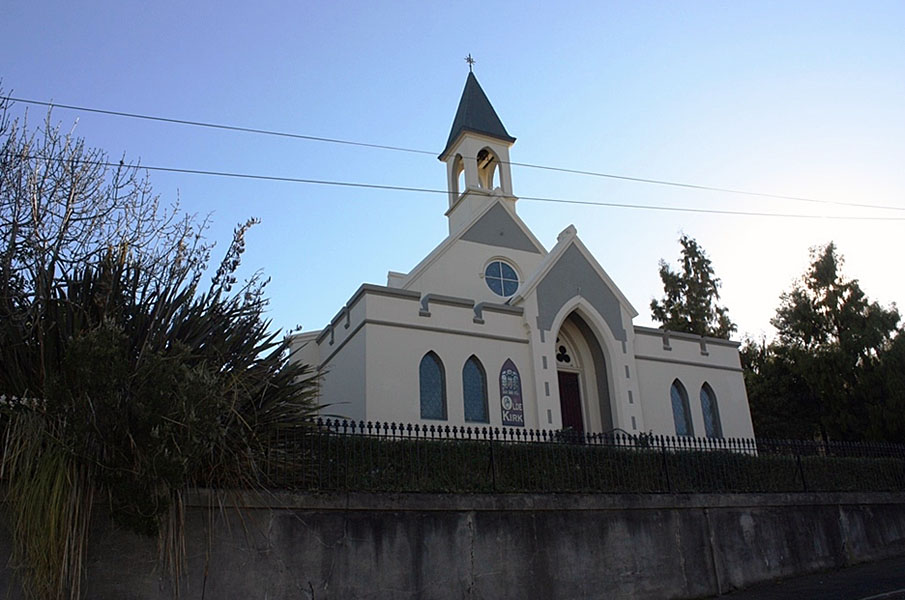
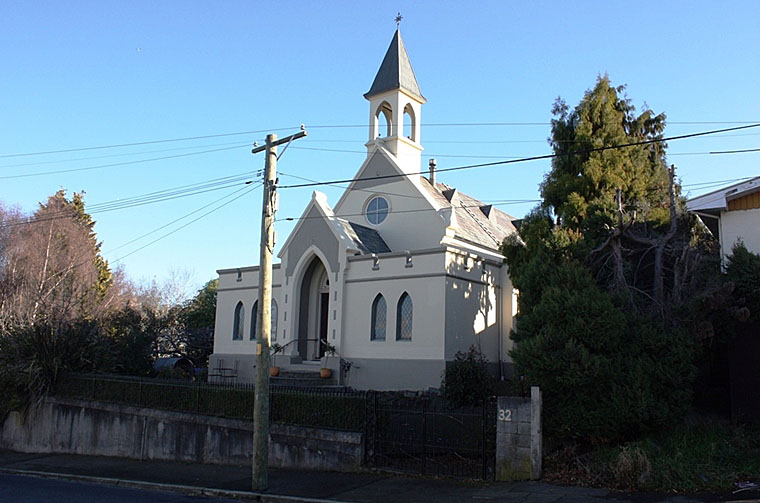
Pre-eminent Dunedin architect Robert Arthur Lawson designed the church and he advertised for tenders in August 1880. In October 1880, the contract was let to builder Francis Wilkinson (1834-1902). The Evening Star described the church as designed in ‘the early English style of Gothic’ to be built of brick with cement facings, with seating for 250 worshippers. Lawson’s plan allowed for the church to expand – the addition of a gallery possible if the building should prove too small. The nave was 55 feet by 19 feet [16.8 by 5.8 metres], with 8 foot [2.4 metre] aisles, extending the full length of the nave on each side and divided into five bays by pillars spaced 11 feet apart [3.4 metres]. The ceiling over the nave was 18 feet [5.5 metres] from the ground with clerestory lights under the eaves. One lancet-headed window was located at the centre of each bay in the side walls of the aisles. The roof was slate, with the interior finished with dressed linings and panelling. In each main gable there was a circular stained-glass window. Above the eastern entrance gable was an open bell turret rising to a height of 52 feet [15.9 metres]. The main entrance was through a ‘recessed and arched doorway’ leading into a vestibule, on each side of which were class-rooms, the vestry, meeting hall, and an additional classroom being cut off by temporary divisions from the main portion of the building at the back.
The Hon. W.H. Reynolds laid the foundation stone on 20 November 1880. Reverend Lindsay Mackie told the assembled gathering that the site was ‘fixed upon as most central and suitable’ and was pleased to note that ‘from the outset the whole responsibility of the erection of the church had been undertaken by those living in the neighbourhood. From that day forward the Mornington Presbyterians would bear their own burden in connection with the Church’ and he was sure they would find success.
Embracing a Larger Flock
The building of the church reflected the Presbyterian Church’s desire to embrace larger flock. The 1880s was a time when the Presbytery’s desire to ‘place the ordinances of the Church within the continual reach of Presbyterians, not merely within the borders of the City, but in the outlying districts. In an important district like Mornington, comprising such a large population, it was a matter of deep satisfaction that a place for the worship of God should be easily accessible.’ Residents would not be put to the inconvenience of travelling into town; neither would they ‘be compelled to seek the opportunity of worshipping in churches belonging to strange denominations.’ When the church was finished, there was, the Jubilee History records, ‘no gainsaying [the congregation’s] pride and satisfaction in the possession of the sacred building in which it was not their privilege to worship.’ The church’s first minister, the Reverend Henry Michie, presided over a soiree celebrating the opening of the Mornington Presbyterian Church on 29 March 1881.
By the mid-1880s, the church was too small for the growing congregation. After the Mornington Borough Council rejected a suggestion that the Council buy the church as their premises, several proposals were submitted to enlarge the church. Enlargement was possible ‘without any consequent disfigurement of its architectural beauty.’
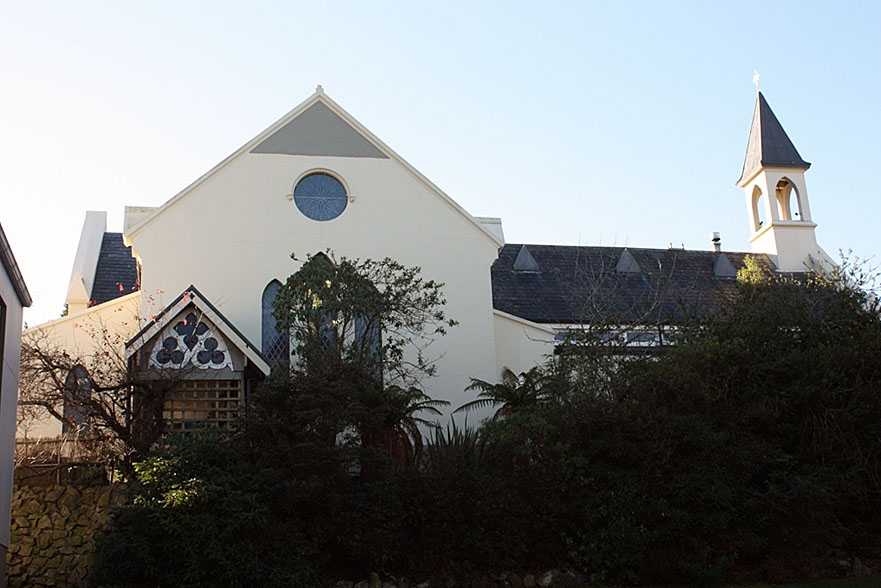
The building committee accepted a tender for £575 for the addition of transepts to provide extra space, while three months later a tender for a Sunday School behind the church was also accepted. The transepts were 54 feet by 24 feet [16.5 by 7.3 metres]. A minister’s vestry and extra space for the choir were also provided. The walls were hollow brickwork on concrete foundations, and the exterior coloured and the joints tuck pointed. The interior was finished with a varnished kauri dado. The roofs were slate, with a ‘neat ventilating turret’ at the apex of the nave and transept. The quarry light windows were made by D. Scott. One hundred and forty-six additional seats were provided, making a total of 435, exclusive of those occupied by the choir. The Sunday School Hall was also then erected. A pipe organ was installed in 1895 – with some controversy – the day it was first played at a service ‘two old ladies of the old school indignantly march[ed] out, one of whom never darkened the Church door again.’
The congregation and the services offered by the church expanded into the twentieth century. In 1906 a Bible Class hall was built, including classrooms and a kitchen. The church itself was improved – the jubilee booklet recalls ‘it was not suggested that there was lacking any spiritual warmth in the atmosphere of the Church, but physical warmth was noticeable by its absence.’ In that year gas heaters were installed. Electric light was installed in October 1915. Following the First World War, a memorial in the form of a new pulpit was erected to commemorate those who had served in the war, and included a tablet listing the 18 local men who had lost their lives and another with the names of the seventy-two survivors.
In 1924 the church managers decided to roughcast the exterior of the church. The Ladies’ Association opposed the proposal, but eventually came round, running a bazaar to help with fundraising. Jubilee celebrations were held in 1931, attended by two surviving foundation members of the church. A book was published recounting the first fifty years of the church’s history.
A Future in Doubt
In the mid-1930s, there was discussion about the future of the church. The Presbytery made its quinquennial visit and noted it was impracticable to remove the present Church and auxiliary buildings but that the present accommodation was inadequate for Bible Classes and Sunday Schools. There was potential for establishing a branch Sunday school and churches in the suburbs of Maryhill and Kenmure.
In the 1960s the Deacon’s Court employed a structural engineer to report on the church. The engineer considered that in some decades it may be necessary to replace the church and the manse. This view was confirmed by architects in 1968. There was support for preserving the current building, and it was repaired, painted, and some of the roof replaced in 1969. The choir room was added in 1970. A structural engineer’s report from 1970 considered that the repairs had extended the working life of the building. A new hall was built on the adjoining section, opened in 1976. Centennial celebrations (including the publication of a revised history), were held in 1981.
In 1997 the congregation voted for the parish to worship in one place (their Maryhill Terrace site), resulting in the sale of the Kenmure Church in 2003 and Mornington Presbyterian Church in 2005. The Presbyterian congregation leased the building back from the new owners and when the church was sold again in 2007, lease arrangements continued until December 2008 when the church was decommissioned in a special service, with the remaining 70 parishioners relocating to the new $2 million Presbyterian Community Centre at 16 Maryhill Terrace.
In an article marking the move from the Glenpark Avenue church to the new consolidated community centre, Reverend Geoffrey Skilton noted the strong association that the community had with the church – the deconsecration being ‘a sad day, particularly for those who have a long association with the church, those who have been baptised here, married here or grieved [for] a loved one here.’
Conversion to a Private Residence
After the church was decommissioned, the owners converted it to a private residence but carefully sought to maintain its integrity, particularly its scale and grandeur. The owners strongly value the former church’s connection with the community and have maintained links with the parish, with an afternoon tea attended by 70 former parishioners. Local women, who looked after the church, also visit regularly. In 2017, the former Mornington Presbyterian Church remains a family home and accommodation business operating as The Olde Kirk.