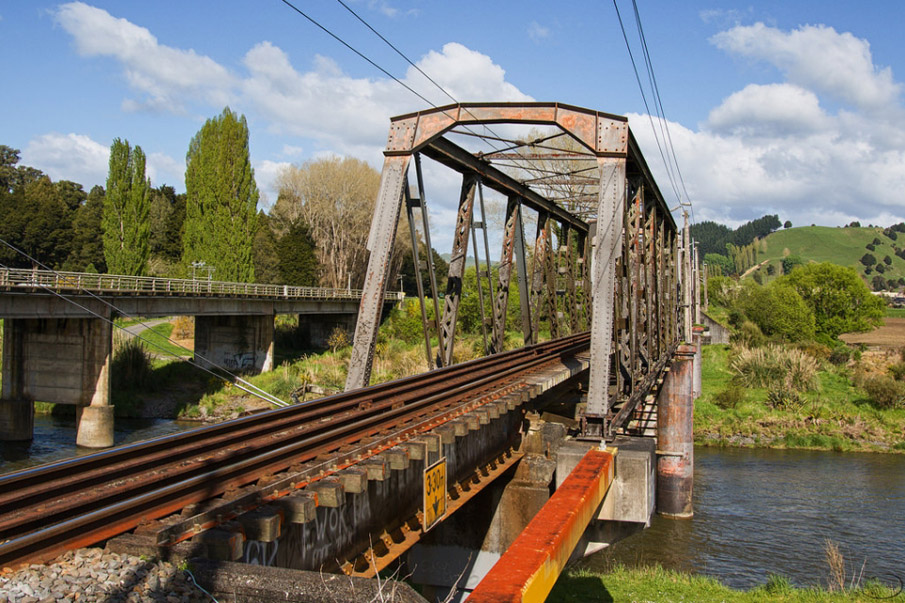
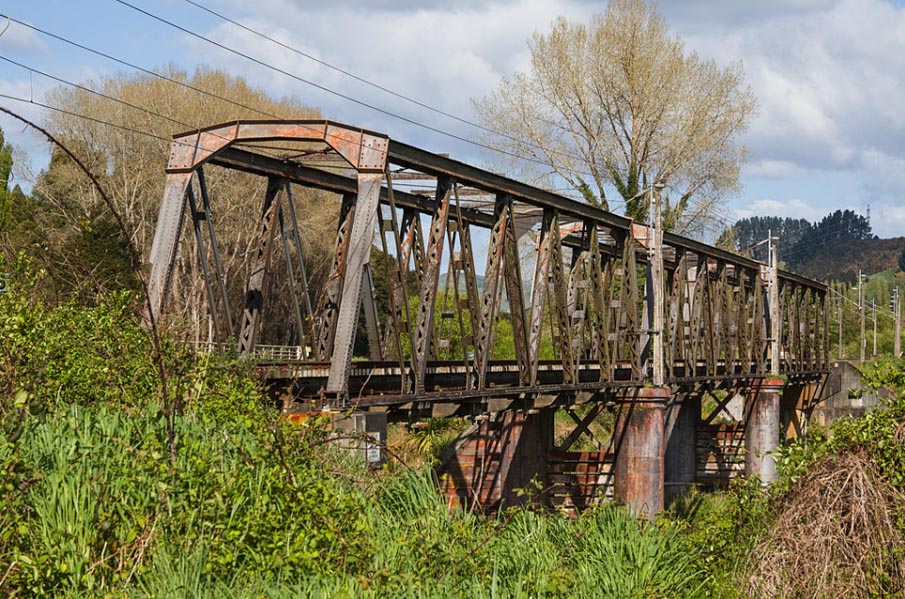
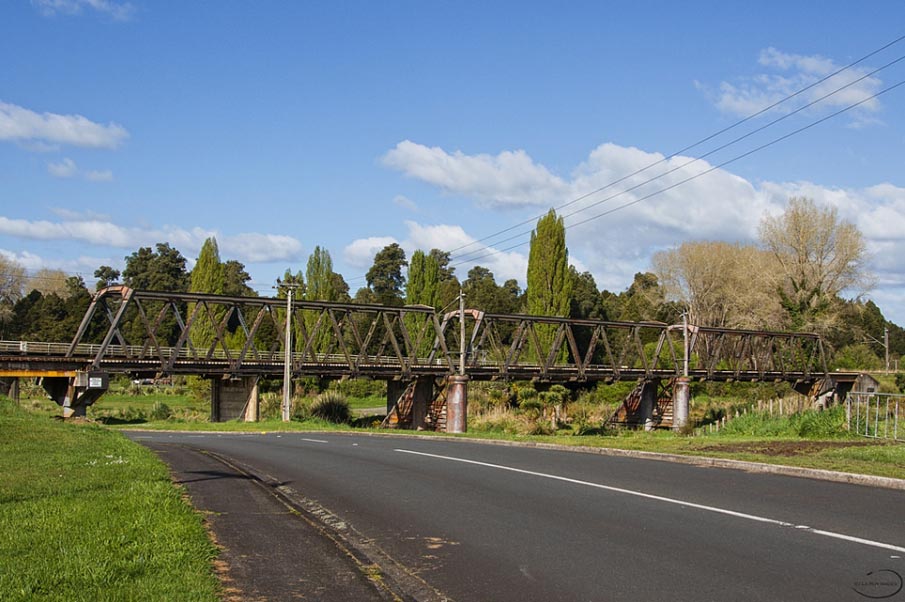
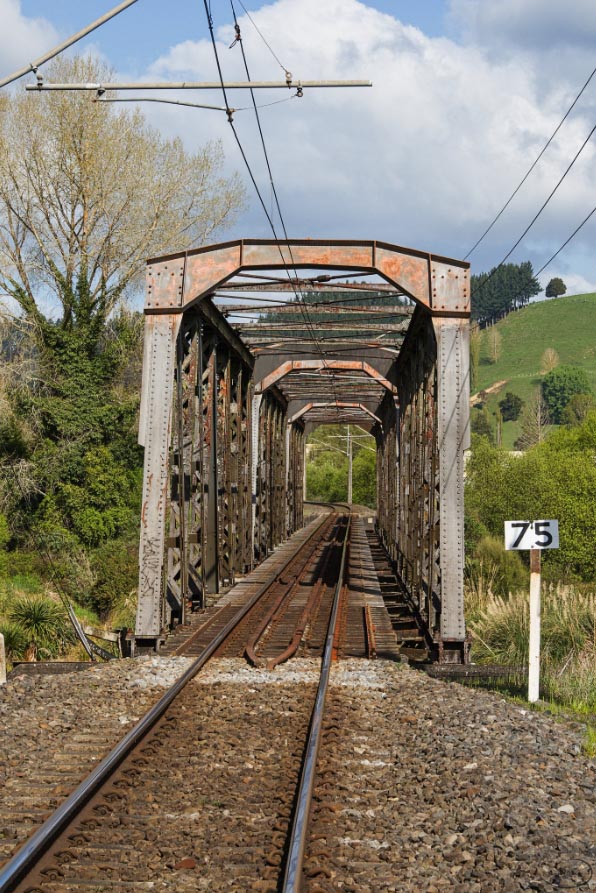
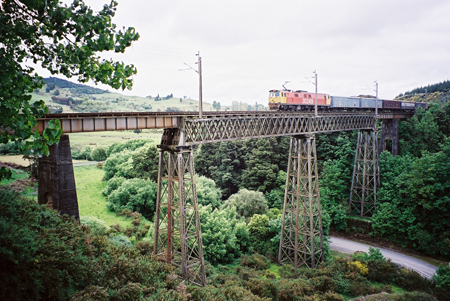
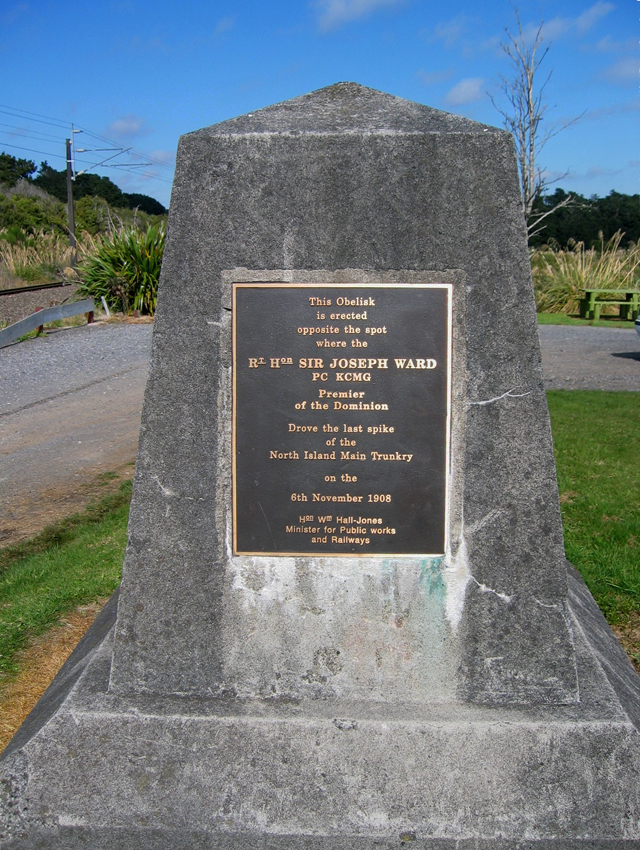
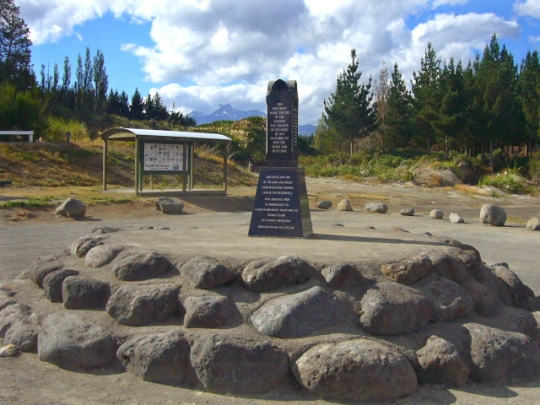
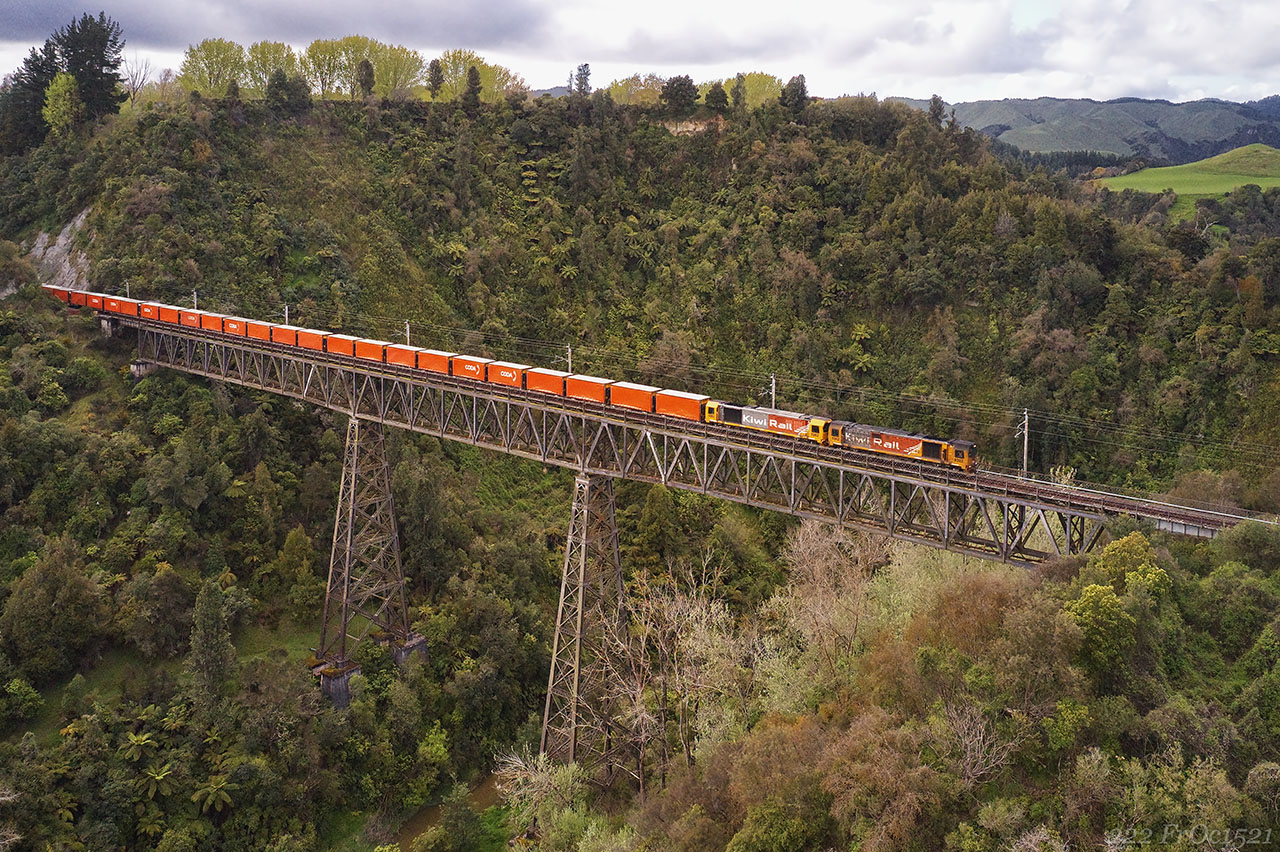
The Matapuna Bridge spans the Whanganui River just east of Taumarunui in the Central North Island. It was constructed as part of the NIMT between 1903 and 1904 and is still a functioning part of that railway. As such, it is part of a wider set of important railway structures, as well as being one of the earliest surviving bridges over the Whanganui River.
The NIMT - a catalyst for change:
The Whanganui River is an important geographical and cultural feature in the North Island and is said to have had its genesis as one of the tear drops that Ranginui laid at the feet of Matua Te Mana - Ruapehu. From its watershed close to the mountains of the Central Plateau, the river courses west before cutting a long path south towards the sea at Wanganui. It was at the western point of the river that Taranaki struck out to the coast to begin his exile away from the rest of the mountain enclave created as company for Ruapehu by Ranginui. As is suggested in its creation story, there is much more to the Whanganui River than its name, 'big harbour,' suggests. The river was an important site of Maori settlement because it was a ready food source, and was also the main transport route in the central North Island, prior to the construction of the NIMT, alongside its two major tributaries, the Manganui-o-te-ao and Ongarue Rivers. From the mid 19th century, Europeans began to use the river and it provided access for missionaries as well as those planning the NIMT. This railway not only revolutionised travel in the North Island, but directly affected the demography of the area, as well as the local and national economies.
The concept of the NIMT was promoted by Julius Vogel (1835-1899), then the Colonial Treasurer in William Fox's government, as part of his bold expansionist policy which was adopted by the House in 1870. From a purely practical stand-point, the NIMT was necessary because it established a direct transport route between New Zealand's two major cities, Auckland and Wellington. For 20 years prior to the NIMT's completion goods and passenger traffic between these cities was typically directed from Auckland to New Plymouth via coastal shipping and then continued by ship or train onto Wellington, and vice versa. This was by no means an ideal, or efficient, means of freight or passenger transport, but a route through the King Country was.
From the mid-1860s Maori in the central North Island had repelled European encroachment by establishing, and staunchly upholding, the restricted area known as the Rohe Potae, and the governments of the late 19th century saw the construction of the NIMT as a tool for gaining access to the King Country. In 1883, after a decade of persistent approaches from the government regarding the area, talks between officials and some King Country chiefs regarding the establishment of the railway through their land began in earnest. A series of rigorous negotiations was then initiated with two Ngati Maniapoto leaders, Wahanui Hautare and Rewi Maniapoto.
There seems to have been a feeling that the railway and European incursion into the King Country was inevitable, but these chiefs wanted to make sure that it was on their terms. In late 1884 Wahanui announced his intention to cooperate with the government over the railway, and he laid out a set of conditions before the House of Representative on 1 November 1884. The conditions included the right of the King movement to manage their own affairs, the banning of liquor from Waikato-Ngati Maniapoto territory, the right of his people to have sole responsibility for administering their ancestral lands, and that they were compensated for the land which was used. Following this, in early 1885 surveyors were allowed into the Rohe Potae to locate possible railway routes. Because of the tenuous relationship between the Crown and King Country iwi it was felt that the negotiation process was essential. However, by only consulting with Wahanui and Maniapoto the government purposely side-stepped King Tawhiao and other leaders who opposed the railway. Therefore, this initial agreement was not universal and accordingly there were instances of resistance, such as the destruction of surveying marks.
Despite some opposition, surveying and construction plans continued and on 15 April 1885 it was Wahanui who wielded the shovel that turned the NIMT's first sod, which was then ceremonially wheeled away by Premier Robert Stout. Prior to the chiefs allowing surveyors into the Rohe Potae, possible railway corridors through the King Country were only speculative because there had not been any previous opportunity to map it in detail. There were several proposed routes for the NIMT and John Rochfort (1832-1893) surveyed for a possible corridor through the Central Plateau between 1883 and 1887. This was said to be his tour de force because he had to start from scratch and cover a large, and topographically complex, area. After much debate and delay it was Rochfort's route that NIMT eventually followed. The Maori land that this route required progressively passed into Crown ownership under the Public Works Acts of 1882 and 1894. This legislation stipulated that construction could not begin until the governor issued a proclamation detailing the middle-line that each successive section would take.
Another key part of Vogel's scheme was to use the construction project as the basis for bringing thousands of assisted immigrants to New Zealand. His policy drew heavily on the model formulated in the United States of America, which used railways to gain access to previously remote areas, then to create settlements in these areas using the construction workers as the foundation of the local populous. The NIMT can be viewed as successful realisation of this model and it was also the catalyst for demographic change for the existing Maori population. In the Central Plateau and King Country Maori settlement was mostly concentrated around the Whanganui River and its tributaries, the Manganui-o-te-ao and Ongarue Rivers. However, the NIMT caused a population shift, for example it is said that by 1900 the various settlements around the Manganui-o-te-ao River were largely depopulated because many inhabitants gained employment as labourers on the railway. Once construction was complete it appears that local Maori gravitated toward railway towns. Therefore, the NIMT is responsible for radically changing the social landscape of the central North Island.
The initial stages of the NIMT were protracted, and once the route was resolved and the required land obtained, the construction progress followed this early pattern and laboured along. The NIMT was eventually completed in 1908 having taken 23 years to finish due to various political and financial impediments, including the economic depression of the 1890s. The slow progress bred public dissatisfaction and this had reached such a pitch by 1900 that it motivated parliament to inject significantly more money and manpower to the project to facilitate a quick resolution. A few years later Taumarunui became the northern railhead, and was a significant launching pad for the drive to complete the railway.
Taumarunui was important because of the railway construction resources which were readily available in the area, such as timber for the sleepers and buildings. The Whanganui River also provided a substantial and essential source of ballast, and most of the original ballast for the central portion of the NIMT was extracted from the river. In particular, the area around the Matapuna Bridge was significant and a Ballast Reserve was established immediately north of the bridge site by 1903. Therefore, the NIMT not only followed the route of the river eastward from Taumarunui, but part of the river became physically intertwined with the railway. The central importance of this resource to the work from the northern end and in the 'final push' between Raurimu and Ohakune meant that, despite track being laid south of Taumarunui, the section was kept under PWD control and not handed over to the Railways Department until 1908.
It was the milling and farming potential of the area, as well as the railway, that drew people to the Taumarunui area and contributed to the exponential increase in the population after the railhead reached the town in 1903. At this time Taumarunui was not an official town and only became one in 1906, although the first leases for sections in 'the native township' were let two years earlier. This means that the Matapuna Bridge is one of the oldest surviving structures in the district. However, Taumarunui was a well-known place prior to the construction of the NIMT. Initially it was settled by Maori because it was situated at the junction of the important Whanganui and Ongarue Rivers. It then became noted as a meeting and council place for the various iwi in the region, and in the late 19th century the area was renowned as a stronghold of the King Movement. It was just upriver from the eventual site of the Matapuna Bridge, at Matahanea, that William Moffat, a European suspected of being a land-buying agent and gold prospector, was killed for trespassing in the Rohe Potae in 1880 after he was warned several times not to return to Taumarunui. There were also kainga in the immediate vicinity of where the bridge was later built. For example, there were Ngati Haua affiliated kainga on the southern side of the bridge site, and at least two other locations nearby.
With the approach of the railway more people were drawn to the area, and the establishment of settlements on the south side of the Whanganui River, such as Manunui, meant there was an urgency to build a bridge across the river which could accommodate road traffic. There was a ford at the Matapuna Bridge site prior to its construction and it had been noted by the House of Representatives that the river was dangerous to cross especially when in flood. Because of this hazard and the lack of bridges upriver, government officials approached the PWD about possibly designing their proposed rail bridge as a combined bridge for road and rail traffic. At this time the only other permanent bridges across the Whanganui River were in Wanganui itself. All of these bridges, except the Aramoho Rail Bridge (1876), have now been replaced, which makes the Matapuna Bridge the oldest surviving upper river bridge and the second oldest remaining bridge over the river.
The Matapuna Bridge - a mixed blessing:
Bridges had been built to accommodate both rail and general traffic from early in railway construction and internationally these often took the form of double-decker bridges. There were only three such bridges built in New Zealand, and the majority of this country's combined bridges are single deck, like the Matapuna Bridge. In the case of the Matapuna Bridge, when it was decided to build it as a combined bridge there was an extra cost of approximately £1000 which the Minister of Lands agreed would be paid. It is unclear exactly how much the bridge cost in total, but the decision to make it a combined bridge would have been dictated by the fact that this was a cheap alternative to building individual traffic structures.
The contract for the bridge was let to Scott Bros. Ltd. in May 1901 and coincided with the bush clearing and building of a service road in the Taumarunui section of the NIMT. Scott Bros. was a prominent Christchurch engineering firm who had a one acre foundry and workshop on Manchester Street from 1876. The firm is perhaps best known as the manufacturers of Atlas ranges, but they also had considerable railway and bridge construction experience before they won the contract to build the Matapuna Bridge. Some of their notable bridge work includes the construction of the Taramakau River Bridge (1890) which was a combined bridge, as was their double-decker bridge over the Awatere River near Seddon (1902). The firm also built the Patterson's Creek Viaduct (1902), manufactured the fabric for the Toi Toi Viaduct (1903), and later constructed the Hurunui River Railway Bridge (1904). All of these projects were PWD contracts and most were designed by Peter Seton Hay (185/53-1907).
Because of the consistent partnership between Peter Seton Hay as the designer of PWD bridges which Scott Bros. were contracted to construct or manufacturer the steelwork for during this time period, it is highly probable that Hay was responsible for the Matapuna Bridge design. Hay is noteworthy because he was the first person to graduate from the University of Otago with a Bachelor of Arts in 1877. He then joined the PWD and gradually progressed through its ranks to become the engineer-in-chief by the time he died prematurely in 1907. Hay's designs for other NIMT structures such as the Makohine, Mangaweka, Hapuawhenua, Taonui, Mangaturuturu, Manganui-o-te-ao, and Makatote Viaducts are recognised alongside his pioneering research into New Zealand's hydroelectric capabilities as his most important legacies. This concentration of known Hay designs within the central section of the NIMT also suggests that he designed the Matapuna Bridge.
If this is correct, then Hay's design became a standard PWD design for this style of bridge, and at Matapuna it consisted of three through steel trusses each 122ft (37m) long. This made the structure the longest bridge, and the fifth longest bridge or viaduct, in the NIMT upon that railways completion in 1908. This length was supported by timber and cast iron cylinder piers, as well as featuring a large proportion of other timber components. Despite the steelwork being manufactured well in advance, Scott Bros., who were due to have completed the bridge by February 1903, only began construction in March 1903. It is unknown why construction was held-up, but it would appear that Scott Bros. were particularly busy at this time which may have been a factor. As a consequence the construction of the northern end of the ‘final push' was delayed until the bridge was finally completed in January 1904. The combination of this setback and frequent slips, which were particularly serious in early 1905, meant that the section was well behind schedule.
Despite being designed as a combined bridge, the decking for road traffic was only installed on the bridge in 1905. Even then the PWD was reluctant to grant public access to the bridge because they asserted that it would delay construction further by interrupting the tide of ballast trains from Taumarunui, and also because they would need to employ a bridge-keeper. The department maintained this stance despite considerable pressure from Ministers and government officials who had been petitioned by local iwi. However, by late 1905 the PWD acceded to these requests and there was talk of building a cottage near the bridge for A. Watson, a disabled railway worker, to use in his role as bridge-keeper. Watson's job was to be the signalman and caretaker at the bridge, and by 1908 this job description also included monitoring the traffic across the bridge. Later, the bridge-keeper also had to accompany the vehicles who needed a permit under the conditions of the bylaw governing use of the bridge. This bylaw was gazetted in 1909 and posted at either end of the bridge. This notice and the available photographs of the bridge demonstrate the quantity and variety of traffic that used the structure, which ranged from trains and carts, to combine harvesters and bicycles, as well as pedestrians, cattle, sheep, pigs, and donkeys.
The volume of traffic is not surprising because farming and the timber industry, and correspondingly, the population increased substantially throughout the district after Taumarunui became the railhead. For the first three decades of the 20th century Taumarunui was considered the hub of the North Island because of its important place within the NIMT, and eventually the road network, as well as being the departure point for the famous Whanganui River steamboat trips. The significance of the Matapuna Bridge to the community and these travellers is confirmed by a PWD survey of the use of the bridge in May 1917. This found that during the month, 1762 pedestrians, 1099 cycles, 688 cars, 663 vehicles, 1422 equestrians, and 6336 livestock of various forms crossed the structure, not including rail traffic. Most of the traffic was from Taumarunui and the nearby mill town of Manunui. The density of the traffic meant that by 1921 there were two bridge-keepers employed at Matapuna who worked day and night shifts.
However, while the bridge was in constant use, getting to it could be problematic because of the appalling state of the roads. This was particularly the case between Manunui and the bridge, and it is reported that in the early period it could take as long as three hours to navigate this 15km stretch of road because of the mud. The first car in Taumarunui was registered in 1912 and it was used as a taxi by Bert Meyenberg. As part of his business Meyenberg frequently used the Matapuna Bridge on his runs from Taumarunui to Manunui and often got stuck in the aforementioned mud on the Manunui side. The bridge was also a key part of a national motoring milestone; the first car trip from Wellington to Auckland via the central North Island. This expedition took eight days and nearly came to a halt in Taumarunui because Meyenberg was out of town and there was no other supply of petrol to be found. This journey was a true pioneering effort when you consider that the return trip along the established roads through Taupo and Napier only took three days.
The Matapuna Bridge was also the site of several instances of drama in the form of crashes and near misses. In 1918 a taxi driver had a lucky escape when he found himself confronted with a train as he was nearing the end of the bridge. While the driver leapt to safety, and it appears the bridge was not damaged, the car was ‘smashed to atoms.' A few years later, in 1925 a female motorist failed to give way to an equestrian and, since the bridge was really only wide enough for the vehicle, the episode ended with the horse being injured to the point where it had to be shot. This latter crash was a catalyst for local people to vent their frustration concerning the bridge in the press. The main problems which were identified included the bridge being too narrow at only 11ft (3.4m) wide, and also the delays caused by rail traffic having preferential use of the structure.
By 1925 gates had been installed across the road at either end of the bridge as a traffic control and safety measure. Rail traffic had priority use of the Matapuna Bridge and it was the bridge-keepers job to close the gates 15 minutes prior to a train being due to cross it. Combined with the fact that 25 to 30 trains crossed the bridge per day and that the bridge-keepers had been working off the schedule and not compensating for the fact that these trains could, and invariably were, late, vehicles were frequently queued for long periods at either end. As well as the irritation this caused, there were also amusing anecdotes about the wait at the bridge, such as the time when a taxi was taking a pregnant woman to the hospital in Taumarunui and got to the bridge just as the gates were shut. This sent the driver into a panic because he was terrified that the wait would be customarily long and that she would have her baby in his taxi. By 1934 the bridge-keepers were being notified, presumably by a telephone in their work hut at the north end of the bridge, when the trains were leaving the last stations before the bridge, but the queues were still notorious. The height of the rails also made it difficult for motor vehicles to navigate the bridge without damaging the vehicle, or the handrail of the bridge, and it was decided to build the deck up to make this easier. However, even with these changes the Matapuna Bridge was labelled a ‘public nuisance.'
It would seem that there were varied feelings towards this vital local link and national transport asset. As well as being a transport focal point, the Matapuna Bridge was also a significant local landmark because of its position on the Whanganui River. Early in the structure's history, the land on the south-east bank of the river was designated as a reserve, which made it a popular river access point and picnic area. For example, the Manunui Club held an annual summer picnic close to the bridge which most of the community would attend. It was also a popular swimming point, and children used to jump off the bridge into the river. Therefore, for many local people, as well as visitors at the current holiday park and to the Manunui Reserve, the bridge is linked to their leisure activities.
Changing with the times:
The infamy of the Matapuna Bridge meant that local people celebrated in the mid-1950s when they were promised a separate highway bridge. However, they had to show further forbearance as the concrete road bridge, immediately east of the Matapuna Bridge, was only completed in May 1962 and not before there was a serious incident on its predecessor. Just prior to the opening of the highway bridge, the Matapuna Bridge reverted to a rail-only structure and motorists used a bailey bridge nearby. This meant that the gates at the Matapuna Bridge were no longer used and there was no bridge-keeper. The change in circumstances must have caused confusion for a couple of children who obviously thought that the Matapuna Bridge was no longer in use for any traffic and they were subsequently caught unaware while playing on it and were struck and killed by a train. As a combined bridge the Matapuna Bridge was a mixed blessing because the bridge had caused years of frustration, but it was also an essential link for the community and motoring travellers. Therefore, it is unfortunate that this history as a combined bridge ended on a sad note in the early 1960s.
Despite the decline in rail traffic in the later 20th century, the strategic importance of the Matapuna Bridge within the NIMT has continued and resulted in the bridge undergoing many repairs and alterations. Railway structures, like the Matapuna Bridge, were built and operated based around the principle of continuous improvement and repair when needed and these alterations often reflect larger historical changes in railway operations and engineering practices. However, up until the bridge reverted to a rail-only bridge in the early 1960s, there had been very little structural change to it aside from strengthening in the 1930s as part of a NIMT-wide programme.
Because of this the structure still featured a significant amount of 1903 and early 20th century timber which was used in some of its spans and piers. Because of their age, these parts of the bridge had degraded to a worrying point by 1965 and needed replacing, as did the trusses lateral bracing systems. In engineering terms, it was not appropriate to replace the timber with like material, and concrete and steel were used instead because of their durability and strength. Two years later it was necessary for further work to be done in order to ensure the integrity of the structure, which resulted in most of the spans being replaced, as well as the abutments, and general strengthening in other parts. The flurry of activity during this period seems to have been a matter of catching-up on work generated by the fact that the Railways Department now had sole use of the bridge. It was at this time that the width of the entire bridge, or at least the deck, seems to have been reduced.