Quick links


Quick links
Quick links
Quick links
Quick links
Quick links
Post Office (Former)
30 Leigh Street (State Highway 10), KAEO
Public
Historic Place Category 2
List No. 9519
Quick links:
List GalleryLocationDetails
30 Leigh Street (State Highway 10), KAEO
Public
Historic Place Category 2
List No. 9519
List Entry Information
Status
Listed
List Entry Status
Historic Place Category 2
Access
Able to Visit
List Number
9519
Date Entered
25th June 2020
Date of Effect
15th July 2020
City/District Council
Far North District
Region
Northland Region
Extent of List Entry
Extent includes the land described as Sec 1 SO 63119 (RT NA77D/139; NZ Gazette 1989, p.3108), North Auckland Land District, and part of the land described as Legal Road, North Auckland Land District, and the buildings and structures known as Post Office (Former) thereon. (Refer to map in Appendix 1 of the List entry report for further information).
Legal description
Sec 1 SO 63119 (RT NA77D/139; NZ Gazette 1989, p.3108) and Legal Road, North Auckland Land District
Location Description
NZTM Easting: 1670962.0 NZTM Northing: 6115614.0
Status
Listed
List Entry Status
Historic Place Category 2
Access
Able to Visit
List Number
9519
Date Entered
25th June 2020
Date of Effect
15th July 2020
City/District Council
Far North District
Region
Northland Region
Extent of List Entry
Extent includes the land described as Sec 1 SO 63119 (RT NA77D/139; NZ Gazette 1989, p.3108), North Auckland Land District, and part of the land described as Legal Road, North Auckland Land District, and the buildings and structures known as Post Office (Former) thereon. (Refer to map in Appendix 1 of the List entry report for further information).
Legal description
Sec 1 SO 63119 (RT NA77D/139; NZ Gazette 1989, p.3108) and Legal Road, North Auckland Land District
Location Description
NZTM Easting: 1670962.0 NZTM Northing: 6115614.0
Why is this place significant?
Cultural Significance
Social Significance or Value Post Office (Former) is socially significant for its importance to the local Kaeo community. The place has been a major social and communications hub since at least 1888, when postal facilities were first operated from an earlier cottage on the site, and more particularly since construction of the current building in 1911-12. Its value to the community is evidenced by purchase of the site by Far North District Council in 1990; and centenary celebrations in 2012, which included a commemorative gathering and refurbishment of the building. The place has been occupied by notable community groups such as Whangaroa Community Trust, and Whangaroa Museum and Archives Society. The ongoing social importance of the place is reflected in its use since at least 2012 as a library and service centre.
Historic Significance
Historical Significance or Value The place has historical significance for its associations with the expansion of the postal service under the first Liberal Government. It has particular value for its connections with the improvement of services in the Far North at this time. It is closely associated with the ongoing importance of rural post offices in the mid- and later twentieth century, with roles as diverse as forming a means of communication for servicemen during the Second World War, facilitating government introduction of car-less days during the Fuel Crisis of 1979-80 and bringing computerisation to smaller settlements. Its decommissioning in the 1980s reflects the reshaping and dismantling of state facilities during economic liberalisation under the fourth Labour Government. The place is significant for its connections with the Post and Telegraph Department - one of the country’s largest employers when the 1911-12 post office was erected. It reflects the widespread transformation of rural post offices from small spaces within pre-existing homes or stores, to purpose-built and often impressive government structures. It has connections with significant aspects of gender history, including the role of early postmistresses in rural New Zealand, and increased replacement by male postmasters in the early 1900s. Female telephonists - many of young age - were employed through much of the twentieth century. The place is historically significant as the last post office in mainland New Zealand to maintain a telephone exchange system utilising manual equipment.
Physical Significance
Architectural Significance or Value The place has significance as a relatively well-preserved example of Edwardian Baroque architecture, adopted as a nationwide style for government buildings in the early twentieth century. It especially reflects the dominant use of Edwardian Baroque for the boom construction of post offices in circa 1900-1914. It can be considered particularly significant for demonstrating the application of Edwardian Baroque to less common post office buildings erected of timber - itself a locally produced material of major economic significance in Northland. The imperial origins of Edwardian Baroque as a style directly convey the extent to which post offices throughout New Zealand - including in small rural towns - formed part of a wider ideological and communications network linked with the British Empire.
Why is this place Category 1 / Category 2?
Detail Of Assessed Criteria
It is considered that this place qualifies as a Category 2 historic place. It was assessed against all criteria, and found to qualify under the following: a, b, c, e, f, g and k. (a) The extent to which the place reflects important or representative aspects of New Zealand history Post Office (Former) reflects the expansion of state activity in the early twentieth century, including in rural New Zealand. It especially demonstrates the key role of the post office as a conduit between government and local communities from this period until liberalisation of the economy in the 1980s. It directly reflects the improvement of postal services and other forms of communication during the twentieth century, important for forging identity and social cohesion as well as economic management and growth. Encompassing the likely in-ground remnants of an earlier residence used as a post office in addition to the current building, it strongly reflects the shift of postal services from encompassment in other premises to more distinctive, purpose-built accommodation. (b) The association of the place with events, persons, or ideas of importance in New Zealand history The place is associated with the activities of the first Liberal Government (1891-1912), notably its improvement of postal services in the Far North, and in wider New Zealand. It is particularly connected with the activities of the Post and Telegraph Department, one of the country’s largest employers and by far the largest state employer. Through its design and construction, Post Office (Former) is associated with the Government Architect John Campbell, a significant figure in early twentieth-century New Zealand architecture. It is also connected with the local firm Hare Brothers, run by Joseph Hare junior and Wesley Hare, who are notable as early members of the Seventh Day Adventist faith in New Zealand. Joseph Hare junior is also significant as a prominent local body politician and is said to have imported the first marine oil engine to New Zealand. The place also has connections to the Second World War (1939-45), during which the Kaeo and Whangaroa area formed a base for military personnel. It has links to other notable events, such as the 1963 Whangaroa earthquake and national fuel shortages of the late 1970s. (c) The potential of the place to provide knowledge of New Zealand history The place has potential to provide knowledge about aspects of New Zealand’s postal and communications service through investigation of physical remnants that include likely in-ground archaeological remains associated with an 1872 cottage on the site, which was used for over thirty years as a post office; the footings of a 1920 washhouse associated with residential use of the current post office building; and surviving elements within the main post office building, including those that relate to its dual function as a place of work and residence. (e) The community association with, or public esteem for the place The place can be considered to have strong community association, having been used continuously for purposes of considerable importance to the local population for more than 130 years. Specifically, it was used as a postal hub from 1888; a more substantial communications centre after 1911-12; and a community and other service centre since the 1990s. Commemorations of the main building’s centenary in 2012 indicate substantial public esteem. (f) The potential of the place for public education Incorporating a publicly owned and accessible building in the centre of Kaeo, the place has considerable potential for public education about aspects of post office history and its relationship with the development of surrounding area. Its potential is enhanced by encompassing a distinctive local landmark beside a major arterial route in a popular holiday area; by the extent to which notable elements of the building survive; and by the connected amount of documentary and oral information that can aid interpretation and presentation of the place and its history. (g) The technical accomplishment, value, or design of the place Post Office (Former) is significant as a relatively well-preserved example of Edwardian Baroque architecture in the Far North of New Zealand. It has particular significance as a relatively uncommon survival of this architectural style in the region. It demonstrates the particular application of Edwardian Baroque to timber buildings, an important vernacular material in the construction of Northland buildings. As a relatively uncommon example of a two-storey timber post office designed under the aegis of Government Architect John Campbell, it demonstrates the flexibility of Campbell’s approach to Edwardian Baroque design while using significant aspects of standardisation. (k) The extent to which the place forms part of a wider historical and cultural area The former Post Office is a central and prominent component of a concentrated group of surviving buildings in central Kaeo, which collectively reflect the variety of activity - residential, commercial, religious, cultural, administrative and other - in small, late nineteenth- and early twentieth-century townships in the Far North. Buildings immediately to the east and west of the former Post Office have particularly direct connections to the place through their past ownership, construction or use. The group contributes to a wider historical and cultural area in Kaeo that reflects several important stages of settlement in the Far North from the late eighteenth century onwards. These include notable examples of both Māori and early missionary occupation, respectively at Pohue Pā, and Wesleydale - the site of the country’s first Wesleyan mission station in the 1820s - as well as the development of European township settlement connected with the kauri timber trade and subsequently dairying.
Why is this place significant?
Cultural Significance
Social Significance or Value Post Office (Former) is socially significant for its importance to the local Kaeo community. The place has been a major social and communications hub since at least 1888, when postal facilities were first operated from an earlier cottage on the site, and more particularly since construction of the current building in 1911-12. Its value to the community is evidenced by purchase of the site by Far North District Council in 1990; and centenary celebrations in 2012, which included a commemorative gathering and refurbishment of the building. The place has been occupied by notable community groups such as Whangaroa Community Trust, and Whangaroa Museum and Archives Society. The ongoing social importance of the place is reflected in its use since at least 2012 as a library and service centre.
Historic Significance
Historical Significance or Value The place has historical significance for its associations with the expansion of the postal service under the first Liberal Government. It has particular value for its connections with the improvement of services in the Far North at this time. It is closely associated with the ongoing importance of rural post offices in the mid- and later twentieth century, with roles as diverse as forming a means of communication for servicemen during the Second World War, facilitating government introduction of car-less days during the Fuel Crisis of 1979-80 and bringing computerisation to smaller settlements. Its decommissioning in the 1980s reflects the reshaping and dismantling of state facilities during economic liberalisation under the fourth Labour Government. The place is significant for its connections with the Post and Telegraph Department - one of the country’s largest employers when the 1911-12 post office was erected. It reflects the widespread transformation of rural post offices from small spaces within pre-existing homes or stores, to purpose-built and often impressive government structures. It has connections with significant aspects of gender history, including the role of early postmistresses in rural New Zealand, and increased replacement by male postmasters in the early 1900s. Female telephonists - many of young age - were employed through much of the twentieth century. The place is historically significant as the last post office in mainland New Zealand to maintain a telephone exchange system utilising manual equipment.
Physical Significance
Architectural Significance or Value The place has significance as a relatively well-preserved example of Edwardian Baroque architecture, adopted as a nationwide style for government buildings in the early twentieth century. It especially reflects the dominant use of Edwardian Baroque for the boom construction of post offices in circa 1900-1914. It can be considered particularly significant for demonstrating the application of Edwardian Baroque to less common post office buildings erected of timber - itself a locally produced material of major economic significance in Northland. The imperial origins of Edwardian Baroque as a style directly convey the extent to which post offices throughout New Zealand - including in small rural towns - formed part of a wider ideological and communications network linked with the British Empire.
Why is this place Category 1 / Category 2?
Detail Of Assessed Criteria
It is considered that this place qualifies as a Category 2 historic place. It was assessed against all criteria, and found to qualify under the following: a, b, c, e, f, g and k. (a) The extent to which the place reflects important or representative aspects of New Zealand history Post Office (Former) reflects the expansion of state activity in the early twentieth century, including in rural New Zealand. It especially demonstrates the key role of the post office as a conduit between government and local communities from this period until liberalisation of the economy in the 1980s. It directly reflects the improvement of postal services and other forms of communication during the twentieth century, important for forging identity and social cohesion as well as economic management and growth. Encompassing the likely in-ground remnants of an earlier residence used as a post office in addition to the current building, it strongly reflects the shift of postal services from encompassment in other premises to more distinctive, purpose-built accommodation. (b) The association of the place with events, persons, or ideas of importance in New Zealand history The place is associated with the activities of the first Liberal Government (1891-1912), notably its improvement of postal services in the Far North, and in wider New Zealand. It is particularly connected with the activities of the Post and Telegraph Department, one of the country’s largest employers and by far the largest state employer. Through its design and construction, Post Office (Former) is associated with the Government Architect John Campbell, a significant figure in early twentieth-century New Zealand architecture. It is also connected with the local firm Hare Brothers, run by Joseph Hare junior and Wesley Hare, who are notable as early members of the Seventh Day Adventist faith in New Zealand. Joseph Hare junior is also significant as a prominent local body politician and is said to have imported the first marine oil engine to New Zealand. The place also has connections to the Second World War (1939-45), during which the Kaeo and Whangaroa area formed a base for military personnel. It has links to other notable events, such as the 1963 Whangaroa earthquake and national fuel shortages of the late 1970s. (c) The potential of the place to provide knowledge of New Zealand history The place has potential to provide knowledge about aspects of New Zealand’s postal and communications service through investigation of physical remnants that include likely in-ground archaeological remains associated with an 1872 cottage on the site, which was used for over thirty years as a post office; the footings of a 1920 washhouse associated with residential use of the current post office building; and surviving elements within the main post office building, including those that relate to its dual function as a place of work and residence. (e) The community association with, or public esteem for the place The place can be considered to have strong community association, having been used continuously for purposes of considerable importance to the local population for more than 130 years. Specifically, it was used as a postal hub from 1888; a more substantial communications centre after 1911-12; and a community and other service centre since the 1990s. Commemorations of the main building’s centenary in 2012 indicate substantial public esteem. (f) The potential of the place for public education Incorporating a publicly owned and accessible building in the centre of Kaeo, the place has considerable potential for public education about aspects of post office history and its relationship with the development of surrounding area. Its potential is enhanced by encompassing a distinctive local landmark beside a major arterial route in a popular holiday area; by the extent to which notable elements of the building survive; and by the connected amount of documentary and oral information that can aid interpretation and presentation of the place and its history. (g) The technical accomplishment, value, or design of the place Post Office (Former) is significant as a relatively well-preserved example of Edwardian Baroque architecture in the Far North of New Zealand. It has particular significance as a relatively uncommon survival of this architectural style in the region. It demonstrates the particular application of Edwardian Baroque to timber buildings, an important vernacular material in the construction of Northland buildings. As a relatively uncommon example of a two-storey timber post office designed under the aegis of Government Architect John Campbell, it demonstrates the flexibility of Campbell’s approach to Edwardian Baroque design while using significant aspects of standardisation. (k) The extent to which the place forms part of a wider historical and cultural area The former Post Office is a central and prominent component of a concentrated group of surviving buildings in central Kaeo, which collectively reflect the variety of activity - residential, commercial, religious, cultural, administrative and other - in small, late nineteenth- and early twentieth-century townships in the Far North. Buildings immediately to the east and west of the former Post Office have particularly direct connections to the place through their past ownership, construction or use. The group contributes to a wider historical and cultural area in Kaeo that reflects several important stages of settlement in the Far North from the late eighteenth century onwards. These include notable examples of both Māori and early missionary occupation, respectively at Pohue Pā, and Wesleydale - the site of the country’s first Wesleyan mission station in the 1820s - as well as the development of European township settlement connected with the kauri timber trade and subsequently dairying.
Construction Professional
Name
Campbell, John
Type
Architect
Biography
John Campbell (1857-1942) served his articles under John Gordon (c1835-1912) in Glasgow. He arrived in Dunedin in 1882 and after a brief period as a draughtsman with Mason and Wales joined the Dunedin branch of the Public Works Department in 1883. His first known work, an unbuilt design for the Dunedin Railway Station, reveals an early interest in Baroque architecture. In November 1888 Campbell was transferred to Wellington where in 1889 he took up the position of draughtsman in charge of the Public Buildings Division of the Public Works Department. He remained in charge of the design of government buildings throughout New Zealand until his retirement in 1922, becoming in 1909 the first person to hold the position of Government Architect. Government architecture designed under his aegis evidences a change in style from Queen Anne to Edwardian Baroque. His best-known Queen Anne design is the Dunedin Police Station (1895-8), modelled on Richard Norman Shaw's New Scotland Yard (1887-90). Among his most exuberant Edwardian Baroque buildings is the Public Trust Office, Wellington (1905-09). Although Campbell designed the Dunedin Law Courts (1899-1902) in the Gothic style with a Scottish Baronial inflection, he established Edwardian Baroque as the government style for police stations, courthouses and post offices throughout New Zealand. In 1911 Campbell won the nation-wide architectural competition for the design of Parliament Buildings, Wellington. Although only partially completed, Parliament House is the crowning achievement of Campbell's career.
Name
Hare Brothers
Type
Builder
Biography
Hare Brothers were shipowners, kauri timber and gum dealers and general merchants, who also undertook boatbuilding and general construction work. Established in Kaeo in 1875, the firm comprised several members of the Hare family - prominent early converts to Seventh Day Adventism in New Zealand in the 1880s. Among those involved in the business were brothers William (c.1846-1890), Joseph (1851-1935), Metcalfe (1855-1938) and Wesley Hare (1858-1933), who arrived at Whangaroa from Armagh, Ireland, with their parents Margaret and Joseph Hare senior in 1865. The firm initially focussed on the kauri timber industry before also becoming general merchants and engaging more extensively in East Coast trade between Whangaroa, Gisborne and Napier. Early construction by the brothers included boatbuilding for Lane and Brown of Whangaroa and road contracting at Kaeo. In 1870, they were involved in the construction of a chapel on the former site of Wesleydale, New Zealand earliest Wesleyan mission station. In the late 1870s and early 1880s, they erected a large, timber residence for Gilbert Lane in Kaeo and undertook minor modifications to Kaeo School. They are also said to have erected a bridge over the Kaeo River. Major shipbuilding projects in the 1890s included several large kauri vessels and what was claimed to be the first petrol-engined craft in New Zealand. In 1911-12, Hare Brothers erected the Kaeo Post Office immediately next to their general store and offices on Leigh Street, Kaeo. William Hare died in 1890, and Metcalfe Hare left the firm in 1894, moving to Australia and helping to design and build structures at Avondale College - the earliest permanent Seventh Day Adventist School in Australia and a model institution for the denomination. Joseph Hare served as the chair of Whangaroa County Council for ten years while working for the firm, and retired to Auckland soon after the Kaeo Post Office had opened. By 1913, Wesley Hare had also moved away, relocating to Australia. Source: Listing Report for Post Office (Former), KAEO, List No. 9519, 20 April 2020, Martin Jones and Bill Edwards
Name
Willy van der Sluis
Type
Builder
Biography
Builder at the time of modifications and garage addition to Kaeo Post Office (Former)
Construction Details
Start Year
1872
Type
Other
Description
Earlier house erected on the site
Type
Other
Description
Lean-to for postal facilities added at rear
Period
Post-1888
Start Year
1911
Type
Other
Description
Demolition or relocation of earlier house
Start Year
1911
Finish Year
1912
Type
Original Construction
Start Year
1919
Type
Addition
Description
New bedrooms, bathroom and telephone exchange
Type
Addition
Description
Addition – Single-storey front porch
Period
Pre-1925
Start Year
1920
Type
Additional building added to site
Description
Original construction – Washhouse
Start Year
1926
Type
Addition
Description
Original construction – Garage and lineman’s store
Type
Additional building added to site
Description
Original construction – Benzine store
Period
c. 1926
Start Year
1935
Type
Addition
Description
Addition – Rear porch and timber walkway
Start Year
1936
Type
Addition
Description
Addition – Concrete paths
Start Year
1941
Type
Addition
Description
Addition – Upper storey front porch, incorporating sun room
Start Year
1961
Type
Addition
Description
Addition – Strong room
Start Year
1962
Type
Addition
Description
Addition – W. extension
Start Year
1962
Type
Modification
Description
Demolition – 1926 Garage and lineman’s shed
Type
Original Construction
Description
Original construction – Garage
Period
c. 1962
Type
Addition
Description
Addition – Single-storey lean-to on E. side of main building
Period
Pre-1968
Type
Modification
Description
Removal of walls between mail room, public counter area, 1919-20 telephone exchange and 1919-20 postmaster’s room
Period
No date
Type
Modification
Description
Demolition – 1920 washhouse and c.1926 benzene store
Period
Post-1990
Construction Materials
Timber with corrugated iron roof and brick chimney. Concrete strong room.
Construction Professional
Name
Campbell, John
Type
Architect
Biography
John Campbell (1857-1942) served his articles under John Gordon (c1835-1912) in Glasgow. He arrived in Dunedin in 1882 and after a brief period as a draughtsman with Mason and Wales joined the Dunedin branch of the Public Works Department in 1883. His first known work, an unbuilt design for the Dunedin Railway Station, reveals an early interest in Baroque architecture. In November 1888 Campbell was transferred to Wellington where in 1889 he took up the position of draughtsman in charge of the Public Buildings Division of the Public Works Department. He remained in charge of the design of government buildings throughout New Zealand until his retirement in 1922, becoming in 1909 the first person to hold the position of Government Architect. Government architecture designed under his aegis evidences a change in style from Queen Anne to Edwardian Baroque. His best-known Queen Anne design is the Dunedin Police Station (1895-8), modelled on Richard Norman Shaw's New Scotland Yard (1887-90). Among his most exuberant Edwardian Baroque buildings is the Public Trust Office, Wellington (1905-09). Although Campbell designed the Dunedin Law Courts (1899-1902) in the Gothic style with a Scottish Baronial inflection, he established Edwardian Baroque as the government style for police stations, courthouses and post offices throughout New Zealand. In 1911 Campbell won the nation-wide architectural competition for the design of Parliament Buildings, Wellington. Although only partially completed, Parliament House is the crowning achievement of Campbell's career.
Name
Hare Brothers
Type
Builder
Biography
Hare Brothers were shipowners, kauri timber and gum dealers and general merchants, who also undertook boatbuilding and general construction work. Established in Kaeo in 1875, the firm comprised several members of the Hare family - prominent early converts to Seventh Day Adventism in New Zealand in the 1880s. Among those involved in the business were brothers William (c.1846-1890), Joseph (1851-1935), Metcalfe (1855-1938) and Wesley Hare (1858-1933), who arrived at Whangaroa from Armagh, Ireland, with their parents Margaret and Joseph Hare senior in 1865. The firm initially focussed on the kauri timber industry before also becoming general merchants and engaging more extensively in East Coast trade between Whangaroa, Gisborne and Napier. Early construction by the brothers included boatbuilding for Lane and Brown of Whangaroa and road contracting at Kaeo. In 1870, they were involved in the construction of a chapel on the former site of Wesleydale, New Zealand earliest Wesleyan mission station. In the late 1870s and early 1880s, they erected a large, timber residence for Gilbert Lane in Kaeo and undertook minor modifications to Kaeo School. They are also said to have erected a bridge over the Kaeo River. Major shipbuilding projects in the 1890s included several large kauri vessels and what was claimed to be the first petrol-engined craft in New Zealand. In 1911-12, Hare Brothers erected the Kaeo Post Office immediately next to their general store and offices on Leigh Street, Kaeo. William Hare died in 1890, and Metcalfe Hare left the firm in 1894, moving to Australia and helping to design and build structures at Avondale College - the earliest permanent Seventh Day Adventist School in Australia and a model institution for the denomination. Joseph Hare served as the chair of Whangaroa County Council for ten years while working for the firm, and retired to Auckland soon after the Kaeo Post Office had opened. By 1913, Wesley Hare had also moved away, relocating to Australia. Source: Listing Report for Post Office (Former), KAEO, List No. 9519, 20 April 2020, Martin Jones and Bill Edwards
Name
Willy van der Sluis
Type
Builder
Biography
Builder at the time of modifications and garage addition to Kaeo Post Office (Former)
Construction Details
Start Year
1872
Type
Other
Description
Earlier house erected on the site
Type
Other
Description
Lean-to for postal facilities added at rear
Period
Post-1888
Start Year
1911
Type
Other
Description
Demolition or relocation of earlier house
Start Year
1911
Finish Year
1912
Type
Original Construction
Start Year
1919
Type
Addition
Description
New bedrooms, bathroom and telephone exchange
Type
Addition
Description
Addition – Single-storey front porch
Period
Pre-1925
Start Year
1920
Type
Additional building added to site
Description
Original construction – Washhouse
Start Year
1926
Type
Addition
Description
Original construction – Garage and lineman’s store
Type
Additional building added to site
Description
Original construction – Benzine store
Period
c. 1926
Start Year
1935
Type
Addition
Description
Addition – Rear porch and timber walkway
Start Year
1936
Type
Addition
Description
Addition – Concrete paths
Start Year
1941
Type
Addition
Description
Addition – Upper storey front porch, incorporating sun room
Start Year
1961
Type
Addition
Description
Addition – Strong room
Start Year
1962
Type
Addition
Description
Addition – W. extension
Start Year
1962
Type
Modification
Description
Demolition – 1926 Garage and lineman’s shed
Type
Original Construction
Description
Original construction – Garage
Period
c. 1962
Type
Addition
Description
Addition – Single-storey lean-to on E. side of main building
Period
Pre-1968
Type
Modification
Description
Removal of walls between mail room, public counter area, 1919-20 telephone exchange and 1919-20 postmaster’s room
Period
No date
Type
Modification
Description
Demolition – 1920 washhouse and c.1926 benzene store
Period
Post-1990
Construction Materials
Timber with corrugated iron roof and brick chimney. Concrete strong room.
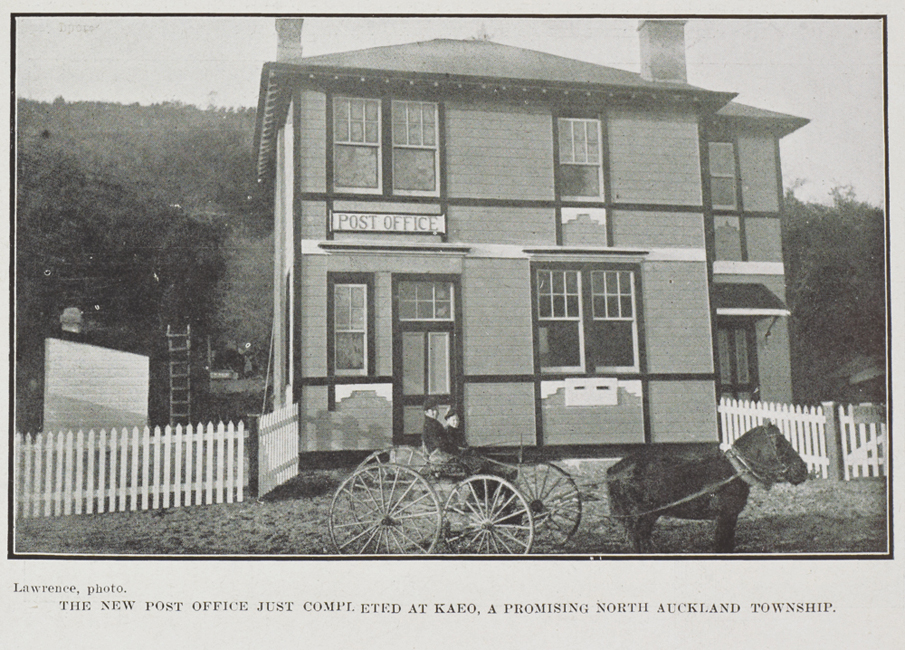
Early history of the site Kaeo lies beside the Kaeo River, which flows into the Whangaroa Harbour. According to Ngāti Whātua traditions, the latter was explored by the waka Māhuhu-ki-te-rangi during early Māori settlement of Aotearoa New Zealand. The Whangaroa area was settled by descendants of Te Māmaru and Mataatua waka crews. The harbour’s name comes from the lament ‘Whaingaroa’ (‘what a long wait’) uttered by Rauru-iti, whose warrior husband had departed on an inter-tribal foray, or taua, to the south. By the late 1700s, there were two primary hapū in the area: Ngāti Pou centred around the Whangaroa Heads and Ngāti Uru further inland. Pohue pā, at the eastern entrance to Kaeo, was established by Ngāti Uru following the hapū’s move from the Bay of Islands. The pā may have been created for largely defensive and ceremonial purposes, with cultivation and settlement occurring on lower ground beside the Kaeo River. In the early nineteenth century, Ngāti Uru was involved in important events in the history of Aotearoa New Zealand, including destruction of the merchant ship Boyd following the onboard mistreatment of one of its rangatira, Te Ara, in 1809; and establishment of New Zealand’s first Wesleyan Mission station at Kaeo in 1823. Known as Wesley-Dale, the latter was abandoned after a raid by warriors of Ngāpuhi leader Hongi Hika in 1827. During the 1830s and 1840s, a large area of land straddling the river - including the current site - was obtained by William Spickman (also known as Spikeman or Spackman), a former convict and Church Missionary Society employee who became involved in the area’s emerging timber trade. A small European settlement subsequently developed, which in the late 1850s contained one of only four sub-post offices in Northland. In 1857, Spickman became Kaeo’s first postmaster, housing the office in his general store. Prior to the twentieth century, postal services outside the region’s main settlements were generally situated in settlers’ homes, general stores or teachers’ residences rather than purpose-built structures. These places frequently became a hub of community life where people could socialise or do business, as well as deliver and collect mail. In 1874, Spickman’s duties as postmaster were taken over by kauri gum trader Richard Edward Gibbs (1838-1876). Gibbs’ store and post office was situated on Allotment 12 - a subdivision of Spickman’s land - fronting Kaeo’s main thoroughfare, Leigh Street. Two years earlier, in 1872, Gibbs had erected a family dwelling on a directly adjoining part of Allotment 12, within the rear of the current post office site. This consisted of a one-and-a-half storey timber structure, with a gabled, shingle roof and front verandah. After Richard Gibbs died in 1876, his wife Miriam (née Lane, c.1843-1934) took over the role of postmistress. For the next twelve years, Miriam Gibbs lived in the residence while operating the adjacent store and post office - situated immediately to the east of the current post office site. The Post Office had been a pioneer in women’s employment in New Zealand, although females were paid less than their male counterparts and required to resign at marriage. First post office on the site (1888-1910) In 1888, Miriam Gibbs sold the store and moved the postal business to her residence. Initially, the post office was situated in a side lean-to, then a rear skillion of the house. By this time, Gibbs’ duties as postmistress also included the registration of European births, deaths and marriages. In 1893, she was one of several women in Kaeo to sign a nationwide petition seeking the right for women to vote in parliamentary elections - enacted later that year as the earliest such legislation passed by a self-governing nation in the world. Postal and related services in New Zealand increased substantially in New Zealand under the first Liberal Government (1891-1912). This reflected both higher public demand as the economy expanded, and an expanding civil service to facilitate the delivery of the government’s legislative programme, which included many social reforms. Post office buildings provided an important state presence, especially in smaller communities, carrying out a range of essential tasks that included the collection of government duties, taxes and fees; payment of pensions and advances; and operation as agents for government bodies such as the Public Trustee. At the time, they were often seen as symbolic of community progress, and wider advances in the British Imperial enterprise. A major period of new post office construction in New Zealand took place in circa 1900-1914. In Northland, the wider period between 1900 and 1930 has been referred to as the ‘golden age’ for post offices in the region - when more than 200 were erected. In 1903, the Post and Telegraph Department purchased Gibbs’ one-and-a-half storey timber residence and its associated eight-acre section. After a new postmistress, Ellen Stephenson, was installed, the department initially converted a bedroom and bathroom to accommodate an enlarged post office in 1905, rather than electing to erect a new building. However, the number of deliveries carried out at Kaeo continued to increase as its population expanded during the area’s shift in emphasis from timber production to dairying. By 1910, plans for a new purpose-built structure on the site were underway. This formed part of a wider improvement of services in Far North centres: new offices in Kaitaia, Kaikohe and Kawakawa, were similarly planned. Construction of the current post office (1911-12) Initial designs drawn up by the Public Works Department were for a single-storey building. Approved by Government cabinet in July 1910, this was intended to be in broadly the same location as the 1872 residence. Prior to January 1911, however, new plans were produced for a two-storey, timber structure and associated outbuilding further west, directly next to the main thoroughfare. The revised plans bore the stamp of John Campbell (1857-1942), who was in charge of the architectural design of government buildings between 1899 and 1922, and formally Government Architect from 1909 onwards. Campbell is a significant figure in the development of New Zealand’s ‘architecture of state’ in the early twentieth century. Endeavouring to standardise design as a way of accommodating an upsurge in demand for government structures, he established Edwardian Baroque as the official style for such buildings. Widely used in Britain and elsewhere, Edwardian or Imperial Baroque referenced the achievements of earlier powers such as the Romans through its use of classical idiom; and in a New Zealand context especially emphasised connections with Britain and other parts of the imperial network. The many post offices designed during this period has been seen as particularly emblematic of Campbell’s standardising approach, and perhaps the major means through which Edwardian Baroque was established as a distinctive government style. Although considered unlikely to have personally designed all small post office buildings, in particular, Campbell is credited with creating a specific post office style, including through developing the architectural vocabulary used in their design and approving their construction. The design for Kaeo post office was based on one of two standard approaches for smaller post offices, which consisted of a two-storeyed block of three bays with a hipped roof. Unlike earlier examples of this type, which generally emphasised the middle bay by incorporating a central gable and front porch, it was more aligned with designs created in the second decade of the 1900s which provided an entrance in each of the end bays and paired windows in a central bay. At Kaeo, the design dispensed with visual symmetry, incorporating a public front door in the western part of its front elevation and a secondary entrance for staff in a set-back bay on the east side. Like many of the later examples, its appearance was simpler and less ornate than the earlier types. Its timber construction differed from Campbell’s general preference for more durable materials, although many Northland post offices of the period were similarly erected of wood. Its two-storey design contrasts with many of Campbell’s timber post offices, both in Northland and elsewhere, which were generally a single storey in height. Internally, the building layout was divided into work and living quarters. The post office occupied the ground floor, and contained an internal porch, a public office, a telegraphic bureau room, a large mail room and a small telegraph exchange. The Postmaster’s residence was upstairs, encompassing a sitting room, two bedrooms, a bathroom, a kitchen and a scullery. Fireplaces heated several of these spaces as well as the ground floor mail room, reflecting the care taken to provide comfortable accommodation and working conditions for employees. A washhouse and other conveniences were contained in a separate outbuilding. Following the evident removal of the earlier residence and excavation of sufficient land beside the road, the post office and its associated outbuilding were erected between August 1911 and January 1912. They were built by local company, Hare Brothers, whose offices were located on the adjoining section to the east. Early converts to Seventh Day Adventism in New Zealand, brothers Joseph Hare junior (1849-1935) and Wesley Hare (1853-1933) were shipowners, kauri gum dealers and general merchants, who had previously undertaken other building work in the region. Joseph Hare junior is said to have imported the first marine oil engine to New Zealand and was also a notable local politician, serving ten years as chair of Whangaroa County Council. During construction, the post office interior was especially admired by local commentators, with its rimu and tōtara linings being considered when polished to ‘look more like a handsome piece of furniture than a public office’. The new building opened for business in May 1912. Initial use and alterations (1912-38) The structure’s earliest occupant was a female employee, postmistress Emily Adams. From 1914, her role included registering Māori births, deaths and marriages in the area. At this time, the Post and Telegraph Department was one of the largest employers in the country, with more staff than the rest of the public service combined. Although the overall number of female employees was increasing, pressure from many men within the service had led in preceding years to more country post offices being placed in the charge of male officers. In 1916, the New Zealand Post and Telegraph Association passed a remit supporting equal pay for female employees, a principle that the Public Services Commissioner agreed with ‘where the duties are equal’. Occurring at a time when jobs were being filled in even greater numbers by women due to overseas conflict during the First World War (1914-18), many men supported this proposal in the belief that it would lead to them being preferred over women for the same position. In the same year, the first permanent male postmaster was appointed to run Kaeo’s post office. Male employees were to hold this role for the following 63 years. Changes to the post office building immediately after the war improved residential and work conditions for the postmaster, and also expanded the services provided. A rear extension erected in 1919-20 incorporated a telephone exchange and postmaster’s room on the ground floor, and enlarged, reconfigured accommodation above. Built of timber provided by local shipbuilders Lane and Sons, the addition encompassed a first-floor walkway that provided access to the embanked rear garden and a new washhouse, erected in 1920. The earlier washhouse was evidently converted to a lineman’s shed associated with the telephone exchange. A single-storey porch at the front of the post office, encroaching on the adjoining road reserve, was also likely built at this time. All additions to the main structure were erected in a similar style to the initial post office design. The new telephone exchange opened in September 1920, with 42 subscribers. Its manual switchboard was operated predominantly by female employees, some as young as fourteen years in age. This facility formed a coordination centre in local emergencies, for example in requesting assistance for childbirths, medical emergencies and fires. Reflecting the growing importance of motorised postal delivery as well as telephone facilities, a detached, timber garage and line store was added immediately to the north of the main building in 1926. Mail to and from Whangaroa had been transported by coach between 1904 and 1924, but was afterwards carried by car. Until 1918, mail between Kaeo and the gum fields at Otoroa and Matauri Bay was carried by horse, and this method continued to be used for Pupuke until 1933. Stabling was located on the west side of Leigh Street. By 1950, only 170 km of Northland’s roads had been sealed. Economic depression in the 1930s led to few further modifications other than refurbishment, necessary repairs and the erection of a rear porch in 1935. Later use and modifications (1939-current) During the Second World War (1939-45), the post office fulfilled important functions for incoming servicemen to the area as well as local residents. The telephone exchange connected servicemen at nearby army, navy and air force camps at Kaeo, Whangaroa Harbour and Radar Hill respectively with their friends and family. Numerous parcels for local servicemen serving overseas also passed through the mail room. The postmaster at this time, Percy Miller, was generally the first to be notified of a local soldier’s death and visited bereaved families to inform them of their loss. In 1941, an additional storey was added to the front porch to incorporate a sun room for Miller’s accommodation. Due to wartime restrictions on materials, its roof initially consisted of bitumastic material rather than corrugated iron, and subsequently required replacement after the latter became available. Informal roles undertaken by staff during the immediate post-war period included translation between te reo Māori and English for older Māori residents drawing their pensions. Until the early 1960s, separate registers for Māori and non-Māori births and deaths were maintained. Changes to the building in the 1960s included the insertion of a strong room (1961) and construction of an addition for extra counter space on the western side of the main building (1962). The latter removed the earlier lineman’s hut and garage, and a new garage appears to have been erected to the east of the main building. A lean-to extension may have also been added to the east elevation of the post office structure at a similar time. A chimney and other parts of the building suffered minor damage during the Whangaroa earthquake in 1963. Mail volumes at Kaeo reached a peak in the 1970s. At this time, the post office provided a wide range of services to the community, with Savings Bank duties representing a significant part of behind-counter work. In order to assist accounting, the business was the first in Kaeo to have a computer. In the global fuel crisis of 1979-80, the post office issued ‘Carless Day’ stickers as part of government attempts to economise consumption. Weddings were carried out. The residential quarters above the post office were occupied by the postmaster and his family until at least 1979. During the liberalisation of government services under the fourth Labour Government in the 1980s, the functions of the Post Office were replaced by three State-owned enterprises: New Zealand Post, Telecom Corporation NZ and PostBank. Kaeo Post Office closed for most business in May 1989. The manual telephone exchange in the building remained in use until November 1989. Still operating some party lines, it was the last of its type to be used in mainland New Zealand: only exchanges on Great Barrier Island and the Chatham Islands retained similar manual technology. In 1990, the property was purchased by the Far North District Council. Some ancillary structures have since been removed. The main building was initially occupied by the Whangaroa Community Trust, and for a period, the Whangaroa Museum and Archives Society. Refurbishment in 2012 was undertaken to commemorate the building’s centenary, and a celebration involving local politicians and former post office employees was held nearby. Since at least 2012, the place has held an important community role as a library and service centre. Upstairs rooms are currently (2020) occupied as offices by a variety of private consultants.
Early history of the site Kaeo lies beside the Kaeo River, which flows into the Whangaroa Harbour. According to Ngāti Whātua traditions, the latter was explored by the waka Māhuhu-ki-te-rangi during early Māori settlement of Aotearoa New Zealand. The Whangaroa area was settled by descendants of Te Māmaru and Mataatua waka crews. The harbour’s name comes from the lament ‘Whaingaroa’ (‘what a long wait’) uttered by Rauru-iti, whose warrior husband had departed on an inter-tribal foray, or taua, to the south. By the late 1700s, there were two primary hapū in the area: Ngāti Pou centred around the Whangaroa Heads and Ngāti Uru further inland. Pohue pā, at the eastern entrance to Kaeo, was established by Ngāti Uru following the hapū’s move from the Bay of Islands. The pā may have been created for largely defensive and ceremonial purposes, with cultivation and settlement occurring on lower ground beside the Kaeo River. In the early nineteenth century, Ngāti Uru was involved in important events in the history of Aotearoa New Zealand, including destruction of the merchant ship Boyd following the onboard mistreatment of one of its rangatira, Te Ara, in 1809; and establishment of New Zealand’s first Wesleyan Mission station at Kaeo in 1823. Known as Wesley-Dale, the latter was abandoned after a raid by warriors of Ngāpuhi leader Hongi Hika in 1827. During the 1830s and 1840s, a large area of land straddling the river - including the current site - was obtained by William Spickman (also known as Spikeman or Spackman), a former convict and Church Missionary Society employee who became involved in the area’s emerging timber trade. A small European settlement subsequently developed, which in the late 1850s contained one of only four sub-post offices in Northland. In 1857, Spickman became Kaeo’s first postmaster, housing the office in his general store. Prior to the twentieth century, postal services outside the region’s main settlements were generally situated in settlers’ homes, general stores or teachers’ residences rather than purpose-built structures. These places frequently became a hub of community life where people could socialise or do business, as well as deliver and collect mail. In 1874, Spickman’s duties as postmaster were taken over by kauri gum trader Richard Edward Gibbs (1838-1876). Gibbs’ store and post office was situated on Allotment 12 - a subdivision of Spickman’s land - fronting Kaeo’s main thoroughfare, Leigh Street. Two years earlier, in 1872, Gibbs had erected a family dwelling on a directly adjoining part of Allotment 12, within the rear of the current post office site. This consisted of a one-and-a-half storey timber structure, with a gabled, shingle roof and front verandah. After Richard Gibbs died in 1876, his wife Miriam (née Lane, c.1843-1934) took over the role of postmistress. For the next twelve years, Miriam Gibbs lived in the residence while operating the adjacent store and post office - situated immediately to the east of the current post office site. The Post Office had been a pioneer in women’s employment in New Zealand, although females were paid less than their male counterparts and required to resign at marriage. First post office on the site (1888-1910) In 1888, Miriam Gibbs sold the store and moved the postal business to her residence. Initially, the post office was situated in a side lean-to, then a rear skillion of the house. By this time, Gibbs’ duties as postmistress also included the registration of European births, deaths and marriages. In 1893, she was one of several women in Kaeo to sign a nationwide petition seeking the right for women to vote in parliamentary elections - enacted later that year as the earliest such legislation passed by a self-governing nation in the world. Postal and related services in New Zealand increased substantially in New Zealand under the first Liberal Government (1891-1912). This reflected both higher public demand as the economy expanded, and an expanding civil service to facilitate the delivery of the government’s legislative programme, which included many social reforms. Post office buildings provided an important state presence, especially in smaller communities, carrying out a range of essential tasks that included the collection of government duties, taxes and fees; payment of pensions and advances; and operation as agents for government bodies such as the Public Trustee. At the time, they were often seen as symbolic of community progress, and wider advances in the British Imperial enterprise. A major period of new post office construction in New Zealand took place in circa 1900-1914. In Northland, the wider period between 1900 and 1930 has been referred to as the ‘golden age’ for post offices in the region - when more than 200 were erected. In 1903, the Post and Telegraph Department purchased Gibbs’ one-and-a-half storey timber residence and its associated eight-acre section. After a new postmistress, Ellen Stephenson, was installed, the department initially converted a bedroom and bathroom to accommodate an enlarged post office in 1905, rather than electing to erect a new building. However, the number of deliveries carried out at Kaeo continued to increase as its population expanded during the area’s shift in emphasis from timber production to dairying. By 1910, plans for a new purpose-built structure on the site were underway. This formed part of a wider improvement of services in Far North centres: new offices in Kaitaia, Kaikohe and Kawakawa, were similarly planned. Construction of the current post office (1911-12) Initial designs drawn up by the Public Works Department were for a single-storey building. Approved by Government cabinet in July 1910, this was intended to be in broadly the same location as the 1872 residence. Prior to January 1911, however, new plans were produced for a two-storey, timber structure and associated outbuilding further west, directly next to the main thoroughfare. The revised plans bore the stamp of John Campbell (1857-1942), who was in charge of the architectural design of government buildings between 1899 and 1922, and formally Government Architect from 1909 onwards. Campbell is a significant figure in the development of New Zealand’s ‘architecture of state’ in the early twentieth century. Endeavouring to standardise design as a way of accommodating an upsurge in demand for government structures, he established Edwardian Baroque as the official style for such buildings. Widely used in Britain and elsewhere, Edwardian or Imperial Baroque referenced the achievements of earlier powers such as the Romans through its use of classical idiom; and in a New Zealand context especially emphasised connections with Britain and other parts of the imperial network. The many post offices designed during this period has been seen as particularly emblematic of Campbell’s standardising approach, and perhaps the major means through which Edwardian Baroque was established as a distinctive government style. Although considered unlikely to have personally designed all small post office buildings, in particular, Campbell is credited with creating a specific post office style, including through developing the architectural vocabulary used in their design and approving their construction. The design for Kaeo post office was based on one of two standard approaches for smaller post offices, which consisted of a two-storeyed block of three bays with a hipped roof. Unlike earlier examples of this type, which generally emphasised the middle bay by incorporating a central gable and front porch, it was more aligned with designs created in the second decade of the 1900s which provided an entrance in each of the end bays and paired windows in a central bay. At Kaeo, the design dispensed with visual symmetry, incorporating a public front door in the western part of its front elevation and a secondary entrance for staff in a set-back bay on the east side. Like many of the later examples, its appearance was simpler and less ornate than the earlier types. Its timber construction differed from Campbell’s general preference for more durable materials, although many Northland post offices of the period were similarly erected of wood. Its two-storey design contrasts with many of Campbell’s timber post offices, both in Northland and elsewhere, which were generally a single storey in height. Internally, the building layout was divided into work and living quarters. The post office occupied the ground floor, and contained an internal porch, a public office, a telegraphic bureau room, a large mail room and a small telegraph exchange. The Postmaster’s residence was upstairs, encompassing a sitting room, two bedrooms, a bathroom, a kitchen and a scullery. Fireplaces heated several of these spaces as well as the ground floor mail room, reflecting the care taken to provide comfortable accommodation and working conditions for employees. A washhouse and other conveniences were contained in a separate outbuilding. Following the evident removal of the earlier residence and excavation of sufficient land beside the road, the post office and its associated outbuilding were erected between August 1911 and January 1912. They were built by local company, Hare Brothers, whose offices were located on the adjoining section to the east. Early converts to Seventh Day Adventism in New Zealand, brothers Joseph Hare junior (1849-1935) and Wesley Hare (1853-1933) were shipowners, kauri gum dealers and general merchants, who had previously undertaken other building work in the region. Joseph Hare junior is said to have imported the first marine oil engine to New Zealand and was also a notable local politician, serving ten years as chair of Whangaroa County Council. During construction, the post office interior was especially admired by local commentators, with its rimu and tōtara linings being considered when polished to ‘look more like a handsome piece of furniture than a public office’. The new building opened for business in May 1912. Initial use and alterations (1912-38) The structure’s earliest occupant was a female employee, postmistress Emily Adams. From 1914, her role included registering Māori births, deaths and marriages in the area. At this time, the Post and Telegraph Department was one of the largest employers in the country, with more staff than the rest of the public service combined. Although the overall number of female employees was increasing, pressure from many men within the service had led in preceding years to more country post offices being placed in the charge of male officers. In 1916, the New Zealand Post and Telegraph Association passed a remit supporting equal pay for female employees, a principle that the Public Services Commissioner agreed with ‘where the duties are equal’. Occurring at a time when jobs were being filled in even greater numbers by women due to overseas conflict during the First World War (1914-18), many men supported this proposal in the belief that it would lead to them being preferred over women for the same position. In the same year, the first permanent male postmaster was appointed to run Kaeo’s post office. Male employees were to hold this role for the following 63 years. Changes to the post office building immediately after the war improved residential and work conditions for the postmaster, and also expanded the services provided. A rear extension erected in 1919-20 incorporated a telephone exchange and postmaster’s room on the ground floor, and enlarged, reconfigured accommodation above. Built of timber provided by local shipbuilders Lane and Sons, the addition encompassed a first-floor walkway that provided access to the embanked rear garden and a new washhouse, erected in 1920. The earlier washhouse was evidently converted to a lineman’s shed associated with the telephone exchange. A single-storey porch at the front of the post office, encroaching on the adjoining road reserve, was also likely built at this time. All additions to the main structure were erected in a similar style to the initial post office design. The new telephone exchange opened in September 1920, with 42 subscribers. Its manual switchboard was operated predominantly by female employees, some as young as fourteen years in age. This facility formed a coordination centre in local emergencies, for example in requesting assistance for childbirths, medical emergencies and fires. Reflecting the growing importance of motorised postal delivery as well as telephone facilities, a detached, timber garage and line store was added immediately to the north of the main building in 1926. Mail to and from Whangaroa had been transported by coach between 1904 and 1924, but was afterwards carried by car. Until 1918, mail between Kaeo and the gum fields at Otoroa and Matauri Bay was carried by horse, and this method continued to be used for Pupuke until 1933. Stabling was located on the west side of Leigh Street. By 1950, only 170 km of Northland’s roads had been sealed. Economic depression in the 1930s led to few further modifications other than refurbishment, necessary repairs and the erection of a rear porch in 1935. Later use and modifications (1939-current) During the Second World War (1939-45), the post office fulfilled important functions for incoming servicemen to the area as well as local residents. The telephone exchange connected servicemen at nearby army, navy and air force camps at Kaeo, Whangaroa Harbour and Radar Hill respectively with their friends and family. Numerous parcels for local servicemen serving overseas also passed through the mail room. The postmaster at this time, Percy Miller, was generally the first to be notified of a local soldier’s death and visited bereaved families to inform them of their loss. In 1941, an additional storey was added to the front porch to incorporate a sun room for Miller’s accommodation. Due to wartime restrictions on materials, its roof initially consisted of bitumastic material rather than corrugated iron, and subsequently required replacement after the latter became available. Informal roles undertaken by staff during the immediate post-war period included translation between te reo Māori and English for older Māori residents drawing their pensions. Until the early 1960s, separate registers for Māori and non-Māori births and deaths were maintained. Changes to the building in the 1960s included the insertion of a strong room (1961) and construction of an addition for extra counter space on the western side of the main building (1962). The latter removed the earlier lineman’s hut and garage, and a new garage appears to have been erected to the east of the main building. A lean-to extension may have also been added to the east elevation of the post office structure at a similar time. A chimney and other parts of the building suffered minor damage during the Whangaroa earthquake in 1963. Mail volumes at Kaeo reached a peak in the 1970s. At this time, the post office provided a wide range of services to the community, with Savings Bank duties representing a significant part of behind-counter work. In order to assist accounting, the business was the first in Kaeo to have a computer. In the global fuel crisis of 1979-80, the post office issued ‘Carless Day’ stickers as part of government attempts to economise consumption. Weddings were carried out. The residential quarters above the post office were occupied by the postmaster and his family until at least 1979. During the liberalisation of government services under the fourth Labour Government in the 1980s, the functions of the Post Office were replaced by three State-owned enterprises: New Zealand Post, Telecom Corporation NZ and PostBank. Kaeo Post Office closed for most business in May 1989. The manual telephone exchange in the building remained in use until November 1989. Still operating some party lines, it was the last of its type to be used in mainland New Zealand: only exchanges on Great Barrier Island and the Chatham Islands retained similar manual technology. In 1990, the property was purchased by the Far North District Council. Some ancillary structures have since been removed. The main building was initially occupied by the Whangaroa Community Trust, and for a period, the Whangaroa Museum and Archives Society. Refurbishment in 2012 was undertaken to commemorate the building’s centenary, and a celebration involving local politicians and former post office employees was held nearby. Since at least 2012, the place has held an important community role as a library and service centre. Upstairs rooms are currently (2020) occupied as offices by a variety of private consultants.
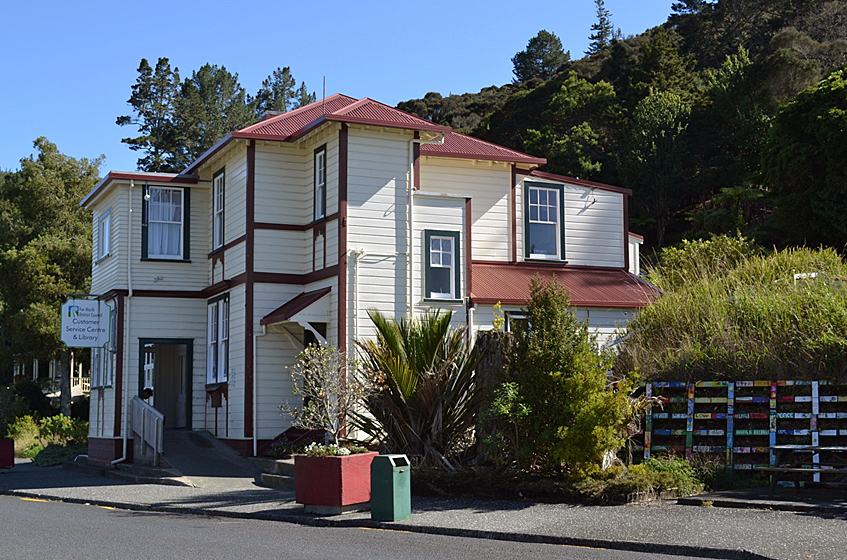
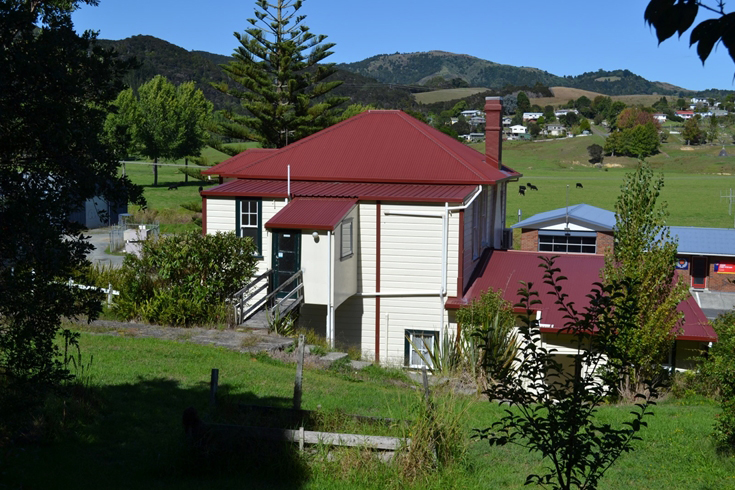
Current Description Context The Post Office (Former) is located in the centre of Kaeo, a small and distinctive Far North township. The settlement is picturesquely situated in a valley beside the River Kaeo, and overlooked by Pohue Pā (List No.7459, Wāhi Tapu Area). The pā contains well-preserved terracing and is visually distinctive. In addition to other recorded pre-1840 sites in the vicinity, Kaeo contains the archaeological remnants of Wesleydale - New Zealand’s oldest Wesleyan mission station. The township is also notable for retaining a number of well-preserved nineteenth- and early twentieth-century buildings. Many of these lie beside Leigh Street (State Highway 10), which forms the main arterial route between the Bay of Islands and coastal areas further north. A particularly significant cluster includes the War Memorial Library (1920; List No.7393, Category 2 historic place), Wesleydale Memorial Church (1922), a former Gum Store (c.1885, which may have originated as an 1870 chapel at the Wesleydale site) and a former saddlery (pre-1900). These are situated at 22, 23, 26 and 34 Leigh Street (State Highway 10), respectively. The Post Office (Former) forms a prominent and central component of this group, situated at a slight bend in Leigh Street. Its location, distinctive architecture and dimensions mark it out as a local landmark, particularly when approaching by road from the west. Immediately to the west and east, buildings also forming part of the cluster have particularly strong historical connections to the former post office site. To the east is the initial general store and post office run by Richard, and then Miriam Gibbs from the early 1870s. This was subsequently used as a premises by Hare Brothers, who constructed the former post office. To the west, at 32 Leigh Street, is a large residence erected for Miriam Gibbs’ brother, Gilbert Lane, in 1879, which was also built by Hare Brothers. Collectively this concentrated cluster in central Kaeo, including the former Post Office, forms a distinctive and representative group reflecting the variety of activity - residential, commercial, religious, cultural, administrative and other - occurring within small, late nineteenth- and early twentieth-century townships in the Far North. The Site The site is approximately rectangular in plan, occupying the main, former post office property and a small extension southward into the road reserve on Leigh Street to accommodate encroachment of the building’s front porch and approaches onto the street pavement. The main post office building lies in the southwest part of the property, directly fronting onto Leigh Street (State Highway 10). Occupying flat ground, the two-storey building has been cut into the lower slope of a hillside, which is retained by a concrete wall incorporating stone aggregate. In the southeast part of the property, adjoining Leigh Street and at the same level, is a 1960s timber garage. Approximately midway between these two structures is a small concrete pad, which represents the former site of a 1920s benzene store. To the north of these structures is a raised, flat terrace, possibly an early landslip near the base of the hillside. This is accessed from the main post office building by a set of concrete steps from the lower rear of the structure, and by a timber walkway extending outwards from the first floor of the building. The terrace contains the rectangular footings and concrete floor of a 1920 washhouse towards the east side of the property. It also likely contains in-ground archaeological remains associated with an earlier, 1872 residence on the site, used as a post office. Land in the very north of the property slopes upwards and contains trees. Main building Exterior The main building consists of a two-storey timber structure, with a hipped roof clad with corrugated iron. The distinctive Edwardian Baroque architecture of the 1911-12 structure is visibly retained, with sympathetic extensions in an identical style undertaken in 1919-20. More recent additions include a single-storey, gabled timber addition on the west side of the building, a second-storey sun-room on the south elevation and a timber lean-to of single-storey height on the east. Collectively, these reflect the building’s ongoing development as a country post office. The main elevation faces south, towards Leigh Street (State Highway 10). Stepped in plan, it incorporates three, two-storey bays clad with rusticated weatherboards. The gabled single-storey addition to the west creates a fourth bay. The latter is clad with horizontal weatherboards of a similar width to those in the other bays. The central bay of the two-storey element contains paired sash windows at ground floor level and a single window above. The upper halves of each sash are divided into multiple panes - a distinctive window type. The lower windows lie directly above a post box delivery feature with covering hood, which features in the 1911-12 plans. The west bay of the two-storey element incorporates a projecting porch, the lower part of which was probably erected in 1919-20. The main public entrance to the building is accessed by doors in both side walls of the porch. A 1941 sun room above is clad with narrower weatherboards, but retains re-used windows from the earlier arrangement in its east and west walls. The east bay is set back and houses much of the stairwell connecting ground and upper floor. It includes an original doorway, which provided staff access to both the mail room at ground level and residential accommodation above. The east elevation contains similar sash windows to those in the south elevation, including in the side wall of the stairwell bay and a two-storey lean-to addition to the main building at the rear. A lower lean-to at ground floor level contains a plainer window. At the back, the north elevation incorporates the rusticated weatherboard walls of the two-storey 1919 addition, against which a plain, projecting porch and timber walkway have been placed to connect the building and rear garden at first floor level. The west part of the elevation incorporates the rear wall of a concrete strong room and the single-storey west addition. The latter contains an access door. The west wall of the addition has narrower weatherboarding than its front (south) elevation, extending up to the eaves of the shallow gable roof. The tall brick chimney of the 1911-12 structure is retained behind the latter extension, together with sash windows at upper storey level. Interior Internally, there has been modification especially at ground floor level. The interior of the former 1911-12 mail room and public counter area has been opened out, as has the former 1919-20 telephone exchange and postmaster’s room at the rear. Original walls at this level have generally been covered or relined. However, early arrangements can be read in the exposed ceiling - which retains extensive board and batten arrangements within the mail room and public counter areas - and through the retention of other features including a brick fireplace in the southeast corner of the former mail room, and a four-panel door connecting the mail room and staff entrance hall to the east. The upstairs area has been less modified in its layout, retaining numerous individual rooms. Four-panel doors and timber floorboards visibly survive. The timber matchlining of a former scullery exists in a small room above the staircase. The early staircase connecting the two storeys is well-preserved, incorporating turned balusters, handrails and dados. The 1960s addition retains significant features linked with post office use, particularly a concrete strong room, lined telephone booth and door to a postmaster’s office. The former retains evidence of formwork construction. Its door bears a manufacturer’s label: ‘GUARDIAN SAFES & STRONGROOM DOORS BY S.A. HUNT & CO. LTD. WELLINGTON’. Both the booth and postmaster’s doors contain lettering linked with their use. The first is ‘TOLLS’ in underlined gold lettering on the outer face of a central glass panel. The second bears the word ‘POSTMASTER’ in similar gold-coloured lettering. Garage A small garage is of timber construction, clad with narrow, horizontal weatherboards. These are similar to those on the west wall of the 1962 post office extension. The garage roof has a shallow gable. A metal door encloses access to the interior on the south side of the building.
Current Description Context The Post Office (Former) is located in the centre of Kaeo, a small and distinctive Far North township. The settlement is picturesquely situated in a valley beside the River Kaeo, and overlooked by Pohue Pā (List No.7459, Wāhi Tapu Area). The pā contains well-preserved terracing and is visually distinctive. In addition to other recorded pre-1840 sites in the vicinity, Kaeo contains the archaeological remnants of Wesleydale - New Zealand’s oldest Wesleyan mission station. The township is also notable for retaining a number of well-preserved nineteenth- and early twentieth-century buildings. Many of these lie beside Leigh Street (State Highway 10), which forms the main arterial route between the Bay of Islands and coastal areas further north. A particularly significant cluster includes the War Memorial Library (1920; List No.7393, Category 2 historic place), Wesleydale Memorial Church (1922), a former Gum Store (c.1885, which may have originated as an 1870 chapel at the Wesleydale site) and a former saddlery (pre-1900). These are situated at 22, 23, 26 and 34 Leigh Street (State Highway 10), respectively. The Post Office (Former) forms a prominent and central component of this group, situated at a slight bend in Leigh Street. Its location, distinctive architecture and dimensions mark it out as a local landmark, particularly when approaching by road from the west. Immediately to the west and east, buildings also forming part of the cluster have particularly strong historical connections to the former post office site. To the east is the initial general store and post office run by Richard, and then Miriam Gibbs from the early 1870s. This was subsequently used as a premises by Hare Brothers, who constructed the former post office. To the west, at 32 Leigh Street, is a large residence erected for Miriam Gibbs’ brother, Gilbert Lane, in 1879, which was also built by Hare Brothers. Collectively this concentrated cluster in central Kaeo, including the former Post Office, forms a distinctive and representative group reflecting the variety of activity - residential, commercial, religious, cultural, administrative and other - occurring within small, late nineteenth- and early twentieth-century townships in the Far North. The Site The site is approximately rectangular in plan, occupying the main, former post office property and a small extension southward into the road reserve on Leigh Street to accommodate encroachment of the building’s front porch and approaches onto the street pavement. The main post office building lies in the southwest part of the property, directly fronting onto Leigh Street (State Highway 10). Occupying flat ground, the two-storey building has been cut into the lower slope of a hillside, which is retained by a concrete wall incorporating stone aggregate. In the southeast part of the property, adjoining Leigh Street and at the same level, is a 1960s timber garage. Approximately midway between these two structures is a small concrete pad, which represents the former site of a 1920s benzene store. To the north of these structures is a raised, flat terrace, possibly an early landslip near the base of the hillside. This is accessed from the main post office building by a set of concrete steps from the lower rear of the structure, and by a timber walkway extending outwards from the first floor of the building. The terrace contains the rectangular footings and concrete floor of a 1920 washhouse towards the east side of the property. It also likely contains in-ground archaeological remains associated with an earlier, 1872 residence on the site, used as a post office. Land in the very north of the property slopes upwards and contains trees. Main building Exterior The main building consists of a two-storey timber structure, with a hipped roof clad with corrugated iron. The distinctive Edwardian Baroque architecture of the 1911-12 structure is visibly retained, with sympathetic extensions in an identical style undertaken in 1919-20. More recent additions include a single-storey, gabled timber addition on the west side of the building, a second-storey sun-room on the south elevation and a timber lean-to of single-storey height on the east. Collectively, these reflect the building’s ongoing development as a country post office. The main elevation faces south, towards Leigh Street (State Highway 10). Stepped in plan, it incorporates three, two-storey bays clad with rusticated weatherboards. The gabled single-storey addition to the west creates a fourth bay. The latter is clad with horizontal weatherboards of a similar width to those in the other bays. The central bay of the two-storey element contains paired sash windows at ground floor level and a single window above. The upper halves of each sash are divided into multiple panes - a distinctive window type. The lower windows lie directly above a post box delivery feature with covering hood, which features in the 1911-12 plans. The west bay of the two-storey element incorporates a projecting porch, the lower part of which was probably erected in 1919-20. The main public entrance to the building is accessed by doors in both side walls of the porch. A 1941 sun room above is clad with narrower weatherboards, but retains re-used windows from the earlier arrangement in its east and west walls. The east bay is set back and houses much of the stairwell connecting ground and upper floor. It includes an original doorway, which provided staff access to both the mail room at ground level and residential accommodation above. The east elevation contains similar sash windows to those in the south elevation, including in the side wall of the stairwell bay and a two-storey lean-to addition to the main building at the rear. A lower lean-to at ground floor level contains a plainer window. At the back, the north elevation incorporates the rusticated weatherboard walls of the two-storey 1919 addition, against which a plain, projecting porch and timber walkway have been placed to connect the building and rear garden at first floor level. The west part of the elevation incorporates the rear wall of a concrete strong room and the single-storey west addition. The latter contains an access door. The west wall of the addition has narrower weatherboarding than its front (south) elevation, extending up to the eaves of the shallow gable roof. The tall brick chimney of the 1911-12 structure is retained behind the latter extension, together with sash windows at upper storey level. Interior Internally, there has been modification especially at ground floor level. The interior of the former 1911-12 mail room and public counter area has been opened out, as has the former 1919-20 telephone exchange and postmaster’s room at the rear. Original walls at this level have generally been covered or relined. However, early arrangements can be read in the exposed ceiling - which retains extensive board and batten arrangements within the mail room and public counter areas - and through the retention of other features including a brick fireplace in the southeast corner of the former mail room, and a four-panel door connecting the mail room and staff entrance hall to the east. The upstairs area has been less modified in its layout, retaining numerous individual rooms. Four-panel doors and timber floorboards visibly survive. The timber matchlining of a former scullery exists in a small room above the staircase. The early staircase connecting the two storeys is well-preserved, incorporating turned balusters, handrails and dados. The 1960s addition retains significant features linked with post office use, particularly a concrete strong room, lined telephone booth and door to a postmaster’s office. The former retains evidence of formwork construction. Its door bears a manufacturer’s label: ‘GUARDIAN SAFES & STRONGROOM DOORS BY S.A. HUNT & CO. LTD. WELLINGTON’. Both the booth and postmaster’s doors contain lettering linked with their use. The first is ‘TOLLS’ in underlined gold lettering on the outer face of a central glass panel. The second bears the word ‘POSTMASTER’ in similar gold-coloured lettering. Garage A small garage is of timber construction, clad with narrow, horizontal weatherboards. These are similar to those on the west wall of the 1962 post office extension. The garage roof has a shallow gable. A metal door encloses access to the interior on the south side of the building.
Historical and Associated Iwi / Hapū / Whānau
Completion Date
20th April 2020
Report Written By
Martin Jones and Bill Edwards
Information Sources
Dictionary of New Zealand Biography
Dictionary of New Zealand Biography
Richardson, 1988
Peter Richardson, 'An Architecture of Empire: The Government Buildings of John Campbell in New Zealand', MA Thesis, University of Canterbury, 1988
Craig, 2014
Craig, Fiona, In Praise of our Post Office: Kaeo and Whangaroa’s Nerve Centres from 1857, [Kaeo, 2014].
Postal History Society of New Zealand
Postal History Society of New Zealand
Other Information
Please note that entry on the New Zealand Heritage List/Rārangi Kōrero identifies only the heritage values of the property concerned, and should not be construed as advice on the state of the property, or as a comment of its soundness or safety, including in regard to earthquake risk, safety in the event of fire, or insanitary conditions. Archaeological sites are protected by the Heritage New Zealand Pouhere Taonga Act 2014, regardless of whether they are entered on the New Zealand Heritage List/Rārangi Kōrero or not. Archaeological sites include ‘places associated with pre-1900 human activity, where there may be evidence relating to the history of New Zealand’. This List entry report should not be read as a statement on whether or not the archaeological provisions of the Act apply to the property (s) concerned. Please contact your local Heritage New Zealand office for archaeological advice. A fully referenced New Zealand Heritage List report is available on request from the Northern Office of Heritage New Zealand
Historical and Associated Iwi / Hapū / Whānau
Completion Date
20th April 2020
Report Written By
Martin Jones and Bill Edwards
Information Sources
Dictionary of New Zealand Biography
Dictionary of New Zealand Biography
Richardson, 1988
Peter Richardson, 'An Architecture of Empire: The Government Buildings of John Campbell in New Zealand', MA Thesis, University of Canterbury, 1988
Craig, 2014
Craig, Fiona, In Praise of our Post Office: Kaeo and Whangaroa’s Nerve Centres from 1857, [Kaeo, 2014].
Postal History Society of New Zealand
Postal History Society of New Zealand
Other Information
Please note that entry on the New Zealand Heritage List/Rārangi Kōrero identifies only the heritage values of the property concerned, and should not be construed as advice on the state of the property, or as a comment of its soundness or safety, including in regard to earthquake risk, safety in the event of fire, or insanitary conditions. Archaeological sites are protected by the Heritage New Zealand Pouhere Taonga Act 2014, regardless of whether they are entered on the New Zealand Heritage List/Rārangi Kōrero or not. Archaeological sites include ‘places associated with pre-1900 human activity, where there may be evidence relating to the history of New Zealand’. This List entry report should not be read as a statement on whether or not the archaeological provisions of the Act apply to the property (s) concerned. Please contact your local Heritage New Zealand office for archaeological advice. A fully referenced New Zealand Heritage List report is available on request from the Northern Office of Heritage New Zealand
Current Usages
Uses: Civic Facilities
Specific Usage: Library
Uses: Trade
Specific Usage: Office building/Offices
Former Usages
General Usage: Civic Facilities
Specific Usage: Museum
General Usage: Communication
Specific Usage: Post Office
General Usage: Communication
Specific Usage: Telephone Exchange
General Usage: Finance
Specific Usage: Bank
Current Usages
Uses: Civic Facilities
Specific Usage: Library
Uses: Trade
Specific Usage: Office building/Offices
Former Usages
General Usage: Civic Facilities
Specific Usage: Museum
General Usage: Communication
Specific Usage: Post Office
General Usage: Communication
Specific Usage: Telephone Exchange
General Usage: Finance
Specific Usage: Bank
Location
Get the latest heritage news, features and events delivered
straight to your inbox.
