Early history of the site
The site of the Government Centre in Wellington has a long history of human occupation. Early tribes that settled around Te Whanganui-a-Tara (‘the great harbour of Tara’) and the south coast included Ngāi Tara, Ngāti Ira, Ngāti Kahungunu, Ngāi Tahu and Ngāti Mamoe. By 1819 the district was mainly occupied by Ngāti Ira and related ‘Whatonga-descent people’, who were subsequently driven out to the eastern side of the harbour and to the Wairarapa when a war party invaded the Wellington area. By 1840 those Māori having rights in Wellington Harbour and its foreshore were Te Atiawa, Ngāti Tama, Taranaki, Ngāti Toa and Ngāti Ruanui, who had migrated there from Taranaki and Waikato during the 1820s.
In the immediate vicinity of today’s Government Centre there are a number of sites significant to tangata whenua. Pipitea Pā, a large settlement established by Ngāti Mutunga in 1824 and gifted by them to Te Atiawa in 1835, was located between today’s Pipitea, Davis and Mulgrave Streets. It was surrounded by extensive cultivations and was home to around 80 people in the 1840s. Also nearby was Kumutoto Kainga, an important flax-gathering and waka-landing site which was also the dwelling place of Te Atiawa chief Wi Tako Ngatata and his people from 1835 to 1853. A small triangle of land on the corner of the parliamentary precinct at Molesworth Street and Lambton Quay, called Waititi Landing Park, commemorates another significant waka-landing site. The future parliamentary precinct itself has been described as a slope of clay hillsides, knolls and swampy ground, bordered by the Waipiro and Tutaenui streams. Where the Parliamentary Library is now was known as Kaiota, and urupā were in the vicinity.
Dedicated British colonisation of Wellington began in 1839 through the New Zealand Company’s scheme. Led by Colonel William Wakefield (1803-1848), the Company negotiated the purchase of tracts of land around the harbour. When the first settlement, Britannia, failed due to its location by the flood-prone Hutt River at Petone, the Company moved the town across to the inner bay of the harbour, despite the fact that the land had not been legally purchased and was occupied by Māori. The scale of the colonisation scheme eventually displaced many of the Māori inhabitants, and the town of Wellington grew through trade and commerce assisted by reclamation of land along the waterfront and the spread of settlement in the surrounding districts.
A local government centre
The prominent rise of land in Pipitea/Thorndon where Parliament sits today was the focus of government activities from the early days of the colonial settlement. It was allocated as a ‘government reserve’ in the New Zealand Company’s plan, and Colonel Wakefield built his house where the Executive Wing is today; it was taken over as the official governor’s residence in 1848. New Zealand was initially administered as British territory by a governor appointed by the British Crown, and although Wakefield hoped that Wellington would be the site of the capital, Governor William Hobson chose Auckland as the national government seat in 1840.
The New Zealand Constitution Act of 1852 was a milestone in New Zealand’s political history. While retaining the sovereign as the head of state, it granted responsible self-government to the colony, and Parliament (then officially called the General Assembly) was set up as a central government with an elected House of Representatives (lower House) and a Legislative Council (upper House). Six provincial governments were also created, and Wellington’s provincial government initially met in Barrett’s Hotel. In 1857-1858, purpose-built Provincial Chambers were constructed where the Parliamentary Library (List no. 217) sits today. This building was designed to have two large chambers suitable for accommodating the House of Representatives and the Legislative Council, should Parliament be persuaded to move to Wellington.
Wellington: the new capital
In 1865 Wellington’s wish was granted, and the capital was moved there because of its location in the centre of the country.
New Zealand’s democratic system of government consists of three branches: the legislature (Parliament), the executive (ministers of the Crown and their government departments), and the judiciary (the court system). The legislature is responsible for making laws, checking and approving governmental spending, and representing the voice of New Zealanders through the elected Member of Parliament system. The executive, which includes Cabinet, initiates and administers laws and governmental policy, and makes day-to-day financial decisions about how New Zealand’s money should be spent. The judiciary’s job is to independently apply and interpret the laws passed by Parliament.
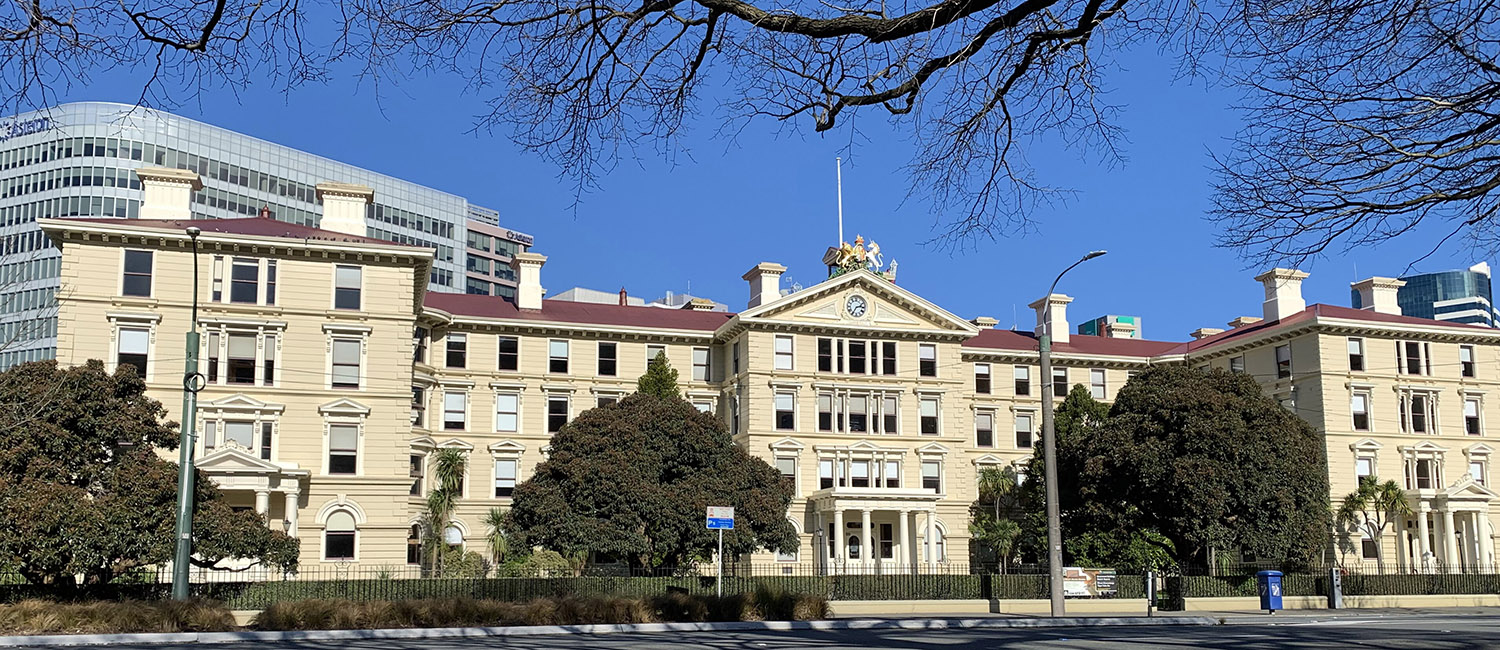
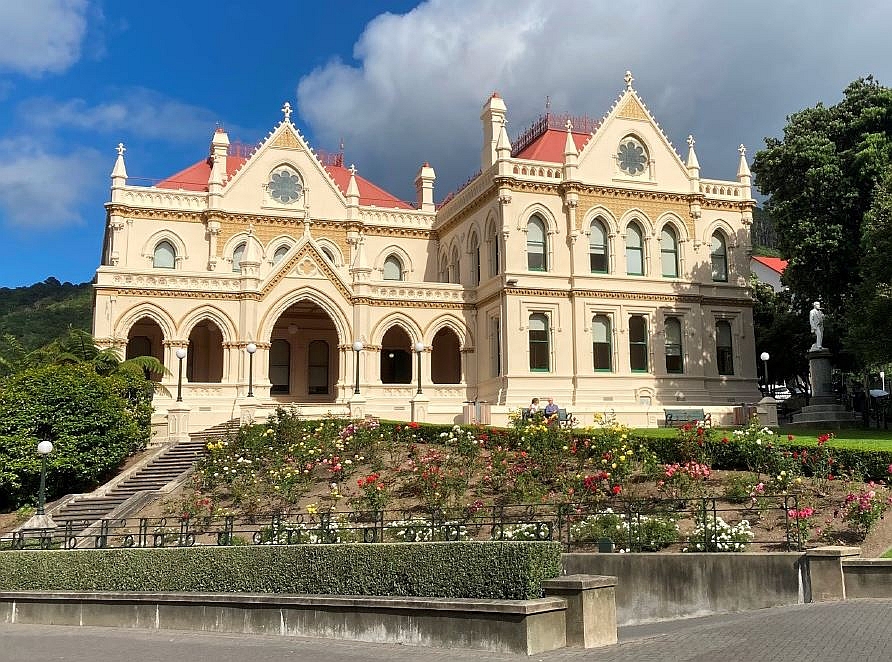
While the judicial arm of the government has always been housed in various buildings around the parliamentary precinct (see Government Centre Historic Area, List no. 7035), since 1865 the legislature and the executive have mostly shared premises within the precinct. Initially, the two houses of Parliament (upper and lower) moved into the former provincial council building, which underwent various alterations and additions until Parliament Buildings became an extended ‘rabbit warren’ of offices, chambers, meeting rooms and also Bellamy’s, the members’ refreshment rooms (which continue a British Commonwealth tradition dating from 1773). The Government Buildings (List no.37), built nearby on reclaimed land, provided much needed departmental office space from 1876. These facilities were supplemented by Thomas Turnbull’s ornate Parliamentary Library building in 1899 (which subsumed the original 1850s building, and included offices for the premier).
Adjacent to the parliamentary buildings, Colonel Wakefield’s old residence was replaced with a new Government House in 1871. Designed by William Clayton (1823-1877) in the Italianate style, this grand and substantial timber residence later became the temporary home of Parliament after a fire in 1907 destroyed Parliament Buildings except for the new library. Until the new Parliament House (List no. 223) was ready for use in 1918, the Legislative Council met in the conservatory and the House of Representatives debated in the ballroom. The building’s poor condition was noted in 1908, and by 1960 it was severely deteriorated and had undergone many ad hoc alterations.
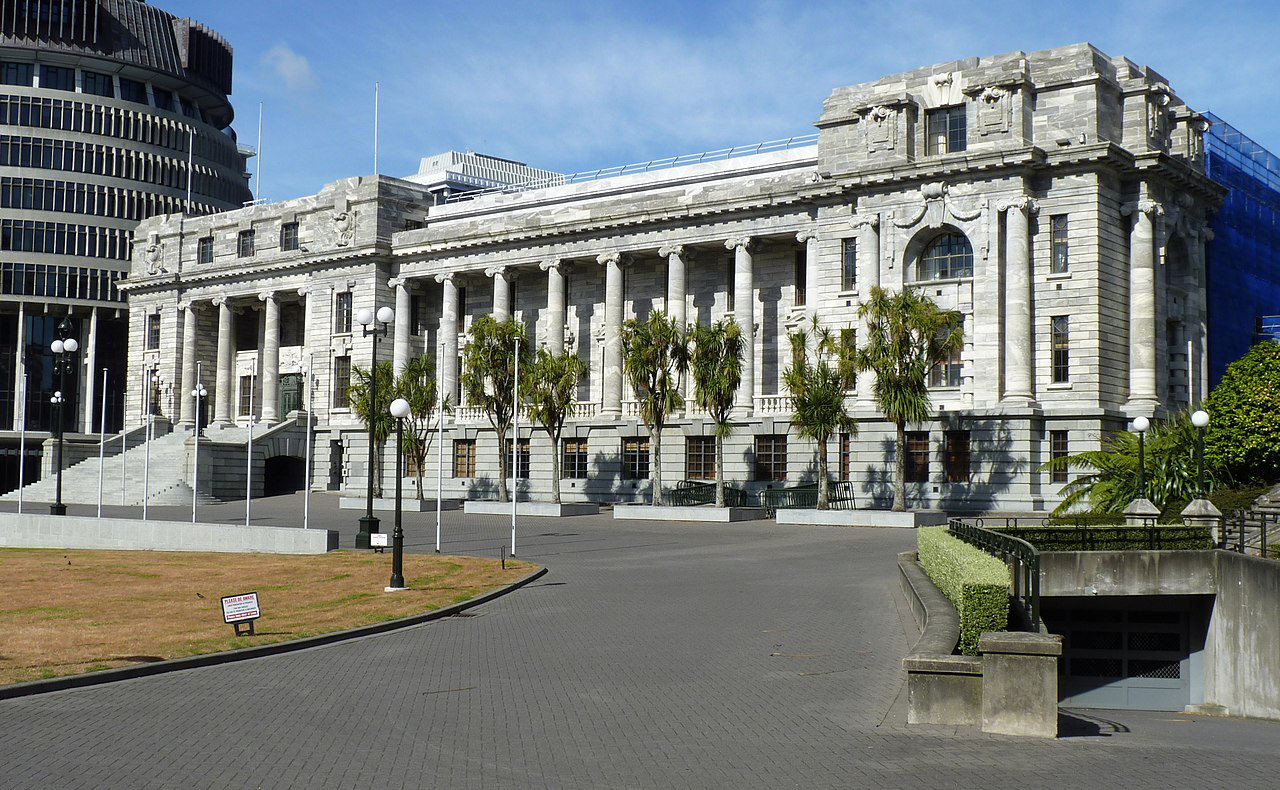
Government Architect John Campbell (1857-1942) and Claude Paton’s winning design for the new Parliament House in 1911 was intended to rectify the parliamentary precinct’s inadequate facilities. However, only one wing of the planned Edwardian neo-classical design was ever built; it was completed in 1922. A decision on resuming the master plan for the precinct remained in limbo for the succeeding decades.
The Depression, Second World War and increased spending on welfare meant there was reluctance to invest in the parliamentary facilities, and all three buildings became increasingly dilapidated and earthquake-prone. As each was unsuitable for parliamentary business, by 1960 it was decided that a major construction project revising the parliamentary precinct was required.
The great dilemma: traditionalist or modernist?
Various master plans for the parliamentary precinct had been considered over the intervening years, including Government Town Planner John Mawson’s 1937 design for a major overhaul of the entire government centre to a classical plan, which allowed for the completion of Parliament House to Campbell’s design. In contrast, in 1949-1950 Prime Minister Peter Fraser (1884-1950) and Government Architect Gordon Wilson (1900-1959) favoured a wholly modern design for the entire precinct – the first public suggestion that the second wing of Parliament House not be built.
Government Architect Fergus Sheppard (1908-1997) gave the issue serious consideration in 1961. Using modernist principles for his analysis of the precinct, he argued that Parliament House and the Library deserved respect even though they had their functional failings, because they portrayed the historically true architecture of their eras. However, to complete Parliament House to its original Edwardian design would be contrary to the modern movement of architecture, which holds that ‘the only true architecture is architecture belonging to its time.’ His recommendation was for a new building of modern design that also respected the historic values of the two existing parliamentary buildings – excepting the old Government House, which was deemed to be beyond repair. He also suggested that the ‘positive vertical emphasis’ of a tower building would counter the increasing number of office blocks rising in the area, and create the desired architectural interest for a precinct of Parliament’s status. A preliminary design by the Ministry of Works was released for public feedback in October 1961, but the rectangular tower block proposal was criticised as being too functional and not architecturally distinctive. The idea of seeking international architectural input was first suggested around this time.
A new Executive Wing – conception of ‘the Beehive’
The story that Scottish architect Sir Basil Spence (1907-1976) conceived the basic design for the building soon to become known as ‘the Beehive’ at a state dinner in 1964, and introduced it to Prime Minister Keith Holyoake via a sketch drawn on his dinner napkin – prompting Holyoake to approve the design on the spot – is a popular myth. In fact, six months earlier Spence had been invited by the New Zealand Government to be a consultant architect for the project, and following the reception to welcome him he presented several sketches of his design to the Special Committee on the Completion of Parliament Buildings. The Committee adopted the provisional design a week later, and agreed the government architect would prepare sketch plans in consultation with Spence.
Reaching that point had not been an easy process. The Special Committee of ministers and officials tasked with the development of the building project had had extensive, heated debates over the previous two years, reaching an impasse between those who believed the functional requirements of the building should be pre-eminent, and those who felt vehemently that the form or style of the building – appropriate to the importance of its government purpose – was the most significant design imperative.
Sir Basil Spence was, at the time, one of Britain’s most celebrated architects, having recently received a knighthood for his striking modernist design of the new Coventry Cathedral. He was also professor of architecture at the Royal Academy (1961-68), and in his career designed a number of important civic buildings including the British Embassy in Rome, Glasgow Airport and the British Pavilion at the 1967 Montreal Expo, as well as numerous churches, education facilities, housing complexes, office blocks, factories, theatres and houses. His public profile in the 1950s and 1960s saw him become ‘the unofficial ambassador for modern architecture in post-war Britain.’
The announcement that he would be in Wellington in March 1964 to lecture at Victoria University prompted the Special Committee and Cabinet to approach him in September 1963, inviting him to advise on the two broad design concepts, hopefully to resolve the impasse. Spence agreed. His response also indicated that he was in favour of retaining the incomplete Parliament House but supplementing it with a new modern building – which he already had design ideas for, despite that being beyond his initial brief.
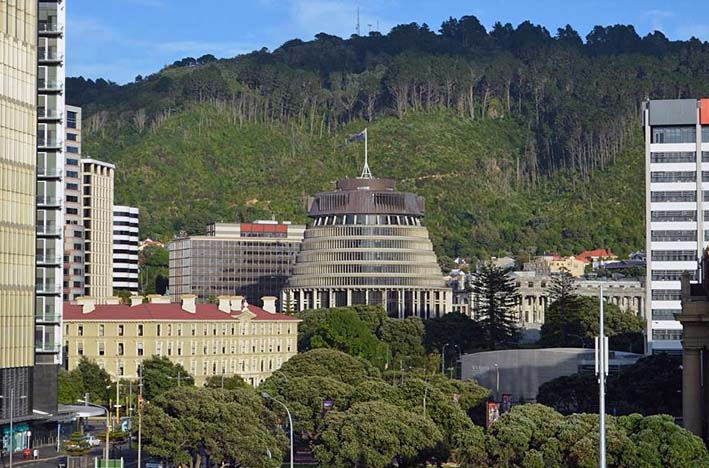
While the government architect’s office had so far proposed ‘benign’ and unthreatening modernist designs, the concept sketch Spence presented to Cabinet on 24 March 1964 was relatively radical: a bold, circular building that would complement the diverse collection of Parliament Buildings. While the details were yet to be worked out, Spence claimed that the ‘rhythmic consistency’ his design would share with the columns, proportions and window openings of Parliament House would bring architectural unity to the precinct. It would also act as a ‘central hinge between the old and new buildings flanking the site’, and its round shape would reflect Parliament’s status as the ‘hub or universal joint’ of New Zealand. The circular form had become popular with architects overseas in the late 1950s, but the Beehive and his chapel for the University of Sussex were the only round buildings of Spence’s that were built.
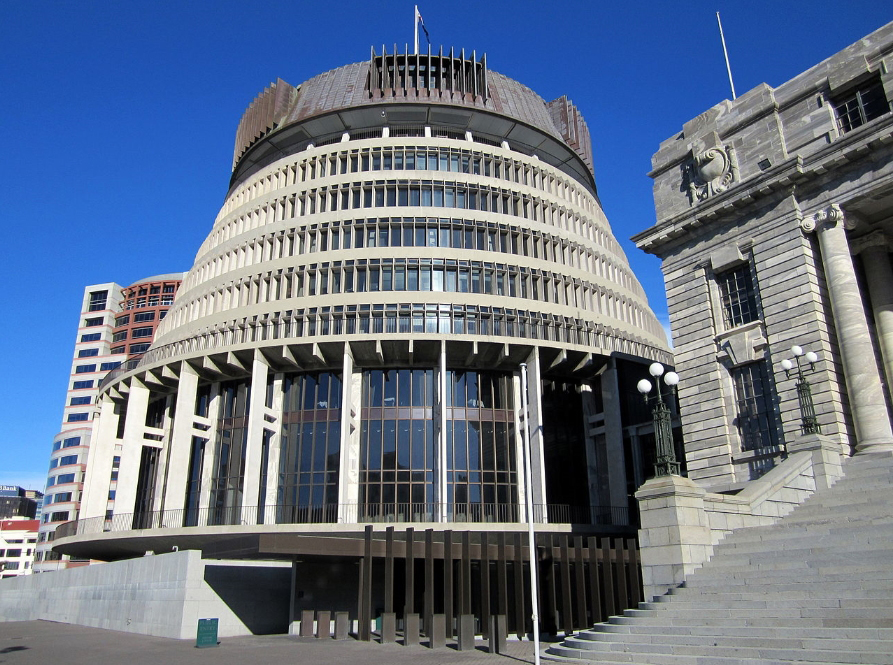
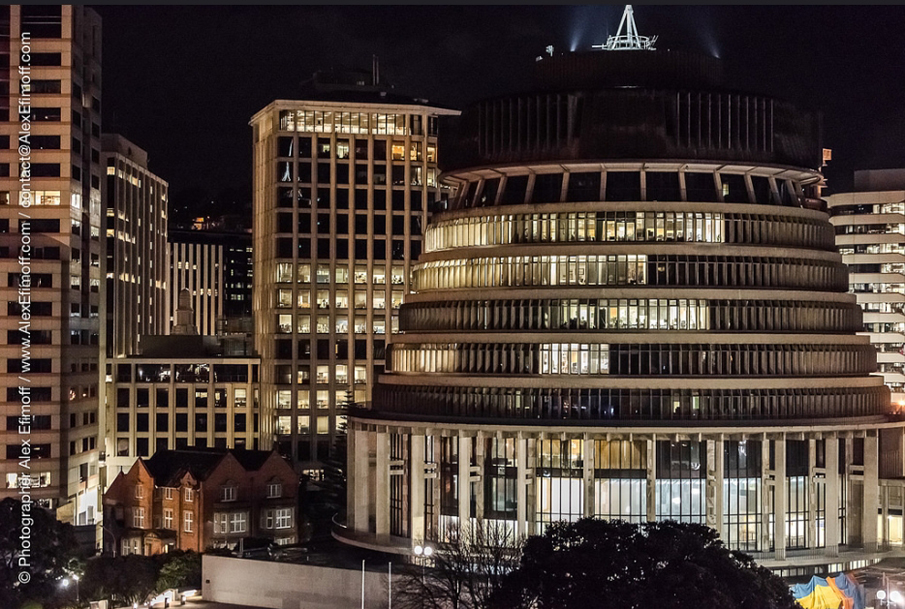
With its series of diminishing concentric discs atop a circular drum the building was soon dubbed ‘the Beehive’, apparently at a press conference where Spence employed a box of Bryant & May ‘Beehive’ matches’ to answer a question about the design, although this may not have been the first instance he had used the matches as an illustrative device. Bryant & May later capitalised on this publicity by offering special ‘Beehive’ matchboxes for sale to MPs.
Public response was positive enough for the project to move forward, although there were those who had reservations – including the architectural community who resented that New Zealand architects had not had the opportunity to compete for this most prestigious national project. Nonetheless, the concept was developed in detail by the Ministry of Works over the next 15 months, and Spence continued to contribute to the design for nearly a year after his visit, paying particular attention to the elevations and the crowning cap of the two top floors. In June 1965 the basic design plans were formally approved and the government architect was given the go-ahead to prepare working drawings for the Beehive.
Fergus Sheppard and his team, particularly project architect Sidney Bates, refined and completed the design over the next four years. This involved extensive consultation and input from parliamentary officials to ensure the building’s functional efficiency.
The interior spaces were laid out hierarchically, with the Cabinet room and prime minister’s office and their departments on the top two floors, ministerial office suites in the conical tower of discs below, and the social and reception areas in the three storeys of the circular drum below them. The entrance and public reception areas are contained in the rectangular podium at ground level, and a central core of lifts controls access. The decision on the location of the prime ministerial suite was made by Holyoake, who chose the ninth floor rather than the larger space available in the first tower disc. This required the installation of an express lift so he could reach the legislative chamber for voting within the three minutes rung by the division bells.
Successive government architects during the course of the construction were Fergus Sheppard (who held the position from 1959-71), John Blake-Kelly (1971-73), Frank Anderson (1973-76), and Graydon Miskimmin (1976-1986). In addition, the project required input from a multitude of engineers, draughtsmen, industrial designers, and over 50 sub-contracting companies.
The conical nature of the circular design posed many unique structural issues for the architects and engineers, who had to develop solutions without any known precedents to work from – Designscape magazine contended that ‘structurally the Beehive is a unique building, certainly unique in New Zealand, and possibly in the world.’ The Executive Wing is thought to have been the first cylindrical and conical structure to undergo thorough structural testing in its model stages: a 1.8 metre high scale model was extensively tested for seismic loading as a means of predicting how a building of this shape and complexity might behave in earthquakes. Inventive solutions to spread the structural loading of the tapering form were also devised.
Construction
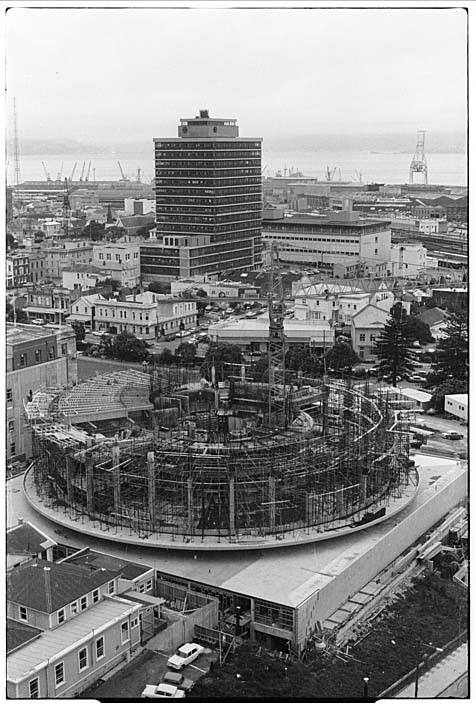
The major period of construction stretched from 1969 to 1981, as it was scheduled during parliamentary recesses to minimise disruption. It was carried out in two stages. Stage One began in late 1969 with the demolition of half of the old Government House building and conversion of the remainder to provide temporary dining and bar facilities, and comprised the foundations, podium and car park of the Beehive building. This was completed in July 1972, by contractors W M Angus Ltd, and the National Crisis Management Centre (known colloquially as ‘the Bunker’), which occupies the lower basement level, has been operational from that time onwards. Stage Two covered the rest of the building, subdivided into two parts: the three floors of the main drum were completed ready for use in 1977, along with the structural frame and roof for the eight floors above; then the interiors of the ministerial and Cabinet floors were finished by September 1979, and the two-storey annexe at the rear of the podium constructed. Stage Two was constructed by Gibson and O’Connor Ltd. Dominant interior finishes were Takaka marble, specially quarried to match that in Parliament House and used to face the exposed structural columns and core wall, lift lobbies, main staircase and the ground floor, and native tawa flooring, and tawa, rimu, mangeao and kohekohe panelling.
Ministry of Works industrial designers Geoffrey Hargreaves and Michael Lamb were responsible for coordinating the furnishing and décor of the entire building, working to Sidney Bates’ loose direction that anything would be considered, ‘as long as it’s brown.’ Taking their inspiration from the architectural detailing, furniture was designed by them and built specially, by New Zealand firms and often using tawa. The ministers’ dining table was curved, to match the shape of the room, and the unusually shaped spaces required the custom-design of office furniture. Detail extended to specially commissioned Crown Lynn dinnerware, planters, pottery lampstands and ashtrays. The furnishings continued the aim that wherever possible, products used in the construction of the Beehive were to be New Zealand-sourced and/or made.
An important and much venerated aspect of the décor is the 42-metre mural in the Banquet Hall, created by significant New Zealand artist John Drawbridge, MBE (1930-2005), who won the commission in 1973. Drawbridge was one of New Zealand’s most internationally successful artists, and he completed a number of major public commissions including murals for New Zealand House in London, and Expo 70. The Beehive mural is considered one of his most important works. The 180 vertical strips of aluminium, affixed to the inner curved wall and mimicking the exterior fins, are coloured with enamel paint to portray the atmosphere and sky of New Zealand. It was installed in May 1976.
Opening and reception
The completion of the reception and function areas in levels 1-3 in 1977 was celebrated with an official opening ceremony on 27 February, where Queen Elizabeth II unveiled a commemorative bronze plaque, followed by a banquet for 300. The building was formally named the Executive Wing by the prime minister at the time, Robert Muldoon.
Public interest in the Beehive’s design had been high from its first release, and a model of the building had toured the country in 1965. On the occasion of the building’s formal opening, Designscape, the magazine of the New Zealand Industrial Design Council, took the unusual step of devoting its entire March 1977 issue to the construction, services, furnishings and fittings of the Beehive, ‘since this is the most important public building to have been constructed in this country in recent times.’ The magazine also contained four pages of opinions from professional experts. Their feelings were polarised at both ends of the spectrum and represented a wider discussion: the building certainly had everyone talking.
When ministers moved into their offices in 1979, comments became focused on the functional difficulties of working within the circular building. Wayfinding was confusing in the disorientating lift lobbies, ministers had to rush from their offices to get to the Legislative Chamber in time, and the separation of Cabinet from the rest of the MPs and ministers removed the ease of casual social and political interaction and suggested the formation of an ‘us and them’ culture. Halliday reports that ‘its inhabitants generally despise the building because of its failures; one long-serving politician [Don McKinnon] remarked that he has yet to find a Minister who likes working in the Beehive.’ Criticisms were also directed at the reported total cost of $17 million.
Later recognition of the design by professional bodies includes the Wellington Branch of the New Zealand Institute of Architects (NZIA), who gave the building an architectural award for technical excellence and superior achievement in 1982, and DOCOMOMO NZ, who have entered it on their register of the nation’s important modern movement buildings. Its striking appearance continues to elicit public comment, and attract tourists. In 2009 it was voted the third ugliest building in the world by an international tourism website, who described it as ‘a slide projector that fell on a wedding cake that fell on a waterwheel’.
An iconic symbol and a landmark
Of those who feel negatively towards the building’s design, many opinions can be attributed to political cynicism, and in this respect the form of the Beehive elicits such strong responses because symbolic interpretations of power and government are easy to apply to its evocative form. For example, apart from the allusions to ‘hives of activity’ and ‘buzzing round and stinging people’, it has been described as having ‘the outward appearance of some giant dynamo. A symbol of power or mindless machinery perhaps.’ Occasionally this symbolism has been literally applied, such as in a 1975 protest action when ‘The World Is Rotten - Do Something,’ and the antinuclear logo were inscribed in red paint on the granite facing of the podium. A more recent figurative protest was the posting of a package of cluster flies to the building.
Extraordinary and memorable, the distinctive shape of the Beehive dominates the parliamentary precinct and is instantly recognisable to New Zealanders. Its pervasiveness in the public consciousness is supported by the fact that its image has appeared on the New Zealand $20 banknote since 1991. As the best-known example of modernist architecture in New Zealand, the Beehive is well acknowledged as an iconic structure. Architectural historian Dr Jessica Halliday theorises that what makes the Beehive’s architecture ‘iconic’ is the distinctive circular shape, ‘and the fact that this shape is realised on a huge scale … amplified, not reduced, by its construction in that most commonplace of materials, concrete given the raw Brutalist treatment fashionable during the post-war era.’ Because of this it is employed in countless satirical cartoons as a shorthand reference for the people, political structure and policies of the government, as well as in media graphics such as the Politics page banner in the Dominion Post newspaper. This ‘unparalleled currency’ has also seen the building become a symbol of Wellington, and it contributes strongly to the identity of the city.
In the mid-1990s a proposal to shift the Beehive back 150 metres so that it would sit behind Parliament House, allowing the completion of Parliament House to its original design, was suggested. Halliday contends that even this illustration of the Beehive’s ‘failed status’ is also an acknowledgement of its cultural importance, because to simply demolish it would have been much more cost-effective than the relocation proposal. Public interest remains high: over 70,000 people take tours of Parliament Buildings each year, including over 13,000 school and university students and around 30,000 international visitors, and the Beehive is the starting point for the tours.
Marae of the Nation
Another element of the Beehive’s significance is its cultural importance to Māori. The Beehive has an integral role in the functioning of Parliament Buildings as a marae of the people of New Zealand. Honoured guests are welcomed by the Parliamentary Kaumātua in the building’s West Foyer, and the Banquet Hall hosts hui and celebrations for the signing of Treaty settlement documents, and other related events.
The building also represents Māori involvement in the New Zealand political system. The Beehive was built on the former site of the geranium planted by prophet T.W. Rātana on 5 July 1934, said to symbolise the Treaty of Waitangi and also his intention to return to Parliament, ‘pluck a flower and its pollen would be blown to the four winds, representing the four Māori seats that would be captured by Rātana candidates.’ The flower bush was carefully moved elsewhere in the grounds to make way for the new Executive Wing. Since its construction, the majority of Ministers of Māori Affairs have also had their offices within the Beehive. Numerous petitions and protests have been made by Māori at the Parliamentary Precinct; notable in recent years were the May 2004 and March 2011 hikoi to protest the Foreshore and Seabed Act and the Marine and Coastal Area (Takutai Moana) Bill, where thousands of people arrived in the capital after marching from Northland, and the tino rangatiratanga flag was raised throughout the crowds that gathered outside the Beehive.
Refurbishment
The interior of the building underwent a major refurbishment by Warren and Mahoney between 1998-2006 in three stages. First, the building’s plant (originally on the floor above the Cabinet room) was replaced and reconfigured in the basement, and lift cores in the lower levels were upgraded (including the addition of orientation aids). The second stage involved a floor-by-floor refurbishment of office areas on the fourth to tenth floors; finally the catering and function areas in the podium and drum up to the third floor were upgraded. Two small additions to the building elevations comprised a new combined public entry facing Molesworth Street and a secure delivery area onto Museum Street, and link bridges were added to connect the first and second levels to Parliament House. The refurbishment project was awarded a New Zealand Architecture Award by the NZIA in 2007. Further work was carried out during 2013-2014 to address leaks in the roof and around the windows. While the Beehive rated well in a 2014 seismic assessment, the Press Gallery annexe at the rear of the building was found to be earthquake-prone and remedial works are planned.